

RADIO CONTROL SOARING
Dave Garwood, 5 Birch Lane, Scotia NY 12302
SCALE SAILPLANES
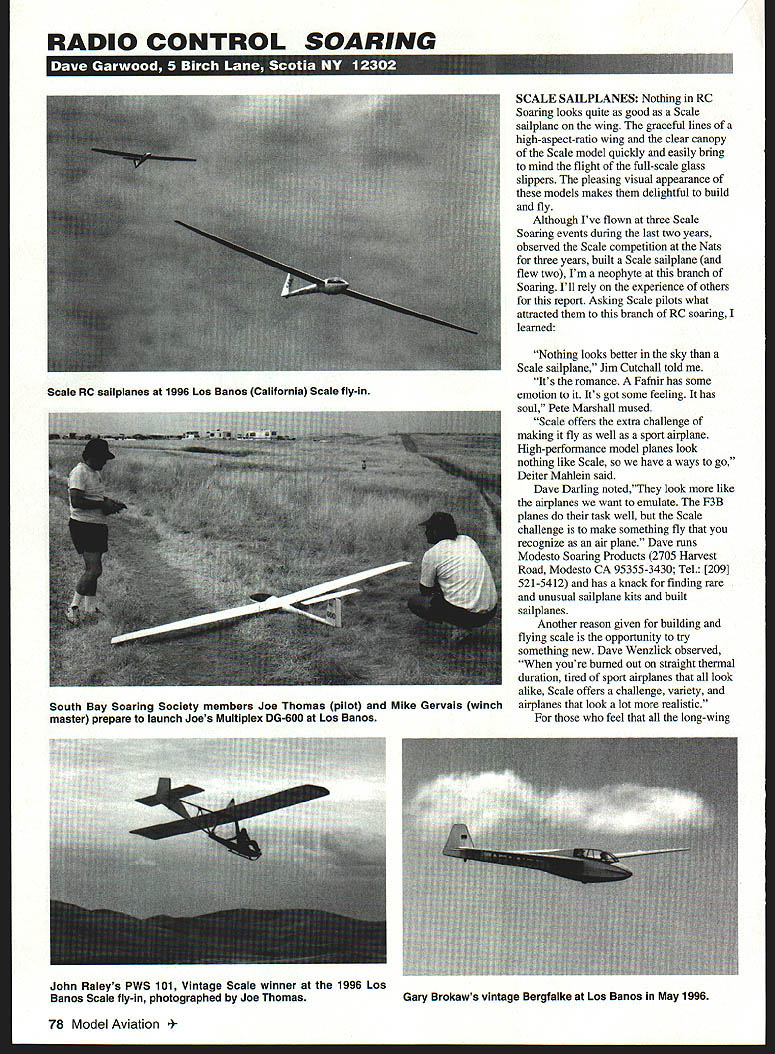
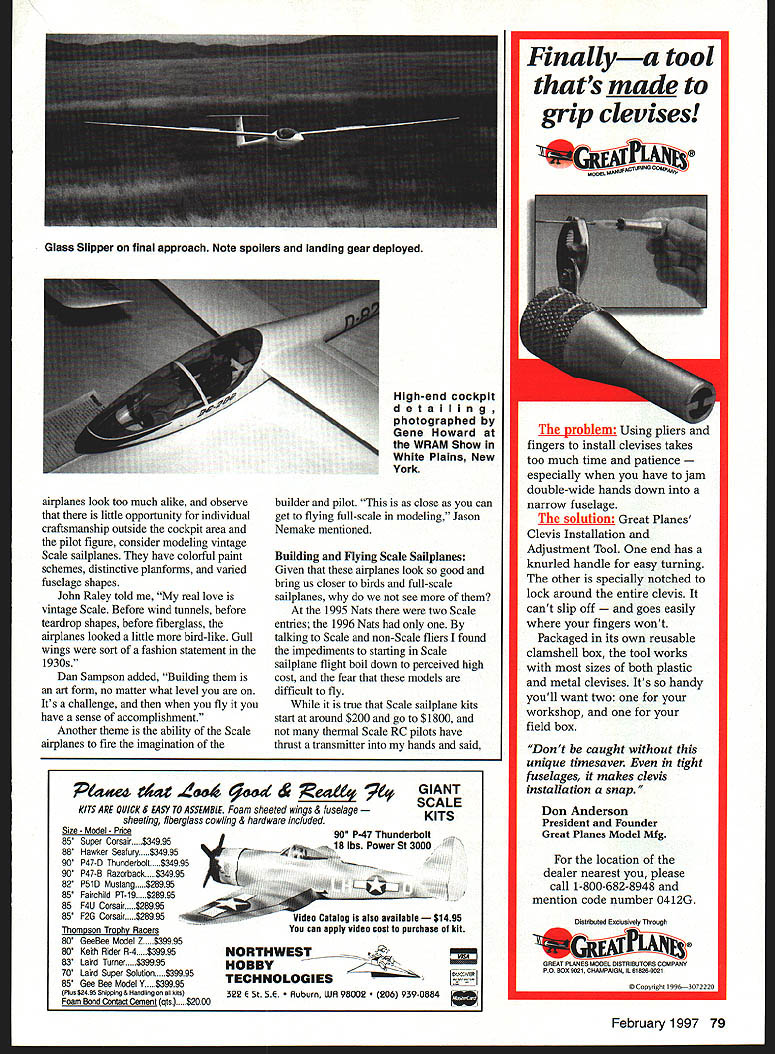
Nothing in RC soaring looks quite as good as a scale sailplane on the wing. The graceful lines of a high-aspect-ratio wing and the clear canopy of the scale model quickly and easily bring to mind the flight of the full-scale "glass ships." The pleasing visual appearance of these models makes them delightful to build and fly.
Although I've flown at three scale soaring events during the last two years, observed the scale competition at the Nats for three years, and built a scale sailplane (and flew two), I'm a neophyte at this branch of soaring. I'll rely on the experience of others for this report. Asking scale pilots what attracted them to this branch of RC soaring, I learned:
- "Nothing looks better in the sky than a scale sailplane," Jim Cutchall told me.
- "It's the romance. A Fafnir has some emotion to it. It's got some feeling. It has soul," Pete Marshall mused.
- "Scale offers the extra challenge of making it fly as well as a sport airplane. High-performance model planes look nothing like scale, so we have a ways to go," Dieter Mahlein said.
- "They look more like the airplanes we want to emulate. The F3B planes do their task well, but the scale challenge is to make something fly that you recognize as an airplane," Dave Darling noted. Dave runs Modesto Soaring Products (2705 Harvest Road, Modesto CA 95355-3430; Tel.: [209] 521-5412) and has a knack for finding rare and unusual sailplane kits and built sailplanes.
- "When you're burned out on straight thermal duration, tired of sport airplanes that all look alike, scale offers a challenge, variety, and airplanes that look a lot more realistic," observed Dave Wenzlick.
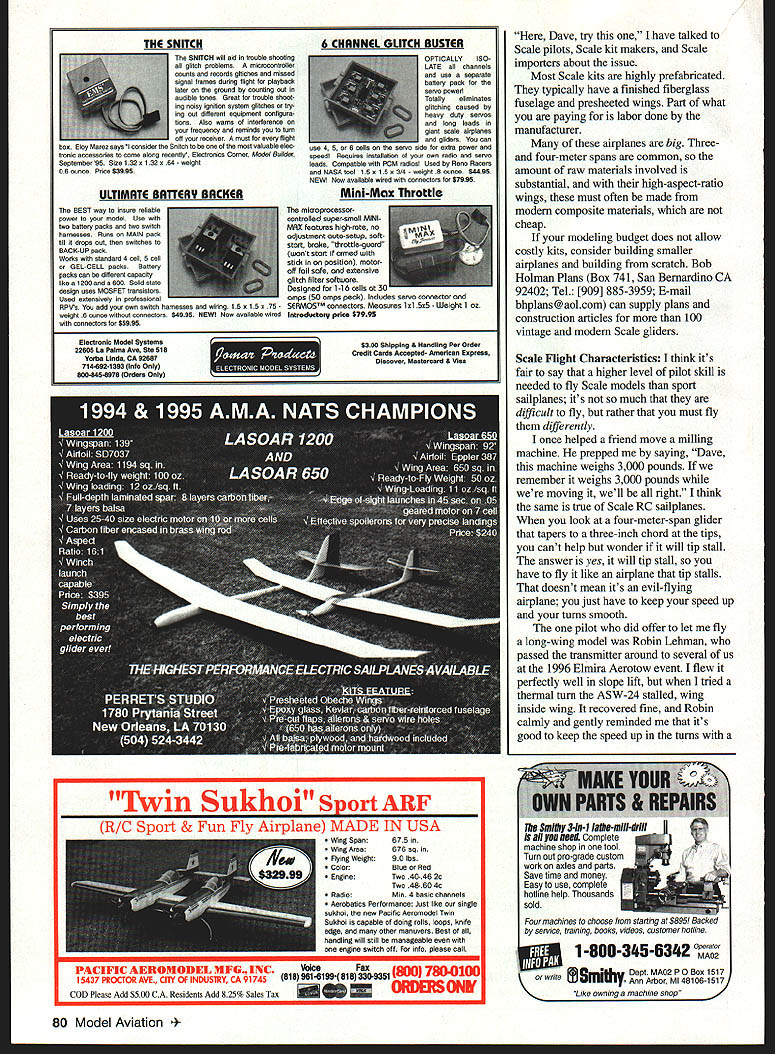
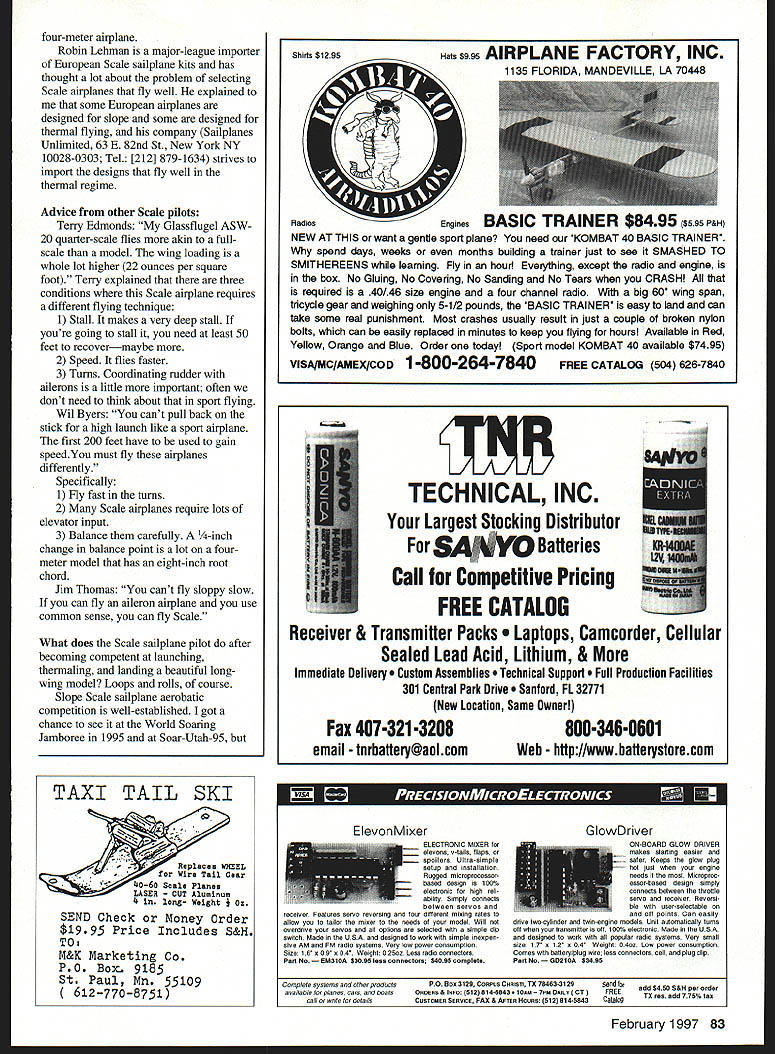
For those who feel that all the long-wing airplanes look too much alike and see little opportunity for individual craftsmanship outside the cockpit area and pilot figure, consider modeling vintage scale sailplanes. They have colorful paint schemes, distinctive planforms, and varied fuselage shapes.
- "My real love is vintage scale. Before wind tunnels, before teardrop shapes, before fiberglass, the airplanes looked a little more bird-like. Gull wings were sort of a fashion statement in the 1930s," John Raley told me.
- "Building them is an art form, no matter what level you are on. It's a challenge, and then when you fly it you have a sense of accomplishment," Dan Sampson added.
Another theme is the ability of scale airplanes to fire the imagination of the builder and pilot. "This is as close as you can get to flying full-scale in modeling," Jason Nemake mentioned.
Building and Flying Scale Sailplanes
Given that these airplanes look so good and bring us closer to birds and full-scale sailplanes, why do we not see more of them? At the 1995 Nats there were two scale entries; the 1996 Nats had only one. By talking to scale and non-scale fliers I found the impediments to starting in scale sailplane flight boil down to perceived high cost and the fear that these models are difficult to fly.
While it is true that scale sailplane kits start at around $200 and go to $1,800, and not many thermal scale RC pilots have thrust a transmitter into my hands and said, "Here, Dave, try this one," I have talked to scale pilots, scale kit makers, and scale importers about the issue.
Most scale kits are highly prefabricated. They typically have a finished fiberglass fuselage and presheeted wings. Part of what you are paying for is labor done by the manufacturer.
Many of these airplanes are big. Three- and four-meter spans are common, so the amount of raw materials involved is substantial, and with their high-aspect-ratio wings these must often be made from modern composite materials, which are not cheap.
If your modeling budget does not allow costly kits, consider building smaller airplanes and building from scratch. Bob Holman Plans (Box 741, San Bernardino CA 92402; Tel.: [909] 885-3959; E-mail bhplans@aol.com) can supply plans and construction articles for more than 100 vintage and modern scale gliders.
Scale Flight Characteristics
I think it's fair to say that a higher level of pilot skill is needed to fly scale models than sport sailplanes; it's not so much that they are difficult to fly, but rather that you must fly them differently.
I once helped a friend move a milling machine. He prepped me by saying, "Dave, this machine weighs 3,000 pounds. If we remember it weighs 3,000 pounds while we're moving it, we'll be all right." I think the same is true of scale RC sailplanes.
When you look at a four-meter-span glider that tapers to a three-inch chord at the tips, you can't help but wonder if it will tip-stall. The answer is yes, it will tip-stall, so you have to fly it like an airplane that tip-stalls. That doesn't mean it's an evil-flying airplane; you just have to keep your speed up and your turns smooth.
The one pilot who did offer to let me fly a long-wing model was Robin Lehman, who passed the transmitter around to several of us at the 1996 Elmira Aerotow event. I flew it perfectly well in slope lift, but when I tried a thermal turn the ASW-24 stalled, wing inside. It recovered fine, and Robin calmly and gently reminded me that it's good to keep the speed up in the turns with a four-meter airplane.
Robin Lehman is a major-league importer of European scale sailplane kits and has thought a lot about the problem of selecting scale airplanes that fly well. He explained to me that some European airplanes are designed for slope and some are designed for thermal flying, and his company (Sailplanes Unlimited, 63 E. 82nd St., New York NY 10028-0303; Tel.: [212] 879-1634) strives to import the designs that fly well in the thermal regime.
Advice from Other Scale Pilots
Terry Edmonds: "My Glasflügel ASW-20 quarter-scale flies more akin to a full-scale than a model. The wing loading is a whole lot higher (22 ounces per square foot)." Terry explained that there are three conditions where this scale airplane requires a different flying technique:
- Stall. It makes a very deep stall. If you're going to stall it, you need at least 50 feet to recover—maybe more.
- Speed. It flies faster.
- Turns. Coordinating rudder with ailerons is a little more important; often we don't need to think about that in sport flying.
Wil Byers: "You can't pull back on the stick for a high launch like a sport airplane. The first 200 feet have to be used to gain speed. You must fly these airplanes differently."
Specifically:
- Fly fast in the turns.
- Many scale airplanes require lots of elevator input.
- Balance them carefully. A 1/4-inch change in balance point is a lot on a four-meter model that has an eight-inch root chord.
Jim Thomas: "You can't fly sloppy slow. If you can fly an aileron airplane and you use common sense, you can fly scale."
What does the scale sailplane pilot do after becoming competent at launching, thermaling, and landing a beautiful long-wing model? Loops and rolls, of course. Slope scale sailplane aerobatic competition is well-established. I got a chance to see it at the World Soaring Jamboree in 1995 and at Soar-Utah-95.
What about aerobatics on the thermal field? Well, the real ones do aerobatics.
The Alexander Schleicher factory brochure for the ASK-21 high-performance trainer notes that the two-place sailplane is rated for aerobatics, including "loop upward, stall turn, split-S, Immelmann turn, slow roll, and inverted flight." There are full-scale sailplane acrobatic competitions in Europe and the United States, so why not fly RC sailplane aerobatics in competition?
There’s been some discussion of the possibility of a new Nats event: Thermal Sailplane Aerobatics. Some ask, "Sailplane aerobatics? I thought they were supposed to fly around gracefully, emulating the smooth flight of the full-scale gliders." Well, aerobatics, when flown well, can be pretty smooth.
Certainly the chance for aerobatics demonstration is included in the pilot-elected maneuvers of current AMA scale competition rules, but that event has been poorly attended in recent years. Would a winch-launched aerobatics contest or thermal-duration sailplanes generate some interest in scale flying? Should it be opened up to non-scale TD sailplanes? Would an aerobatics contest be more interesting to spectators than the precision-duration and precision-landing tasks? How would TV crews covering the Nats react to scale aerobatics? What would this do for public acceptance of RC soaring?
If you have an opinion on this proposal, let us know about it—maybe on the Internet RC Soaring Exchange (RCSE) or the model airplane discussion bases on AOL (America Online) or CompuServe.
Resources:
- Books on building and flying scale sailplanes, as well as documentation references, are available from booksellers like Zenith Books (Box 1, Osceola, WI 54020-0001; Tel.: [800] 826-6600) and 2+2 Streamlines (Box 976, Olalla, WA 98359-0976; E-mail: Bsquared@halcyon.com; WWW: http://www.halcyon.com/bsquared).
Closing Observation: "We're both ex-power flyers. We used to think gliders were for people who can't fly power. Now we know power is for people who can't fly gliders." — Dennis Duncan and Dave Sanders
Transcribed from original scans by AI. Minor OCR errors may remain.

