
RADIO CONTROL SOARING
Dave Garwood 5 Birch Lane, Scotia NY 12302 E-mail: dgarwood@logical.net
A SOARING TIME CAPSULE:
A reader proposed this month's futuristic topic: crystal-ball gazing into the prospects for RC soaring. Andrew Westreich suggested polling sailplane designers, builders, and fliers to "ask them where they think the sport is going in the next ten years. It'll be fun to see how wrong they all are. It might also be fun to speculate on what evolutionary changes may be in the offing for the hobby."
So here goes. For the last year I've asked sailplane people what they think we'll see in RC soaring in five years and in ten years, and I present the responses below. In 2002 and 2007 we can reread this column and laugh (or cry).
The Present:
It's discontent with one's present situation that stirs activity to improve it. Some respondents articulated problems we have today:
- "We need to push for more beginner and intermediate-type airplanes, like the ones Airtronics is reintroducing, so more people can enter the sport." — Deanna Vignolini
- "We need onboard instrumentation and a downlink telemetry system. With this type of information, the performance could be measured and ultimately lead to quantitative data to guide design." — Michael Selig
- "The '90s are stagnant years. To kick off research and development we must abolish the current competition format. Instead of rocketing a sailplane to 700 feet and coming down in minutes, let's limit the launch altitude to 200 feet, fly out and find the lift, go to 700 feet, and fly back in ten minutes. This will create a new type of airplane, maybe less expensive, and a new type of expert flier." — Mike Popescu
- "I'm hoping the price of computer radios will come down." — Steve Lucke
- "Airplanes today are all the same: super-strong. You go down the flightline and you don't see much difference. If we go back to hi-starts, designers would be working with balsa and Japanese tissue. Anything will go up in strong lift; we need airplanes that will go up in light lift." — Chris Burns
- "I would like to see simple pressurized or propellant-launched HLGs or even all classes. A sensory glove that fully controls the aircraft from launch to landing via simple hand and finger movements. Holographic goggles providing full HUD (Head-Up Display) in-flight views." — Jim Raichele
- "We'd like to see designs for line retrievers that work efficiently, with a view to having winches and retrievers manufactured for the newcomers in the hobby to use." — Gary Burrows
- "I'd like to see a crashproof trainer fully equipped with real radio gear for less than $200. EPP foam construction and idiotproof controls will bring in newcomers who have been scared off by the repair time." — Erik Halberstadt
- "I'd like to see video feedback to a CCD screen on the transmitter. We have fly-by-wire now, but we have no feedback. It's what we call in the business 'open loop.' I'd like to see air data sensors in sailplanes, feedback to the aircraft (transparent to the pilot) while the airplane is in the air. That's the next step for computer transmitters. If you can feed back Alpha (angle of attack) and Beta (sideslip) you could have a CG so far back that the airplane wouldn't fly without the radio on." — Josh Glaab
Five-Year Forecast:
Many respondents took up the challenge to predict what we will see at the sailplane flying field within half a decade:
- "We'll see two-way telemetry. The sailplane will be sending data back to the pilot." — Mark LeVoe
- "I think we'll see molded models become more common at US thermal duration contests. We'll probably have molded HLGs, too." — Steve Condon
- "In five years the diversity of airplanes available 10 years ago should be available again. The entry level and intermediate all-wood ships are enjoying a resurgence (Airtronics is back in the wood kit business) and the market seems saturated with high-tech sheeted foam wing/glass fuselage types. In ten years I think we will be back where we are now. Some good entry level ships and more intermediate to advanced types. It's all cyclic and we're due for another go-round." — Jim Thomas
- "Contest work will concentrate more on flight and less on landings; as this trend has been going for the past decade. With the aircraft as good as they are, both landing and air time are not a problem. However, the airborne task can be made more difficult by limiting the winch line length, making a pilot scramble for good air at lower altitudes from the very beginning." — Mike Lee
- "Indoor slope soaring could well be here, and I think that will revolutionize the hobby." — Erik Halberstadt
- "We'll have an understanding of the nature of thermals over a large area and on the micro level, and that will help virtually everyone. Weather forecasts that actually indicate the wind direction at the flying field." — Dennis Phelan
- "Pilots will be getting older, but we may see some younger people as the kids now in Jr/Sr high school will be looking for a high-tech hobby besides computers. There will be more computer-generated and optimized designs in airfoils, planforms, and fuselage/empennage and these designs will fly great. Transmitters will get better programming interfaces. They'll be easier to understand and to work with, and their capabilities will increase. The airplanes will be mostly composite materials and some of them will be computer-constructed." — Dave Wood
- "An international Thermal Duration classification using winches, that is an F3J task with F3B winches." — Wayne Angevine
- "Aircraft will stabilize in design, with current high-tech breeds being dominant. Unless a significant breakthrough in design occurs, one which allows a serious advantage in contest work for the common man, we will not see airplanes much different from what now exist. I believe we are at the pinnacle of current design." — Mike Lee
- "Aerotowing will be a common method of launching. F3J (hand tow) will be a popular event. Computer radios will be less expensive than now. Standard class (100-inch) span will be deleted from AMA rules. We'll see subtle refinements in competition sailplane design." — Terry Edmonds
- "Expect better soaring airfoils to come. An airfoil family based on the SD-7037 will be tested early in 1997." — Michael Selig
- "Lightweight four-meter scale sailplanes suitable for thermal competition, and suitable tasks for them." — Wayne Angevine
- "Tower Hobbies will have taken over all RC sailplane design and manufacture, and will be employing Frank Weston." — Tom Nagel
Ten-Year Forecast:
- "Ten years from now? I hope I'm still around! I see a trend toward the FAI classes of flying, although not to the same degree as in Pattern and Pylon Racing. Americans like Thermal Duration. They also like winch-launching, and would much rather do that than run like hell with a towline. Why do you think Americans use golf carts instead of walking the course, despite saying they golf for exercise?" — Mike Lee
- "Point-of-View (POV) remote-piloted airplanes. Stereo goggles that let you fly from the cockpit POV. I suspect prices will fall to the point where a full system will cost less than $500." — Erik Halberstadt
- "Micro-Soaring! We will have miniaturized (micro) soaring on a scale that allows backyard thermal soaring. Picture a hand-launch glider only about one-third the size, flying the thermals generated by the barbecue, or the hot roof of the car in your driveway." — Dave Wood
- "Something to replace the servo." — Dennis Phelan
- "Scale sailplanes will make a resurgence in competition, possibly combined with aerotowing. Appearance of air-to-ground telemetry interacting with a computer in the transmitter for a closed-loop type of automated control. Someone finally coming up with a way to de-emphasize the landing in Thermal Duration contests. Highly efficient factory-made composite models will be required to be competitive in most events. Increasing problems with radio interference due to high demands for RF spectrum space." — Terry Edmonds
- "Expert pilots flying wooden sailplanes designed before 1985 because it's more fun." — Wayne Angevine
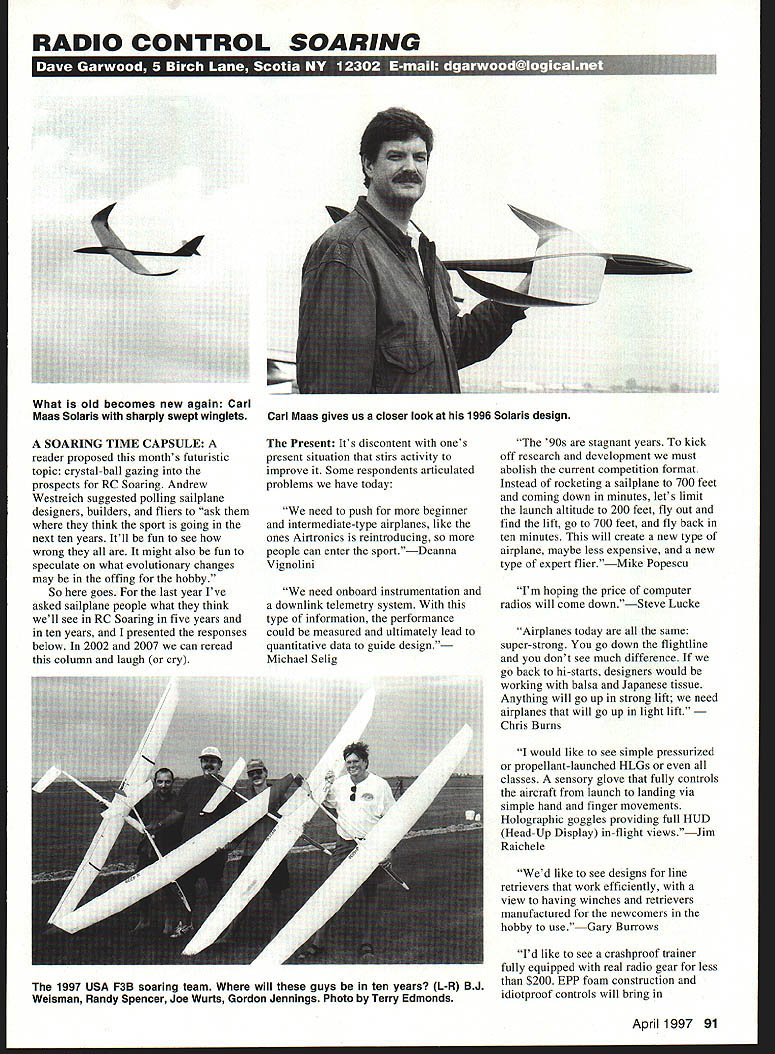
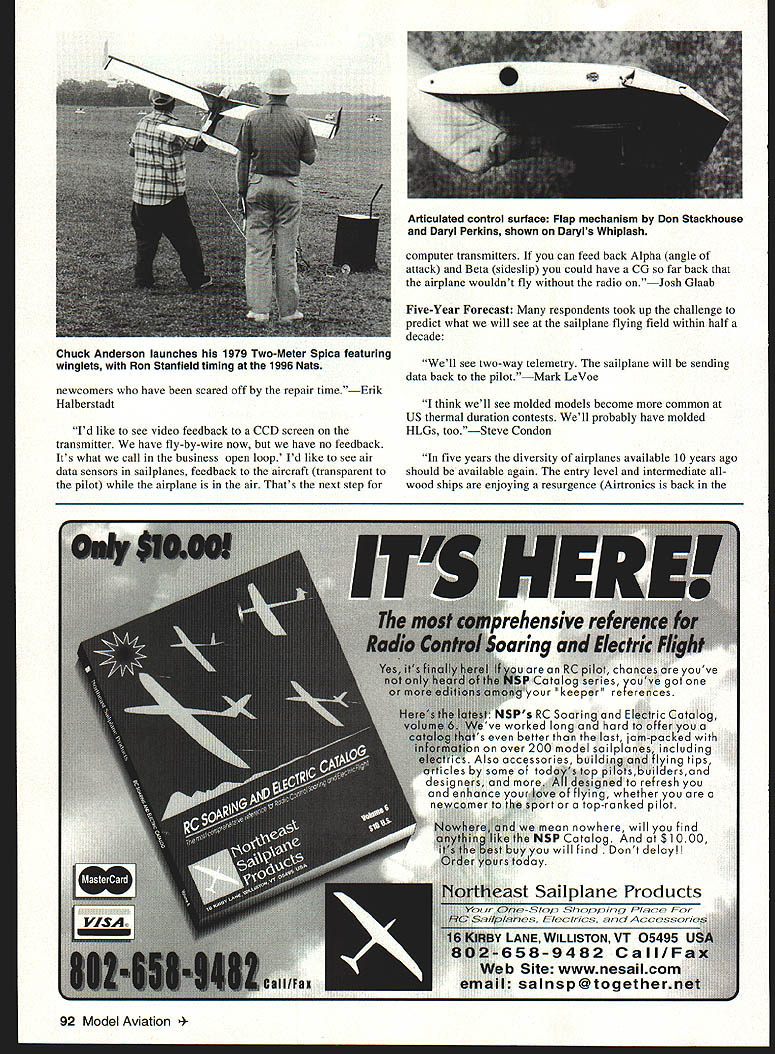
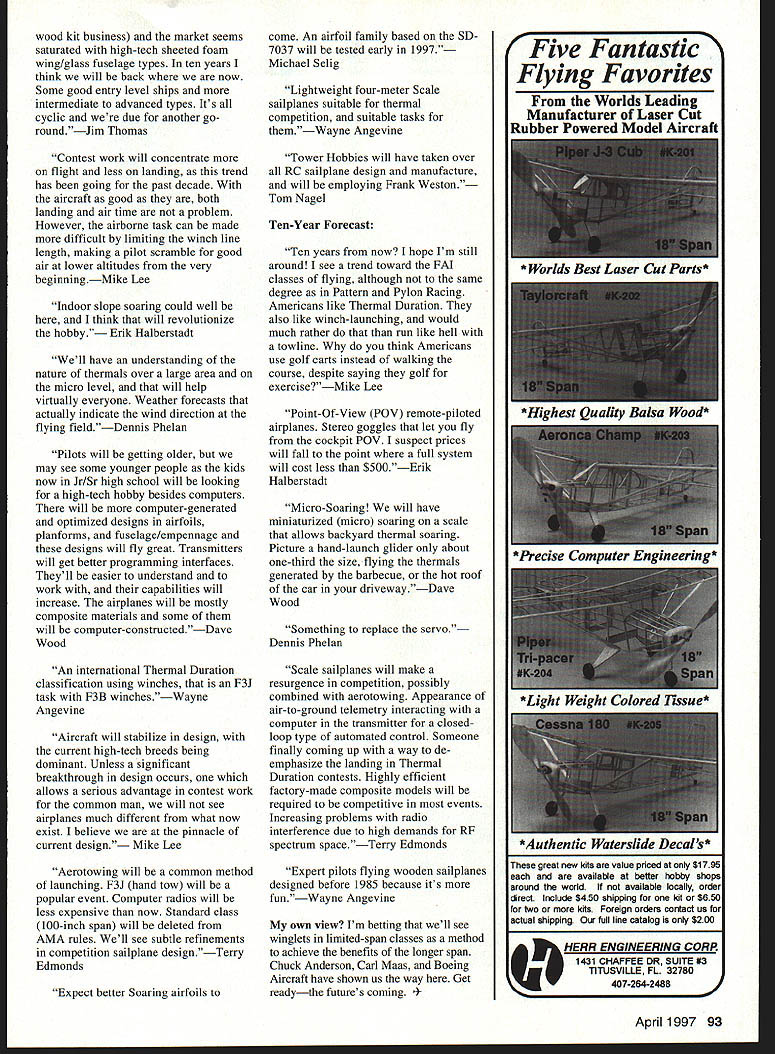
My own view? I'm betting that we'll see winglets in limited-span classes as a method to achieve the benefits of the longer span. Chuck Anderson, Carl Maas, and Boeing Aircraft have shown us the way here. Get ready—the future's coming.
Transcribed from original scans by AI. Minor OCR errors may remain.

