
Radio Control: Soaring
Dave Garwood 5 Birch Lane, Scotia NY 12302 E-mail: dgarwood@logical.net
AERIAL PHOTOGRAPHY From Sailplanes
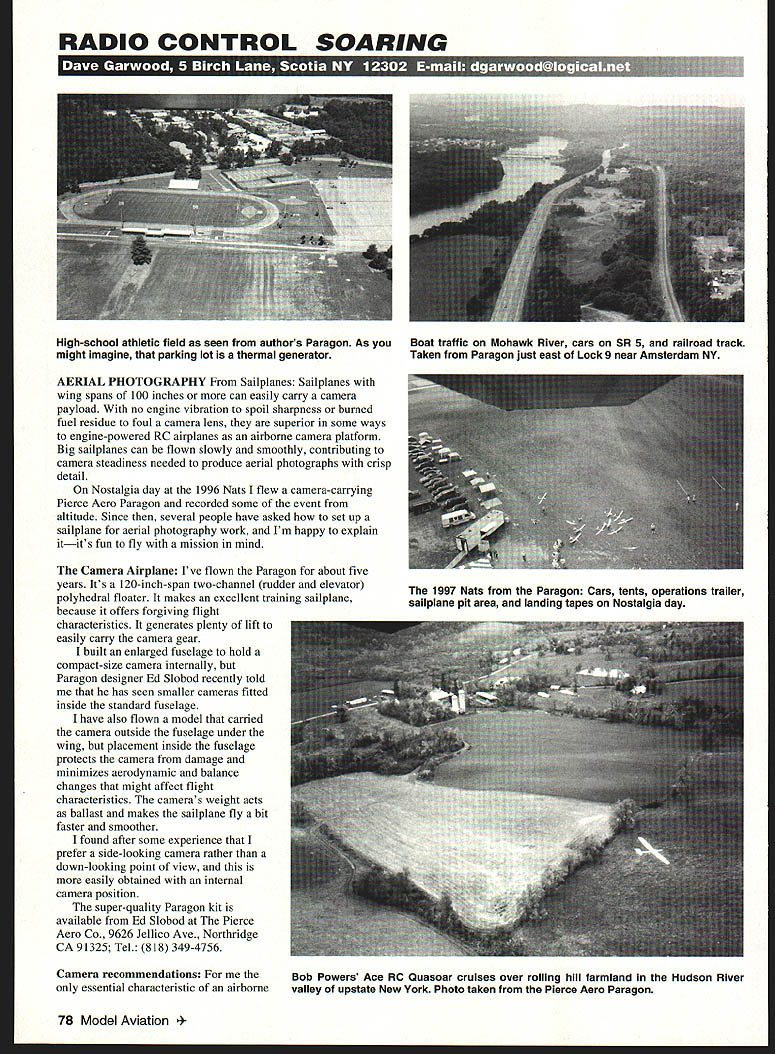
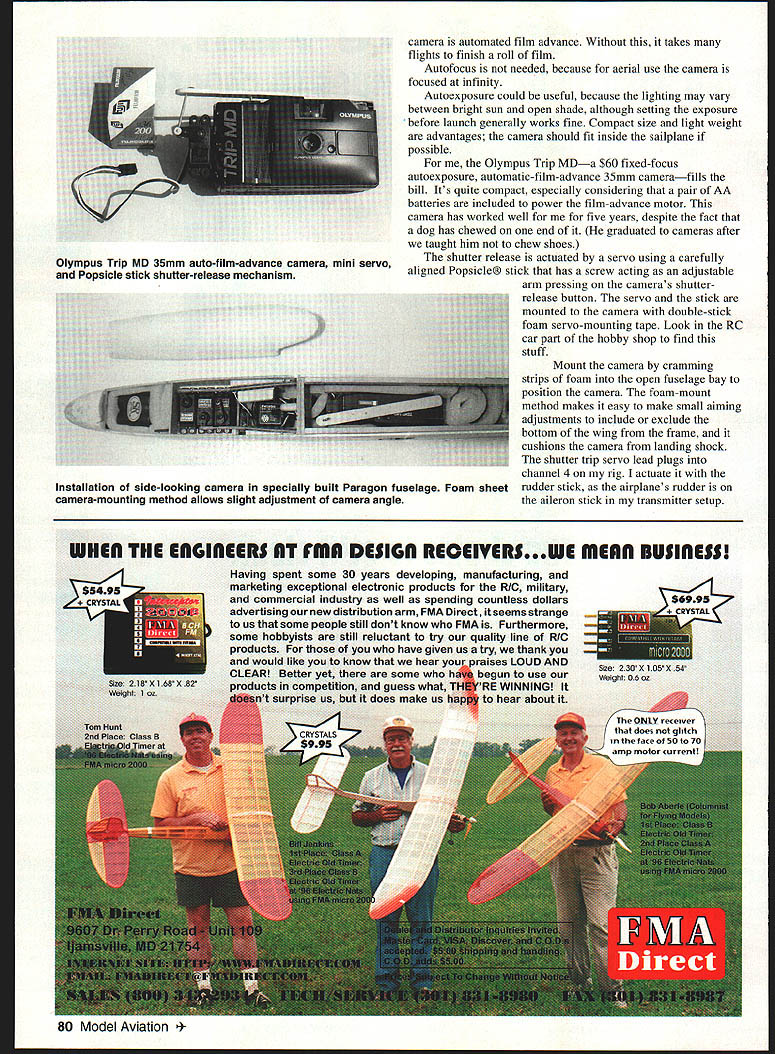
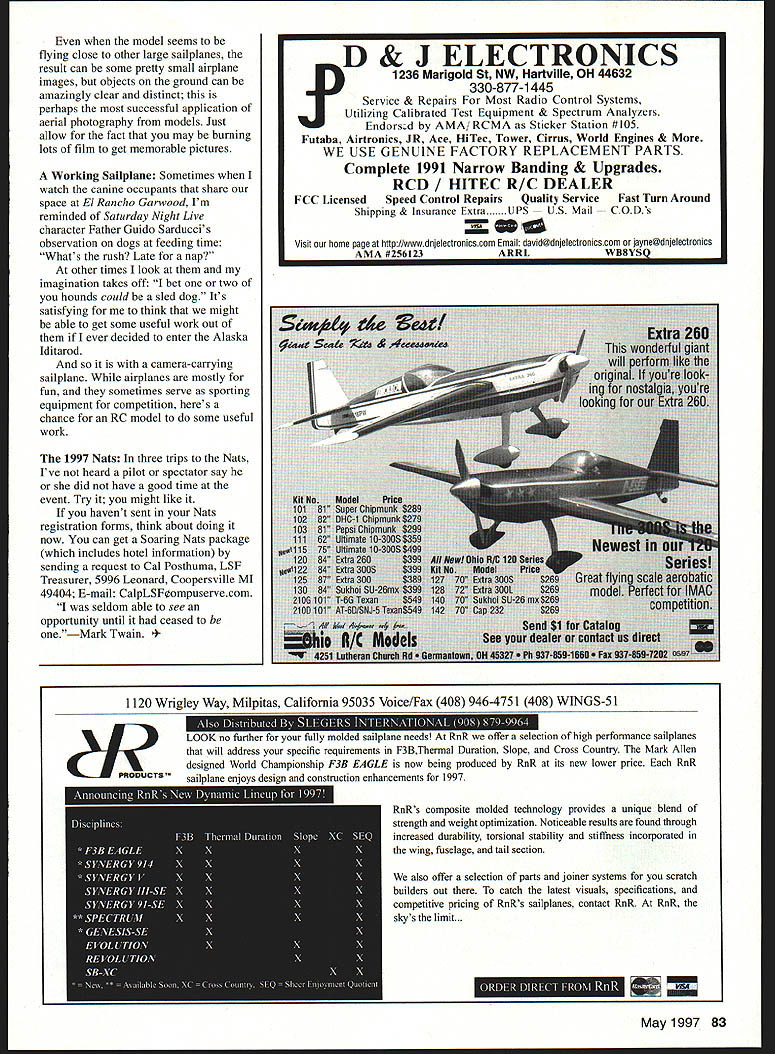
Sailplanes with wingspans of 100 inches or more can easily carry a camera payload. With no engine vibration to spoil sharpness or burned fuel residue to foul a lens, sailplanes are superior in some ways to engine-powered RC airplanes as airborne camera platforms. Big sailplanes can be flown slowly and smoothly, which helps keep the camera steady and produces crisp aerial photographs.
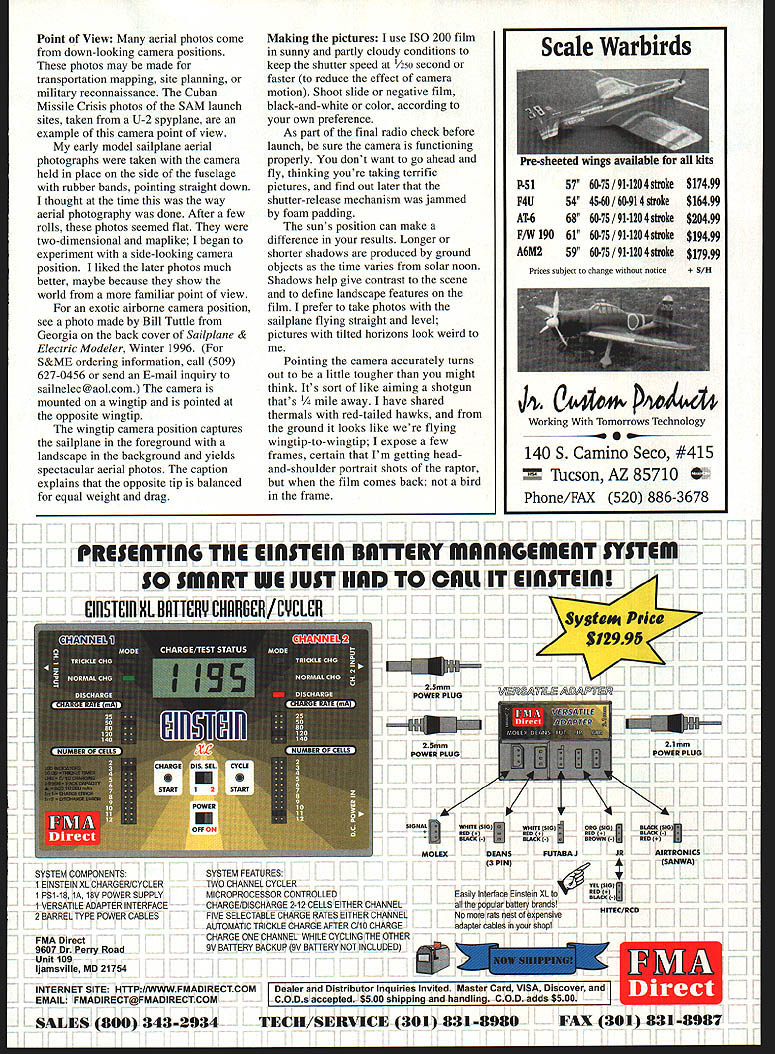
On Nostalgia Day at the 1996 Nats I flew a camera-carrying Pierce Aero Paragon and recorded some of the event from altitude. Since then several people have asked how to set up a sailplane for aerial photography work. It's fun to fly with a mission in mind, and the setup is straightforward.
Camera Airplane
I've flown the Paragon for about five years. It's a 120-inch-span, two-channel (rudder and elevator) polyhedral floater. It makes an excellent training sailplane because it offers forgiving flight characteristics, generates plenty of lift, and will easily carry camera gear.
I built an enlarged fuselage to hold a compact-size camera internally, but Paragon designer Ed Slobod recently told me he has seen smaller cameras fitted inside the standard fuselage. I have also flown a model that carried the camera outside the fuselage under the wing, but an internal mounting protects the camera from damage and minimizes aerodynamic and balance changes that might affect flight characteristics. The camera's weight acts as ballast and makes the sailplane fly a bit faster and smoother.
After some experience I found I prefer a side-looking camera rather than a down-looking point of view; a side view is more easily obtained with an internal camera position.
The super-quality Paragon kit is available from Ed Slobod at The Pierce Aero Co., 9626 Jellico Ave., Northridge CA 91325; Tel.: (818) 349-4756.
Camera recommendations
Essential camera characteristics for airborne use:
- Automatic film advance — without it you'll need many short flights to finish a roll.
- Ability to focus at infinity. Autofocus is helpful but not strictly required if the camera can be set or fixed at infinity.
- Autoexposure can be useful because lighting may vary between sun and open shade, although setting exposure before launch often works fine.
- Compact size and light weight so the camera can fit inside the sailplane if possible.
A specific example: the Olympus Trip MD — a low-cost fixed-focus, autoexposure, automatic-film-advance 35mm camera — fills the bill. It's compact and runs the film-advance motor from a pair of AA batteries. I've used one successfully for five years despite one end having been chewed by the dog.
Mounting and actuation:
- The shutter release is actuated by a servo. I use a carefully aligned Popsicle stick as the servo arm, with a small screw as an adjustable finger to press the camera's shutter button.
- The servo arm and camera are mounted with double-stick foam or servo-mounting tape.
- Position the camera inside the fuselage by cramming strips of foam into the open bay. The foam-mount method makes small aiming adjustments easy, allows you to include or exclude the bottom wing/frame from the picture, and cushions the camera from landing shock.
- Plug the shutter-trip servo lead into an auxiliary channel (I use channel 4). Rig it to actuate with the rudder stick on two-channel rudder/elevator airplanes, or with whichever stick assignment suits your transmitter.
Point of View
Many aerial photos are made with a down-looking camera for mapping, site planning, or reconnaissance. My early model-sailplane photos were taken with the camera rubber-banded to the fuselage pointing straight down. After a few rolls those pictures seemed flat and maplike, so I experimented with a side-looking camera position and liked the results better — they show the world from a more familiar point of view.
For an exotic camera position, see a photo by Bill Tuttle (Georgia) on the back cover of Sailplane & Electric Modeler, Winter 1996: the camera is mounted on a wingtip and pointed at the opposite wingtip. The wingtip camera captures the sailplane in the foreground with landscape in the background and yields spectacular images. The opposite tip is balanced for equal weight and drag.
Making the pictures
I use ISO 200 film in sunny and partly cloudy conditions to keep shutter speed at 1/250 second or faster to reduce the effect of camera motion. Shoot slide or negative film, black-and-white or color, according to your preference.
As part of the final radio check before launch, verify the camera is functioning properly. You don't want to fly thinking you're taking terrific pictures only to discover later that the shutter-release mechanism was jammed by foam padding.
Sun position affects results. Shadows, which vary with time from solar noon, help give contrast and define landscape features on film. I prefer to take photos with the sailplane flying straight and level; tilted horizons often look odd.
Pointing the camera accurately can be tougher than it seems — it's like aiming at something far away. I've shared thermals with red-tailed hawks; from the ground it looks like we're wingtip-to-wingtip, so I expose a few frames expecting a portrait of the raptor, but later find not a bird in the frame. Even when the model seems close to other sailplanes, those aircraft can appear tiny in the photo while ground objects come out amazingly clear and distinct. Expect to burn a lot of film to get memorable pictures.
A Working Sailplane
Sometimes when I watch the people camping near us at El Rancho Garwood, I'm reminded of Saturday Night Live character Father Guido Sarducci's observation on dogs at feeding time: "What's the rush? Late for a nap?" At other times my imagination takes off: "I bet one or two of you hounds could be a sled dog." It's satisfying to think we might get useful work out of them if we ever entered the Iditarod.
So it is with a camera-carrying sailplane. While airplanes are mostly for fun and sometimes for competition, here's a chance for an RC model to do some useful work.
The 1997 Nats
In three trips to the Nats I've never heard a pilot or spectator say they didn't have a good time. Try it — you might like it.
If you haven't sent in your Nats registration forms, consider doing it now. You can get a Soaring Nats package (which includes hotel information) by sending a request to Cal Posthuma, LSF Treasurer, 5996 Leonard, Coopersville MI 49404; E-mail: CalPLS@compuserve.com.
"I was seldom able to see an opportunity until it had ceased to be one." — Mark Twain
Transcribed from original scans by AI. Minor OCR errors may remain.

