
RADIO CONTROL: SOARING
Dave Garwood 5 Birch Lane, Scotia, NY 12302 E-mail: dgarwood@logical.net
Young sailplane fliers
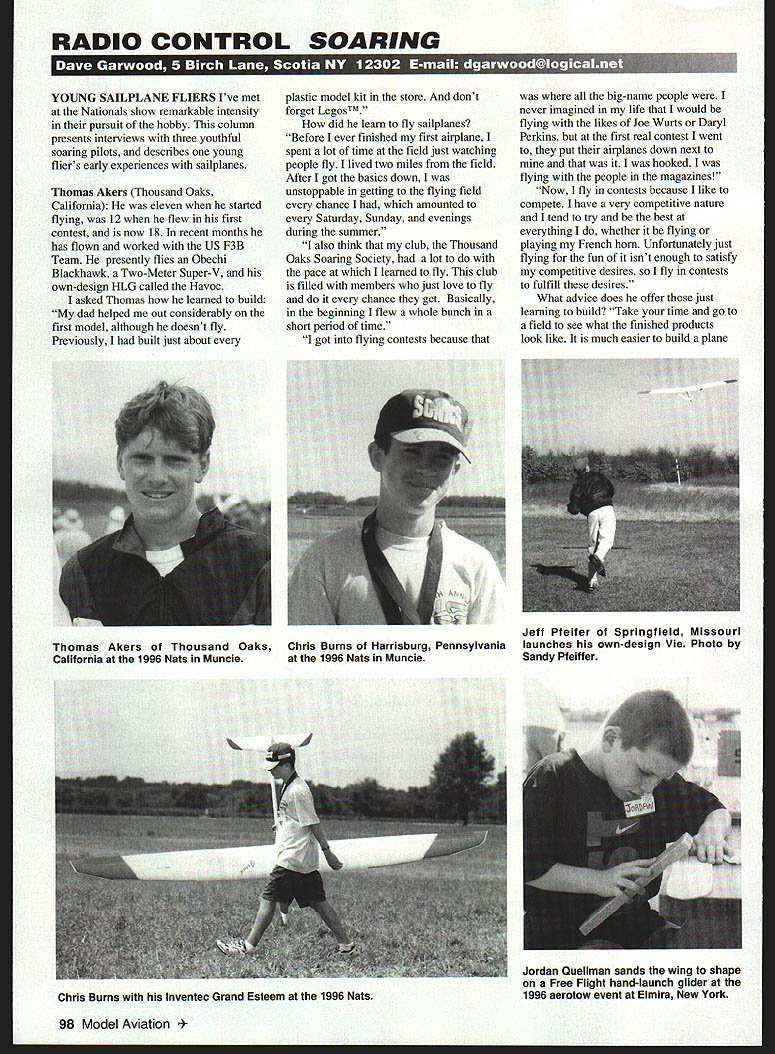
Young sailplane fliers I've met at the Nationals show remarkable intensity in their pursuit of the hobby. This column presents interviews with three youthful soaring pilots and describes one young flier's early experiences with sailplanes.
Thomas Akers (Thousand Oaks, California)
He was eleven when he started flying, was twelve when he flew in his first contest, and is now eighteen. In recent months he has flown and worked with the U.S. F3B Team. He presently flies an Obechi Blackhawk, a Two-Meter Super-V, and his own-design HLG called the Havoc.
On learning to build: "My dad helped me out considerably on the first model, although he doesn't fly. Previously, I had built just about every plastic model kit in the store. And don't forget Legos."
How he learned to fly sailplanes: "Before I ever finished my first airplane, I spent a lot of time at the field just watching people fly. I lived two miles from the field. After I got the basics down, I was unstoppable in getting to the flying field every chance I had, which amounted to every Saturday, Sunday, and evenings during the summer.
"I also think that my club, the Thousand Oaks Soaring Society, had a lot to do with the pace at which I learned to fly. This club is filled with members who just love to fly and do it every chance they get. Basically, in the beginning I flew a whole bunch in a short period of time.
"I got into flying contests because that was where all the big-name people were. I never imagined in my life that I would be flying with the likes of Joe Wurts or Daryl Perkins, but at the first real contest I went to, they put their airplanes down next to mine and that was it. I was hooked. I was flying with the people in the magazines!
"Now, I fly in contests because I like to compete. I have a very competitive nature and I tend to try and be the best at everything I do, whether it be flying or playing my French horn. Unfortunately, just flying for the fun of it isn't enough to satisfy my competitive desires, so I fly in contests to fulfill these desires."
Advice for those learning to build: "Take your time and go to a field to see what the finished products look like. It is much easier to build a plane right when you know what it is supposed to look like."
Advice for those learning to fly: "Get a foamie and head to the slope. It is much easier to learn how to fly when you don't have to worry about crashing. Don't give up."
For those starting in competition: "Find the best pilot in your club and latch onto him or her like a leech. Learn what they do and why they do it. Everything from the countdown at the end of the flight to something as simple as 'don't fly back through the sink you just flew through.' This is the biggest mistake that I see. Beginners quite often take off in one direction, fly until they hit sink, fly through the sink for a little bit, do a 180, and fly right back through the same sink."
What makes RC sailplanes so interesting: "Well, I have always been fascinated with flying. I just love flying and RC sailplanes have provided me with a means to experience it. Being in control of something that is flying is absolutely wonderful. It is constantly changing and constantly challenging.
"The coolest thing about flying RC sailplanes is the fact that age really isn't a determining factor in this sport. As a result, I have been able to fly and compete without being second-guessed because of my age."
Jeff Pfeifer (Springfield, Missouri)
Jeff started flying when he was seven and is now seventeen. In 1997 he was flying his own V-tail design, The Vie, in three versions: HLG, Two-Meter, and Unlimited/F3J.
"They are all full-house composite sailplanes with RG-15 airfoil, because of its ability to launch high and travel far. They fit my flying style perfectly."
Jeff's father, Norm, taught him to build, and he learned to fly with the help of several people: his dad, Jim and Mike Frickey, and Gary and Tim Gastinger.
How he got interested in competition: "I was in Lincoln, Nebraska, flying in the Electric class at a sailplane contest. Four guys (named above) watched me fly and after the contest approached me about flying in the 1994 LSF Nats. They thought I had a good chance in the Junior division. Two weeks later, after three days with a new airplane, I placed second in the Sportsman division of the Flatland Open in Kansas City. I went on to win Hand Launch and Two-Meter in Junior at the 1994 Nats. From that point on, I have been hooked on sailplanes."
Advice for those learning to build: "Take your time and don't rush things. You will be much happier with the finished product. Also, get involved in a club, where people can guide you through building and setup of your sailplane."
Advice for those learning to fly: "Practice! Practice! Practice! And don't ever give up or get discouraged. Buy or borrow a copy of Dave Thornburg's Old Buzzard's Soaring Book."
Advice to new competition fliers: "Just jump in and get your feet wet. You will learn more flying in one contest than if you just stand around watching everyone else have fun. If you don't place well at a contest, don't worry about it. Use that contest as a learning experience. Find out where you need to improve, and practice, practice, practice!
"The thing that makes sailplanes so cool is that every flight is a new adventure. You don't always know where you will have to go to find lift."
Chris Burns (Harrisburg, Pennsylvania)
Chris started flying at age four. "My dad would toss my Gentle Lady and I would crash it. It had about a million colors of MonoKote on it."
At the 1996 Nationals, when he was twelve, Chris was already a soaring competition veteran. "My second airplane, a birthday present, was a Bob Martin Pussycat, the first airplane I had started. Next I got a Gnome with spoilers; a big advancement for me, but I didn't really need help coming down."
Chris took his first trophy at age seven: first place in the Junior/Senior division at a Baltimore Area Soaring Society contest, then placed first at a Capital Area Soaring Society contest with a Paragon. "A Gummi was my first airplane with a fiberglass fuselage. Now I had something that I could do damage with."
"My first straight-wing airplane was a Windsong. Unfortunately that got wrecked. I built a mid-tail Magic from Frank Weston plans. Now that thing was my killer machine. I won at least ten trophies with it."
"Now I'm flying a Mike Popescu Grand Esteem, but I'm brand new to it. I got a 5:21 time and 95 landing points on my first round today. This is the first year I can launch on a winch by myself."
How he gained his flying skill and why he likes RC soaring: "I fly just about every week. It's more than a sport or a hobby. I really love it. It's fun. It's a challenge. The open sky is a lot more exciting than the open sea. I love the change; in a couple minutes everything is different. Plus, I love to be different, to go to the Nationals instead of the beach."
"The difference between a novice and an expert is the expert can read the sky, and can keep the plane in one piece. Some adults think airplanes are expendable; I don't. I sort of think of them as living things. There are a couple pilots in our club (Lift Club of York, PA) who are really, really good—but they don't know it. If they would fly out and push the outer limits, they would be amazed at how well they fly."
How a young person can get started: "You have to have a family member help you. It's hard to afford a $160 airplane on my $9 allowance."
"A lot of kids don't know about soaring. They may see a sailplane but think they cost $20,000. They could start by asking for a sailplane for their birthday."
Jordan Quellman (Lake Luzerne, New York)
Jordan is my ten-year-old nephew. Two years ago we went to a Wintonbury (CT) Flying Club contest and his interest lasted the whole day. Last year we spent three days on the road attending the Elmira, NY aerotow event, and Jordan built two free-flight hand-launched gliders in the motel at night. He learned about the importance of center of gravity (CG) placement by tossing the tiny airplanes with and without the clay nose weight.
This year he got some stick time on a Minimax-700, hand-launching it 50–60 times, learning to break the stall and to land smoothly. We have had one hi-start session with the Minimax, and he has begun building his first Two-Meter kit, the House of Balsa 2 x 4. He seems to have the skill and interest to continue.
Sources
- Midwest Products Co., Box 564, Hobart, IN 46302. Tel.: 800-348-3497. Write or call for the Airplane and Boat Models Catalog and the Educational Modeling Catalog.
- Future Flight, 1256 Prescott Ave., Sunnyvale, CA 94089. Tel.: 408-735-8260. They sell a pair of Klingberg Mini-Wings, 14-inch-span catapult-launch gliders, for about three bucks.
Transcribed from original scans by AI. Minor OCR errors may remain.

