
RADIO CONTROL SOARING
Dave Garwood 5 Birch Lane, Scotia NY 12302 E-mail: dgarwood@logical.net
F3J hand-tow soaring — background
F3J hand-tow soaring can be thought of as a British import. I first saw F3J at the 1984 World Soaring Jamboree in Pasco, Washington, and there were as many teams from England and Canada as from the U.S. F3J is an international event, often flown in the United Kingdom and Europe, and it is now gradually entering the American soaring scene.
Rich Burnowski pointed out that hand-towing is not entirely new, noting that in 1978 and before, F3B (multitask) was launched by hand-tow instead of winches. Terry Edmonds mentioned that "hand-towing" is not an entirely accurate nickname for the event, which is more properly called "Thermal Duration Gliders" as in the FAI rules. It is an interesting and promising event and deserves a more descriptive name.
I saw F3J flown at the 1995 and 1996 Nats and I became convinced that it has great potential for a new type of club and regional competition. F3J requires more teamwork and strategy than our usual Thermal Duration events, yet it requires less equipment than the better-known F3B event.
Winches are not needed because the sailplanes are launched with human power. Sighting devices are not needed as in the F3B speed and distance tasks. Simpler airplanes than F3B can be flown, but acute competition still results because of the man-on-man format and the team strategy involved.
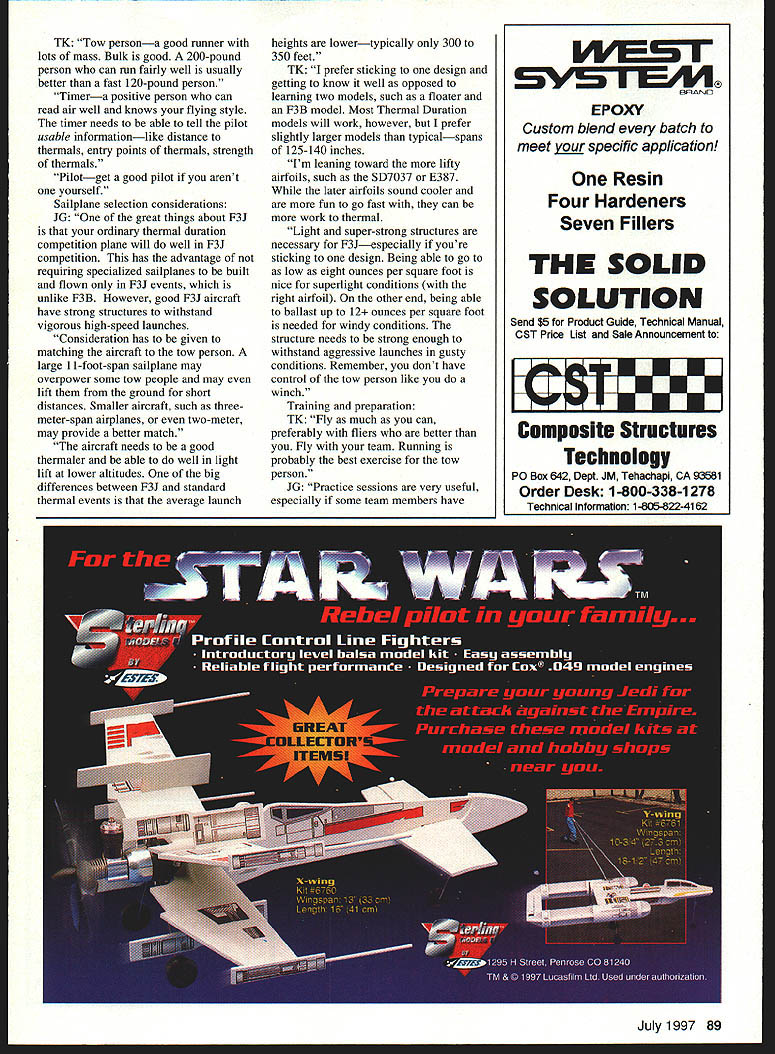
There are two additional reasons why F3J generates more interest than most Thermal Duration contests: rounds frequently begin with a mass launch, and rounds end with a mass landing—exciting for participants and spectators.
Starting in 1998, F3J will be flown as a World Championship event, alternating years with F3B, and the US team selection will be held this year. For the most current information on the 1997 US team selection process for the 1998 World Championships, contact the US team selection committee chair, Terry Edmonds: E-mail: tedmonds@icaen.uiowa.edu or (319) 644-2822 (evenings).
Team composition and aircraft
- Team: pilot, tow person, and one or two timer/spotters.
- Typical airplanes: light six-servo models of about 120–140 inch wingspan.
- Landing skegs: not allowed.
- Tasks: a thermal duration task and a precision spot landing.
The airplanes I've seen are light but strong—able to withstand vigorous high-speed launches. Consideration must be given to matching the airframe to the tow person. A large 11-foot-span sailplane may overpower some tow people and may even lift them from the ground for short distances. Smaller aircraft, such as three-meter-span airplanes or even two-meter models, may provide a better match.
The aircraft needs to be a good thermaler and perform well in light lift at lower altitudes. One of the big differences between F3J and standard thermal events is that the average launch heights are lower—typically only 300 to 350 feet.
Aircraft and setup considerations
- Many ordinary thermal duration competition planes will do well in F3J. This has the advantage of not requiring specialized sailplanes built only for F3J, unlike F3B.
- Good F3J aircraft have strong structures to withstand vigorous launches.
- Match airframe to the tow person: avoid overpowering the tow person.
- Preferred spans: slightly larger models—125–140 inches—are common.
- Airfoils: some pilots prefer more "lifty" airfoils, such as the SD7037 or E387. Lifty sections help low-altitude thermalling but some can be more work to thermal.
- Weight range: be able to go as light as about eight ounces per square foot for very light conditions, and ballast up to 12+ ounces per square foot for windy conditions.
- Structure: light and super-strong construction is necessary, especially if using one design for all conditions.
Competition format and timing
- Competition windows are ten minutes long (15 minutes in flyoff rounds) with a five-minute preparation time.
- Strategy becomes important quickly when lift is marginal.
- If good lift appears, most pilots launch at the beginning of the round.
- If lift is marginal, pilots tend to wait and see.
- The "pucker factor" increases near the end of a round because all landing points are lost if the aircraft is still in the air when the window closes; competitive rounds often end with an exciting mass landing.
- Relaunches are allowed, adding further strategic considerations: initial launch timing, finding lift (or not), and deciding whether to relaunch.
B.J. Weisman summarized the F3J experience: "It's a lot more fun than Thermal Duration because there's more strategy involved. There's more action because there's the possibility of a relight [relaunch]. The man-on-man format weeds out the good and bad pilots. The only negative is you've got to have more guys."
1996 Nats — example team and comeback
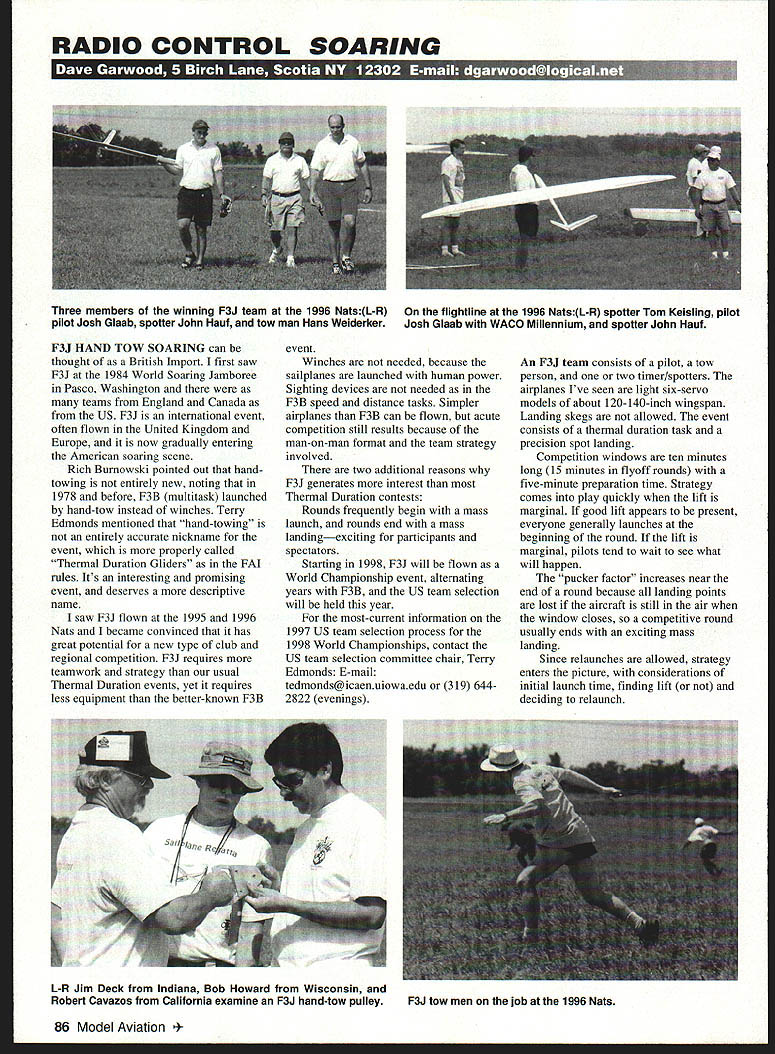
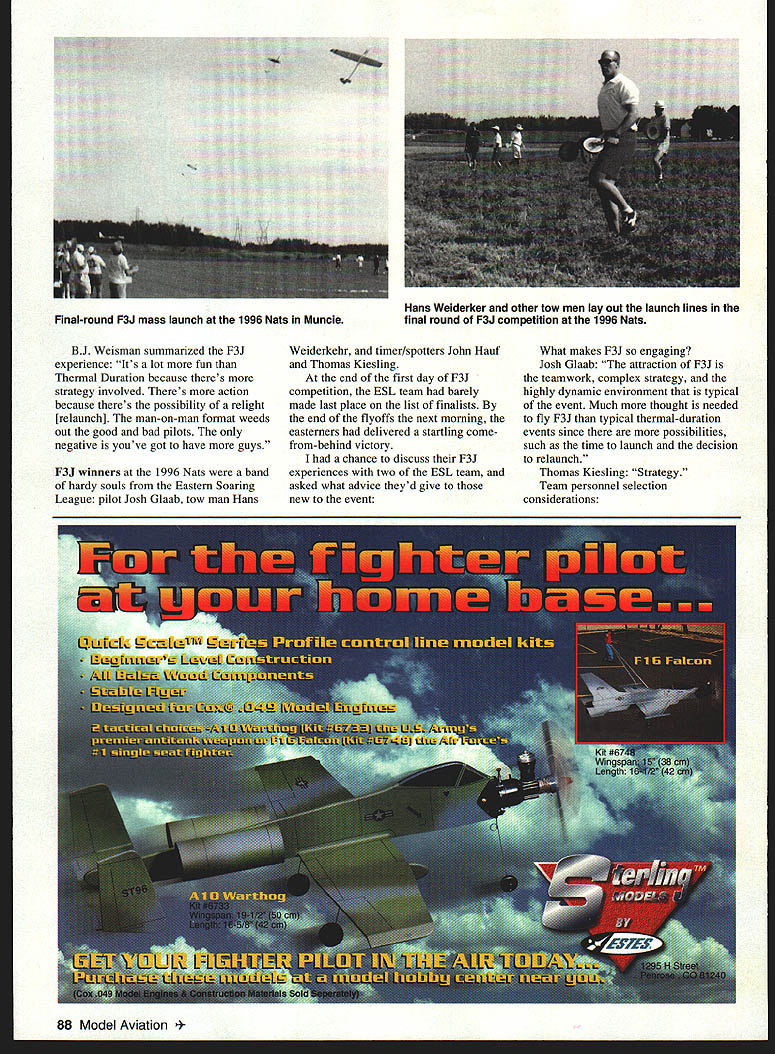
F3J winners at the 1996 Nats were a band of hardy souls from the Eastern Soaring League: pilot Josh Glaab, tow man Hans Weiderkehr, and timer/spotters John Hauf and Thomas Kiesling.
At the end of the first day of F3J competition, the ESL team had barely made last place on the list of finalists. By the end of the flyoffs the next morning, the easterners had delivered a startling come-from-behind victory.
I discussed their F3J experiences with two of the ESL team and asked what advice they'd give to those new to the event.
What makes F3J so engaging?
Josh Glaab: "The attraction of F3J is the teamwork, complex strategy, and the highly dynamic environment that is typical of the event. Much more thought is needed to fly F3J than typical thermal-duration events since there are more possibilities, such as the time to launch and the decision to relaunch."
Thomas Kiesling: "Strategy."
Team personnel selection considerations
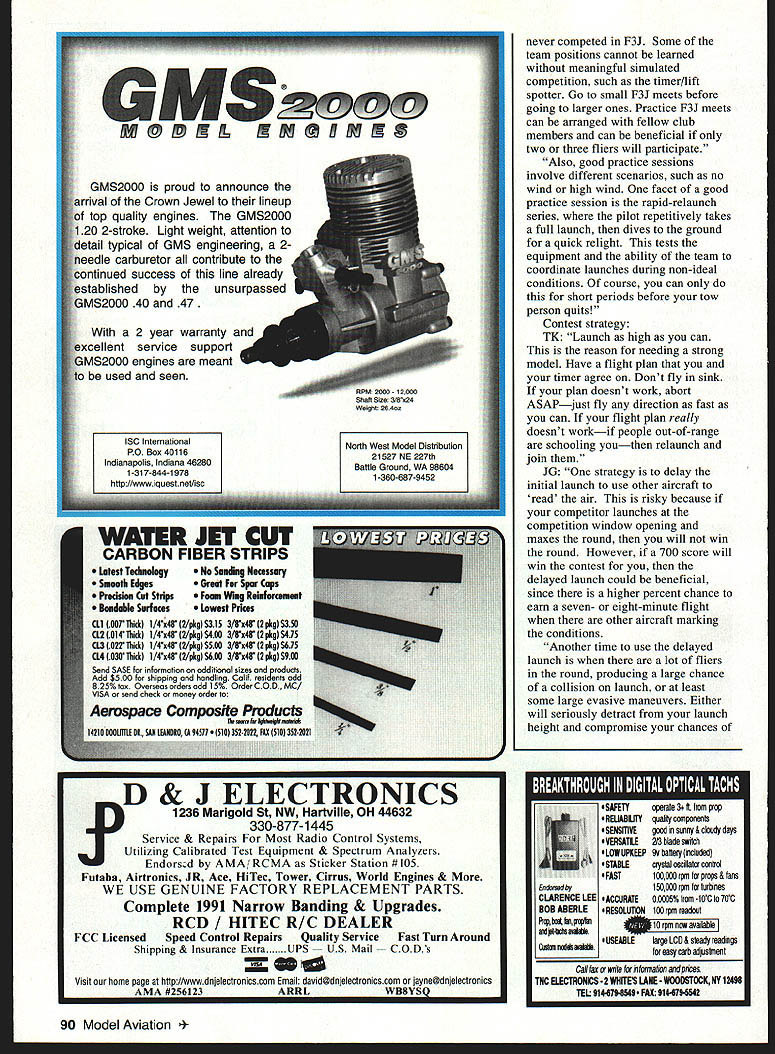
- Tow person: a good runner; lots of mass helps. A good 200-pound person can run fairly well—usually better than a fast 120-pound person.
- Timer: a positive person who can read the air well and knows flying style. The timer needs to be able to tell the pilot usable information, like distance, thermals' entry points, and thermals' strength.
- Pilot: get a good pilot; don't put yourself in that role unless you are the best choice.
Training and preparation
- Fly as much as you can, preferably with fliers who are better than you. Fly with your team.
- Running is probably the best exercise for the tow person.
- Practice sessions are very useful, especially if some team members have not flown together much. Practice launch timing, landing procedures, relaunches, and the radio communication you'll use on contest day.
- Some team members may have never competed in F3J. Certain positions (such as timer/lift spotter) cannot be learned without meaningful simulated competition. Go to small F3J meets before entering larger ones.
- Practice F3J meets can be arranged with fellow club members and are beneficial even if only two or three fliers participate.
- Good practice sessions involve different scenarios (no wind, high wind). One useful drill is rapid-relaunch series: the pilot repeatedly takes a full launch, then dives to the ground for a quick relight. This tests equipment and team coordination during non-ideal conditions. Note: you can only do this for short periods before your tow person quits!
Contest strategy
Thomas Kiesling:
- "Launch as high as you can." This is the reason for needing a strong model.
- Have a flight plan that you and your timer agree on.
- Don't fly in sink. If your plan doesn't work, abort ASAP—fly any direction as fast as you can.
- If your flight plan really doesn't work and others out-of-range are schooling you, relaunch and join them.
Josh Glaab:
- One strategy is to delay the initial launch to use other aircraft to "read" the air. This is risky because if a competitor launches at the opening and makes the round, you will not win that round. However, if a 700 score will win the contest for you, a delayed launch could be beneficial because there's a higher chance to earn a seven- or eight-minute flight when other aircraft are marking conditions.
- Delay launch when there are many fliers in the round (risk of collisions or evasive maneuvers that will compromise launch height).
- Once in the air, a common strategy is to shadow aircraft below you to be the last one down. The flaw is you may not fly your own plane as well when watching others. Better pilots blaze their own trails, though at increased risk.
- If you run downwind on an educated guess, you're vulnerable to small upwind thermals others may find. If that happens, rapidly land and relaunch to save as much of the round as possible.
- Decision-making is critical. Remember you are competing against all other pilots and yourself; you should have a significant chance of beating your current effort before relaunching. Once committed to a relaunch, maximum speed is essential.
Josh added, "The one thing I regret was that when the trophy for first place was awarded, I went up alone to receive it. We all should have received it, because without the consistently superb teamwork we definitely would not have won by such a wide margin, and probably would not have won at all."
Josh has made a great deal of information available to prospective F3J fliers on his WWW site: http://www.pinn.net/~ljgaab/ljgmain.html.
Transcribed from original scans by AI. Minor OCR errors may remain.

