


RADIO CONTROL: Soaring
Dave Garwood 5 Birch Lane, Scotia NY 12302 E-mail: DaveGarwood@compuserve.com
Fear-reduction foam has come to thermal soaring. Two big scary impediments new soaring pilots face are fear of breaking the airplane and its twin fear of long hours at the bench repairing the model.
A new construction material is helping to tame these fears: expanded polypropylene (EPP) foam. EPP looks a lot like white closed-cell Styrofoam™ and weighs about the same—but that's where the resemblance ends. When you press a finger into EPP, it pops back on release. Step on an EPP foam wing and it springs back. Hit a fence post with an EPP foam wing and the leading edge returns to its original shape on its own.
Is this a miracle material? Yes. I speak from personal experience: I have two EPP foam sailplanes of my own; my son has one; and I've flown three that belonged to other pilots.
EPP Foam Development
Pat Bowman, a shipping manager for the US Navy, examined EPP properties and was the first to learn to work with it for model building. In 1996 Pat developed the Ruffneck, a slope-soaring combat sailplane. Use of EPP spread rapidly in the southern California slope scene, and by late last year half a dozen EPP foam slope-combat airplanes were on the market.
One design problem to be solved for EPP's adoption in thermal sailplane design is wing stiffness. Two approaches seen so far use nylon filament tape spar systems.
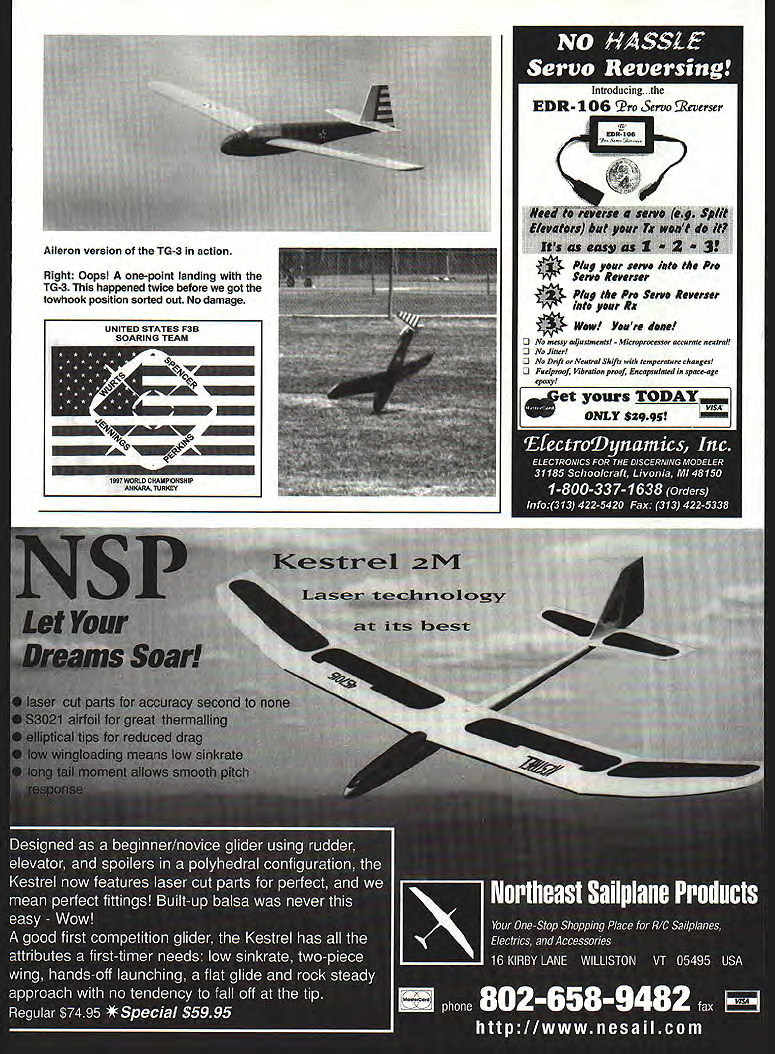
Last year EPP proved its value in slope soaring; this year it entered the Thermal Duration market. At the time of this writing, three designers had announced thermal EPP foam sailplanes. I had a chance to fly the first of them: the DAW TG-3.
TG-3 Flying
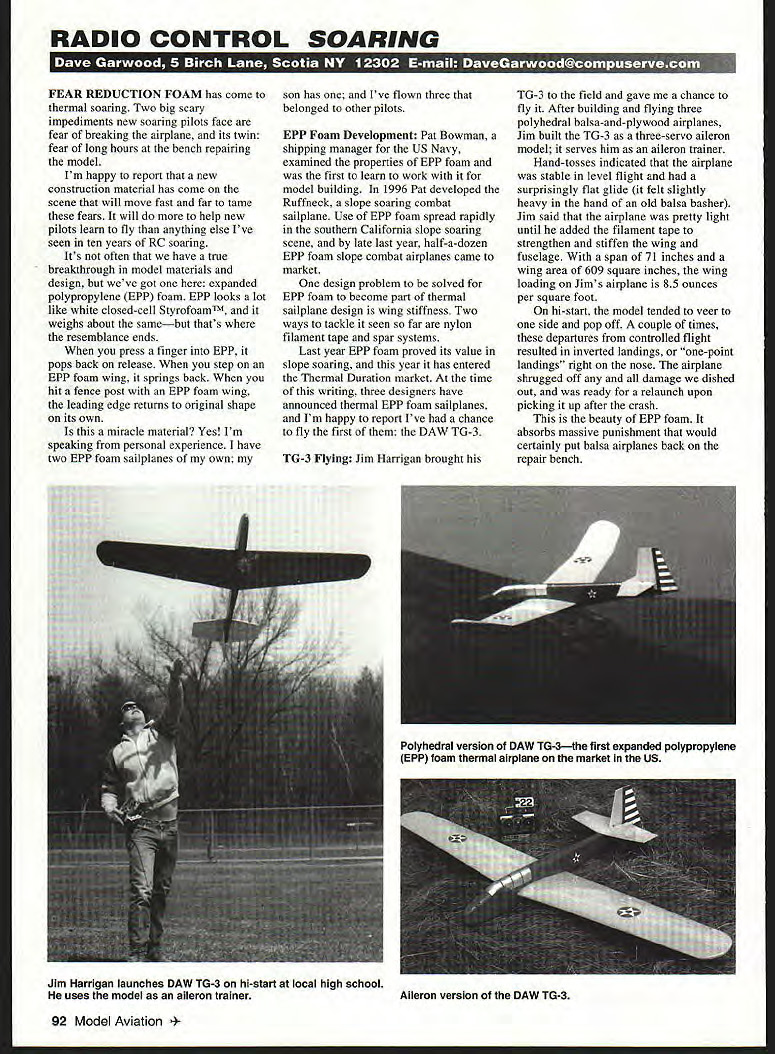
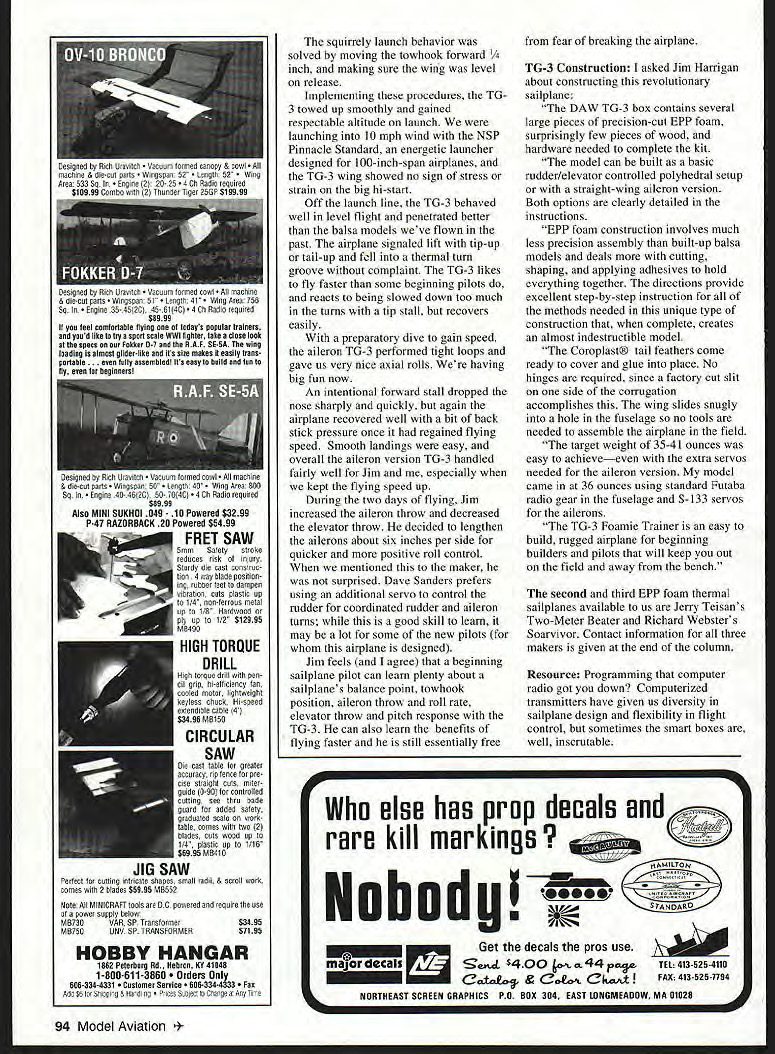
Jim Harrigan brought his TG-3 to the field and let me fly it. After building and flying three polyhedral balsa-and-plywood airplanes, Jim built the TG-3 as a three-servo aileron model; it serves him as an aileron trainer.
Hand-tosses indicated the airplane was stable in level flight and had a surprisingly flat glide (it felt slightly heavy in the hand to an old balsa basher). Jim said the airplane was pretty light until he added the filament tape to strengthen and stiffen the wing and fuselage. With a span of 71 inches and a wing area of 609 square inches, the wing loading on Jim's airplane is 8.5 ounces per square foot.
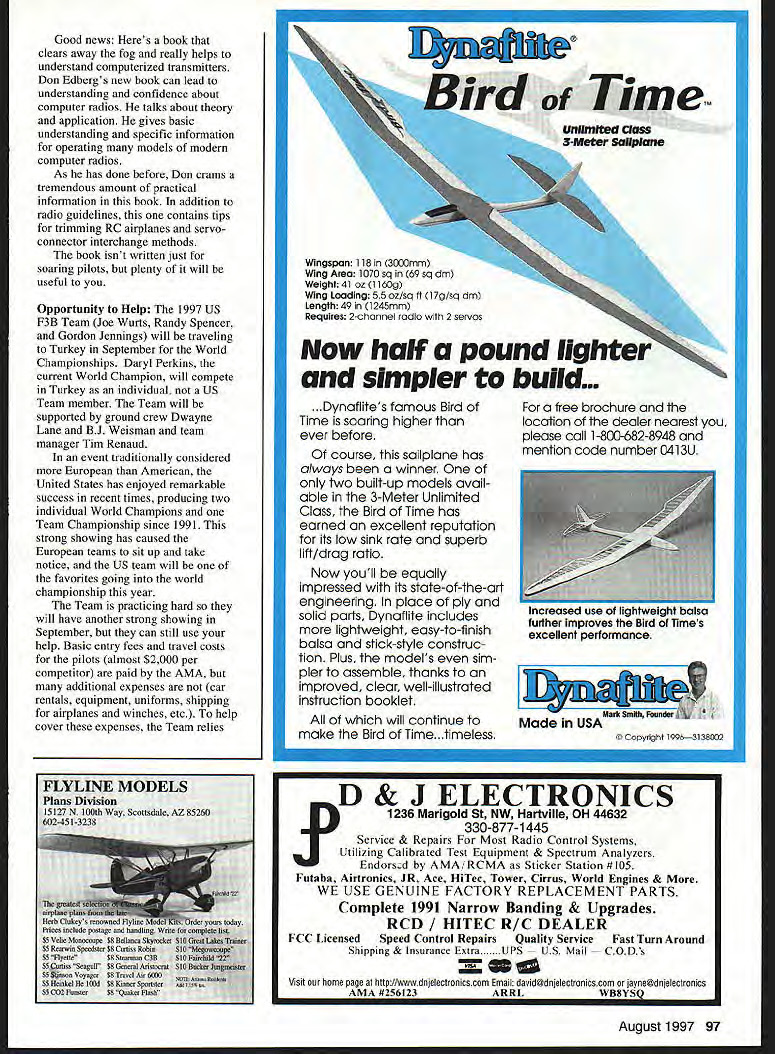
On hi-start, the model tended to veer to one side and pop off. A couple of times these departures from controlled flight resulted in inverted landings—or "one-point landings" right on the nose. The airplane shrugged off the punishment and was ready for relaunch after picking it up following the crash. This is the beauty of EPP: it absorbs massive punishment that would put balsa airplanes back on the repair bench.
(The original photo captions noted the aileron version of the TG-3 in action and showed an "oops" one-point landing that caused no damage.)
The squirrely launch behavior was solved by moving the towhook forward 1/4 inch and making sure the wing was level on release. With these adjustments the TG-3 towed up smoothly and gained respectable altitude. We were launching into a 10 mph wind with the NSP Pinnacle Standard (an energetic launcher for large-span airplanes), and the TG-3 wing showed no sign of stress on the big hi-start.
Off the launch line the TG-3 behaved well in level flight and penetrated better than the balsa models we've flown. The airplane signaled lift with tip-up or tail-up and entered thermals willingly. The TG-3 likes to fly faster than some beginning pilots do, and if slowed too much in turns it may tip-stall, but it recovers easily.
With a preparatory dive to gain speed, the aileron TG-3 performed tight loops and nice axial rolls. An intentional forward stall dropped the nose sharply and quickly, but the airplane recovered well with a bit of back-stick once flying speed returned. Smooth landings were easy. Overall, the aileron TG-3 handled fairly well for Jim and me, especially when we kept flying speed up.
During our two days of flying Jim increased aileron throw, decreased elevator throw, and lengthened the ailerons about six inches per side for quicker, more positive roll control. Dave Sanders (the maker) prefers using an additional servo to control the rudder for coordinated rudder-and-aileron turns; that is a good skill to learn but may be a lot for some new pilots (for whom this airplane is designed).
Jim and I agree that a beginning sailplane pilot can learn a lot about balance point, towhook position, aileron throw and roll rate, elevator throw and pitch response with the TG-3. Pilots also learn benefits of flying faster while remaining essentially free from fear of breaking the airplane.
TG-3 Construction
The DAW TG-3 kit contains several large pieces of precision-cut EPP foam, surprisingly few pieces of wood, and the hardware needed to complete the kit. The model can be built as a basic rudder/elevator-controlled polyhedral setup or as a straight-wing aileron version. Both options are clearly detailed in the instructions.
EPP foam construction involves much less precision assembly than built-up balsa models and focuses more on cutting, shaping, and applying adhesives. The directions provide excellent step-by-step instruction for all the methods needed in this unique construction style that, when complete, creates an almost indestructible model.
The Coroplast® tail feathers come ready to cover and glue into place. No hinges are required; a factory-cut slot on one side of the corrugation accomplishes the hinge function. The wing slides snugly into a hole in the fuselage so no tools are needed to assemble the airplane in the field. The target weight for this 35–41 ounce class is easy to achieve—even with the extra servos for the aileron version. Jim's model came in at 36 ounces using standard Futaba radio gear in the fuselage and S-133 servos for the ailerons.
The TG-3 Foamie Trainer is an easy-to-build, rugged airplane for beginning builders and pilots that will keep you out on the field and away from the bench.
The second and third EPP-foam thermal sailplanes available are Jerry Teisan's Two-Meter Beater and Richard Webster's Soarvivor. Contact information for all three makers is given at the end of the column.
Resource
Programming that computer radio got you down? Computerized transmitters have given us diversity in sailplane design and flexibility in flight control, but sometimes the smart boxes are inscrutable.
Don Edberg's new book, Guide to Computer RC Systems, clears away the fog and helps readers understand computerized transmitters. He covers theory and application, provides basic understanding and specific information for operating many models of modern computer radios, and includes practical tips for trimming RC airplanes and servo-connector interchange methods. The book isn't written just for soaring pilots, but plenty of it is useful to glider flyers.
Opportunity to Help
The 1997 US F3B Team (Joe Wurts, Randy Spencer, and Gordon Jennings) will travel to Turkey in September for the World Championships. Daryl Perkins, the current World Champion, will compete as an individual, not a US Team member. The Team will be supported by ground crew Dwayne Lane and B.J. Weisman and team manager Tim Renaud.
The United States has enjoyed remarkable F3B success in recent times—two individual World Champions and one Team Championship since 1991—so the US team will be one of the favorites this year. Basic entry fees and travel costs for the pilots (almost $2,000 per competitor) are paid by the AMA, but many additional expenses are not covered (car rentals, equipment, uniforms, shipping for airplanes and winches, etc.). To help cover these costs the Team relies on donations from clubs and individuals.
If you'd like to help support the US Soaring Team, send a contribution or order souvenir merchandise:
- Official US Team T-shirts (M, L, XL, XXL): $15
- Official US Team Pins: $3
- Official US Team Patches: $5
Make checks payable to "US F3B Soaring Team." Please add 10% for shipping and send to: US F3B Soaring Team 22412 Rippling Brook Lake Forest CA 92630
The Team's web site: http://www.netmeister.net/~pwt/f3b/usaf3b.htm
Sources
- TG-3 EPP foam trainer:
Dave Sanders Dave's Aircraft Works 34455 Camino El Molino Capistrano Beach, CA 92624 (714) 248-2773 104271.3352@compuserve.com
- Two-Meter Beater EPP foam trainer:
Jerry Teisan Trick R/C Venice, CA 90291 (310) 301-1614 e-mail: ZOD@zagi.com WWW site: http://www.ZAGI.com
- Soarvivor EPP foam trainer:
Richard Webster Silent Squadron R/C 22912 W. Frisca Drive Valencia, CA 91354 (805) 297-3948 silentsqdron@earthlink.com
- Guide to Computer RC Systems:
Don Edberg Dynamic Modeling 4922 Rochelle Avenue Irvine, CA 92604-2941 (714) 552-1812 don_edberg@compuserve.com
Transcribed from original scans by AI. Minor OCR errors may remain.

