
RADIO CONTROL SOARING
Dave Garwood 5 Birch Lane, Scotia NY 12302 E-mail: DaveGarwood@compuserve.com
The joy of simple sailplanes
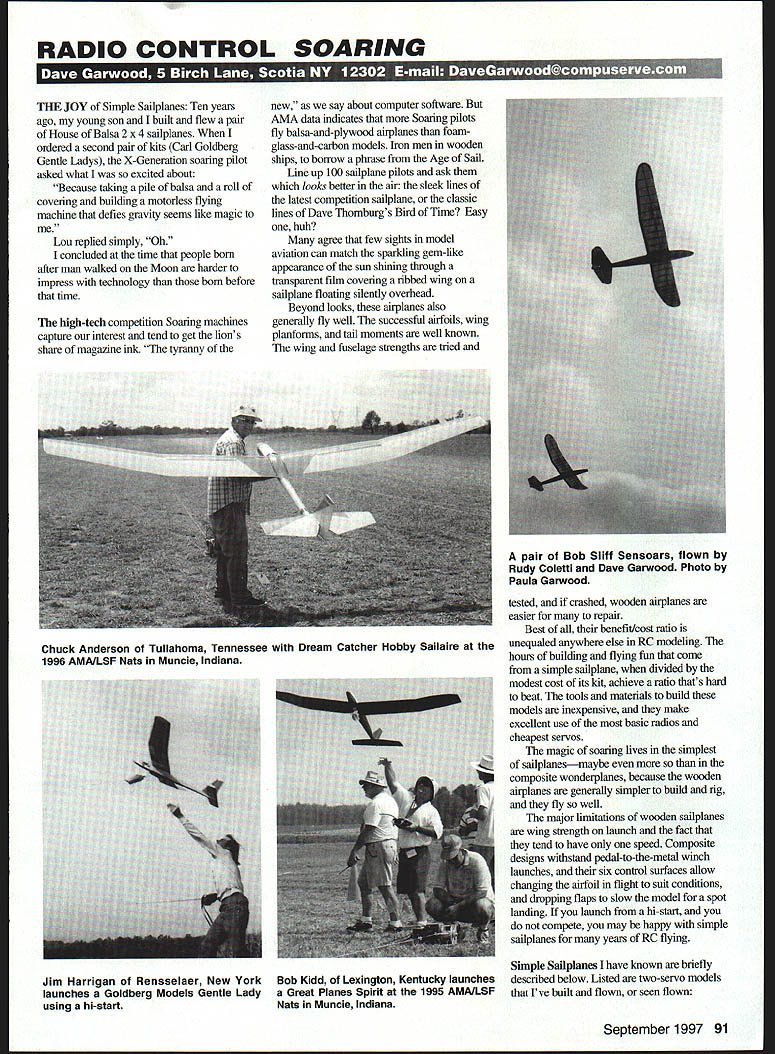
Ten years ago my young son and I built and flew a pair of House of Balsa 2 x 4 sailplanes. When I ordered a second pair of kits (Carl Goldberg Gentle Lady), the X‑Generation soaring pilot asked what I was so excited about.
"Because taking a pile of balsa and a roll of covering and building a motorless flying machine that defies gravity seems like magic to me."
Lou replied simply, "Oh."
I concluded at the time that people born after man walked on the Moon are harder to impress with technology than those born before that time.
High‑tech competition soaring machines capture attention and tend to get the lion's share of magazine ink — "the tyranny of the new," as we say about computer software. But AMA data indicates that more soaring pilots fly balsa‑and‑plywood airplanes than foam‑glass‑and‑carbon models. Iron men in wooden ships, to borrow a phrase from the Age of Sail.
Line up 100 sailplane pilots and ask which looks better in the air: the sleek lines of the latest competition sailplane, or the classic lines of Dave Thornburg's Bird of Time? Easy one, huh?
Few sights in model aviation match the sparkling, gem‑like appearance of the sun shining through a transparent film covering a ribbed wing on a sailplane floating silently overhead.
Beyond looks, these airplanes generally fly well. Successful airfoils, wing planforms, and tail moments are well known. Wing and fuselage strengths are tried and tested, and if crashed, wooden airplanes are easier for many to repair.
Best of all is the benefit/cost ratio. The hours of building and flying fun from a simple sailplane, divided by the modest cost of its kit, is hard to beat. Tools and materials are inexpensive, and these models make excellent use of basic radios and inexpensive servos.
The magic of soaring lives in the simplest sailplanes — perhaps even more so than in composite wonderplanes — because wooden airplanes are generally simpler to build and rig, and they fly so well.
Limits and where composite designs excel
The major limitations of wooden sailplanes are wing strength on launch and the fact that they tend to have only one speed. Composite designs withstand pedal‑to‑the‑metal winch launches, offer multiple control surfaces to change the airfoil in flight, and can drop flaps for slower spot landings. If you launch from a hi‑start and do not compete, simple sailplanes may be fine for many years of RC flying.
Simple sailplanes I have flown or seen flown
- House of Balsa 2 x 4 — 48-inch wingspan. Nonstandard size and a little heavy, but successful in thermal flight. Inexpensive kit, builds fast; a rugged airplane that makes a good slope trainer and thermal trainer.
- House of Balsa 2 x 6 (2M) — Two‑meter version with longer span than the 2 x 4; carries radio gear more easily. Optimized for quick building and ruggedness; a good first building project.
- Carl Goldberg Gentle Lady (Two‑Meter, 78-inch span) — Probably the best‑known design of the last decade. Builds easily and flies well; seemingly anybody can build one. Caution: use stiff covering material like MonoKote or Solartex for necessary wing rigidity.
- Bob Sliff Sensoar 2M — Chosen by Rudy Coletti for visual appeal: elliptical tips and rounded stabs and fin give it a classic look. Flies well and survives hard landings; a 1/8" plywood bottom on the fuselage is a good substitution.
- Great Planes Spirit 2M — Recent design by Paul Carlson. A little heavier with a faster airfoil; handles windy conditions better. A third‑servo spoiler option is useful for beginning contest fliers. Excellent instructions and drawings.
- Minimax 700 2M — Wooden design optimized for low weight and low wing loading; flies slowly and gives the pilot time for decisions.
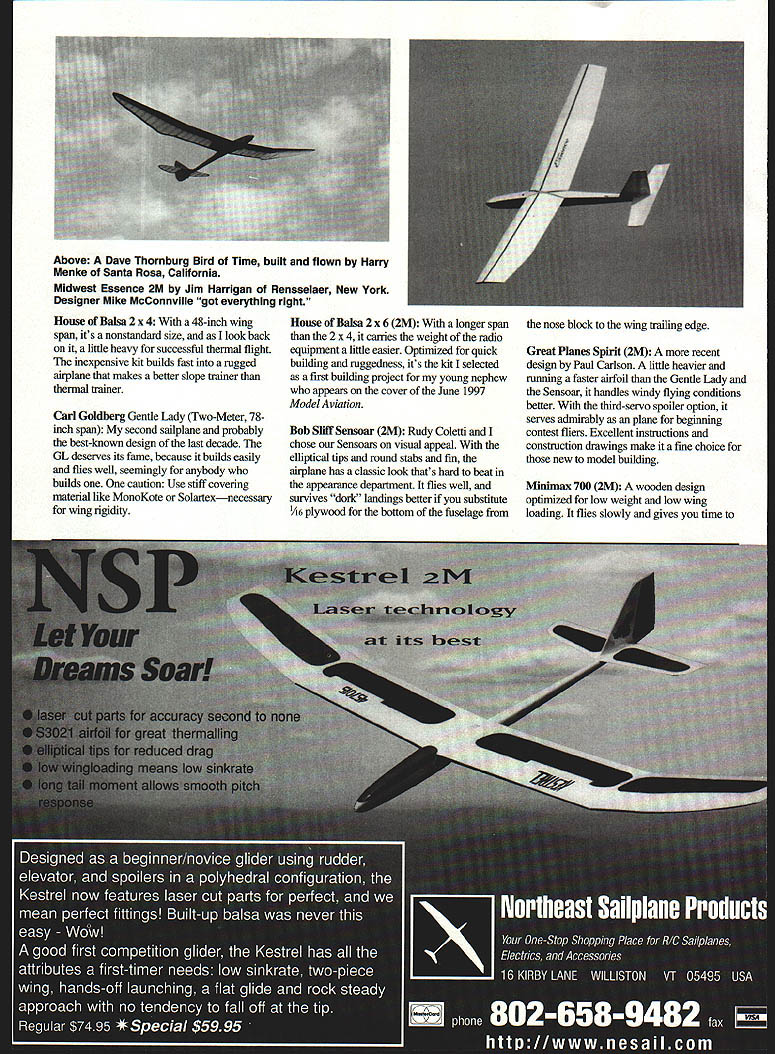
- Dave Thornburg Bird of Time — Classic design; outstanding handling and appearance.
- Midwest Essence 2M — Designed by Mike McConville: excellent nose block, wing, and trailing edge. Flies remarkably well; reportedly one of the first sailplanes that could be launched by hand, circled back, and hand‑caught. (Also, it was the first sailplane my wife broke in ten minutes.)
- Olympic 650 (2M) — Solid, good‑flying design published by RC Modeler and central to Al Doig's Sailplane and Soaring Manual. Once kited by Airtronics; plans available from RCM (order plans #845 and the book if you enjoy scratch‑building).
- Olympic II (100-inch) — Special to me: the first where stick time exceeded building time. Delivered my first 1/2‑hour thermal flight using lift from a hot tar roof. Formerly an Airtronics kit; plans available from RCM.
- Sig Manufacturing Riser 100 (100-inch; 2M version available) — Perhaps the most common 100‑inch starter airplane seen at soaring fields. Similar to the Olympic II; kit currently in production with high‑grade Sig balsa.
- Great Planes Spirit 100 (100-inch) — Larger version of the Spirit; clear canopy and vacuum‑molded pilot figure. Can be built as a two‑servo polyhedral version or as a full‑house with flaps and ailerons.
- Dynaflite Bird of Time (120-inch) — Widely recognized Open‑class sailplane because of its distinctive planform. A Dave Thornburg design, available from Tower Hobbies. One of the most impressive‑looking RC aircraft you can fly with two servos.
- Pierce Aero Paragon (120-inch) — Praised as an excellent trainer, handling sailplane, and all‑around light‑air thermal model. A top choice for many.
- Dream Catcher Sailaire (149-inch) — A huge floater, easy to see at distance, and a frequent entry at nostalgia contests. Gentle giant that puts smiles on pilots' faces.
- Larry Jolly Flinger (60-inch) — Cheap, simple, sweet‑handling hand‑launch glider (HLG). Needs microservos. Larry Jolly won the HL Nats with it in 1991; standard for comparing other HLGs.
Notes on kits, availability, and contemporary offerings
Sorry this list is not longer, but I stick to sailplanes I have flown or seen flown. Some kits are currently out of production, but the essential characteristics — simple construction, light wing loading, slow‑and‑forgiving flying characteristics, and simple two‑channel control (some use an optional third channel for spoilers) — are available from companies reissuing classic kits and from new manufacturers.
Classic designs are being re‑kitted by companies like Dream Catcher Hobby (Nomad) and Hobby Hanger (Windfree). New simple sailplane designs are made by companies such as DJ Aerotech (Chrysalis), Future Flight (Thermal Thing 2M), Fling Thing (HL), GM Glider Tech (Illusion), Northeast Sailplanes (Kestrel), and Sky Bench Aerotech (HL‑size Bird of Time).
Closing thought
"If God had wanted us to fly fiberglass airplanes, He would have given us fiberglass trees." — old balsa‑basher motto.
Transcribed from original scans by AI. Minor OCR errors may remain.

