
Radio Control: Soaring
Dave Garwood, 5 Birch Lane, Scotia NY 12302 E-mail: DaveGarwood@compuserve.com
New England RC Soaring Convention
The New England RC Soaring Convention will be held Saturday, November 15 in Portland, ME. In past years we have flown sailplanes on the Friday before and the Sunday after the convention.
Scheduled speakers:
- John Derstine and Steve Savoie — "Aerotowing Scale Gliders"
- Bill Kuhlman (B2 Streamlines) — "Use of Polars in Airfoil Comparisons"
- Larry Lloyd (Airtronics) — "Programming Computer Radios"
- George Sparr (Aerospace Composite Products) — "Choice and Use of Composite Materials in Sailplane Design and Construction"
- Dave Garwood — "Slope Jets and Foamy Slope Combat"
Seating is limited and reservations are required by November 3. Send check or money order payable to Downeast Soaring Club to reserve your seat:
Jim Armstrong 292 Foreside Rd. Topsham, ME 04086 Tel.: (207) 725-5758 (evenings) E-mail: Jim.Armstrong@juno.com
Tools for Building
Building is part of soaring for most of us, and having the right tools makes the work easier, faster, and safer. We discussed modeling tools in the April 1996 issue, but there are more tools you should know about to enhance your enjoyment and improve the results of your building time and effort.
Long sanding blocks
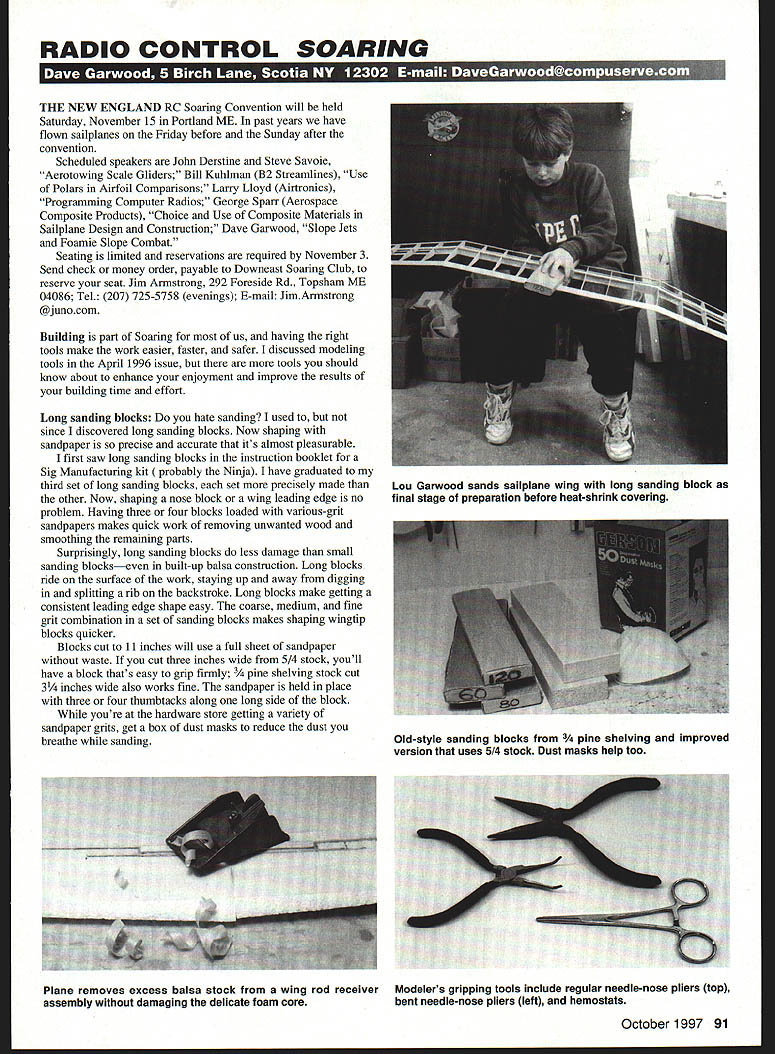
Long sanding blocks make shaping with sandpaper precise and accurate — almost pleasurable. I first saw them in the instruction booklet for a Sig Manufacturing kit (probably the Ninja). I now use several sets, each more precisely made than the last. Having three or four blocks loaded with various-grit sandpapers makes quick work of removing unwanted wood and smoothing parts.
Advantages:
- Long blocks ride the surface of the work, reducing the tendency to dig in and split ribs on the backstroke.
- They make getting a consistent leading-edge shape easy.
- A coarse/medium/fine grit combination speeds shaping wingtip blocks.
Construction and use:
- Blocks cut to 11 inches will use a full sheet of sandpaper with little waste.
- Cut about 3 inches wide from 5/4 stock for an easy grip; 3/4" pine shelving stock cut roughly 3 1/4 inches wide also works.
- Hold the sandpaper in place with three or four thumbtacks along one long side of the block.
- While at the hardware store, buy a variety of sandpaper grits and a box of dust masks to reduce inhaled dust while sanding.
Razor plane
A plane removes unwanted wood faster than a sanding block, especially along long dimensions like aileron stock and leading edges. Planing produces shavings instead of dust, which is easier on the eyes and lungs. A plane is excellent for cleaning up wing skin overhang after sheeted-foam wings come out of the press or bag and has many uses for precise shaping.
Recommended tool:
- Solingen Balsa Planer, part number HLAE 801, from Hobby Lobby International, 5614 Franklin Pike Circle, Brentwood TN 37027; (615) 373-1444. Hobby Lobby will send a free catalog on request. This plane works well on spruce, basswood, 1/64" plywood, and balsa.
Gripping tools
Common gripping tools and their uses:
- Needle-nose pliers: general assembly; available in many tip shapes.
- Bent-nose pliers: often most useful — grip more things in more places, from screws and washers to clevises and battery packs.
- Hemostats: long-nose locking pliers with a scissors-type handle for fine control. Indispensable on the workbench and in the field box; useful for removing headless nylon bolts. Available from medical-supply companies, fishing-supply stores, and tool catalogs in several lengths.
- Self-locking pliers: useful in needle-nose and other configurations. Vise-Grip is a reliable brand; Sears and Channellock also make them.
Soldering tools
Soldering provides solid metal-to-metal joints that can be undone by reheating, making it preferable for many mechanical and electrical repairs. Some building instructions specify soldering for mechanical joints, though epoxy is sometimes allowed.
Common tools:
- Soldering gun: convenient and provides plenty of heat for most mechanical repairs in model aviation.
- 25-watt pencil-type soldering iron: preferred for electrical work on small wires, battery packs, extension cables, and servo leads. The small iron provides enough heat for fine wires and allows careful repair of servo leads at the printed circuit board level.
Practical tips and techniques:
- An easy way to make a Y-shaped control rod is to bind three wires with fine copper wire and solder the junction to form a strong, trouble-free joint.
- For electrical work use rosin-core solder.
Steps to making successful solder joints:
- Let the iron heat up fully before starting.
- While the iron is heating, clean the parts to be joined.
- Clean the iron with a wet sponge or fine sandpaper when it's hot.
- "Tin" the iron by melting a fine coating of solder onto its tip.
- Immobilize the parts to be soldered with clamps, weights, or special clamping tools.
- Heat the work, not the solder; touch the solder to the heated work and let the solder flow onto the work. For soldering onto circuit boards, keep the iron in contact with the work for no more than ten seconds.
- When the solder flows onto the joint, withdraw the iron and let the work cool without movement of the parts.
- Inspect the joint for a shiny surface on the solder when cool. If the solder is gray and dull, the parts were likely moved during cooling and the joint should be re-soldered.
- To remove solder, apply desoldering braid to the solder blob and heat the work through the braid, wicking the molten solder away from the joint.
Transcribed from original scans by AI. Minor OCR errors may remain.

