
Radio Control: Soaring
Dave Garwood 5 Birch Lane, Scotia NY 12302 E-mail: DaveGarwood@compuserve.com
THIRD IN A SERIES of powerful and productive collaborations between AMA and the League of Silent Flight, the 1997 Soaring Nats was another fine flying meet. Approximately 200 pilots came from 28 states to fly in six contests from July 26 through August 1.
We had memorable weather: plenty of heat on the weekend and three days of wind from "an unusually strong high pressure system," as The Weather Channel described it. Only once was flying curtailed because of rain, and that happened late in the afternoon.
We flew from 12 powerful winches prepared by Michigan's Mike Wade. With strong winds and strong winches, about 30 sailplanes were lost on launch. About half folded wings or blew stabs on tow; about half winched into the ground after getting out of shape after release. I was surprised by the number of molded "supermodels" that were destroyed — more than the wooden and obeche-over-foam airplanes combined.
The wind did not preclude making duration times, but many pilots parked in wave lift for their 10 minutes rather than fly thermal turns. Many landed short and several landed off-field. Those who practiced in wind were better prepared to handle their airplanes in these conditions.
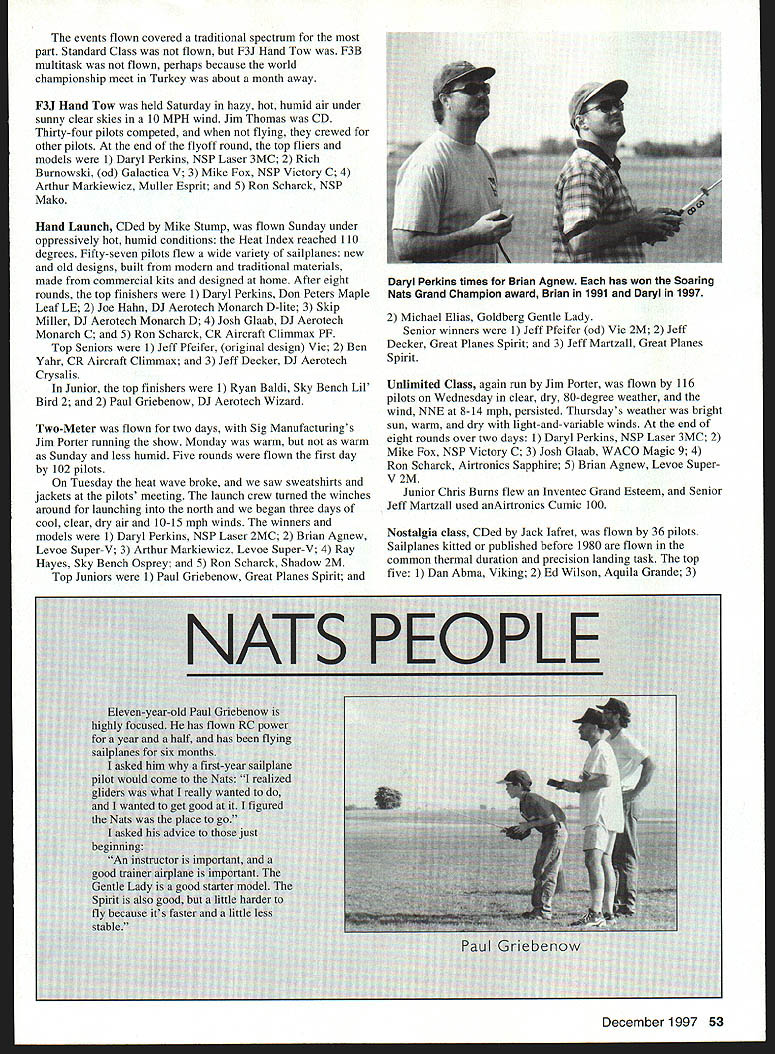
While the airplanes and the flying provide a focus for the Nats, it's the people who make participating a terrific experience. You expect to see top fliers at the Nats, and they were there: Daryl Perkins, current world soaring champion, swept the HL, F3J, 2M, and Unlimited contests. Former Soaring Nats grand champions Brian Agnew and Jim Thomas were also there for the week.
You can walk up to any of these guys and ask them about their models and their flying techniques. Any of them will time a round for you if you ask. Beyond that, they spend lots of their time helping other fliers and advising young pilots and other newcomers. Jim Thomas CD'ed the F3B contest and spent much of the rest of the week on the flightline, honchoing winch launches. Volunteer enthusiasm and support from experienced fliers is what makes the Nats work so well.
New and returning competitors
On the other end of the experience scale were first-time Nats competitors and newcomers who made strong impressions.
- Paul Griebenow, 11, West Lafayette, IN, had been flying sailplanes for only a few months when he showed up for Hand Launch and Two-Meter. His HL airplane was lost during the contest, and he folded a wing on a Spirit in the wind during the Two-Meter event, but his quiet enthusiasm was infectious. Fellow competitors contributed: Joe Hahn gave him a DJ Aerotech Monarch to continue HL flying; Sal DeFrancesco gave him an NSP Kestrel kit; and Mike Stump gave him a Sig Riser 100 kit.
- Tim Vandenheuvel drove four days from Seattle with his dad to fly the week. A starter with RC power airplanes, he switched to sailplanes after seeing them flown locally and came to Muncie to try his own-design Impulse HLG (an 11.5-ounce, three-servo machine) in HL. Tim broke several airplanes on launch due to the strong winds and winches, but fellow fliers loaned him backup ships. He enjoyed the experience so much that a raffle winner gave him a Slegers International Skyhawk to better suit his skills.
- Ron Stanfield of Arkansas has attended 22 or 23 AMA Nationals; this was his first trip to Muncie. He offered the best single thermal-finding tip I’ve heard: "Don't try to see thermals — know where guys can see thermals by what they're doing watching airplanes." He prefers wooden polyhedral models in winds less than 10 mph; in contests over 10 mph, faster ships are better. Ron has logged RC flight for more than 20 years — five of his top 50 flights exceeded two hours, and the shortest of his top 50 was an hour and five minutes. For Ron, flying at the Nats is also a social event.
Regulars such as Don Vickers, Joe Wurts and Daryl Perkins acknowledged they still learn about reading air from designers and other experienced fliers. Designers on hand included Mike and Charlie Fox, Terry Edmonds, Rusty Shaw, Troy Lawicki, Joe Hahn, Don Stackhouse, and Mike Ziaskas.
F3J Hand Tow
F3J Hand Tow was held Saturday under hazy, hot, humid air with sunny skies and a 10 mph wind. Jim Thomas was CD. Thirty-four pilots competed, with crews and other pilots helping at the end of the flyoff round.
Results
- Daryl Perkins — NSP Laser 3MC
- Rich Burnowski — (od) Galactica V
- Mike Fox — NSP Victory C
- Arthur Markiewicz — Muller Esprit
- Ron Scharck — NSP Mako
Hand Launch
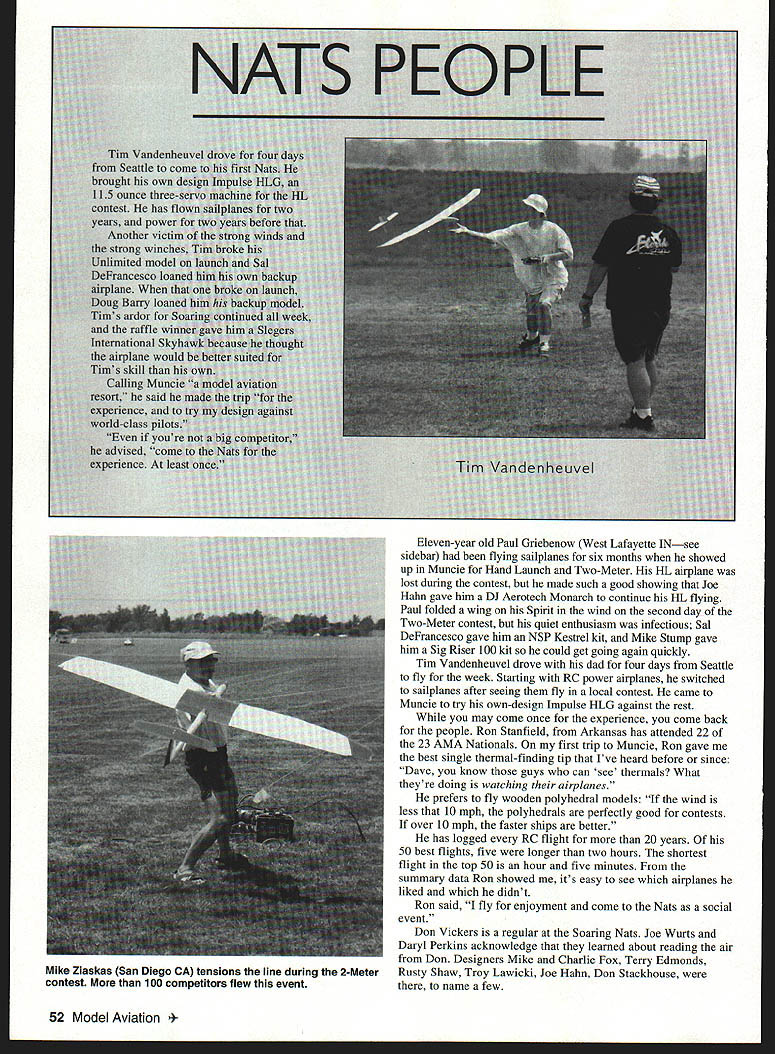
Hand Launch, CD'ed by Mike Stump, was flown Sunday under oppressively hot, humid conditions; the heat index reached 110 degrees. Fifty-seven pilots flew a wide variety of sailplanes — new and old designs, commercial kits and home-designed ships. After eight rounds, the top finishers were:
Overall
- Daryl Perkins — Don Peters Maple Leaf LE
- Joe Hahn — DJ Aerotech Monarch D-lite
- Skip Miller — DJ Aerotech Monarch D
- Josh Glaab — DJ Aerotech Monarch C
- Ron Scharck — Aircraft Climax PF
Seniors
- Jeff Pfeifer — (original design) Vice
- Ben Yahr — CR Aircraft Climax
- Jeff Decker — DJ Aerotech Chrysalis
Juniors
- Ryan Baldi — Sky Bench Lil' Bird II
- Paul Griebenow — DJ Aerotech Wizard
Two-Meter
Two-Meter was flown over two days with Sig Manufacturing's Jim Porter running the event. Monday was warm and less humid; five rounds were flown the first day by 102 pilots. On Tuesday the heat wave broke, and cooler weather arrived with 10–15 mph winds after turning the winches to launch into the north.
Results
- Daryl Perkins — NSP Laser 2M
- Brian Agnew — LeVoe Super-V
- Arthur Markiewicz — LeVoe Super-V
- Ray Hayes — Sky Bench Osprey
- Ron Scharck — Shadow 2M
Juniors
- Paul Griebenow — Great Planes Spirit
- Michael Elias — Goldberg Gentle Lady
Seniors
- Jeff Pfeifer — (original design) Vice
- Jeff Decker — Great Planes Spirit
- Jeff Martzall — Great Planes Spirit
Unlimited Class
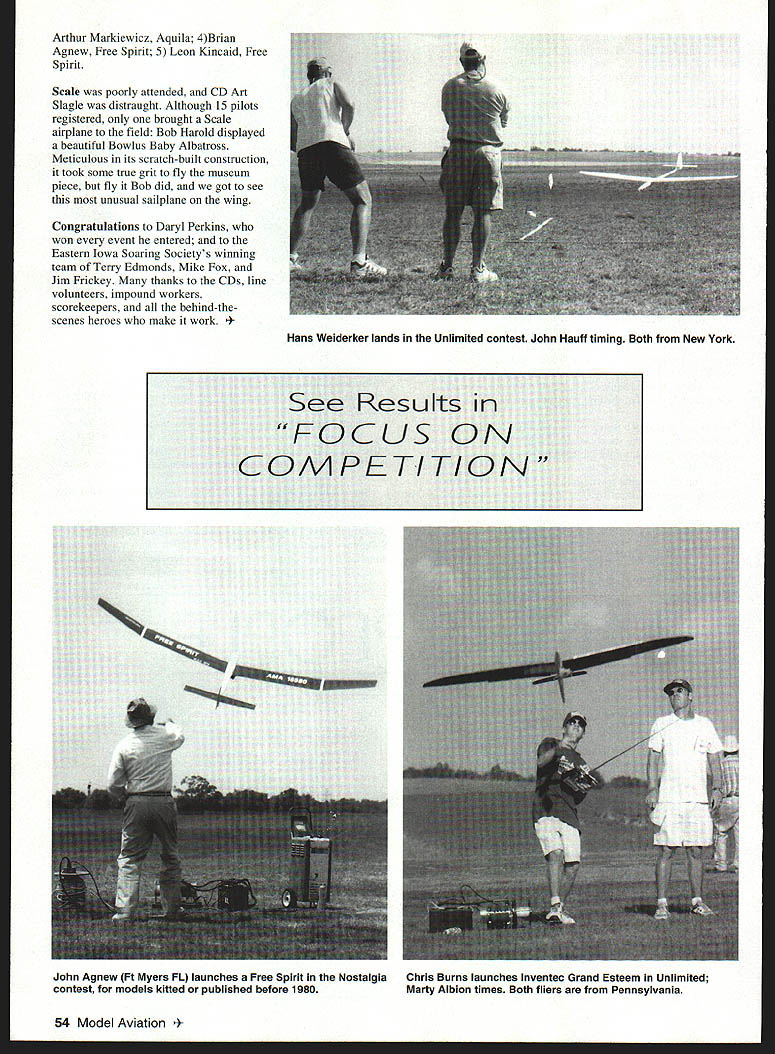
Unlimited Class, also run by Jim Porter, was flown by 116 pilots on Wednesday in clear, dry 80-degree weather with an NNE wind at 8–14 mph. Thursday was bright, warm and dry with light-and-variable winds. After eight rounds over two days, the results were:
Results
- Daryl Perkins — NSP Laser 3MC
- Mike Fox — NSP Victory C
- Josh Glaab — WACO Magic 9
- Ron Scharck — Airtronics Sapphire
- Brian Agnew — LeVoe Super-V
Junior competitor Chris Burns flew an Inventec Grand Esteem; Senior Jeff Martzall used an Airtronics Ultimate 100.
Nostalgia Class
Nostalgia class, CD'ed by Jack Iafret, was flown by 36 pilots. Sailplanes kitted or published before 1980 competed in common thermal duration and precision landing tasks.
Results
- Dan Abma — Viking
- Ed Wilson — Aquila Grande
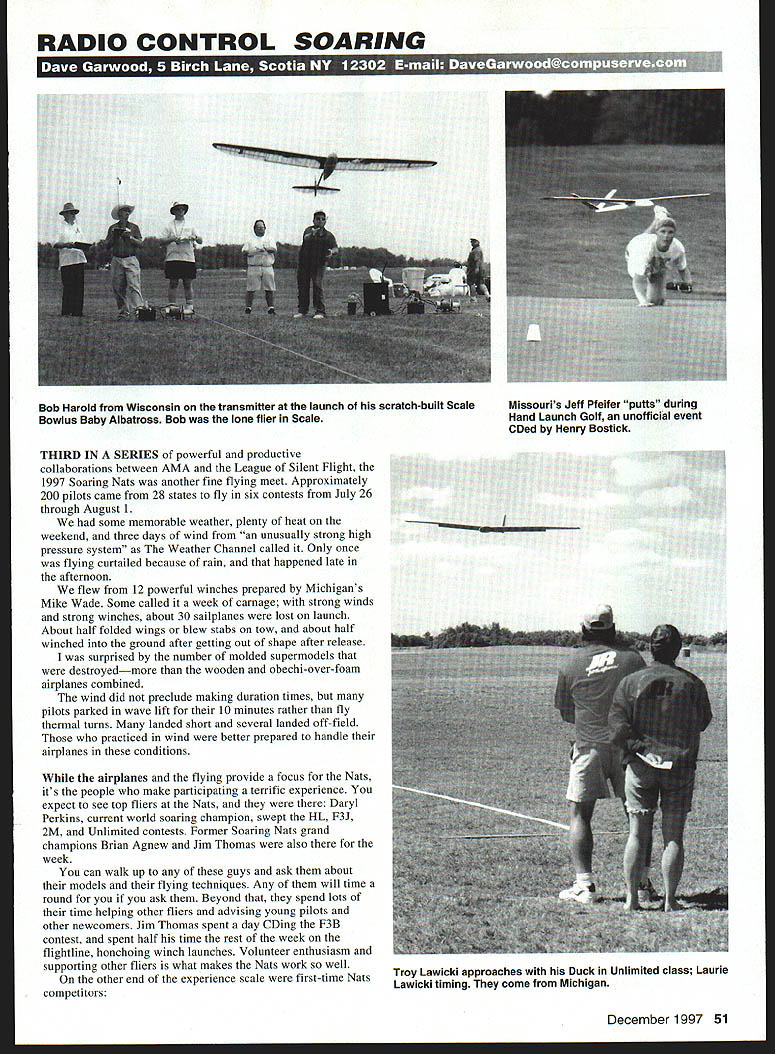
Scale was poorly attended, and CD Art Slagle was distraught. Although 15 pilots registered, only one brought a Scale airplane to the field: Bob Harold displayed a beautiful, meticulously scratch-built Bowlus Baby Albatross. It took true grit to fly the museum piece, but fly it Bob did, and we got to see this most unusual sailplane on the wing.
Congratulations to Daryl Perkins, who won every event he entered; and to the Eastern Iowa Soaring Society's winning team of Terry Edmonds, Mike Fox, and Jim Frickey. Many thanks to the CDs, line volunteers, impound workers, scorekeepers, and all the behind-the-scenes heroes who make it work.
Transcribed from original scans by AI. Minor OCR errors may remain.

