
Radio Control: Soaring
Dan Pruss
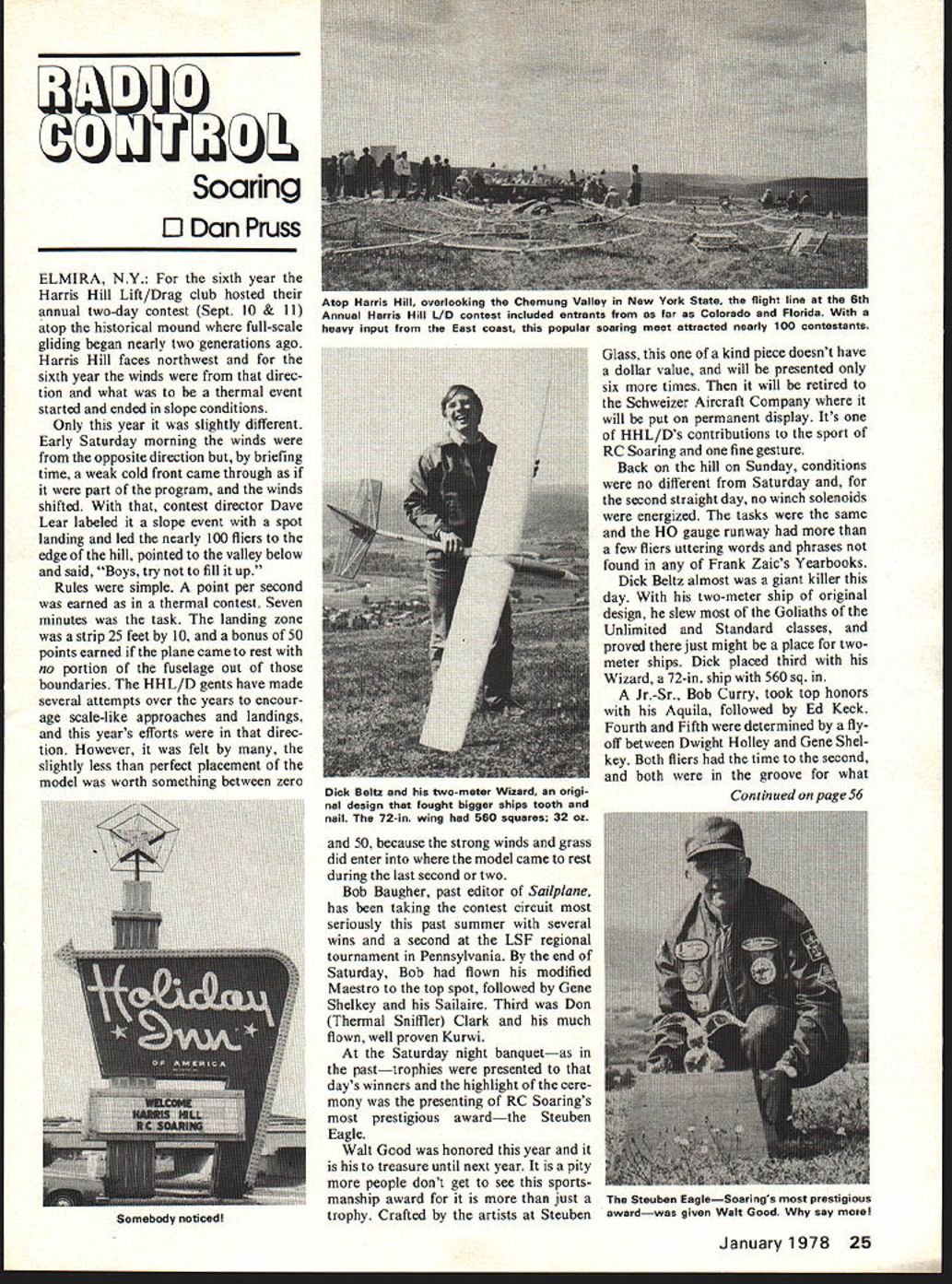
ELMIRA, N.Y.: For the sixth year the Harris Hill Lift/Drag club hosted their annual two-day contest (Sept. 10 & 11) atop the historical mound where full-scale gliding began nearly two generations ago. Harris Hill faces northwest and for the sixth year the winds were from that direction and what was to be a thermal event started and ended in slope conditions.
Only this year it was slightly different. Early Saturday morning the winds were from the opposite direction but, by briefing time, a weak cold front came through as if it were part of the program, and the winds shifted. With that, contest director Dave Lear labeled it a slope event with a spot landing and led the nearly 100 fliers to the edge of the hill, pointed to the valley below and said, "Boys, try not to fill it up."
Rules were simple. A point per second was earned as in a thermal contest. Seven minutes was the task. The landing zone was a strip 25 feet by 10, and a bonus of 50 points earned if the plane came to rest with no portion of the fuselage out of those boundaries. The HHL/D gents have made several attempts over the years to encourage scale-like approaches and landings, and this year's efforts were in that direction. However, it was felt by many, the slightly less than perfect placement of the model was worth something between zero
and 50, because the strong winds and grass did enter into where the model came to rest during the last second or two.
Bob Baugher, past editor of Sailplane, has been taking the contest circuit most seriously this past summer with several wins and a second at the LSF regional tournament in Pennsylvania. By the end of Saturday, Bob had flown his modified Maestro to the top spot, followed by Gene Shelkey and his Sailaire. Third was Don (Thermal Sniffer) Clark and his much flown, well proven Kurvi.
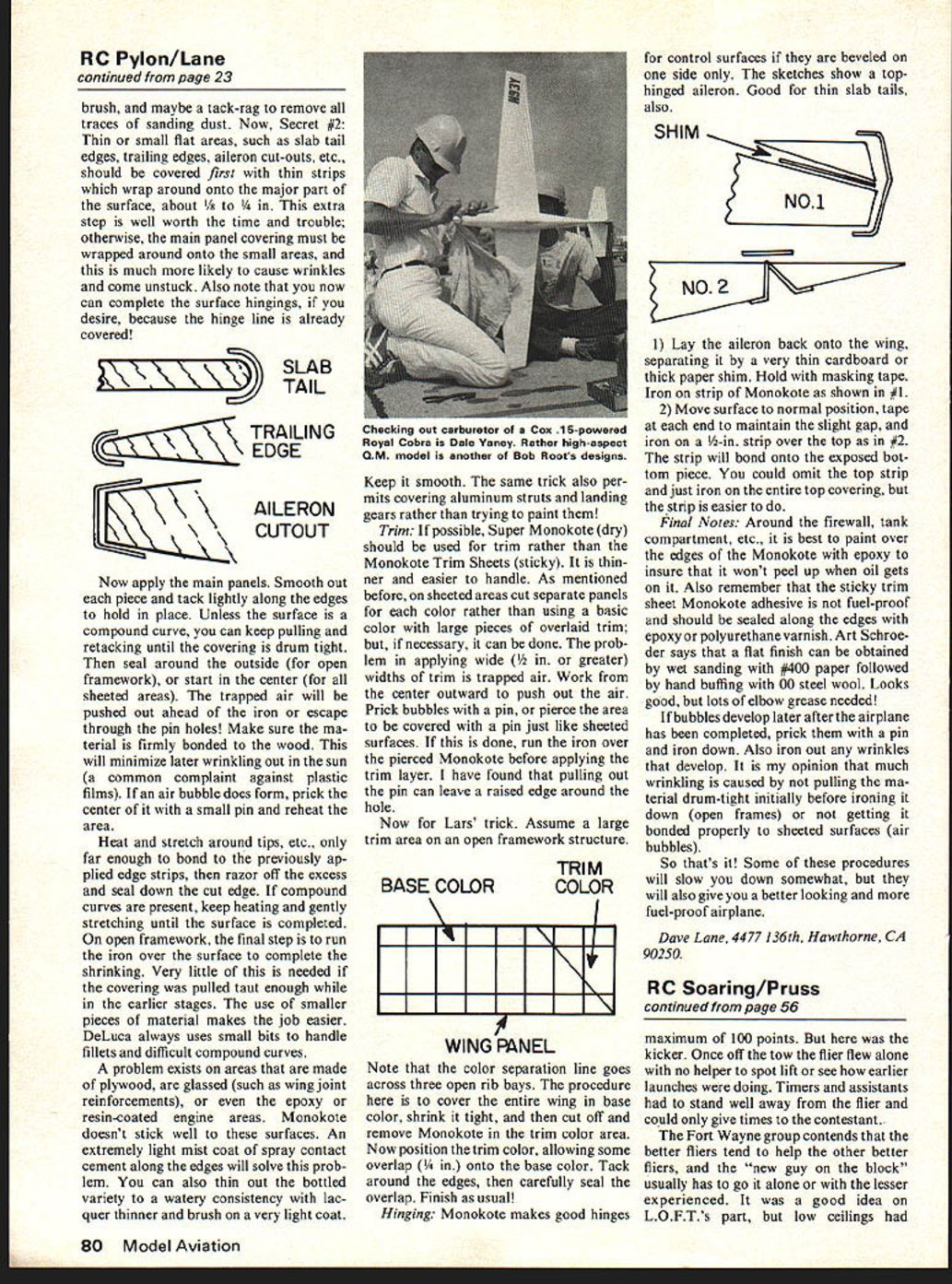
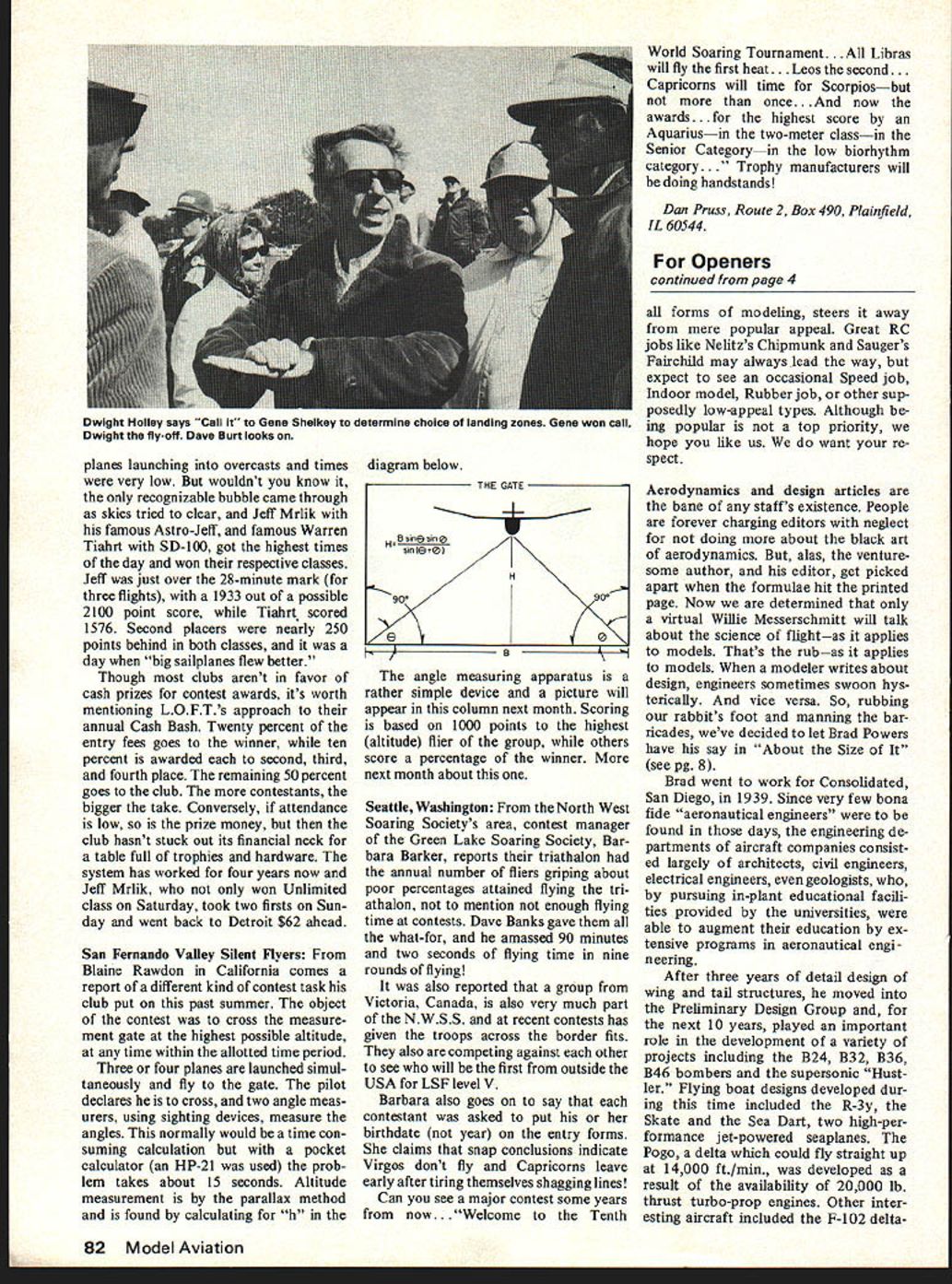
At the Saturday night banquet—as in the past—trophies were presented to that day's winners and the highlight of the ceremony was the presenting of RC Soaring's most prestigious award—the Steuben Eagle.
Walt Good was honored this year and it is his to treasure until next year. It is a pity more people don't get to see this sportsmanship award for it is more than just a trophy. Crafted by the artists at Steuben Glass, this one of a kind piece doesn't have a dollar value, and will be presented only six more times. Then it will be retired to the Schweizer Aircraft Company where it will be put on permanent display. It's one of HHL/D's contributions to the sport of RC Soaring and one fine gesture.
Back on the hill on Sunday, conditions were no different from Saturday and, for the second straight day, no winch solenoids were energized. The tasks were the same and the HO gauge runway had more than a few fliers uttering words and phrases not found in any of Frank Zaic's Yearbooks.
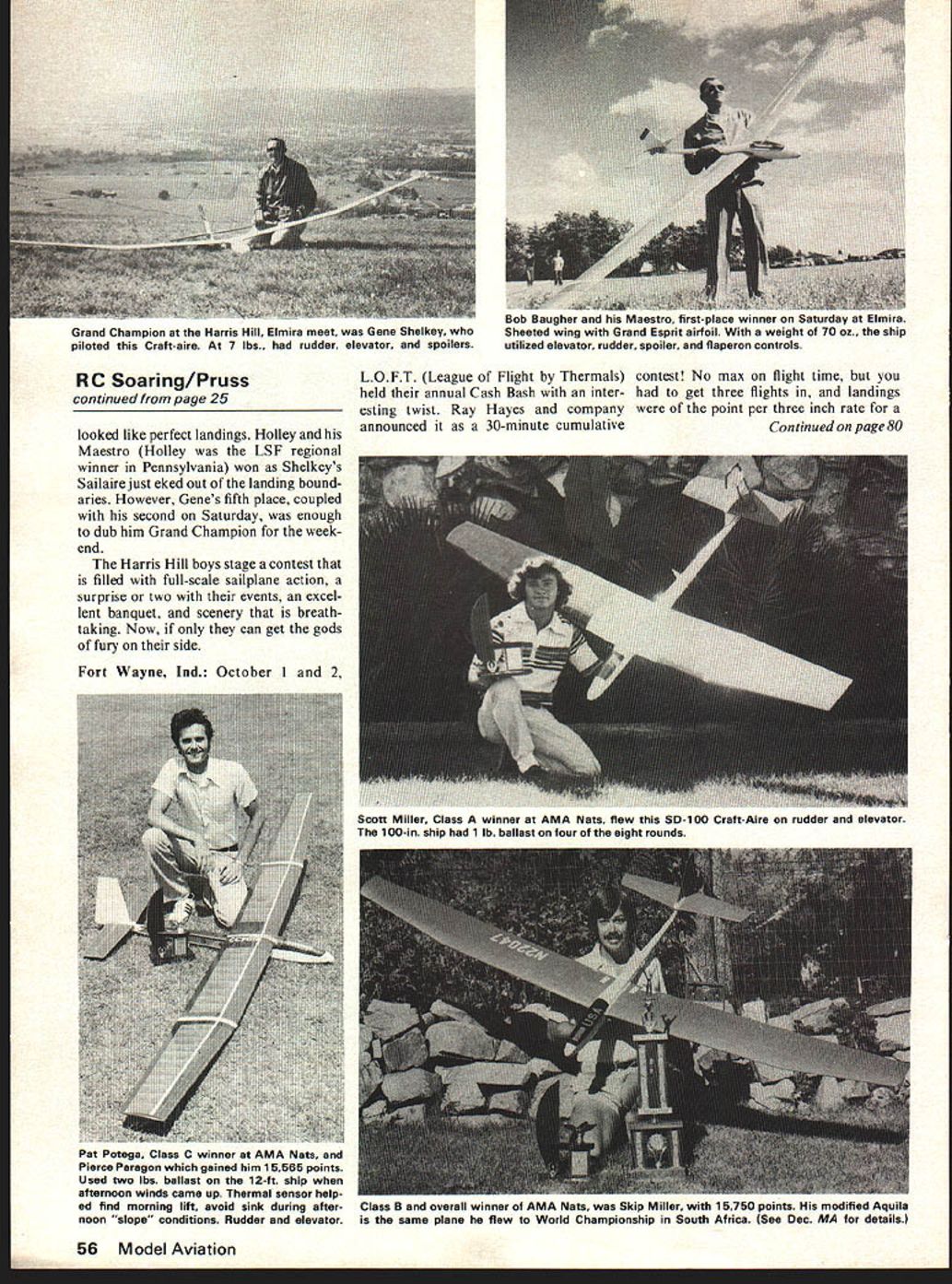
Dick Boltz almost was a giant killer this day. With his two-meter ship of original design, he slew most of the Goliaths of the Unlimited and Standard classes, and proved there just might be a place for two-meter ships. Dick placed third with his Wizard, a 72-in. ship with 560 sq. in. and 32 oz.
A Jr.-Sr., Bob Curry, took top honors with his Aquila, followed by Ed Keck. Fourth and Fifth were determined by a fly-off between Dwight Holley and Gene Shelkey. Both fliers had the time to the second, and both were in the groove for what looked like perfect landings. Holley and his Maestro (Holley was the LSF regional winner in Pennsylvania) won as Shelkey's Sailaire just eked out of the landing boundaries. However, Gene's fifth place, coupled with his second on Saturday, was enough to dub him Grand Champion for the weekend.
The Harris Hill boys stage a contest that is filled with full-scale sailplane action, a surprise or two with their events, an excellent banquet, and scenery that is breathtaking. Now, if only they can get the gods of fury on their side.
Fort Wayne, Ind.: October 1 and 2.
L.O.F.T. (League of Flight by Thermals) held their annual Cash Bash with an interesting twist. Ray Hayes and company announced it as a 30-minute cumulative contest! No max on flight time, but you had to get three flights in, and landings were of the point per three inch rate for a maximum of 100 points. But here was the kicker. Once off the tow the flier flew alone with no helper to spot lift or see how earlier launches were doing. Timers and assistants had to stand well away from the flier and could only give times to the contestant.
The Fort Wayne group contends that the better fliers tend to help the other better fliers, and the "new guy on the block" usually has to go it alone or with the lesser experienced. It was a good idea on L.O.F.T.'s part, but low ceilings had planes launching into overcasts and times were very low. But wouldn't you know it, the only recognizable bubble came through as skies tried to clear, and Jeff Mrlik with his famous Astro-Jeff, and famous Warren Tiahrt with SD-100, got the highest times of the day and won their respective classes. Jeff was just over the 28-minute mark (for three flights), with a 1933 out of a possible 2100 point score, while Tiahrt scored 1576. Second placers were nearly 250 points behind in both classes, and it was a day when "big sailplanes flew better."
Though most clubs aren't in favor of cash prizes for contest awards, it's worth mentioning L.O.F.T.'s approach to their annual Cash Bash. Twenty percent of the entry fees goes to the winner, while ten percent is awarded each to second, third, and fourth place. The remaining 50 percent goes to the club. The more contestants, the bigger the take. Conversely, if attendance is low, so is the prize money, but then the club hasn't stuck out its financial neck for a table full of trophies and hardware. The system has worked for four years now and Jeff Mrlik, who not only won Unlimited class on Saturday, took two firsts on Sunday and went back to Detroit $62 ahead.
San Fernando Valley Silent Flyers: From Blaine Rawdon in California comes a report of a different kind of contest task his club put on this past summer. The object of the contest was to cross the measurement gate at the highest possible altitude, at any time within the allotted time period.
Three or four planes are launched simultaneously and fly to the gate. The pilot declares he is to cross, and two angle measurers, using sighting devices, measure the angles. This normally would be a time-consuming calculation but with a pocket calculator (an HP-21 was used) the problem takes about 15 seconds. Altitude measurement is by the parallax method and is found by calculating for "h" in the diagram below.
The angle measuring apparatus is a rather simple device and a picture will appear in this column next month. Scoring is based on 1000 points to the highest (altitude) flier of the group, while others score a percentage of the winner. More next month about this one.
Seattle, Washington: From the North West Soaring Society's area, contest manager of the Green Lake Soaring Society, Barbara Barker, reports their triathlon had the annual number of fliers griping about poor percentages attained flying the triathlon, not to mention not enough flying time at contests. Dave Banks gave them all the what-for, and he amassed 90 minutes and two seconds of flying time in nine rounds of flying!
It was also reported that a group from Victoria, Canada, is also very much part of the N.W.S.S. and at recent contests has given the troops across the border fits. They also are competing against each other to see who will be the first from outside the USA for LSF level V.
Barbara also goes on to say that each contestant was asked to put his or her birthdate (not year) on the entry forms. She claims that snap conclusions indicate Virgos don't fly and Capricorns leave early after tiring themselves shagging lines!
Can you see a major contest some years from now... "Welcome to the Tenth World Soaring Tournament... All Libras will fly the first heat... Leos the second... Capricorns will time for Scorpios—but not more than once... And now the awards... for the highest score by an Aquarius—in the two-meter class—in the Senior Category—in the low biorhythm category..." Trophy manufacturers will be doing handstands!
Dan Pruss, Route 2, Box 490, Plainfield, IL 60544
Transcribed from original scans by AI. Minor OCR errors may remain.

