
Radio Control: Soaring
Dave Garwood 5 Birch Lane, Scotia NY 12302 E-mail: DaveGarwood@compuserve.com
Soaring Safety
"Aviation in itself is not inherently dangerous. But like seafaring, it is terribly unforgiving of any carelessness, incapacity, or neglect." That old pilot's maxim gives insight into the methodology for making our flying safer: preparation is the key.
The more I fly, the longer my list of safety rules gets. These tips come from my experience and that of pilots with whom I've flown. They are aimed at keeping you in control of your airplane, preserving the model, and averting damage to people and property. I also briefly cover winch safety and Lyme disease.
Preflight Inspection
A thorough preflight will prevent more launch accidents and flight crashes than almost anything else. Full-scale pilots use a written checklist; model fliers should adopt the same discipline.
- Bench-check the airframe before you leave the field. Inspect repaired areas and check for cracks in the wing, fuselage, and empennage.
- Verify servos are mounted securely and control linkages are free-moving and firmly attached.
- Check the tow hook is firm and tight and that hinges are secure.
- After charging batteries, check transmitter and receiver battery-pack voltage with an expanded-scale voltmeter (ESV) that places a load on the circuit. Look for readings consistent with new packs; lower voltage can indicate a weak or dead cell.
- Discard electrical components that show intermittent functioning or other faults. Crashes blamed on radio interference have been traced to loose or worn connectors.
After assembling the airplane at the field, check that all control surfaces move correctly and freely. If in doubt, get a second opinion — a momentary brain cramp here can put your model in the dirt. Grasp a control surface and move it against some resistance to detect loose servos and weak linkages.
A cautionary example: an incidence pin lying on top of an elevator bellcrank once shifted and jammed the elevator; the model crashed right after launch. Two recent launch accidents were caused by elevator reversal when pilots swapped models or copied radio programs incorrectly — both could have been avoided by carefully watching surface movement rather than just wiggling sticks and listening to servos.
Always perform the radio range check according to the manufacturer's instructions. Radio problems get worse aloft.
If you're unfamiliar with the hazards of lead-acid storage batteries, get a briefing from an experienced automobile mechanic or battery dealer.
Winch Safety
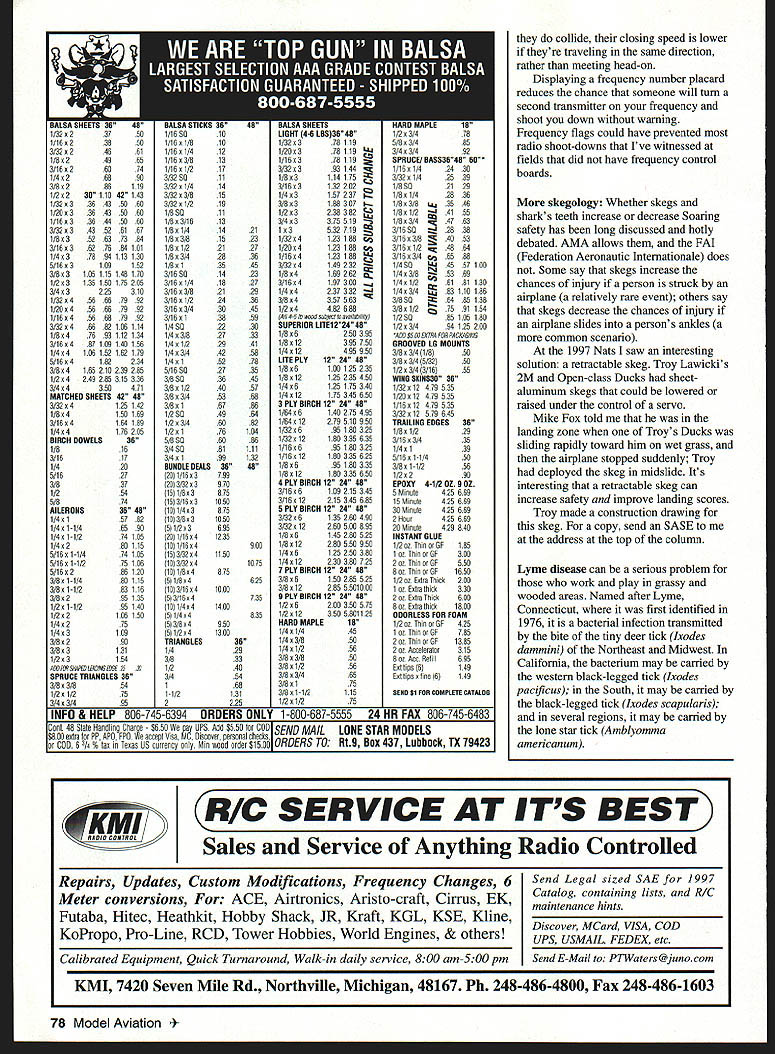
Respect the power generated by the winch motor and the line speed it produces. Electric motors draw more amperage under load; a nearly stalled motor can suffer considerable damage. A runaway winch can pull an airplane into the ground at high speed far quicker than pilots can react.
- Install a heavy-duty motor kill switch in the high-amperage circuit. Automotive starter-type relay switches can fail closed (contacts welding), leaving the motor energized and the foot pedal ineffective. Suitable heavy-duty switches are available at marine and RV dealers. Make sure winch users know where the motor kill switch is and how to operate it.
- Use an "arming switch" in the low-amperage relay circuit to prevent accidentally energizing the winch (for example, stepping on the foot switch while someone is handling the parachute or line). A household wall light switch is suitable for this purpose.
- Wear gloves when handling the line. When fetching the parachute, do not put your finger through the tow ring — fold the parachute and carry it in your closed fist. If the winch is accidentally energized or the line snags, it will pull out of your hand if not properly held.
Launch and Flying Procedures
- Get in the habit of throwing your sailplane vigorously on launch (winch or high-start). Achieving flying speed quickly increases airflow over control surfaces and gives you positive control sooner, allowing faster corrections during the critical launch phase.
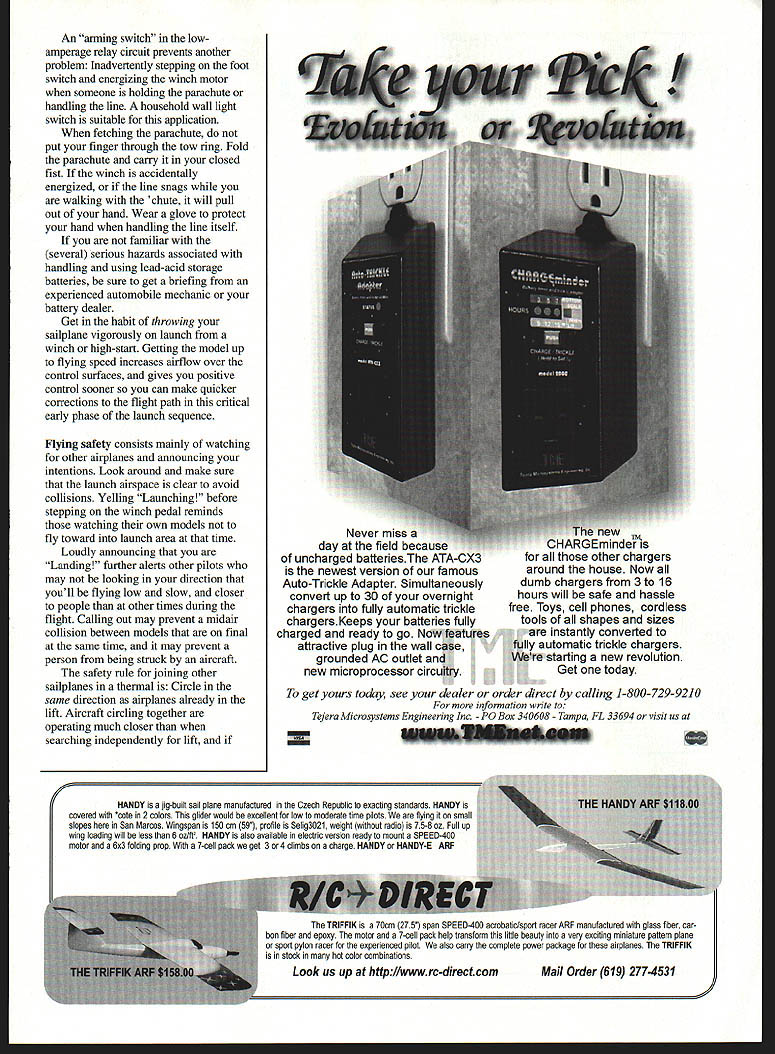
- Watch for other airplanes and announce your intentions loudly. Yell "Launching!" before stepping on the winch pedal so others avoid the launch area. Call out "Landing!" when on final to alert pilots who may not be looking in your direction.
- When joining other sailplanes in a thermal, circle in the same direction as airplanes already in the lift. Aircraft circling together operate much closer than when searching independently for lift. If you must position yourself slightly above the field while landing, do so so as not to cut into the path of others. If they do collide, their closing speed is lower when they are traveling in the same direction rather than meeting head-on.
Frequency Control
Displaying a frequency-number placard reduces the chance someone will turn on a second transmitter on your frequency and shoot you down without warning. Frequency flags could have prevented most radio shoot-downs observed at fields without frequency control boards.
Skegs and Shark's Teeth
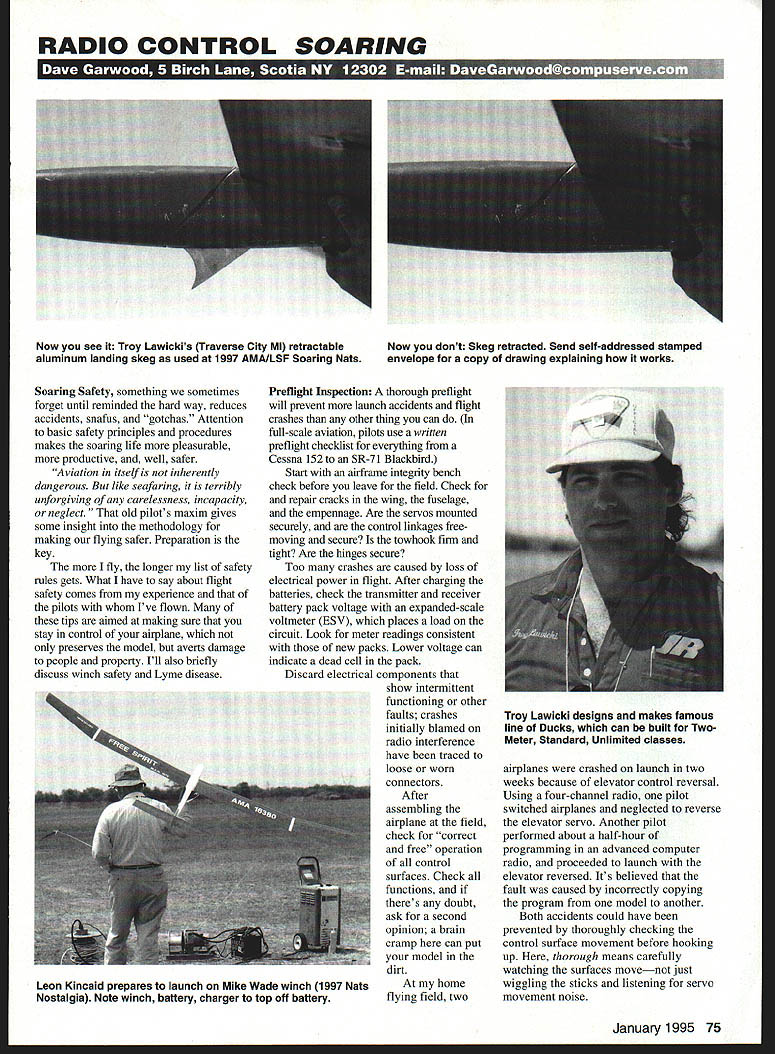
Whether skegs and shark's teeth increase or decrease safety has been long debated. The AMA allows them; the FAI does not. Some argue skegs increase injury risk if a person is struck by an airplane (a rare event); others say skegs reduce injury when an airplane slides into a person's ankles (more common).
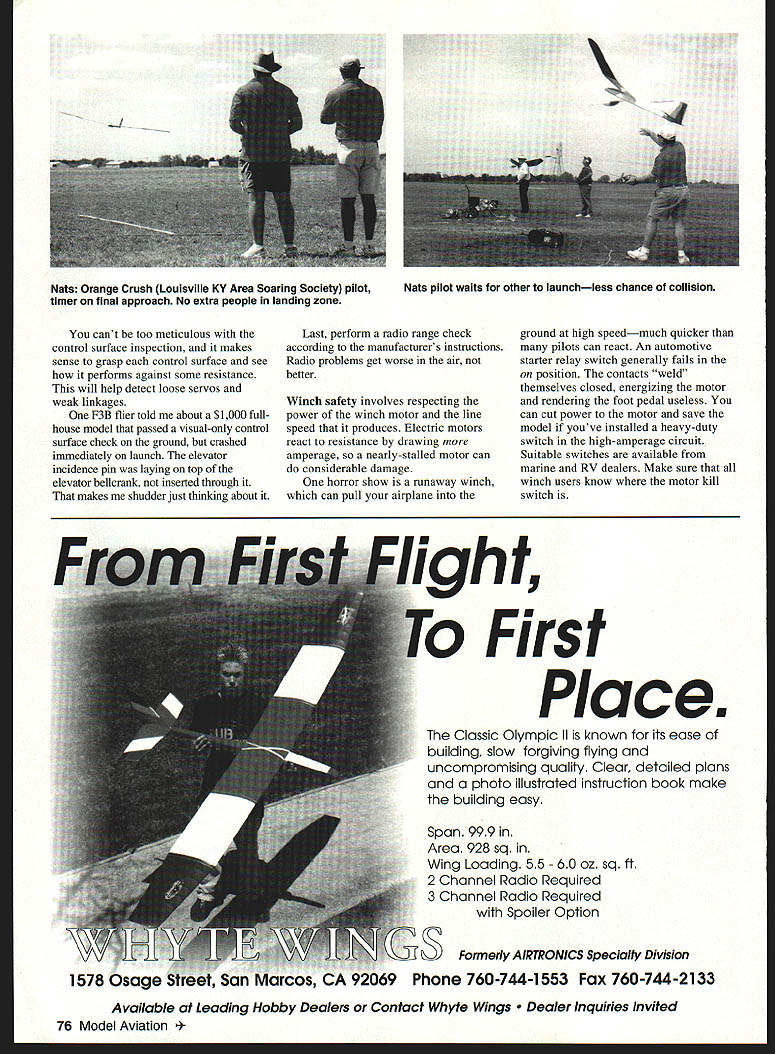
At the 1997 Nats I saw an interesting solution: a retractable skeg. Troy Lawicki's 2M and Open-class Ducks had sheet-aluminum skegs that could be lowered or raised under servo control. Mike Fox reported being in the landing zone when one of Troy's Ducks slid rapidly toward him on wet grass, then stopped suddenly when Troy deployed the skeg mid-slide. A retractable skeg can increase safety and improve landing scores.
For a construction drawing of this skeg, send an SASE to the address at the top of this column.
Lyme Disease
Lyme disease can be a serious problem for those who work and play in grassy and wooded areas. Named after Lyme, Connecticut, where it was first identified in 1976, it is a bacterial infection transmitted by the bite of tiny deer ticks (Ixodes dammini in the Northeast and Midwest). In California it may be carried by the western black-legged tick (Ixodes pacificus); in the South by the black-legged tick (Ixodes scapularis); and in some regions by the lone star tick (Amblyomma americanum).
- Early symptoms may include a red skin rash, fatigue, mild headache, muscle and joint pain or stiffness, slight fever, or swollen glands. Anyone who has had a tick bite followed by these symptoms should see a physician; treatment at this stage is usually effective.
- If untreated, the rash may spread for several weeks then fade. Sometimes nothing further happens, but advanced disease can affect the heart, nervous system, or joints. These stages are treatable with antibiotics but are more difficult to resolve.
- Prevent infection by wearing protective clothing, applying insect repellant, and checking your body after coming indoors. Pay attention to hidden and hairy areas: scalp, groin, armpits, and backs of knees. The deer tick is much smaller than common wood or dog ticks — about the size of a pinhead. Most ticks do not carry Lyme disease.
- If you find a tick, remove it by pulling gently with tweezers and swab the area with alcohol. Transmission typically requires 24–36 hours of attachment, so prompt removal reduces risk.
Prevention and treatment information is available from:
- your state health department;
- the Lyme Disease Foundation, 18th Floor, 1 Financial Plaza, Hartford CT 06103; Tel.: 1-800-886-LYME;
- the American Lyme Disease Foundation, Mill Pond Offices Suite 204, 293 Route 100, Somers NY 10589; Tel.: 1-800-876-LYME or 914-277-6970.
Review Lyme disease brochures to see photographs of the ticks and the characteristic "bull's-eye" rash that appears in about 80% of infections.
Live to fly. Fly to live.
Transcribed from original scans by AI. Minor OCR errors may remain.

