
Radio Control: Soaring
Dave Garwood 5 Birch Lane, Scotia NY 12302 E-mail: DaveGarwood@compuserve.com
This is the first of a two-column set of basic information and resources for beginning RC sailplane aerotowing.
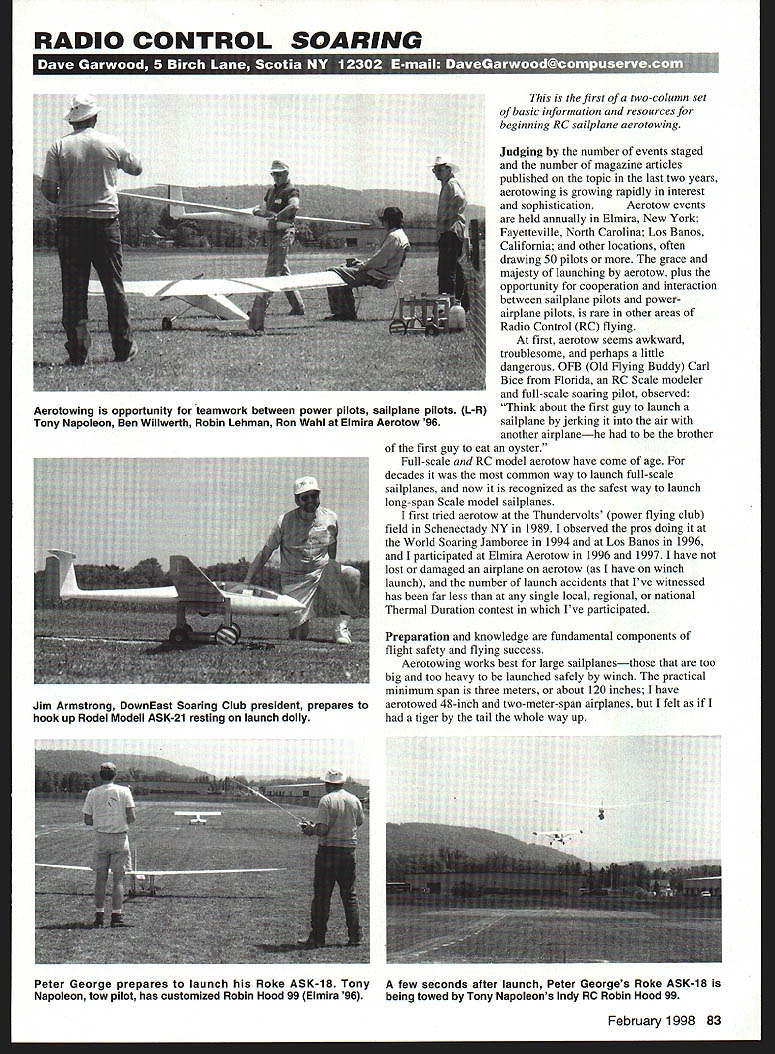
Judging by the number of events staged and the number of magazine articles published on the topic in the last two years, aerotowing is growing rapidly in interest and sophistication. Aerotow events are held annually in Elmira, New York; Fayetteville, North Carolina; Los Banos, California; and other locations, often drawing 50 pilots or more. The grace and majesty of launching by aerotow, plus the opportunity for cooperation and interaction between sailplane pilots and power‑airplane pilots, is rare in other areas of Radio Control (RC) flying.
At first, aerotow seems awkward, troublesome, and perhaps a little dangerous. Old Flying Buddy (OFB) Carl Bice from Florida, an RC scale modeler and full‑scale soaring pilot, observed: "Think about the first guy to launch a sailplane by jerking it into the air with another airplane—he had to be the brother of the first guy to eat an oyster."
Full‑scale and RC model aerotow have come of age. For decades it was the most common way to launch full‑scale sailplanes, and now it is recognized as the safest way to launch long‑span scale model sailplanes.
I first tried aerotow at the Thundervolts field (a power flying club) in Schenectady, NY, in 1989. I observed the pros doing it at the World Soaring Jamboree in 1994 and at Los Banos in 1996, and I participated at Elmira Aerotow in 1996 and 1997. I have not lost or damaged an airplane on aerotow (as I have on winch launch), and the number of launch accidents that I've witnessed has been far less than at any single local, regional, or national Thermal Duration contest in which I've participated.
Preparation and knowledge are fundamental components of flight safety and flying success.
Aerotowing works best for large sailplanes—those that are too big and too heavy to be launched safely by winch. The practical minimum span is three meters (about 120 inches); I have aerotowed 48‑inch and two‑meter‑span airplanes, but I felt as if I had a tiger by the tail the whole way up.
Beginning aerotow launches generate enough jitters; introducing an unfamiliar sailplane or an unfamiliar tow pilot makes success less likely. The tow pilot must be a smooth, accomplished flier with substantial flight time in the tow aircraft. The sailplane pilot can be anyone who can confidently handle a large‑aileron sailplane.
Sailplane preparation
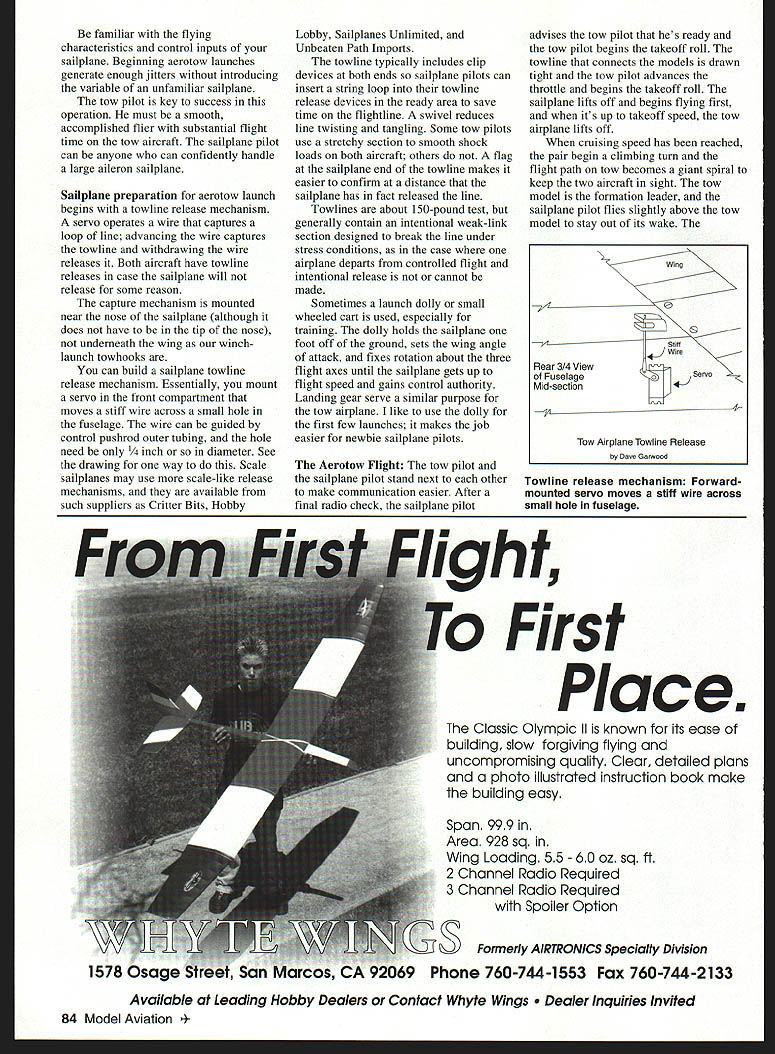
An aerotow launch begins with the towline release mechanism. A servo‑operated wire captures a loop in the line; advancing the wire captures the towline, withdrawing the wire releases it. Both aircraft have towline releases. In case the towline must be released, the capture mechanism on the sailplane is usually mounted near the nose, although scale types may have a tip‑nose or a hook mounted under the wing. Winch‑launch tow hooks can also be used.
You can build a sailplane towline release mechanism by mounting a servo in the front compartment and moving a stiff wire across a small hole in the fuselage. The wire can be guided by the control pushrod and outer tubing. The hole need only be about 1/4‑inch diameter.
Scale sailplanes may use scale‑like release mechanisms available from suppliers such as Critter Bits, Hobby Lobby, Sailplanes Unlimited, and Unbeaten Path Imports.
Towlines typically include clip devices on both ends so sailplane pilots can insert a string loop into the towline release device, ready in the area to save time at the flightline. A swivel reduces line twisting and tangling. Some tow pilots use a stretchy section to smooth shock loads between the two aircraft; others flag the sailplane end of the towline to make it easier to confirm distance and to verify that the sailplane has in fact released the line.
Towlines of about 150‑pound test generally contain an intentional weak‑link section designed to break under stress conditions in case the airplane departs controlled flight and an intentional release cannot be made.
Sometimes a launch dolly—a small wheeled cart—is used, especially in training. The dolly holds the sailplane's skid or wheel off the ground, sets the wing angle of attack, and fixes rotation about the three flight axes until the sailplane gets up to flying speed and gains control authority. Landing gear serve a similar purpose on tow airplanes. I like to use a dolly for the first few launches; it makes the job easier for a newbie sailplane pilot.
The Aerotow Flight
The tow pilot and the sailplane pilot stand next to each other to make communication easier. After a final radio check, the sailplane pilot advises the tow pilot that he's ready and the tow pilot begins the takeoff roll. The towline connecting the models is drawn tight as the tow pilot advances the throttle and begins the takeoff roll. The sailplane lifts off and begins flying first, and when it's up to takeoff speed the tow airplane lifts off. When cruising speed has been reached, the pair begin a climbing turn and the flight path on tow becomes a giant spiral to keep the two aircraft in sight. The tow model is the formation leader, and the sailplane pilot flies slightly above the tow model to stay out of its wake.
The towplane flies larger‑radius turns than the sailplane to keep the towline taut.
Following a tow airplane is substantially easier with an aileron sailplane that has a separate (uncoupled) rudder than it is with a polyhedral model. The main job of the sailplane pilot is to keep the wings level and maintain the correct height above the tow airplane. The tow line will yaw the sailplane, and banking in turns is not needed. Sometimes outside rudder is needed on the sailplane to keep the towline taut.
While on tow, your sailplane will be flying faster than it does on its own—much faster. Be prepared for the snappy control responses and its newfound ability to get out of position quickly. If you have high‑wind slope experience or power flying experience, this will not be a surprise. In any case, stay alert while on tow and fly the airplane; don’t let the airplane fly you.
The two models may circle several times until the desired release altitude is attained. At this point, the sailplane pilot declares that he is ready to release, hits the release switch on his transmitter, drops the line, and announces to the tow pilot when he is off the towline. The tow pilot dives away from the sailplane, quickly loses altitude, lands, and sets up for the next tow. The sailplane pilot begins the search for lift or begins an aerobatic routine.
The result of this teamwork is a sailplane launch that is higher, gentler, and more aesthetic than a winch launch or a bungee launch. The capability of this method to put your sailplane in any part of the sky, at any desired altitude, makes you want to try it again.
Next month I’ll discuss tow airplane selection and preparation and the tow pilot’s part of the flight.
Resources
Aerotowing is a fascinating, serious, somewhat complex endeavor. People who have more experience than I do have written 4,000‑word articles about it. To learn more, see:
- Robin Lehman’s treatment of the topic in Sailplane & Electric Modeler (S&EM), Vol. 2, No. 2 and Vol. 2, No. 3, and Robin’s columns. Some of Robin’s articles appear on the Sailplanes Unlimited web site: www.sailplanes.com
- John Derstine’s articles in recent issues of R/C Soaring Digest (RCSD)
- Simon Cocker’s article in the June/July 1996 Quiet Flight International (QFI)
- For clear drawings of towline release mechanisms for sailplanes and tow airplanes, see Asher Carmichael’s article in the June 1996 RCSD and John Derstine’s web site: www.geocities.com/CapeCanaveral/Lab/5739
- Lee Murray has prepared an index to RCSD articles; it’s available for download from Bill and Bunny Kuhlman’s website: www.halcyon.com/bsquared/RCSD.html
To get back issues or subscriptions to these specialty publications, contact the publishers at the following addresses:
- R/C Soaring Digest
Box 2108 Wylie, TX 75098-2108 (972) 442-3910 E-mail: rcsdigest@aol.com
- Sailplane & Electric Modeler
Box 4267 W. Richland, WA 99353 (509) 627-0456 E-mail: wilbyers@aol.com
- Quiet Flight International
Traplet Publications, Ltd., Traplet House Severn Drive Upton-upon-Severn, Worcestershire WR8 0JL United Kingdom E-mail: qfijd@waverider.co.uk
Closing Quote
“Anyone who stops learning is old, whether at 20 or 80. Anyone who keeps learning stays young. The greatest thing in life is to keep your mind young.” — Henry Ford
Transcribed from original scans by AI. Minor OCR errors may remain.

