
RADIO CONTROL SOARING
Dave Garwood 5 Birch Lane, Scotia NY 12302 E-mail: DaveGarwood@compuserve.com
This is the second of two columns on aerotowing, and it gives basic information about preparing and flying the tow airplane. I have not flown one myself, so I present the experiences of other pilots.
First are suggestions for the fuel-power tow pilot. I am indebted to John Derstine of the Harris Hill L/D Club, Elmira NY, and Robin Lehman of Sailplanes Unlimited for the material about fuel-power tow airplanes. I can say from being towed by these guys that they know what they're doing.
A tow pilot must be experienced in all phases of Radio Control (RC) flight and be familiar with his or her tow airplane; it's helpful if the pilot has flown sailplanes. The pilot must be able to fly large, smooth circles while towing a sailplane at a steady rate of climb until both airplanes are nearly out of sight.
Sound easy? It's not. Practice is important. Each sailplane tows differently, and elevator trim on the tug has to be adjusted accordingly. The pilot's experience will allow them to not only fly their own airplane, but to look out for the sailplane pilot, who will often have less flight time.
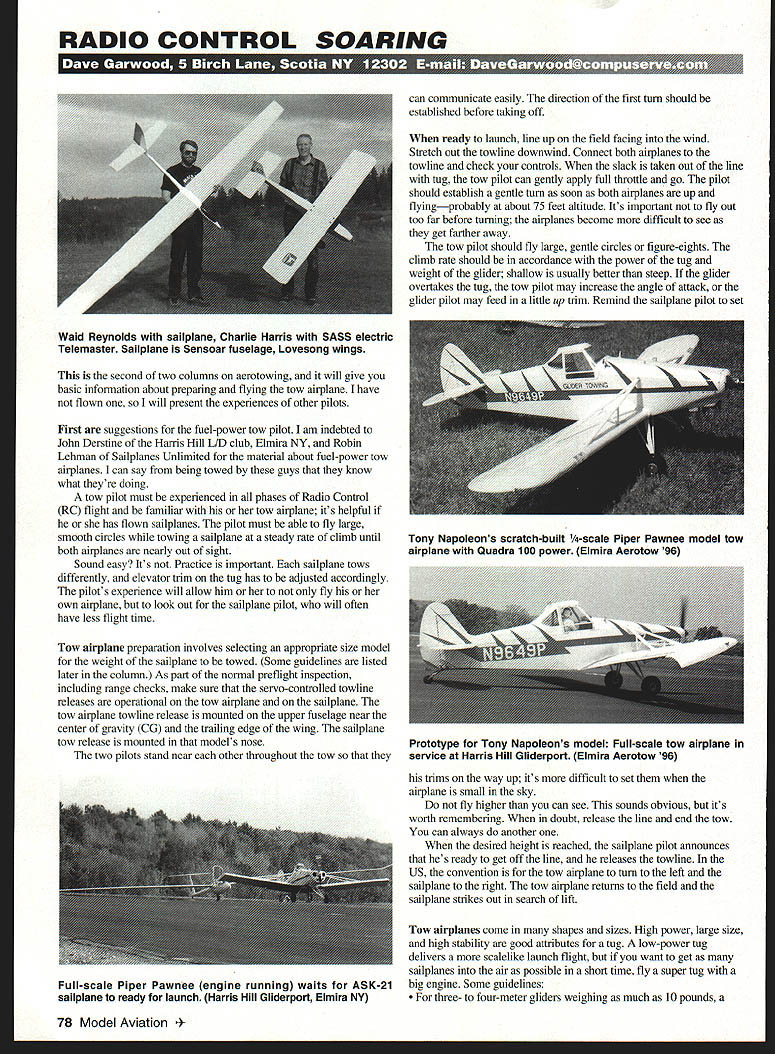
Tow airplane preparation involves selecting an appropriate size model for the weight of the sailplane to be towed (some guidelines are listed later). As part of the normal preflight inspection, including range checks, make sure that the servo-controlled towline releases are operational on the tow airplane and on the sailplane. The tow-airplane towline release is mounted on the upper fuselage near the center of gravity (CG) and the trailing edge of the wing. The sailplane tow release is mounted in the model's nose.
The two pilots stand near each other throughout the tow so they can communicate easily. The direction of the first turn should be established before taking off.
When ready to launch, line up on the field facing into the wind. Stretch out the towline downwind. Connect both airplanes to the towline and check your controls. When the slack is taken out of the line with the tug, the tow pilot can gently apply full throttle and go. The pilot should establish a gentle turn as soon as both airplanes are up and flying—probably at about 75 feet. It's important not to fly out too far before turning; the airplanes become more difficult to see as they get farther away.
The tow pilot should fly large, gentle circles or figure-eights. The climb rate should be in accordance with the power of the tug and weight of the glider; shallow is usually better than steep. If the glider overtakes the tug, the tow pilot may increase the angle of attack, or the glider pilot may feed in a little up trim. Remind the sailplane pilot to set trims on the way up; it's more difficult to set them when the airplane is small in the sky.
Do not fly higher than you can see. When in doubt, release the line and end the tow. You can always do another one.
When the desired height is reached, the sailplane pilot announces that he's ready to get off the line and releases the towline. In the U.S., the convention is for the tow airplane to turn to the left and the sailplane to the right. The tow airplane returns to the field and the sailplane strikes out in search of lift.
Tow airplanes come in many shapes and sizes. High power, large size, and high stability are good attributes for a tug. A low-power tug delivers a more scale-like launch flight, but if you want to get as many sailplanes into the air as possible in a short time, fly a super tug with a big engine.
Some guidelines:
- For three- to four-meter gliders weighing as much as 10 pounds, a generic Telemaster-type airframe with a .35 BGX-1/35cc two-stroke is easy to fly, relatively inexpensive, and dependable.
- For four- to six-meter sailplanes weighing 10–25 pounds, a minimum Telemaster with a 35cc glow engine up to a 70cc gasoline engine is suitable; tugs in this class typically weigh 25–30 pounds and develop similar static thrust.
- For larger, 1/4-scale and full-scale models (six meters and larger) weighing 35–50 pounds, use higher-displacement gasoline engines (for example, 100cc class) or large four-strokes to provide the required static thrust.
Note about propellers: you can spend much time and money trying different propeller combinations to get the best static thrust/engine performance for the tug. A good rule for aerotowing is to use the highest-pitch prop that will let your engine produce the most static thrust, which usually translates to an 8- or 10-pitch prop in the upper end of diameters for your engine. John has also tried multiblade props and has found that some work well and some do not. A happy tow airplane delivers a 1:1 or better power-to-weight ratio.
For further information about tow airplanes and aerotowing in general, contact Robin Lehman at (212) 879-1634 or robin@sailplanes.com, or John Derstine at (717) 596-2392 or johnderstine@postoffice.ptd.net.
An electric tug was built by a small group of Seattle Area Soaring Society (SASS) members who wanted to try aerotowing on a field where internal combustion engines are not allowed. Charlie Harris built the Hobby Lobby Telemaster 60 wing; John Oberto built the horizontal and vertical tail; Jim Thomas built the fuselage and installed the electronics; and Don Bailey covered the airplane.
Originally, a geared AstroFlight 25 motor was used on the tug to test the concept. It worked, but climb rate was lower than desired. With a geared Astro 40 running on 20 cells, the Telemaster 60 has proven itself to be an excellent tow airplane and a good airplane to fly for fun. SASS is considering a larger and more powerful airplane for 1/4- and 1/3-scale sailplanes; perhaps a twin-40 Senior Telemaster with 40 cells would meet that need.
The tug tow release is on top of the airplane near the CG. Flaps are used for better approach control. This Telemaster will tow gliders up to six pounds, but will make only one good high tow on a battery charge. With lighter gliders, such as the Olympic II, SASS gets two high tows per charge. With a fast field charger and three battery packs, they can tow all day.
SASS uses a towline made of braided winch line about 75 feet long with a loop tied in each end. A bungee is neither employed nor needed. A cloth streamer tied a few feet in front of the glider end of the line allows the glider pilot to see when the line is released. SASS members reported that towing turned out to be easy. The glider pilot must keep the wings fairly level and the tug will drag the glider behind with little effort.
Some of the gliders are hand-launched because they have shark’s teeth on the nose. Glider HL works fine. The launch person has to adjust his speed to keep a little slack in the line as the tug accelerates, then toss the glider when adequate speed is achieved. SASS is experimenting with a launch dolly for the sailplane.
Specifications of the SASS electric tug:
- Airplane: Hobby Lobby Telemaster 60 (6-foot wingspan)
- Flying weight: 10 pounds
- Motor: Astro Cobalt 40, geared
- Motor controller: AstroFlight 205
- Batteries: (2) N-1400 mAh SCR
- Servos and radio: Airtronics
- Propeller: Master Airscrew Electric 13 x 8
For more electric-tug information, contact Charlie Harris via E-mail at DACEH@aol.com. On page 33 of the November 1997 Model Aviation is a photo of Etienne Dorig and Alex Wenzel preparing to aerotow with an electric Cub. Etienne has also agreed to answer questions about electric aerotowing. You may E-mail him at ICARE@botsonline.com or call him at (514) 449-9094.
Resources:
- Aero-Towing
John Clarke The Creative Image of New Hyde Park 911 Covert Ave. New Hyde Park, NY 11040 $19.95, shipping and handling included PAL or Secam formats also available at extra charge (516) 775-4780 E-mail: TCI@ix.netcom.com
- Elmira Aerotow ’96
John Derstine RD 3 Box 366 Gillette, PA 16925 $19.95 + $3 shipping and handling E-mail: johnderstine@postoffice.ptd.net
Transcribed from original scans by AI. Minor OCR errors may remain.

