
RADIO CONTROL SOARING
Dave Garwood 5 Birch Lane, Scotia NY 12302 E-mail: DaveGarwood@compuserve.com
The Inventec Pelikan has been enthusiastically discussed on the Internet RC (Radio Control) Soaring Exchange, and has received enough rave comments that I'm starting to think it may be a breakthrough sailplane.
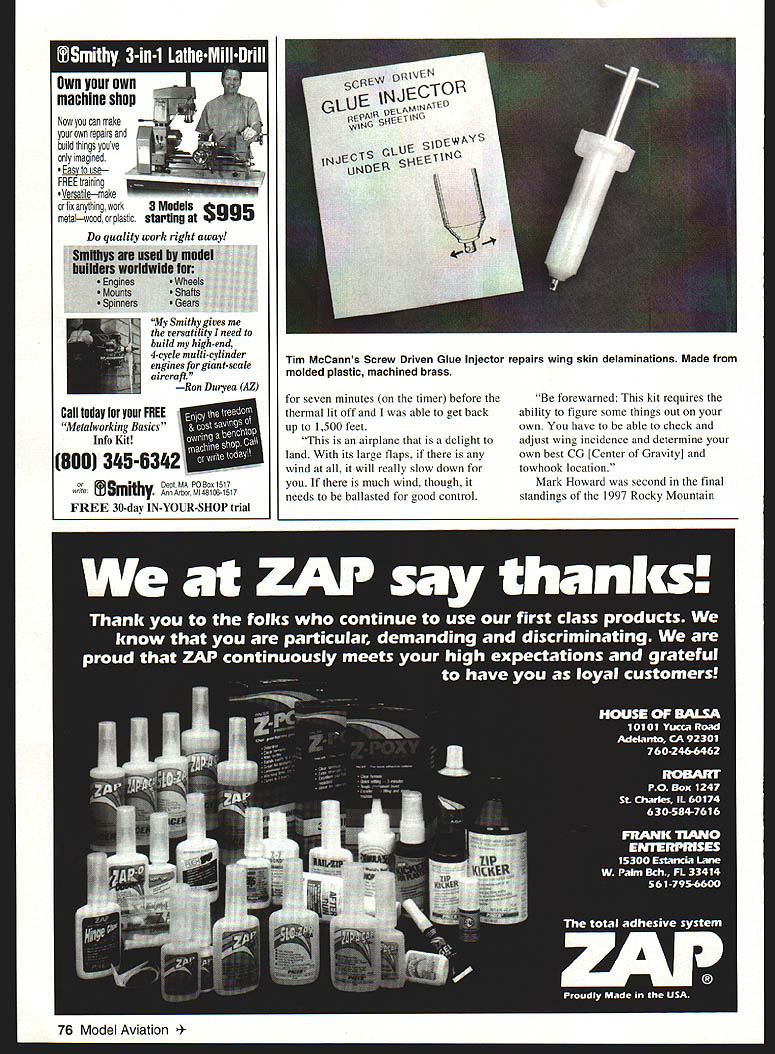
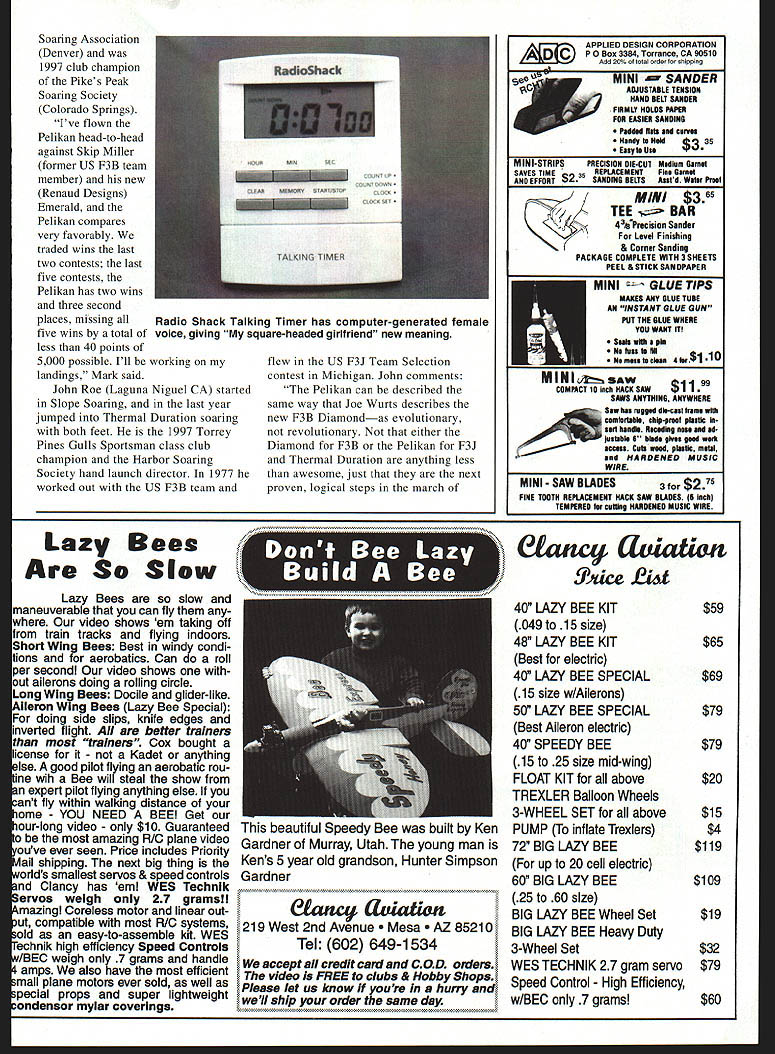
I had a chance to briefly fly two Pelikans: the first belonged to Mark Howard, who was kind enough to let three of us fly his model from a hi-start late one afternoon at the 1997 Nationals (at the AMA flying site, Muncie IN). Gordy Stahl (Louisville Area Soaring Society, KY) went first.
"Gordy's landing. He's high. Going long. What's he doing? Catch..." Mark's heart stopped. I know because it was beating very loud before, said Steve Siebenaler (North Alabama Silent Flyers, Huntsville). Then Steve flew the model and summarized his impressions.
"My flight of Mark's Pelikan was my first of that breed. After flying my 88-ounce lead-sled Peregrine earlier that day in Unlimited, I equated the Pelikan to flying an Olympic II with the added benefit of maneuverability. The plane was flying as slow as I ever have seen. L/D [lift-to-drag ratio] was tremendous."
Finally I took the sticks, and even though we were working below 300 feet, the airplane felt marvelously maneuverable and completely controllable. On my first launch I rolled inverted and flew a figure-eight pattern. Airspeed was minimal when the model got down to the 80-foot level, but the Pelikan pulled out inverted smoothly with a half-loop and finished with a one-handed catch.
Gordy summarized the flying session: "Most would say that it's impossible to catch a big airplane with your bare hands, but with this Pelikan you can do it with one hand tied behind your back. Three of us proved it on our first flights!"
Mark was calm throughout our hijinks with his new model. It's hard to say whether he had confidence in the airplane or in the pilots, but he displayed maximum imperturbability. Thanks, Mark, for the stick time, and sorry for the new gray hairs.
While snappy aerobatic performance is not a primary design goal, nor the most important characteristic of an Open-class Thermal Duration sailplane, there are two strong reasons why smooth positive control and instant responsiveness are important in thermal flying.
First is control on launch; gusts or poor release technique can get a sailplane "out of shape" on tow, and strong control response can often save it from disaster.
Second is flying in lift. Coring the thermal—finding its hot, high-lift center—is made easier with a nimble airplane. Fine adjustments to the circling flight path as the airplane encounters head wind and tail wind are simpler with smooth control response. This is apparent with Hand-Launched Gliders (HLG) and partly explains the trend toward four-servo HLGs, but it's just as important in the big models.
On the return trip from Muncie, I got another chance to fly a Pelikan—this time at an Eastern Soaring League contest put on by the Millstone Valley Soaring Club at their Allentown, NJ flying site. Designer Mike Popescu let me fly his personal airplane. It was smooth and responsive—a tremendously fun sailplane to fly. In the windy conditions I didn't catch a thermal. Reports on the Pelikan's soaring performance come from the West.
Carl Otto (Mill Valley, CA) was overall runner-up for 1997, missing the Sacramento Valley Soaring Society championship by only a few points. He is relatively new to Thermal Duration competition and credits part of his rapid skill advancement to the Pelikan. Carl offers these observations on the design:
"This is the best flying thermal ship I have owned. It performs slow, flat turns without tip-stalling, giving confidence to go for those developing thermals. On one flight I was able to maintain an altitude of about 40 feet in very light lift for seven minutes (on the timer) before the thermal lit off and I was able to get back up to 1,500 feet.
"This is an airplane that is a delight to land. With its large flaps, if there is any wind at all, it will really slow down for you. If there is much wind, though, it needs to be ballasted for good control.
"Be forewarned: this kit requires the ability to figure some things out on your own. You have to be able to check and adjust wing incidence and determine your own best CG (center of gravity) and towbook location."
Mark Howard was second in the final standings of the 1997 Rocky Mountain Soaring Association (Denver) and was 1997 club champion of the Pike's Peak Soaring Society (Colorado Springs).
"I've flown the Pelikan head-to-head against Skip Miller (former US F3B team member) and his newest (Renaud Designs) Emerald, and the Pelikan compares very favorably. We traded wins the last two contests; the last five contests, the Pelikan has two wins and three second places, missing all five wins by a total of less than 40 points of 5,000 possible. I'll be working on my landings," Mark said.
John Roe (Laguna Niguel, CA) started in Slope Soaring, and in the last year jumped into Thermal Duration soaring with both feet. He is the 1997 Torrey Pines Gulls Sportsman class club champion and the Harbor Soaring Society hand launch director. In 1977 he worked out with the US F3B team and flew in the US F3J Team Selection contest in Michigan. John comments:
"The Pelikan can be described the same way that Joe Wurts describes the new F3B Diamond—as evolutionary, not revolutionary. Not that either the Diamond or F3B or the Pelikan for F3J and Thermal Duration are anything less than awesome, just that they are the next proven, logical steps in the march of sailplane design."
The Pelikan has a large wingspan (big airplanes fly better), and is very light and strong (composite building techniques continue to advance). It uses a planform and airfoil designed to work together in ways only recently understood. The SD7080 airfoil is one of several that have a wide speed range now really beginning to catch on in the US. The advantages of these airfoils are that they launch higher and range farther than the venerable SD7037, while still working the lightest of lift. In Europe, where hand-tow has been flown for years, faster and higher launches are of prime importance, as the time on tow is working time lost from your round.
In the US, and especially on the West Coast, making flight times is not usually a problem, while making incredibly precise landings is important. Just the opposite is true in European F3J thermal duration, where times are either 10 or 15 minutes, and the landing task is relatively easy. This led to US airplanes being smaller and more maneuverable "spot-landers," which have higher sink rates. Now with advances in design, airplanes like the Pelikan let you have it all: incredible dead-air hang time, and with proper mixing and setup, very precise and nimble spot-landing capabilities.
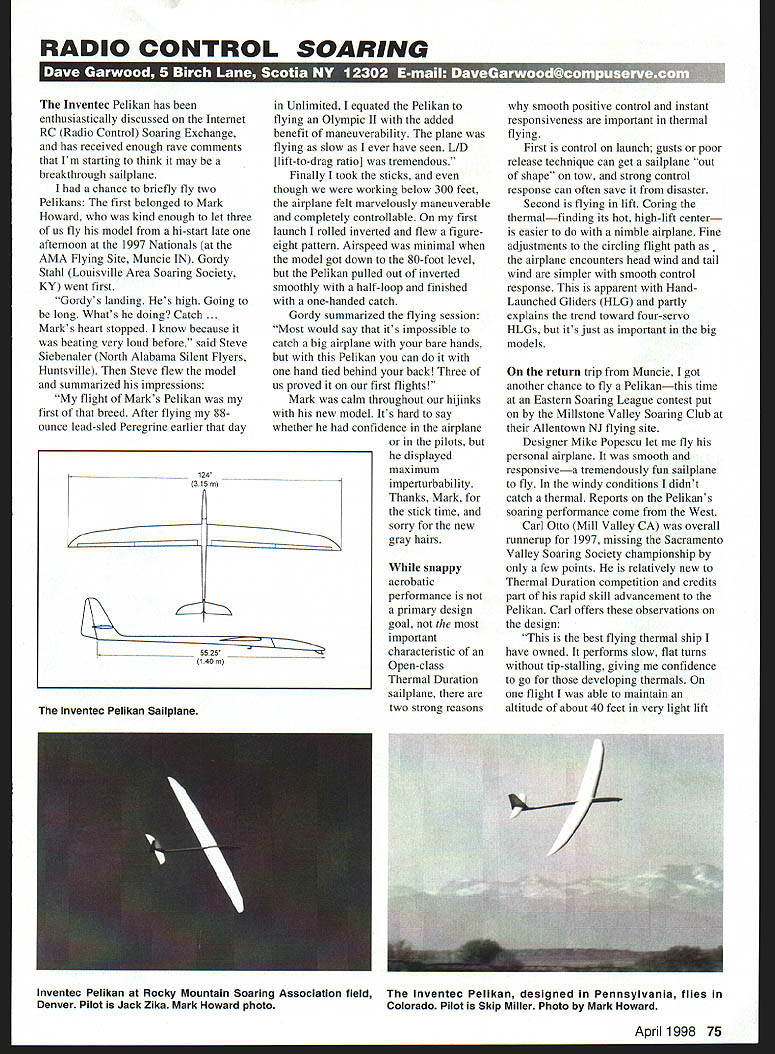
For more information on this 124-inch span, 62–70 ounce, full-house competition machine, contact Inventec Corporation, 808 David Drive, Trevose PA 19053; Tel.: (215) 953-1736. E-mail: MPopescu@dynanet.com. Inventec has an unusual warranty; it will replace a fuselage or one wing panel, regardless of the cause of failure, within one year of purchase.
Cool Tools:
- Radio Shack Talking Timer
Radio Shack offers a Talking Timer with a "computer" female voice that speaks several of the timing functions; it's useful for practicing contest tasks without the help of a human timer. The hand-held device reads out to an LCD (Liquid Crystal Display) showing hours, minutes, and seconds, and it includes a regular clock that can be set to display time of day and announces the time audibly at the press of a button.
The timer counts down for 24 hours, and when it reaches zero it counts up for 24 hours. The voice is not available in the count-up mode, but the countdown mode talks as the timer continues past 00:00:00, speaking the time elapsed for a contest time slot or a long-task LSF.
The Talking Timer is designed for bench use and has small buttons; it does not claim water resistance, but has a stand, a pocket clip, and a magnet for mounting flexibility. In addition to flight timing, it's useful for keeping track of epoxy pot life. It's available from the Radio Shack Catalog (Number 61-877) for $16.95.
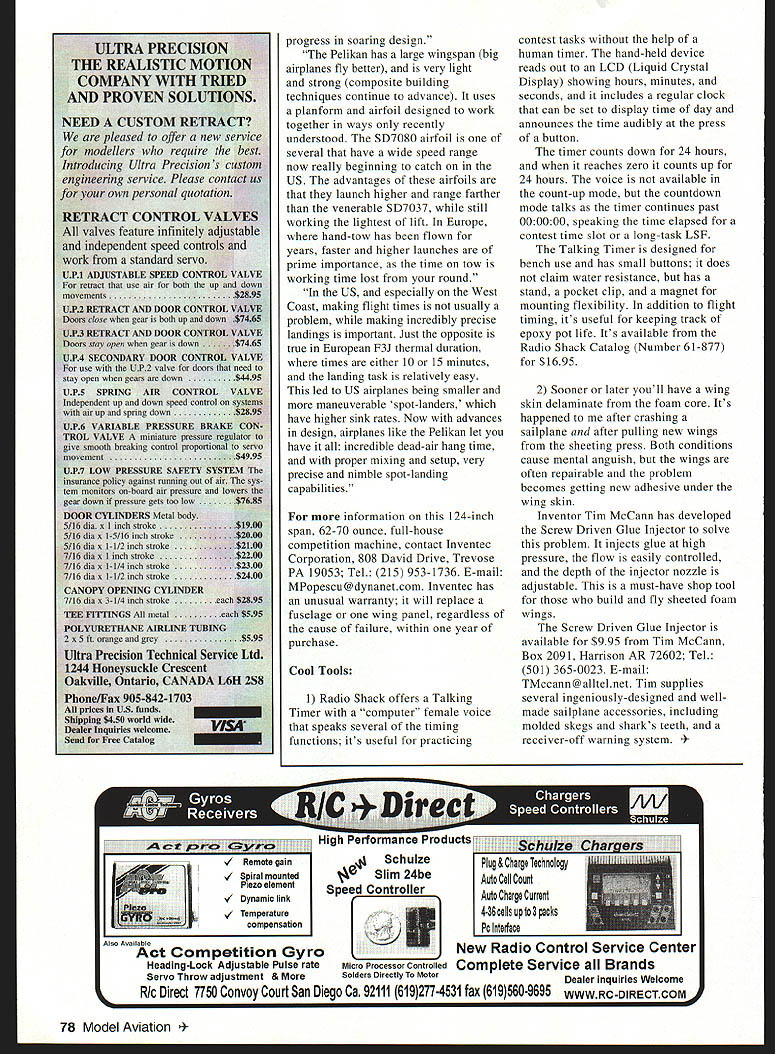
- Screw Driven Glue Injector
Sooner or later you'll have a wing skin delamination from the foam core. It's happened to me after crashing a sailplane and after pulling new wings from the sheeting press. Both conditions cause the adhesive to separate, but the wings are often repairable and the problem becomes getting new adhesive under the wing skin.
Inventor Tim McCann has developed the Screw Driven Glue Injector to solve this problem. It injects glue at high pressure, the flow is easily controlled, and the depth of the injector nozzle is adjustable. This is a must-have shop tool for those who build and fly sheeted foam wings.
The Screw Driven Glue Injector is available for $9.95 from Tim McCann, Box 2091, Harrison AR 72602; Tel.: (501) 365-0023. E-mail: TMcCann@alltel.net. Tim supplies several ingeniously designed and well-made sailplane accessories, including molded skegs and shark's teeth, and a receiver-off warning system.
Transcribed from original scans by AI. Minor OCR errors may remain.

