
Radio Control: Soaring
Dave Garwood 5 Birch Lane, Scotia NY 12302 E-mail: DaveGarwood@compuserve.com
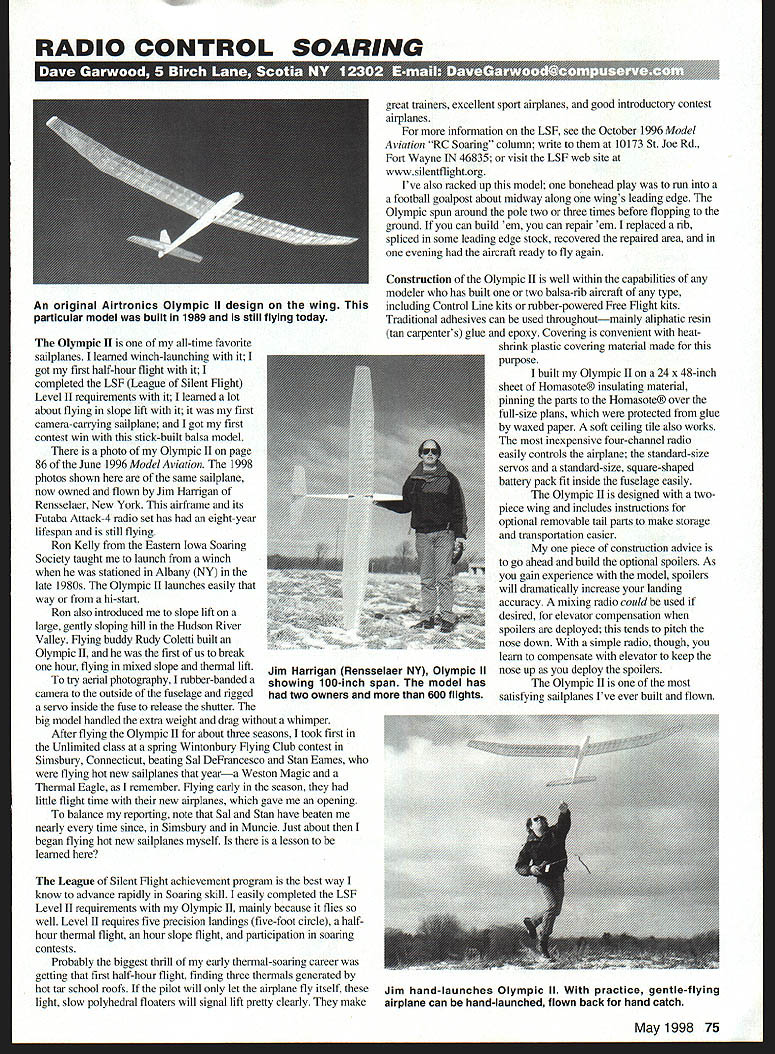
The Olympic II is one of my all-time favorite sailplanes. I learned winch-launching with it; I got my first half-hour flight with it; I completed the LSF (League of Silent Flight) Level II requirements with it; I learned a lot about flying in slope lift with it; it was my first camera-carrying sailplane; and I got my first contest win with this stick-built balsa model.
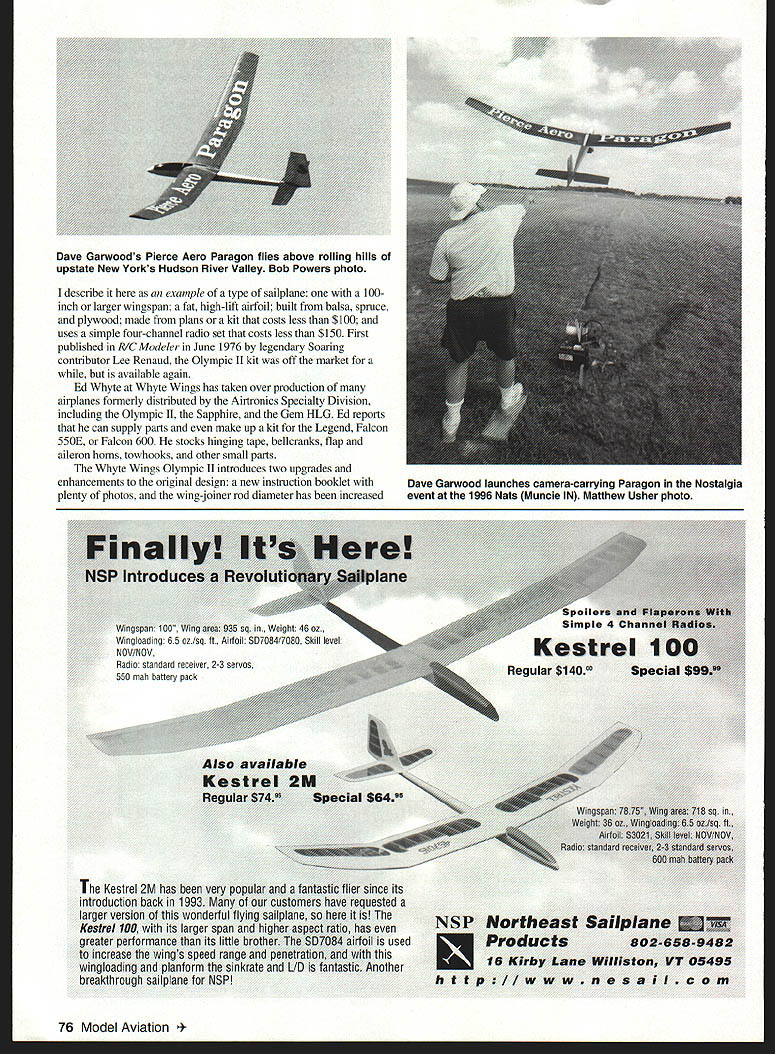
There is a photo of my Olympic II on page 86 of the June 1996 Model Aviation. The 1998 photos shown with this article are of the same sailplane, now owned and flown by Jim Harrigan of Rensselaer, New York. This airframe and its Futaba Attack-4 radio set have had an eight-year lifespan and are still flying.
Learning to Winch-Launch and Slope Soar
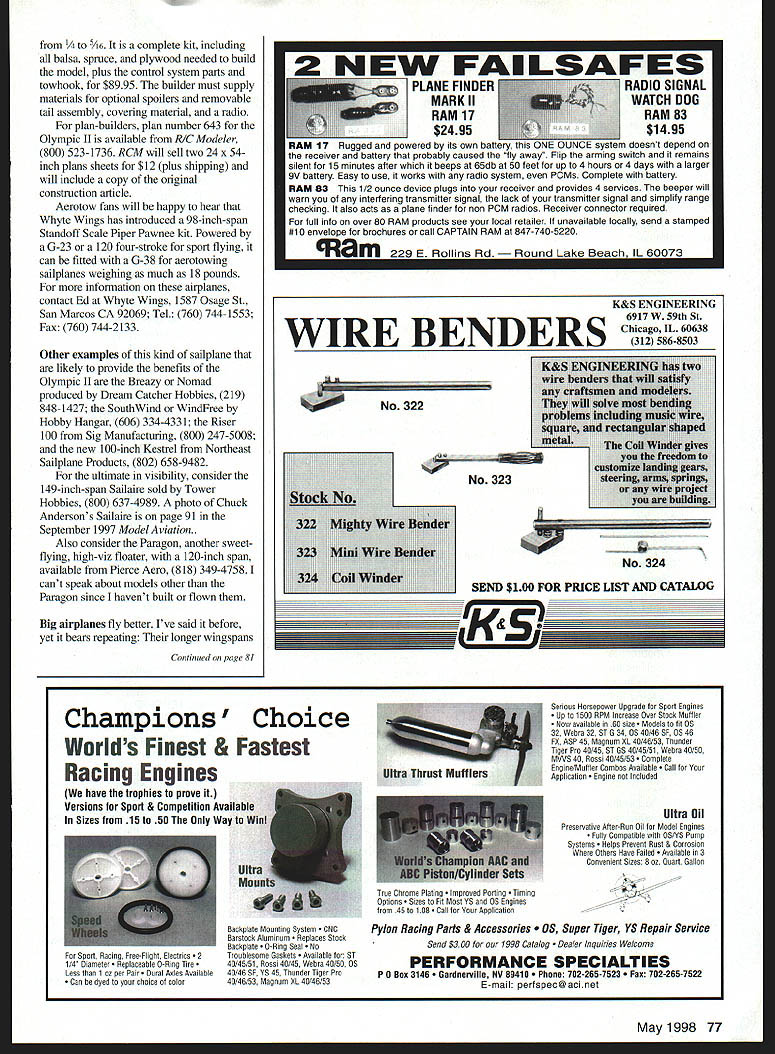
Ron Kelly of the Eastern Iowa Soaring Society taught me to winch-launch when he was stationed in Albany, NY, in the late 1980s. The Olympic II launches easily from a winch or from a hi-start.
Ron also introduced me to slope lift on a large, gently sloping hill in the Hudson River Valley. My flying buddy Rudy Coletti built an Olympic II and was the first in our area to break the hour, flying mixed slope and thermal lift.
Aerial Photography
To try aerial photography, I rubber-banded a camera to the outside of the fuselage and rigged a servo inside the fuselage to release the shutter. The big model handled the extra weight and drag without a whimper.
Contests and the League of Silent Flight
After flying the Olympic II for about three seasons I took first place in the Unlimited class at the spring Wintonbury Flying Club contest in Simsbury, Connecticut, beating Sal DeFrancesco and Stan Eames, who were flying hot new sailplanes that year. Flying early in the season, they had less time on their new planes, which gave me an opening. Since then, Sal and Stan have beaten me almost every time — a reminder to keep improving.
The League of Silent Flight achievement program is the best way I know to advance rapidly in soaring skill. I easily completed the LSF Level II requirements with my Olympic II, mainly because it flies so well.
- LSF Level II requirements:
- Five precision landings within a five-foot circle
- A half-hour thermal flight
- An hour of slope flight
- Participation in soaring contests
For more information on the LSF, see the October 1996 Model Aviation "RC Soaring" column; write to LSF at 10173 St. Joe Rd., Fort Wayne, IN 46835; or visit the LSF web site at www.silentflight.org.
Accidents and Repairs
I've had my share of bonehead plays. One time I ran into a football goalpost about midway along one wing's leading edge. The Olympic spun around the pole two or three times before flopping to the ground. If you can build 'em, you can repair 'em: I replaced a rib, spliced in some leading-edge stock, recovered the repaired area, and had the aircraft ready to fly again that evening.
Construction and Setup
Construction of the Olympic II is well within the capabilities of any modeler who has built one or two balsa-rib aircraft, including control-line kits or rubber-powered free-flight kits. Traditional adhesives can be used throughout — mainly aliphatic resin (tan carpenter's) glue and epoxy. Covering is convenient with heat-shrink plastic covering material made for this purpose.
I built my Olympic II on a 24 x 48-inch sheet of Homasote insulating material, pinning the parts to the Homasote over the full-size plans, which were protected from glue by waxed paper. A soft ceiling tile also works.
The most inexpensive four-channel radio easily controls the airplane; standard-size servos and a standard, square-shaped battery pack fit inside the fuselage easily. The Olympic II is designed with a two-piece wing and includes instructions for optional removable tail parts to make storage and transportation easier.
One piece of construction advice: go ahead and build the optional spoilers. As you gain experience with the model, spoilers will dramatically increase your landing accuracy. A mixing radio can be used for elevator compensation when the spoilers are deployed (spoilers tend to pitch the nose down). With a simple radio, you learn to compensate with elevator to keep the nose up as you deploy the spoilers.
Kit, Plans, and Upgrades
The Olympic II kit was first published in R/C Modeler in June 1976 by Lee Renaud. The kit eventually went off the market for a while but is available again.
- Kit details:
- Complete kit includes all balsa, spruce, and plywood needed to build the model, plus control system parts and a towhook
- Price (as offered): $89.95
- The builder must supply materials for optional spoilers and removable tail assembly, covering material, and a radio
- Plans:
- Plan number 643 for the Olympic II is available from R/C Modeler: (800) 523-1736
- RCM will sell two 24 x 54-inch plan sheets for $12 (plus shipping) and will include a copy of the original construction article
Ed Whyte at Whyte Wings has taken over production of many airplanes formerly distributed by the Airtronics Specialty Division, including the Olympic II, the Sapphire, and the Gem HLG. Ed reports he can supply parts and even make up a kit for the Legend, Falcon 550E, or Falcon 600. He stocks hinging tape, bellcranks, flap and aileron horns, towhooks, and other small parts.
The Whyte Wings Olympic II introduces two upgrades and enhancements to the original design:
- A new instruction booklet with plenty of photos
- An increase in the wing-joiner rod diameter from 1/4 to 5/16 inch
Whyte Wings contact:
- Ed Whyte / Whyte Wings
1587 Osage St., San Marcos, CA 92069 Tel.: (760) 744-1553 Fax: (760) 744-2133
Aerotow, Other Sailplanes, and Options
Aerotow fans will be happy to hear that Whyte Wings has introduced a 98-inch-span Standoff Scale Piper Pawnee kit. Powered by a G-23 or a .120 four-stroke for sport flying, it can be fitted with a G-38 for aerotowing sailplanes weighing as much as 18 pounds.
Other examples of this kind of sailplane that are likely to provide similar benefits to the Olympic II:
- Breezy or Nomad — Dream Catcher Hobbies, (219) 848-1427
- SouthWind or WindFree — Hobby Hangar, (606) 334-4331
- Riser 100 — Sig Manufacturing, (800) 247-5008
- Kestrel (100-inch) — Northeast Sailplane Products, (802) 658-9482
- Sailaire (149-inch span) — Tower Hobbies, (800) 637-4989 (see Chuck Anderson's Sailaire photo, Model Aviation, Sept 1997, p.91)
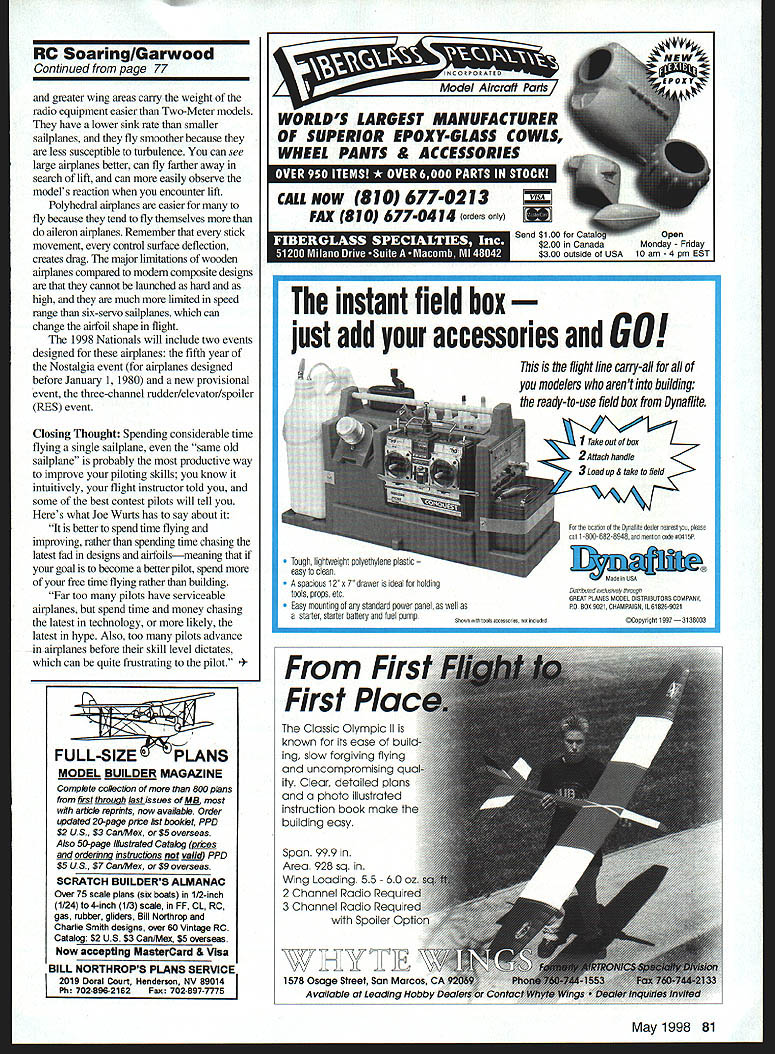
- Paragon (120-inch span) — Pierce Aero, (818) 349-4758
Why Big Airplanes Fly Better
Big airplanes fly better in many ways:
- Longer wingspans and greater wing area carry the weight of radio equipment easier than two-meter models.
- They have a lower sink rate and fly smoother because they are less susceptible to turbulence.
- They are easier to see and can be flown farther away in search of lift.
- Polyhedral airplanes tend to "fly themselves" more than aileron airplanes, making them easier for many pilots.
- Every stick movement and control-surface deflection creates drag; simpler designs often teach better energy management.
The major limitations of wooden airplanes compared to modern composite designs are that wooden planes cannot be launched as hard and as high, and they are more limited in speed range than six-servo sailplanes, which can change airfoil shape in flight.
Events and Closing Thought
The 1998 Nationals include two events designed for these airplanes: the fifth year of the Nostalgia event (airplanes designed before January 1, 1980) and a new provisional three-channel rudder/elevator/spoiler (RES) event.
Closing thought: Spending considerable time flying a single sailplane — even the "same old sailplane" — is probably the most productive way to improve your piloting skills. You know it intuitively, your flight instructor told you, and some of the best contest pilots will tell you.
Joe Wurts on the subject: "It is better to spend time flying and improving, rather than spending time chasing the latest fad in designs and airfoils—meaning that if your goal is to become a better pilot, spend more of your free time flying rather than building.
Far too many pilots have serviceable airplanes, but spend time and money chasing the latest in technology, or more likely, the latest in hype. Also, too many pilots advance in airplanes before their skill level dictates, which can be quite frustrating to the pilot."
Transcribed from original scans by AI. Minor OCR errors may remain.

