
RADIO CONTROL: SOARING
Dave Garwood 5 Birch Lane, Scotia NY 12302 E-mail: DaveGarwood@compuserve.com
Introduction
Hand Launch (HL) seems to be the fastest-growing branch of radio control (RC) thermal soaring, and the development of new airplanes continues at a remarkable pace. Any listing of HL models available would be out-of-date by the time it was published.
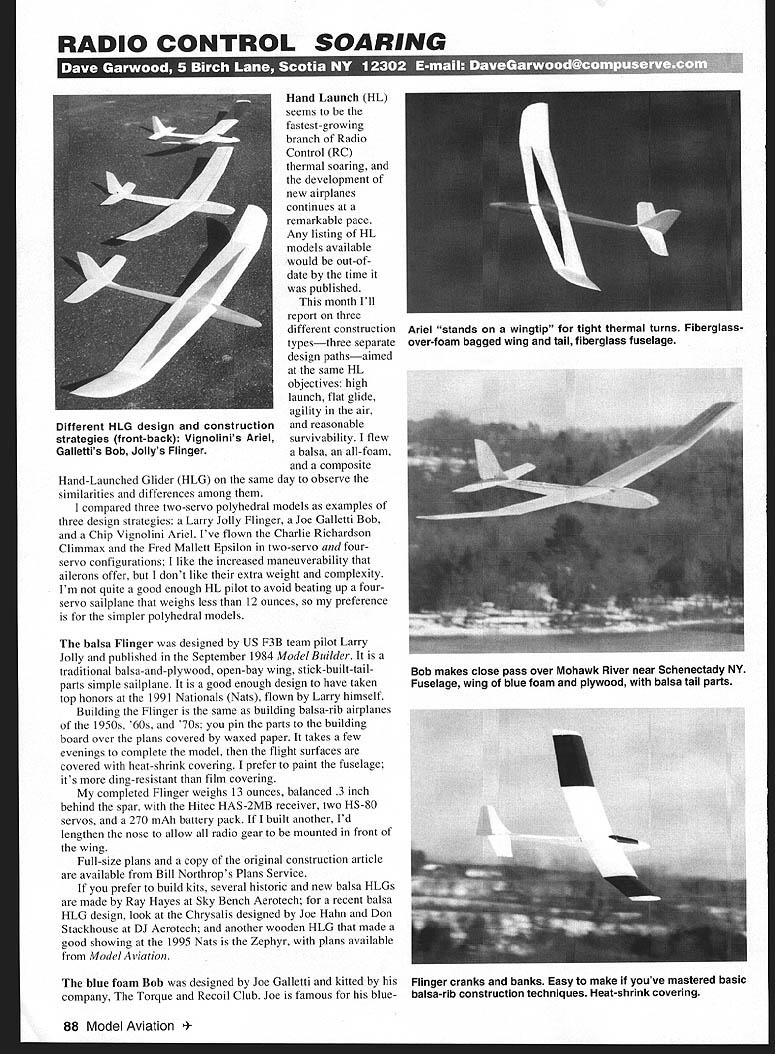
This month I report on three different construction types—three separate design paths—aimed at the same HL objectives: high launch, flat glide, agility in the air, and reasonable survivability. I flew a balsa, an all-foam, and a composite Hand-Launched Glider (HLG) on the same day to observe the similarities and differences among them.
I compared three two-servo polyhedral models as examples of three design strategies: a Larry Jolly Flinger, a Joe Galletti Bob, and a Chip Vignolini Ariel. I've flown the Charlie Richardson Climax and the Fred Mallett Epsilon in two-servo and four-servo configurations; I like the increased maneuverability that ailerons offer, but I don't like their extra weight and complexity. I'm not quite a good enough HL pilot to avoid beating up a four-servo sailplane that weighs less than 12 ounces, so my preference is for the simpler polyhedral models.
The Three Models
#### Flinger (balsa)
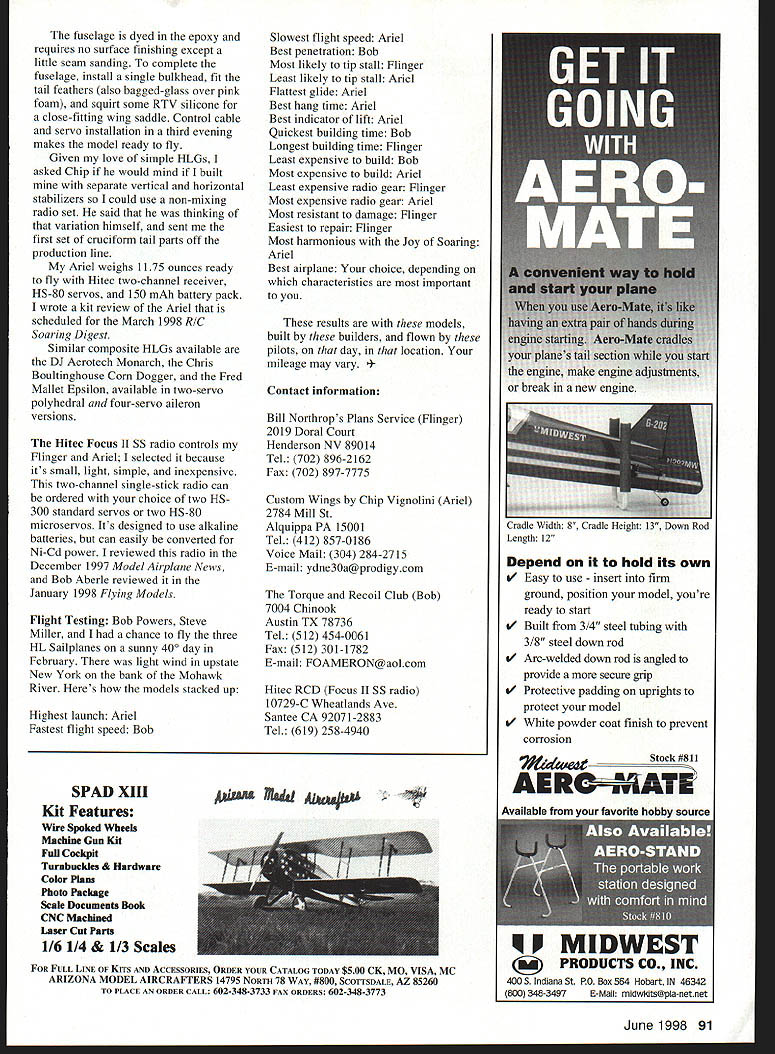
The balsa Flinger was designed by US F3B team pilot Larry Jolly and published in the September 1984 Model Builder. It is a traditional balsa-and-plywood, open-bay wing, stick-built tail-parts simple sailplane. It is a good enough design to have taken top honors at the 1991 Nationals (Nats), flown by Larry himself.
Building the Flinger is the same as building balsa-rib airplanes of the 1950s, '60s, and '70s: you pin the parts to the building board over the plans covered by waxed paper. It takes a few evenings to complete the model, then the flight surfaces are covered with heat-shrink covering. I prefer to paint the fuselage; it's more ding-resistant than film covering.
My completed Flinger weighs 13.0 ounces, balanced 0.3 inch behind the spar, with the Hitec HAS-2MB receiver, two HS-80 servos, and a 270 mAh battery pack. If I built another, I'd lengthen the nose to allow all radio gear to be mounted in front of the wing.
Full-size plans and a copy of the original construction article are available from Bill Northrop's Plans Service.
If you prefer to build kits, several historic and new balsa HLGs are made by Ray Hayes at Sky Bench Aerotech. For a recent balsa HLG design, look at the Chrysalis designed by Joe Hahn and Don Stackhouse of DJ Aerotech. Another wooden HLG that made a good showing at the 1995 Nats is the Zephyr, with plans available from Model Aviation.
#### Bob (blue foam)
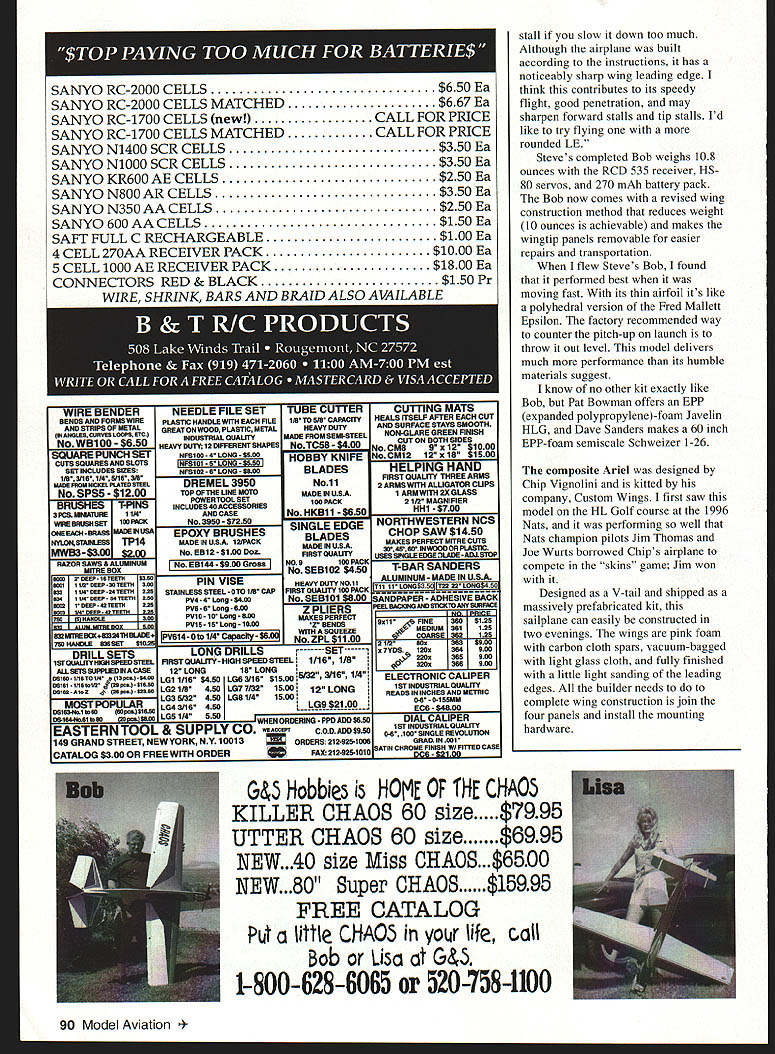
The blue-foam Bob was designed by Joe Galletti and kitted by his company, The Torque and Recoil Club. Joe is famous for his blue-foam models. The Bob is the first nearly-all-foam HLG that I've seen. The fuselage and wings are hot‑wire cut from blue foam, with light plywood fuselage stiffeners and balsa tail parts. It's designed for a small receiver and microservos, and by covering the airplane with clear packing tape the kit can be built in four to six hours. Joe designed Bob to deliver contest-level performance, including high maneuverability and penetration into the wind.
(The Foameron is a pivot-wing slope airplane constructed entirely without the use of adhesives.)
Flying buddy Steve Miller from Rexford, New York built a Bob and made these observations about the kit:
- "Yes, you can build Bob in four to six hours. I had a little trouble with getting sufficient depth for my HS‑80 servos and the supplied E‑Z connectors, but with a little fiddling it all fit. Submicro servos would go in easier."
- On flight performance, Steve noted, "On a hard launch, the Bob zoomed up, even balanced at the factory recommendation. When I trimmed it to avoid the pitch-up on launch, I had to fly the whole flight with back stick. Once I shimmed the wing trailing edge up 1/16 inch, launches were a whole lot better."
- "The airplane flies fast, penetrates well, and is plenty maneuverable, but it will tip." Still, if you slow it down too much.
Although Steve built the airplane according to the instructions, it has a noticeably sharp wing leading edge. I think this contributes to its speedy flight and good penetration, and may sharpen forward stalls and tip stalls. I'd like to try flying one with a more rounded leading edge.
Steve's completed Bob weighs 10.8 ounces with the RCD 535 receiver, HS‑80 servos, and 270 mAh battery pack. The Bob now comes with a revised wing construction method that reduces weight (10 ounces is achievable) and makes the wingtip panels removable for easier repairs and transportation.
When I flew Steve's Bob, I found that it performed best when it was moving fast. With its thin airfoil it's like a polyhedral version of the Fred Mallett Epsilon. The factory‑recommended way to counter the pitch‑up on launch is to throw it out level. This model delivers much more performance than its humble materials suggest.
I know of no other kit exactly like Bob, but Pat Bowman offers an EPP (expanded polypropylene)-foam Javelin HLG, and Dave Sanders makes a 60‑inch EPP-foam sailplane, the Schweizer 1‑26.
#### Ariel (composite)
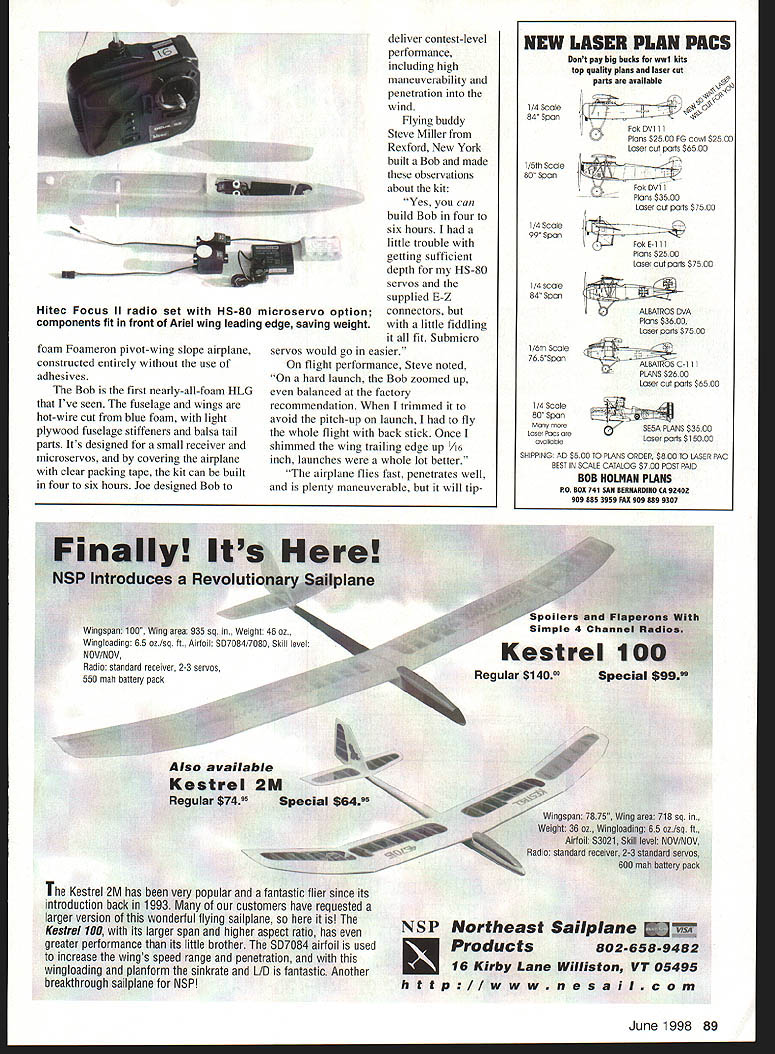
The composite Ariel was designed by Chip Vignolini and is kitted by his company, Custom Wings. I first saw this model on the Hill Golf course at the 1996 Nats, and it was performing so well that champion pilots Jim Thomas and Joe Wurts borrowed Chip's airplane to compete in the Nats F3B comp; Jim won with it.
Designed as a V‑tail and shipped as a massively prefabricated kit, this sailplane can easily be constructed in two evenings. The wings are pink foam with carbon cloth spars, vacuum‑bagged with light glass cloth, and fully finished with a little light sanding of the leading edges. All the builder needs to do to complete the wing construction is join the four panels and install the mounting hardware.
The fuselage is dyed in the epoxy and requires no surface finishing except a little seam sanding. To complete the fuselage, install a single bulkhead, fit the tail feathers (also bagged‑glass over pink foam), and squirt some RTV silicone for a close‑fitting wing saddle. Control cable and servo installation in a third evening makes the model ready to fly.
Given my love of simple HLGs, I asked Chip if he would mind if I built mine with separate vertical and horizontal stabilizers so I could use a non‑mixing radio set. He said that he was thinking of that variation himself, and sent me the first set of cruciform tail parts off the production line.
My Ariel weighs 11.75 ounces ready to fly with a Hitec two‑channel receiver, HS‑80 servos, and a 150 mAh battery pack. I wrote a kit review of the Ariel that was scheduled for the March 1998 R/C Soaring Digest.
Similar composite HLGs available are the DJ Aerotech Monarch, the Boultinghouse Corn Dogger, and the Fred Mallett Epsilon, available in two‑servo polyhedral and four‑servo aileron versions.
Radio and Gear
The Hitec Focus II SS radio controls my Flinger and Ariel; I selected it because it's small, light, simple, and inexpensive. This two‑channel single‑stick radio can be ordered with your choice of two HS‑300 standard servos or two HS‑80 microservos. It's designed to use alkaline batteries, but can easily be converted for Ni‑Cd power. I reviewed this radio in the December 1997 Model Airplane News, and Bob Aberle reviewed it in the January 1998 Flying Models.
Flight Testing
Bob Powers, Steve Miller, and I had a chance to fly the three HLG sailplanes on a sunny 40° day in February. There was light wind in upstate New York on the bank of the Mohawk River. Here's how the models stacked up:
- Highest launch: Ariel
- Fastest flight speed: Bob
- Most likely to tip stall: Flinger
- Least likely to tip stall: Ariel
- Flattest glide: Ariel
- Best hang time: Ariel
- Best indicator of lift: Ariel
- Quickest building time: Bob
- Longest building time: Flinger
- Least expensive to build: Bob
- Most expensive to build: Ariel
- Least expensive radio gear: Flinger
- Most expensive radio gear: Ariel
- Most resistant to damage: Flinger
- Easiest to repair: Flinger
- Most harmonious with the Joy of Soaring: Ariel
- Best airplane: Your choice, depending on which characteristics are most important to you.
These results are with these models, built by these builders, and flown by these pilots, on that day, in that location. Your mileage may vary.
Contact Information
- Bill Northrop's Plans Service (Flinger)
2019 Doral Court Henderson NV 89014 Tel.: (702) 896‑2162 Fax: (702) 897‑7775
- Custom Wings by Chip Vignolini (Ariel)
2784 Mill St. Aliquippa PA 15001 Tel.: (412) 857‑0186 Voice Mail: (304) 284‑2715 E‑mail: yde30a@prodigy.com
- The Torque and Recoil Club (Bob)
7004 Chinook Austin TX 78736 Tel.: (512) 454‑0061 Fax: (512) 301‑1782 E‑mail: FOAMERONE@aol.com
- Hitec RCD (Focus II SS radio)
10792‑C Wheatlands Ave. Santee CA 92071‑2883 Tel.: (619) 258‑4940
Transcribed from original scans by AI. Minor OCR errors may remain.

