
Radio Control: Soaring
Dave Garwood, 5 Birch Lane, Scotia NY 12302 E-mail: DaveGarwood@compuserve.com
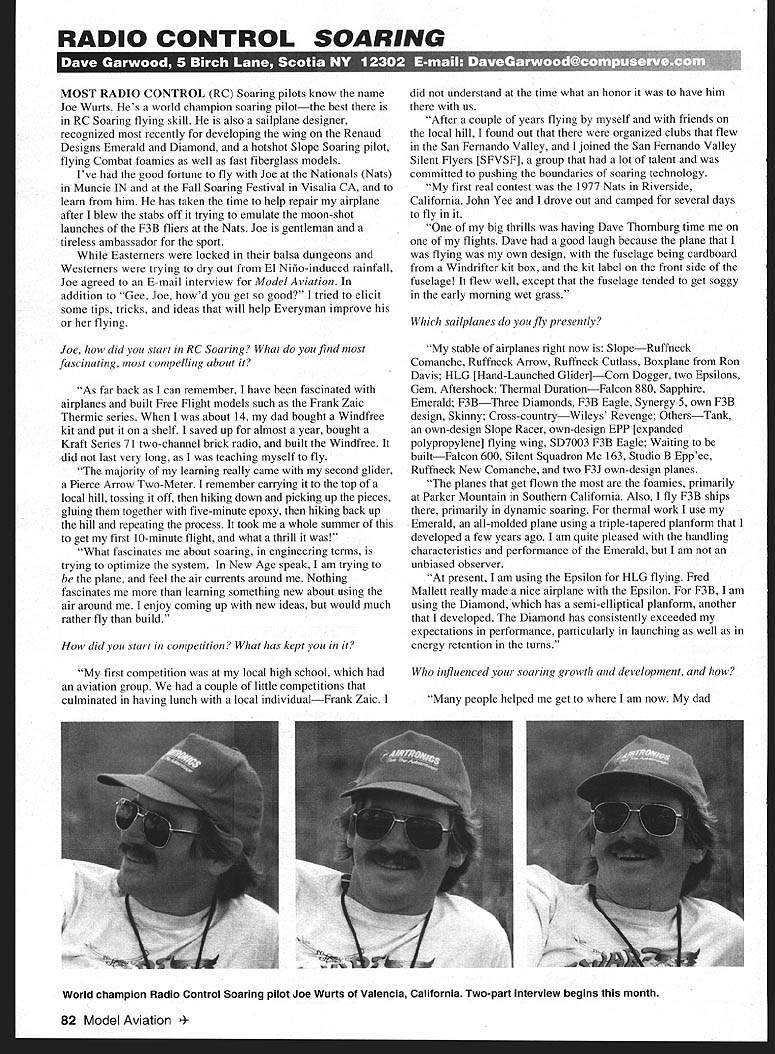
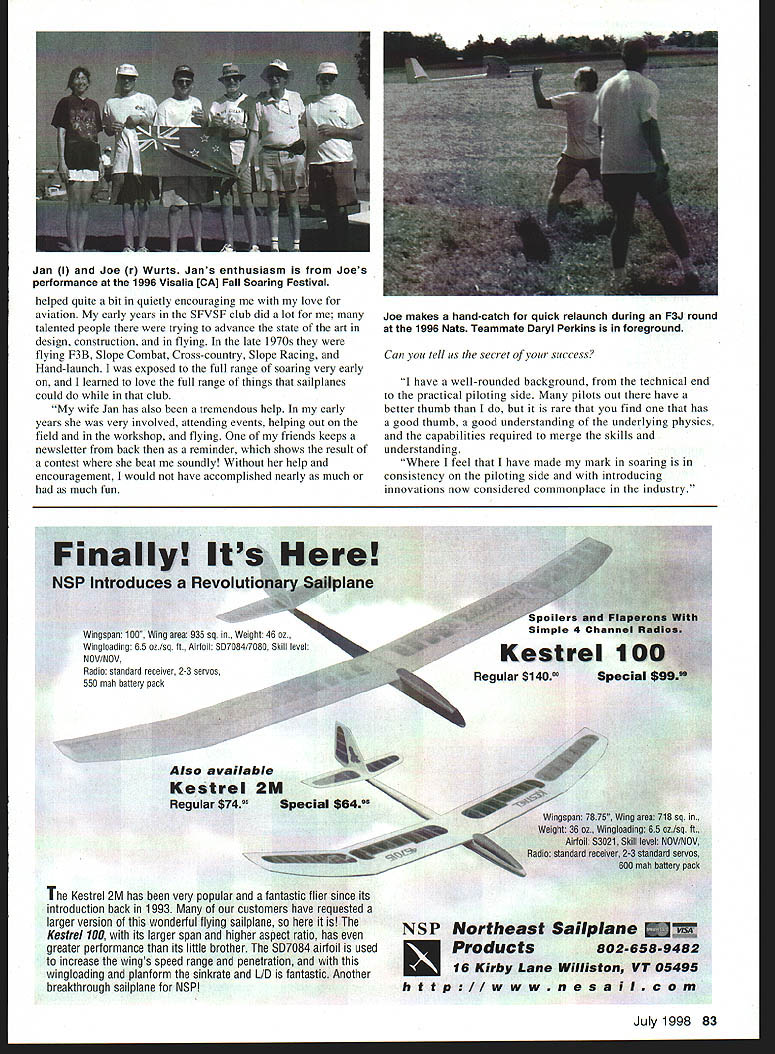
Most radio control (RC) soaring pilots know the name Joe Wurts. He's a world-champion soaring pilot—the best there is in RC soaring flying skill. He is also a sailplane designer, recognized most recently for developing the wing on the Renaud Designs Emerald and Diamond, and a hotshot slope-soaring pilot. Flying combat foamies as well as fast fiberglass models, I've had the good fortune to fly with Joe at the Nationals (Nats) in Muncie, IN, and at the Fall Soaring Festival in Visalia, CA, and to learn from him. He has taken the time to help repair my airplane after I blew the stabs off it trying to emulate the moon-shot launches of the F3B fliers at the Nats. Joe is a gentleman and a tireless ambassador for the sport.
While Easterners were locked in their balsa dungeons and Westerners were trying to dry out from El Niño–induced rainfall, Joe agreed to an e-mail interview for Model Aviation. In addition to "Gee, Joe, how'd you get so good?" I tried to elicit some tips, tricks, and ideas that will help everyman improve his or her flying.
How did you start in RC soaring? What do you find most fascinating, most compelling about it?
As far back as I can remember, I have been fascinated with airplanes and built free-flight models such as the Frank Zaic Thermic series. When I was about 14, my dad bought a Windfree kit and put it on a shelf. I saved up for almost a year, bought a Kraft Series 71 two-channel brick radio, and built the Windfree. It did not last very long, as I was teaching myself to fly.
The majority of my learning really came with my second glider, a Pierce Arrow two-meter. I remember carrying it to the top of a local hill, tossing it off, then hiking down and picking up the pieces, gluing them together with five-minute epoxy, then hiking back up the hill and repeating the process. It took me a whole summer of this to get my first 10-minute flight, and that was it!
What fascinates me about soaring, in engineering terms, is trying to optimize the system. In New Age speak, I am trying to be the plane and feel the air currents around me. Nothing fascinates me more than learning something new about using the air around me. I enjoy coming up with new ideas, but would much rather fly than build.
How did you start in competition? What has kept you in it?
My first competition was at my local high school, which had an aviation group. We had a couple of little competitions that culminated in having lunch with a local individual—Frank Zaic. I did not understand at the time what an honor it was to have him there with us.
After a couple of years flying by myself and with friends on the local hill, I found out that there were organized clubs that flew in the San Fernando Valley, and I joined the San Fernando Valley Silent Flyers (SFVSF), a group that had a lot of talent and was committed to pushing the boundaries of soaring technology.
My first real contest was the 1977 Nats in Riverside, California. John Yee and I drove out and camped for several days to fly in it.
One of my big thrills was having Dave Thornburg time me on one of my flights. Dave had a good laugh because the plane that I was flying was my own design, with the fuselage being cardboard from a Windfree kit box, and the kit label on the front sort of the fuselage! It flew well, except that the fuselage tended to get soggy in the early morning wet grass.
Which sailplanes do you fly presently?
My stable of airplanes right now is:
- Slope: Ruffneck Comanche, Ruffneck Arrow, Ruffneck Cutlass, Boxplane from Ron Davis
- HLG (hand-launched glider): Corn Dogger, two Epsilons, Gem, Aftershock
- Thermal duration: Falcon 880, Sapphire, Emerald
- F3B: Three Diamonds, F3B Eagle, Synergy 5, my own F3B design, Skinny
- Cross-country: Wiley's Revenge
- Others: Tank, my own-design slope racer, my own-design EPP flying wing, 5D7003 F3B Eagle
- Waiting to be built: Falcon 600, Silent Squadron Me 163, Studio B Eppee, Ruffneck New Comanche, and two F3J own-design planes
The planes that get flown the most are the foamies, primarily at Parker Mountain in Southern California. Also, I fly F3B ships there, primarily in dynamic soaring. For thermal work I use my Emerald, an all-molded plane using a triple-tapered planform that I developed a few years ago. I am quite pleased with the handling characteristics and performance of the Emerald, but I am not an unbiased observer.
At present, I am using the Epsilon for HLG flying. Fred Mallett really made a nice airplane with the Epsilon. For F3B, I am using the Diamond, which has a semi-elliptical planform—another shape that I developed. The Diamond has consistently exceeded my expectations in performance, particularly in launching as well as in energy retention in the turns.
Who influenced your soaring growth and development, and how?
Many people helped me get to where I am now. My dad helped quite a bit in quietly encouraging me with my love for aviation. My early years in the SFVSF club did a lot for me; many talented people there were trying to advance the state of the art in design, construction, and flying. In the late 1970s they were flying F3B, slope combat, cross-country, slope racing, and hand-launch. I was exposed to the full range of soaring very early on, and I learned to love the full range of things that sailplanes could do while in that club.
My wife Jan has also been a tremendous help. In my early years she was very involved, attending events, helping out on the field and in the workshop, and flying. One of my friends keeps a newsletter from back then as a reminder, which shows the result of a contest where she beat me soundly! Without her help and encouragement, I would not have accomplished nearly as much or had as much fun.
Can you tell us the secret of your success?
I have a well-rounded background, from the technical end to the practical piloting side. Many pilots out there have a better thumb than I do, but it is rare that you find one that has a good thumb, a good understanding of the underlying physics, and the capabilities required to merge the skills and understanding.
Where I feel that I have made my mark in soaring is in consistency on the piloting side and with introducing innovations now considered commonplace in the industry.
What sailplane preparation and setup methods and techniques work for you?
So you want me to tell my secrets now! For all of my technical background, I approach setting up a sailplane on an intuitive basis. It took me several years to learn what I am looking for in setting up a plane, but I can now do it from scratch in about 15 minutes and rarely change anything after the initial programming.
For placing the CG (center of gravity), I go to a slope and fly the plane and find what it feels like. If it is sluggish, I add control throw or move the CG back. I do not use the dive test, but rather get it to a cruise and do a half-roll. I then find out how much down elevator it takes to keep it inverted. The amount of down required is directly related to the static margin; that is, how nose-heavy the plane is. Typically, less is better, so I keep moving the CG back until it gets difficult to fly, then move it slightly forward from that point.
I know that you take the launch phase very seriously. What can you say that will help us “regular” fliers launch higher?
This is a tough subject and could be an entire column, or even a couple of columns. A quick synopsis:
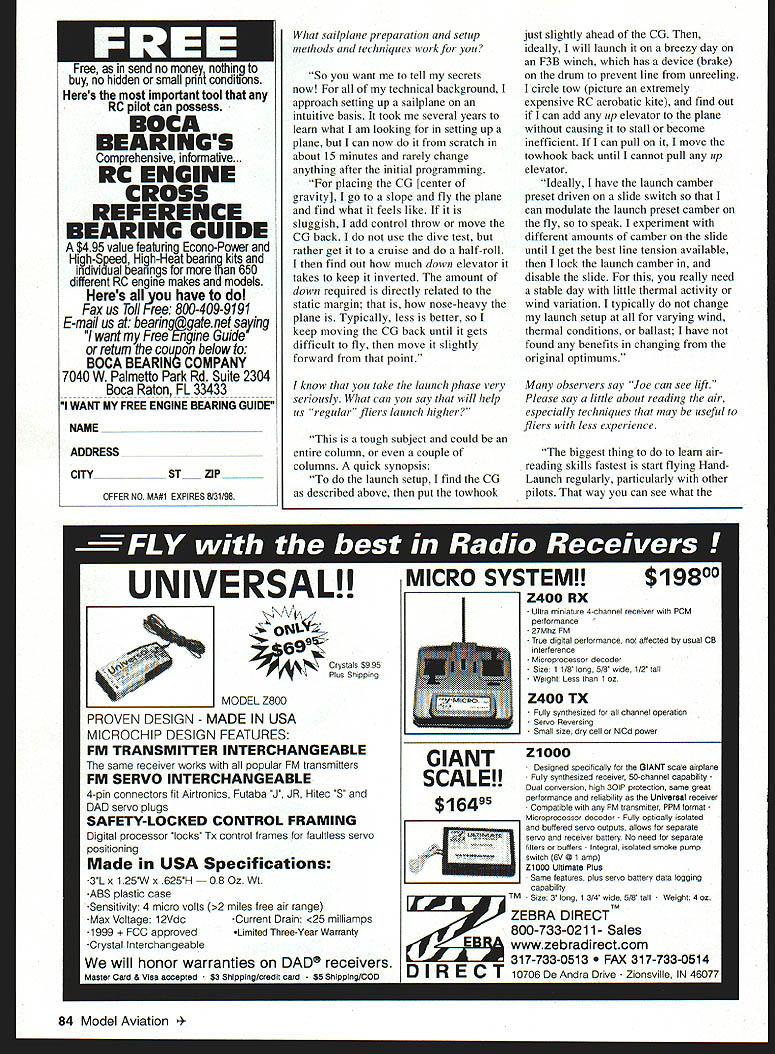
To do the launch setup, I find the CG as described above, then put the tow hook just slightly ahead of the CG. Then, ideally, I will launch it on a breezy day on an F3B winch, which has a device (brake) on the drum to prevent line from unreeling. I circle tow (picture an extremely expensive RC acrobatic kite), and find out on the tow hook how much up elevator I can apply without causing the plane to stall or become inefficient. If I can pull on it, I move the tow hook back until I cannot pull any up elevator.
Ideally, I have the launch camber preset driven on a slide switch so that I can modulate the launch preset camber on the fly, so to speak. I experiment with different amounts of camber on the slide until I get the best line tension available, then I lock the launch camber in, and disable the slide. For this, you really need a stable day with little thermal activity or wind variation. I typically do not change my launch setup at all for varying wind, thermal conditions, or ballast; I have not found any benefits in changing from the original options.
Many observers say “Joe can see lift.” Please say a little about reading the air, especially techniques useful to less experienced fliers.
The biggest thing to do to learn air-reading skills fast is start flying hand-launch regularly, particularly with other pilots. That way you can see what the other pilots do and the obvious clues of convergence, birds, dust devils, and clouds. Watch how planes behave, feel changes in elevator pressure or rudder lightness, and use your variometer to confirm what you see and feel.
The biggest thing to learn is the effect a thermal has on the surrounding air. Think of a thermal as a vacuum cleaner, sucking up the warm air near the ground; the thermal pulls air toward itself near the ground, and this is really what you are trying to sense. If the thermal is upwind of you, the normal wind will diminish or even stop. Similarly, if the thermal is to one side, the wind direction will shift toward the thermal. As a rule of thumb, a thermal is normally somewhere downwind of the relative wind change.
What do you do to find lift when air signs and ground signs fail?
If I am at a field that I know well, where I have a good idea of where the thermals are typically found, I check those areas. Neglecting that, I tend to fly out to a good distance away, where I can see the variations in lift and sink the best. Also, if there are variations in the geography, such as a tree line or a hill, I check slightly downwind from those to see if they are kicking off any thermals.
How do you decide to leave a decaying thermal and look elsewhere for lift?
A typical mistake that many pilots make is not leaving soon enough after that area has turned bad. A common theme is that a pilot will make several circles in an area that has turned bad before departing. As soon as I feel that I am not achieving what is necessary for the task, I'll do something. As I see the air deteriorating, I'll open up my circle just in case I've misplaced the thermal core. If, after a brief search, I do not see any areas that have potential, I will leave in a straight line toward what I've already identified as the next-most-likely thermal location.
Even if you are in great air, always evaluate wind shifts, other airplanes, and any other indications on the field in order to have a backup plan. Use your tow/spotter here; he or she should be watching the rest of the field, not your plane. The timer/spotter should spend about 80% of the time looking around, and 20% of the time evaluating your plane and performance.
This is different than leaving zero sink. I have a philosophy: the objective is to make your time, not get high, which means that if you have something that is workable, do not leave it for the big boomer that you think is out there. Even if someone else is in big lift, that big boomer might not still be working by the time you get there. But if your air does go away, by all means use what others have found to better your odds.
What competition strategies and tactics can you mention for the club-contest flier?
One thing that I see quite a bit is that many serious contest pilots rarely push their envelopes, or take chances. Particularly in the club-level contests, start taking chances in order to better yourself.
If the launch is open flight-order, step up and launch, even if you do not see any signs of lift. Even better, if you see a subtle ground sign that is pointing to lift that nobody is in, give it a try. And if the wind comes up or a light rain starts when you are fun flying, do not pack it up immediately; make a few flights, expand your envelope while you go out and not under any contest pressure. You will be improving your skills in the long run.
This will come in handy when you are at a big event where you are frequently stuck launching in very poor conditions. It is stressful enough to fly in a big event without the additional worry of flying in worse conditions than you are familiar with.
The interview will continue next month.
Transcribed from original scans by AI. Minor OCR errors may remain.

