

Radio Control: Soaring
Dave Garwood, 5 Birch Lane, Scotia NY 12302 E-mail: DaveGarwood@compuserve.com
This is the second part of an interview conducted in February with Joe Wurts, world champion F3B soaring pilot, sailplane designer, and slope flier. The first part was featured in the July Model Aviation.
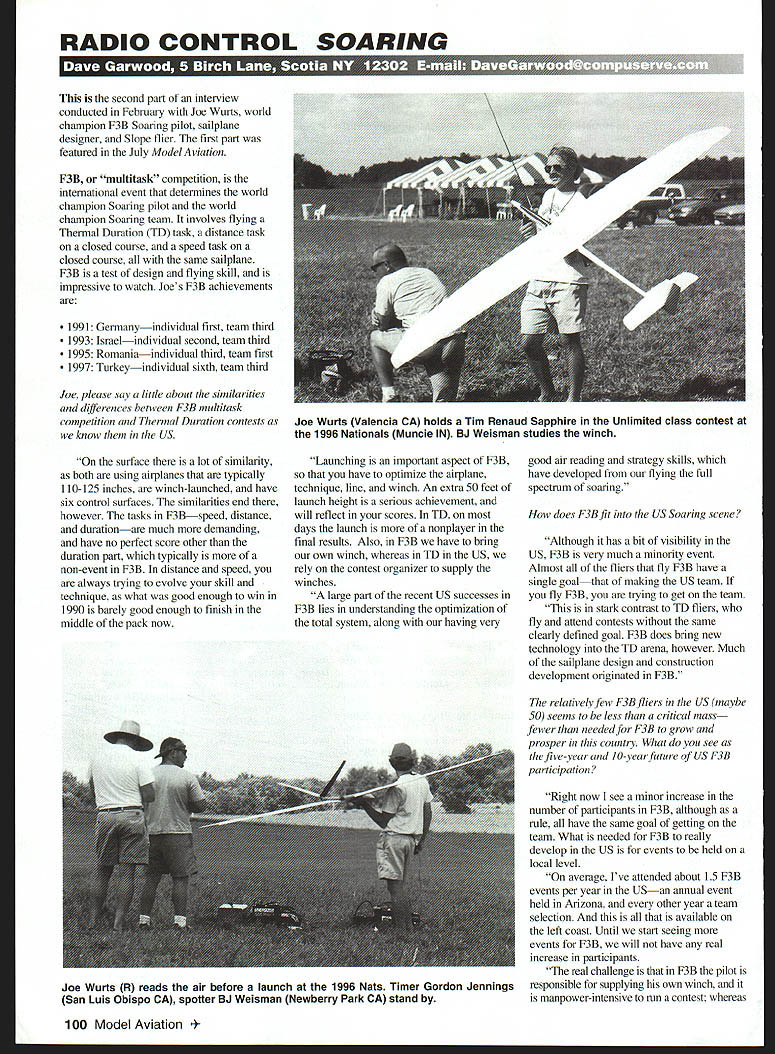
F3B, or "multitask" competition, is the international event that determines the world champion soaring pilot and the world champion soaring team. It involves flying a Thermal Duration (TD) task, a distance task on a closed course, and a speed task on a closed course, all with the same sailplane. F3B is a test of design and flying skill, and is impressive to watch. Joe's F3B achievements are:
- 1991: Germany — individual first, team third
- 1993: Israel — individual second, team third
- 1995: Romania — individual third, team first
- 1997: Turkey — individual sixth, team third
How does F3B multitask competition compare to Thermal Duration contests in the US?
"On the surface there is a lot of similarity, as both are using airplanes that are typically 110–125 inches, are winch-launched, and have six control surfaces. The similarities end there, however. The tasks in F3B—speed, distance, and duration—are much more demanding, and have no perfect score other than the duration part, which typically is more of a non-event in F3B. In distance and speed, you are always trying to evolve your skill and technique, as what was good enough to win in 1990 is barely good enough to finish in the middle of the pack now.
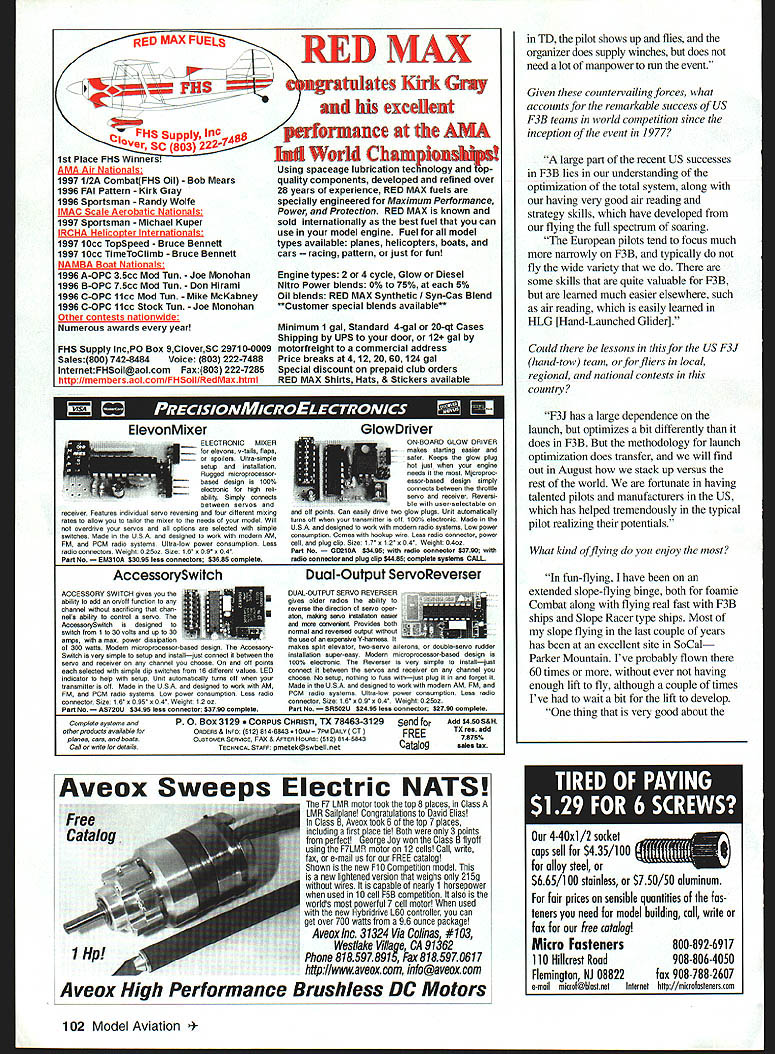
"Launching is an important aspect of F3B, so that you have to optimize the airplane, technique, line, and winch. An extra 50 feet of launch height is a serious achievement, and will reflect in your scores. In TD, on most days the launch is more of a nonplayer in the final results. Also, in F3B we have to bring our own winch, whereas in TD in the US, we rely on the contest organizer to supply the winches.
"A large part of the recent US successes in F3B lies in understanding the optimization of the total system, along with our having very good air reading and strategy skills, which have developed from our flying the full spectrum of soaring."
How does F3B fit into the US soaring scene?
"Although it has a bit of visibility in the US, F3B is very much a minority event. Almost all of the fliers that fly F3B have a single goal—that of making the US team. If you fly F3B, you are trying to get on the team. This is in stark contrast to TD fliers, who fly and attend contests without the same clearly defined goal. F3B does bring new technology into the TD arena, however. Much of the sailplane design and construction development originated in F3B.
"The relatively few F3B fliers in the US (maybe 50) seems to be less than a critical mass—fewer than needed for F3B to grow and prosper in this country."
What do you see as the five-year and ten-year future of US F3B participation?
"Right now I see a minor increase in the number of participants in F3B, although as a rule, all have the same goal of getting on the team. What is needed for F3B to really develop in the US is for events to be held on a local level. On average, I've attended about 1.5 F3B events per year in the US—an annual event held in Arizona, and every other year a team selection. And this is all that is available on the left coast. Until we start seeing more events for F3B, we will not have any real increase in participation.
"The real challenge is that in F3B the pilot is responsible for supplying his own winch, and it is manpower-intensive to run a contest; whereas in TD, the pilot shows up and flies, and the organizer does supply winches, but does not need a lot of manpower to run the event."
Given these countervailing forces, what accounts for the remarkable success of US F3B teams in world competition since the event began in 1977?
"A large part of the recent US success in F3B lies in our understanding of the total system, along with our having very good air reading and strategy skills, which have developed from our flying the full spectrum of soaring.
"The European pilots tend to focus much more narrowly on F3B, and typically do not fly the wide variety that we do. There are some skills that are quite valuable for F3B, but are learned much easier elsewhere, such as air reading, which is easily learned in HLG [Hand-Launched Glider]."
Could there be lessons here for the US F3J (hand-tow) team or for fliers in local, regional, and national contests?
"F3J has a large dependence on the launch, but optimizes a bit differently than it does in F3B. But the methodology for launch optimization does transfer, and we will find out in August how we stack up versus the rest of the world. We are fortunate in having talented pilots and manufacturers in the US, which has helped tremendously in the typical pilot realizing their potentials."
What kind of flying do you enjoy the most?
"In fun-flying, I have been on an extended slope-flying binge, both for foamie combat and along with flying real fast with F3B ships and Slope Racer-type ships. Most of my slope flying in the last couple of years has been at an excellent site in SoCal—Parker Mountain. I've probably flown there 60 times or more, without ever not having enough lift to fly, although a couple of times I've had to wait a bit for the lift to develop.
"One thing that is very good about the site is that it is flyable in both of our two normal wind conditions, along with the local geography funneling the wind into the hill. Also, due to the hill shape, it allows dynamic soaring, which has to be seen to be believed.
"For flat-land fun-flying, I really enjoy HLG, along with pushing my thermal envelope with either the Emerald or Diamond."
Which sailplane is most memorable to you?
"In the early '80s, when I was attending college at Cal Poly San Luis Obispo, I designed and built a plane that had a 25:1 aspect ratio and about a 120-inch span. I only had it for about a week, and I flew it only about four times before it was (euphemism alert) set free.
"I was flying it during a storm front at the sand cliffs of Montana de Oro, a local state park a few miles from where I was living. The wind was about 60 mph, and I had about five pounds of ballast on the plane. (It weighed just over three pounds empty!) There were wind-whipped whitecaps all over the ocean below, and the sand was blowing up the cliff and getting in my eyes. I took my eyes off it for just a second to step back out of the wind, and never saw it again.
"With the skinny wings, I suspect that I just could not pick it out from the whitecaps, as it was all white. The plane had a huge carbon-fiber spar and with the ballast that it was carrying, it would give a beautiful elliptical flex in the wings during a high-speed turn. For its limited life, it was the most graceful plane I've seen."
What developments do you see in RC sailplanes of the future?
"It is easy to foresee evolutionary growth, but difficult to predict the revolutionary. I am most gratified to see the EPP [expanded polypropylene] foamie plane explosion that is currently happening.
"Ever since I got into the hobby, I have seen a greying of the populace. That is, the majority of sailplane modelers were lifers, and few new people were entering the sport. Thanks to Jeff Raskin of Anabat fame, and Pat Bowman of Ruffneck fame, we are entering a new and growing phase of the hobby.
"Jeff started the small, lightweight foamie revolution with his Anabat Slope Soarer, which was the first step in cheap and durable gliders. They still did not wear very well, however, and after a while, they would self-destruct. Then Pat discovered EPP foam.
"I remember one evening when he came by the house with a sample of the foam, wondering if it would really work for a foamie. A couple of weeks later, he had built a plane from it, which he started marketing as the Ruffneck. I still have his original prototype in flying condition, although it is on its third covering job. It is amazing to have a glider that can be brought back to virtually new condition just by peeling off the old covering and applying new.
"Since the advent of the foamies, I have seen many new young fliers enter the hobby. Many of these new pilots will stay in the hobby, primarily as slope soarers, but a few are transitioning into the full realm of sailplane flying.
"In the high end, we are seeing the transition to ARF (Almost Ready-to-Fly) molded airplanes with a rather high technology embedded in the design and manufacture. This trend is bound to continue, although I feel that there will be a bit of a backlash in the near future. That is, some people would like to return a bit to the simpler airplanes of the past.
"One development that I expect to see in the near future is the implementation of a stabilization system in sailplanes. In the next couple of years, I suspect that a few pilots will start flying with gyros for pitch and roll stabilization. This will free the pilot from having quite as much concentration focused on the plane, and will allow the pilot to start paying more attention to reading the air conditions around him or her.
"Another development that I expect is the advent of leading-edge devices on some models. I feel that there is a potential for a large benefit here if integrated correctly into the system. The challenge is that the plane has to be designed around them, not only structurally, but aerodynamically.
"The trend of stronger and lighter will continue, as we have not gotten anywhere close to the possible best strength-to-weight ratios that are possible. F3J will be the driving force in evolving better manufacturing techniques here, although it will not be cheap."
Transcribed from original scans by AI. Minor OCR errors may remain.

