
RADIO CONTROL SOARING
Dave Garwood 5 Birch Lane, Scotia NY 12302 E-mail: DaveGarwood@compuserve.com
People start in Radio Control (RC) soaring every month. Often they visit a flying site, watch, then ask questions. If you've been flying sailplanes for a while, you've probably heard these inquiries; if you're a newcomer, here are one man's answers to what might be your first 10 questions.
How do sailplanes stay up there without engines?
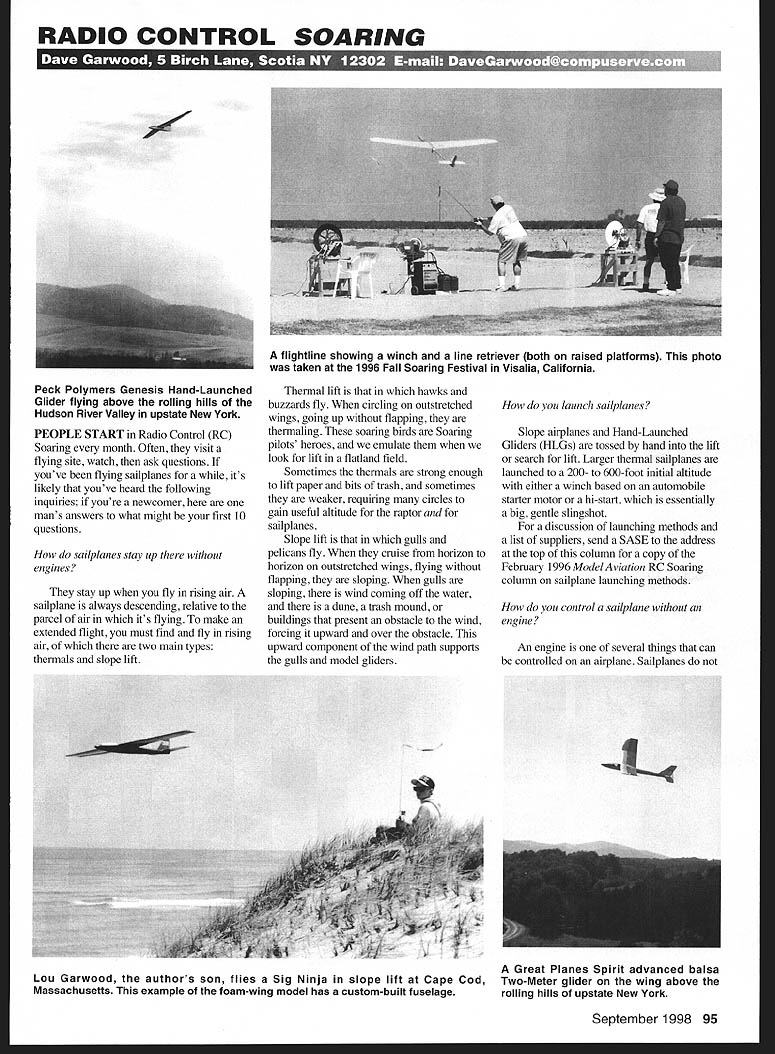
They stay up when you fly in rising air. A sailplane is always descending relative to the parcel of air in which it is flying. To make an extended flight, you must find and fly in rising air, of which there are two main types: thermals and slope lift.
Thermal lift is what hawks and buzzards use. When circling on outstretched wings and going up without flapping, they are thermaling. Thermals can be strong enough to lift bits of paper and trash, or weaker and require many circles to gain useful altitude for the raptor or a model sailplane.
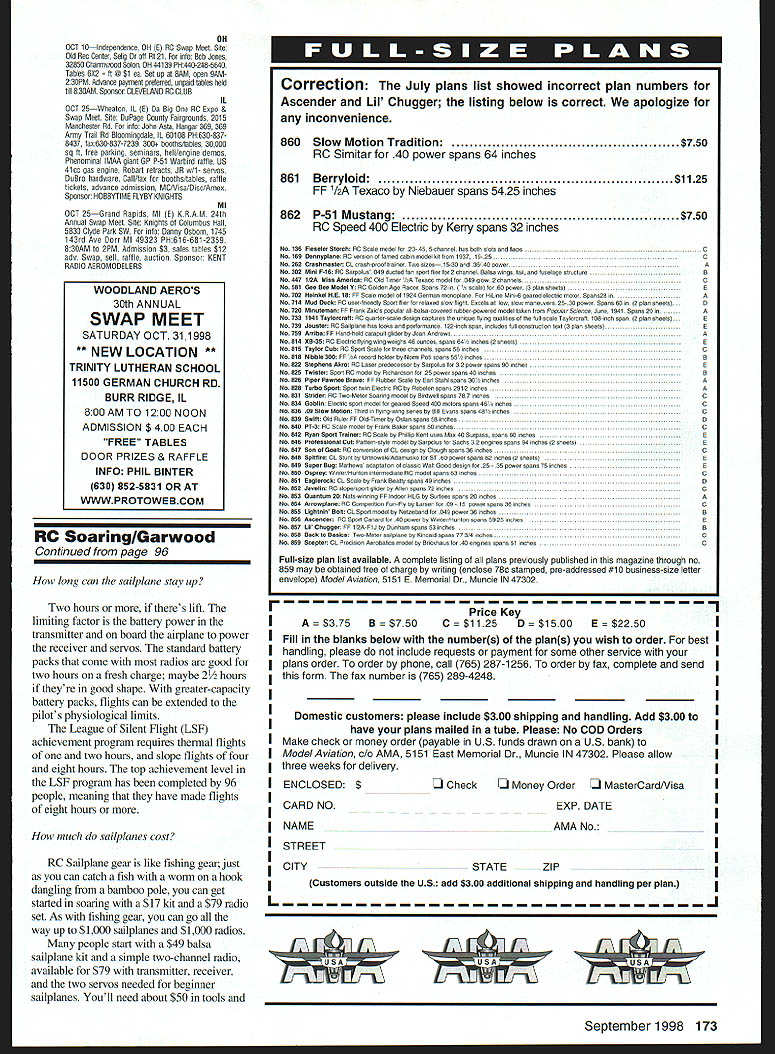
Slope lift is what gulls and pelicans use when they cruise on outstretched wings from horizon to horizon without flapping. When wind encounters an obstacle (a dune, a trash mound, a cliff, or buildings) it is forced upward; that upward component supports gulls and model gliders.
How do you launch sailplanes?
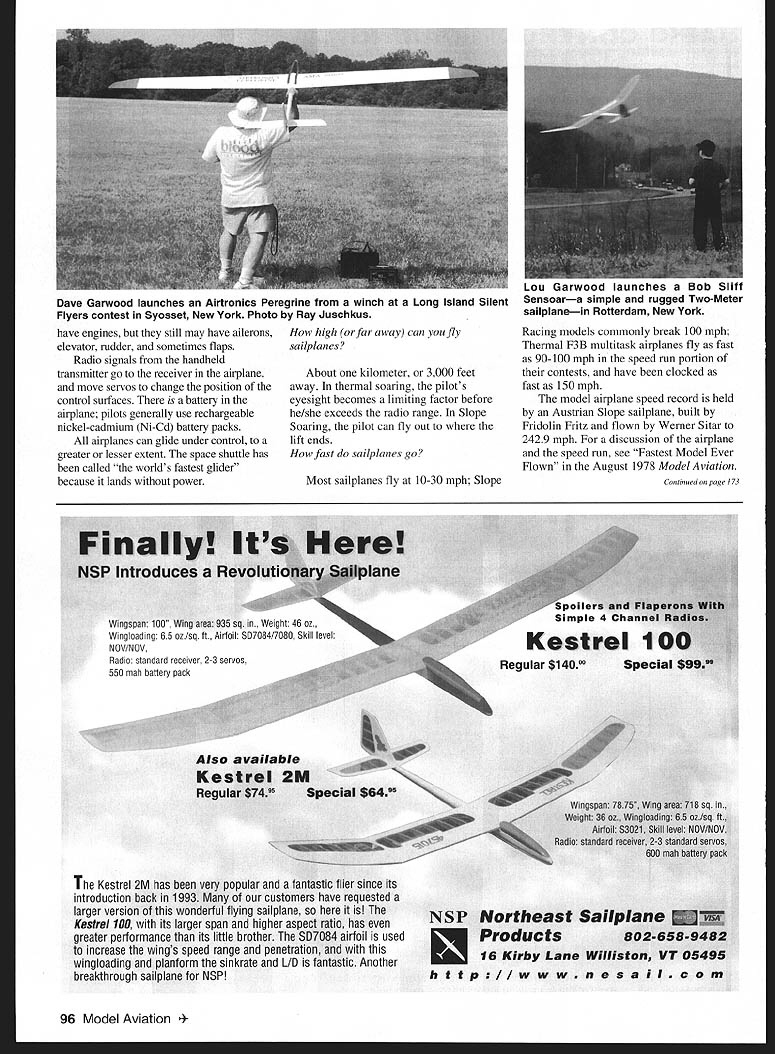
Slope airplanes and hand-launched gliders (HLGs) are simply tossed by hand into rising air to search for lift. Larger thermal sailplanes are launched to a 200–600 foot initial altitude using a winch (often based on an automobile starter motor), an automobile-starter-motor launcher, or a hi-start (essentially a big, gentle slingshot).
For a discussion of launching methods and a list of suppliers, send a SASE to the address at the top of this column for a copy of the February 1996 Model Aviation RC Soaring column on sailplane launching methods.
How do you control a sailplane without an engine?
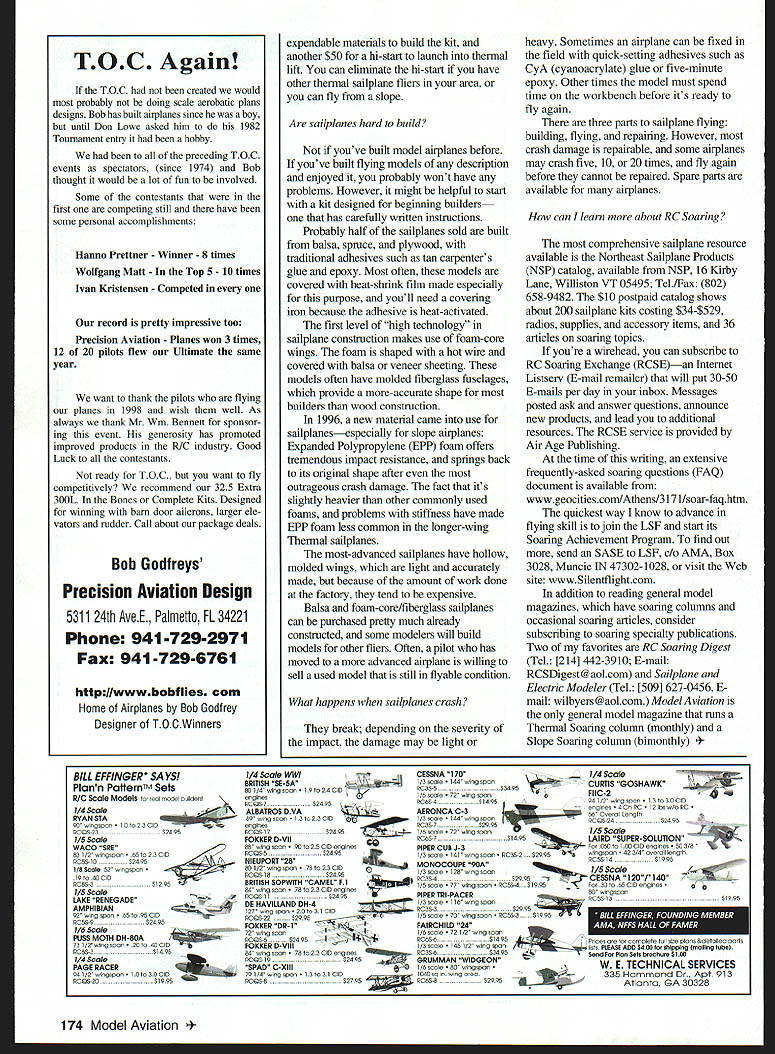
An engine is one of several things that can be controlled on an airplane. Sailplanes do not have engines, but they still may have ailerons, elevator, rudder, and sometimes flaps. Radio signals from the handheld transmitter go to the receiver in the airplane and move servos to change the position of the control surfaces. The airplane's electronics are powered by a battery—pilots usually use rechargeable nickel-cadmium (Ni-Cd) battery packs.
All airplanes can glide under control to a greater or lesser extent; the space shuttle, for example, has been called "the world's fastest glider" because it lands without power.
How high (or far away) can you fly sailplanes?
About one kilometer (3,000 feet) away is typical. In thermal soaring, the pilot's eyesight usually becomes the limiting factor before radio range is exceeded. In slope soaring, a pilot can fly out to where the lift ends; once out of lift the sailplane will descend relatively quickly.
How fast do sailplanes go?
Most sailplanes fly 10–30 mph. Slope-racing models commonly exceed 100 mph. Thermal F3B multitask airplanes fly as fast as 90–100 mph in the speed-run portion of contests, and speeds up to 150 mph have been recorded in model speed events. The model airplane speed record cited in older reports was set by an Austrian slope sailplane built by Fridolin Fritz and flown to speeds reported at 242.9 mph (see "Fastest Model Ever Flown," August 1978 Model Aviation).
How long can the sailplane stay up?
Two hours or more, if there's lift. The limiting factors are battery power for the transmitter and the on-board battery that powers the receiver and servos. Standard battery packs that come with most radios are good for about two hours on a fresh charge (maybe 2½ hours if in good shape). With greater-capacity packs, flights can be extended to the pilot's physiological limits.
The League of Silent Flight (LSF) achievement program requires thermal flights of one and two hours, and slope flights of four and eight hours. The top achievement level in the LSF program has been completed by 96 people, meaning they have made flights of eight hours or more.
How much do sailplanes cost?
RC sailplane gear is like fishing gear: you can get started very inexpensively, or spend a lot. You can begin with a $17 kit and a $79 radio set, or with a $49 balsa sailplane kit and a simple two-channel radio (about $79 with transmitter, receiver, and the two servos). Expect to spend roughly $50 more on basic tools and spare parts. At the other end, $1,000 sailplanes and $1,000 radios are common for advanced pilots.
Are sailplanes hard to build?
Not if you've built model airplanes before. If you've built flying models and enjoyed it, you probably won't have any problems. It's helpful to start with a kit designed for beginning builders with careful instructions.
Common construction methods:
- Traditional wood: balsa, spruce, and plywood with carpenter's glue and epoxy; covered with heat-shrink film using a covering iron.
- Foam-core wings: foam shaped with a hot wire and covered with balsa or veneer sheeting, often with molded fiberglass fuselages.
- EPP foam (since the mid-1990s): Expanded Polypropylene offers tremendous impact resistance and springs back after many crashes; slightly heavier and less stiff than other foams, so less common for long-wing thermal sailplanes.
- Molded hollow wings: light and accurately made but more expensive due to factory work.
Balsa and foam-core/fiberglass sailplanes can be purchased nearly ready to fly, and many pilots buy used models as they move up.
What happens when sailplanes crash?
They break; damage may be light or heavy depending on the impact. Small field repairs can often be done with quick-setting adhesives such as CA (cyanoacrylate) glue or five-minute epoxy. Other times the model requires bench work. Most crash damage is repairable; some airplanes crash many times and fly again before they are beyond repair. Spare parts are available for many models.
There are three parts to sailplane flying: building, flying, and repairing.
How can I learn more about RC soaring?
Resources and suggestions:
- Northeast Sailplane Products (NSP) catalog: NSP, 16 Kirby Lane, Williston VT 05495; Tel./Fax: (802) 658-9482. The $10 postpaid catalog (historically) showed about 200 sailplane kits and many accessories.
- RC Soaring Exchange (RCSE): an Internet listserver (mailing list) that posts many messages per day asking and answering questions, announcing products, and sharing resources. Service provided by Air Age Publishing.
- Frequently-asked-soaring-questions (FAQ) (historical location): http://www.geocities.com/Athens/3171/soar-faq.htm
- League of Silent Flight (LSF): join and start the Soaring Achievement Program. Send an SASE to LSF, c/o AMA, Box 3028, Muncie IN 47302-3028, or visit www.SilentFlight.com.
- Publications: consider soaring-specialty magazines such as RC Soaring Digest and Sailplane & Electric Modeler. Model Aviation is a general-model magazine that runs a monthly Thermal Soaring column and a bimonthly Slope Soaring column.
In addition to reading, the quickest way to advance in flying skill is to join a club, fly with experienced pilots, and participate in organized achievement programs such as the LSF Soaring Achievement Program.
Transcribed from original scans by AI. Minor OCR errors may remain.

