
Radio Control: Soaring
Author
- Dave Garwood
- 5 Birch Lane, Scotia, NY 12302
- E-mail: DaveGarwood@compuserve.com
Introduction
Hand-Launch Gliders (HLGs) are the purest form of Radio Control (RC) flight. With nothing but yourself, your sailplane, and your knowledge of the air, you coax the airplane to defy gravity.
Hand-launching into a thermal, coring it, and watching your airplane soar into a tiny speck in the sky can be one of the most rewarding events in RC soaring. HL flying can also be frustrating, requiring many launches to find lift and leaving you with sore arms by the end of a flying session.
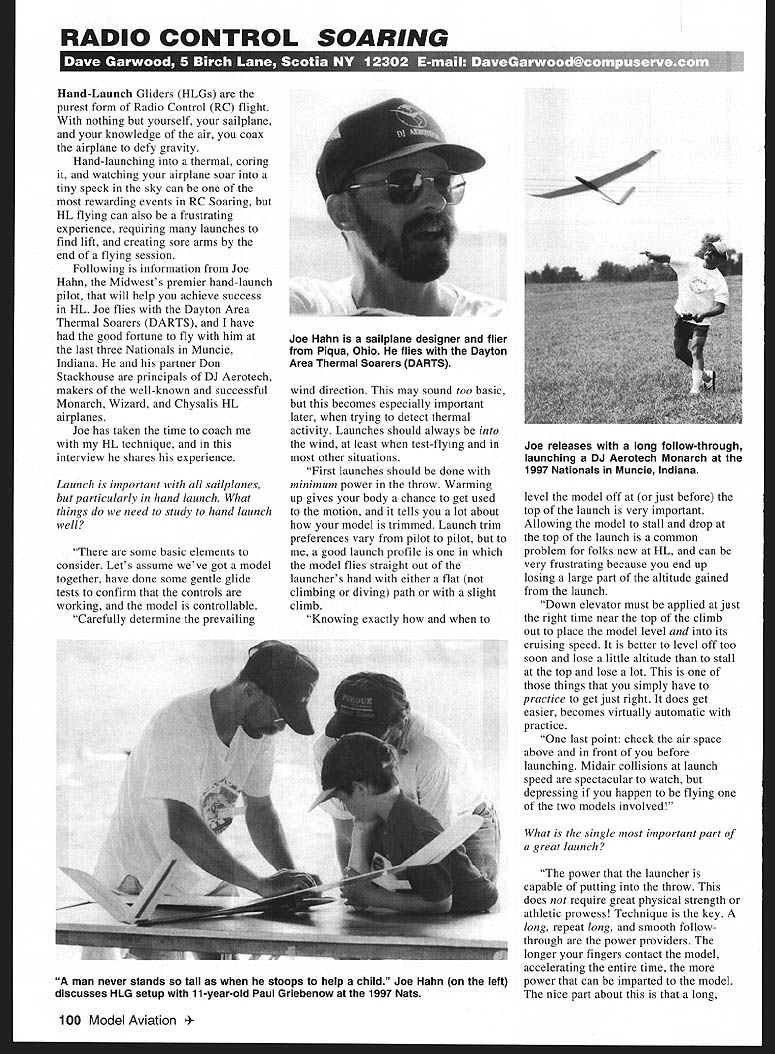
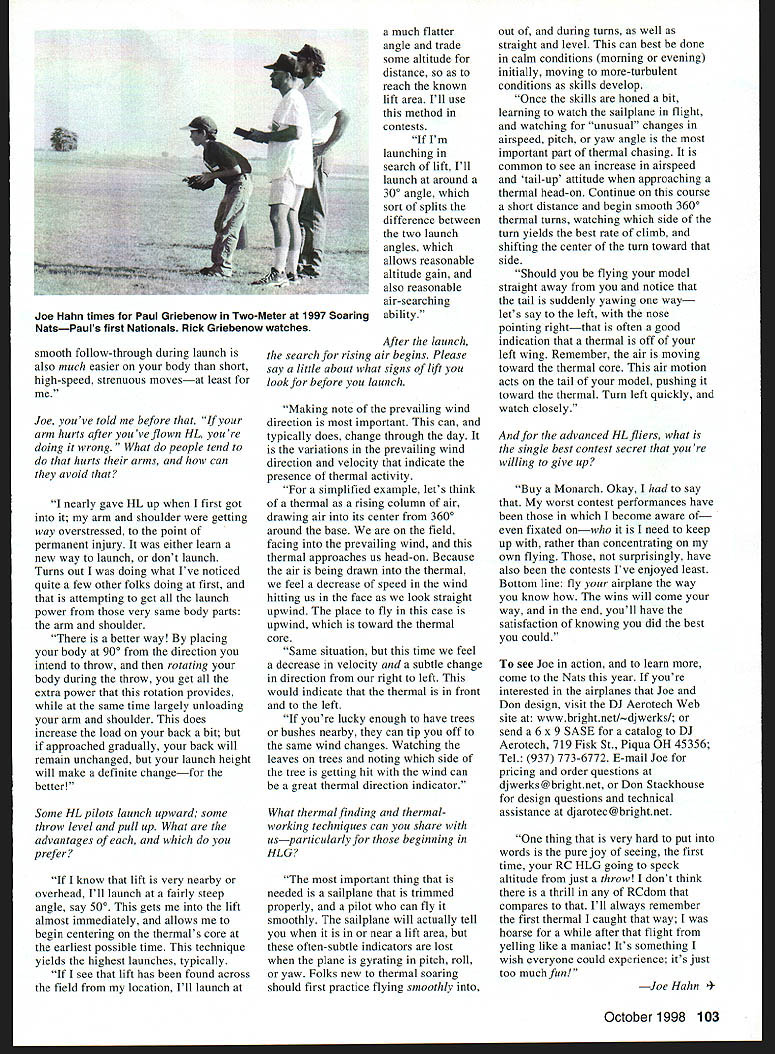
Following is information from Joe Hahn, the Midwest's premier hand-launch pilot, that will help you achieve success in HL. Joe flies with the Dayton Area Thermal Soarers (DARTS). He and his partner Don Stackhouse are principals of DJ Aerotech, makers of the Monarch, Wizard, and Chrysalis HL airplanes. In this interview Joe shares his experience and coaching tips.
Launch basics — what to study to hand-launch well
"There are some basic elements to consider. Let's assume we've got a model together, have done some gentle glide tests to confirm that the controls are working, and the model is controllable.
Carefully determine the prevailing wind direction. This may sound basic, but it becomes especially important later when trying to detect thermal activity. Launches should always be into the wind, at least when test-flying and in most other situations.
First launches should be done with minimum power in the throw. Warming up gives your body a chance to get used to the motion, and it tells you a lot about how your model is trimmed. Launch-trim preferences vary from pilot to pilot, but a good launch profile is one in which the model flies straight out of the launcher's hand with either a flat (not climbing or diving) path or with a slight climb.
Knowing exactly how and when to level the model off at (or just before) the top of the launch is very important. Allowing the model to stall and drop at the top of the launch is a common problem for folks new at HL, and can be very frustrating because you end up losing a large part of the altitude gained from the launch.
Down elevator must be applied at just the right time near the top of the climb to place the model level and into its cruising speed. It is better to level off too soon and lose a little altitude than to stall at the top and lose a lot. This is one of those things that you simply have to practice to get just right; it does get easier and becomes virtually automatic with practice.
One last point: check the airspace above and in front of you before launching. Midair collisions at launch speed are spectacular to watch, but depressing if you happen to be flying one of the two models involved."
The single most important part of a great launch
"The power that the launcher is capable of putting into the throw. This does not require great physical strength or athletic prowess! Technique is the key. A long, repeatable, and smooth follow-through are the power providers. The longer your fingers contact the model, accelerating the entire time, the more power that can be imparted to the model. The nice part about this is that a long, smooth follow-through is much easier on the body than short, high-speed, strenuous moves.
If your arm hurts after you've flown HL, you're doing it wrong. What people tend to do that hurts their arms can be avoided. I nearly gave HL up when I first got into it because my arm and shoulder were getting overstressed to the point of potential permanent injury. Either learn a new way to launch or don't launch.
What I've noticed quite a few folks doing when first attempting to get launch power — using the same body parts, the arm and shoulder — is not the best way. A better way is placing your body at 90° to the direction you intend to throw and rotating your body during the throw to get extra power. Rotation provides power while largely unloading the arm and shoulder. It does increase the load on the back a bit, but approached gradually the back will remain unchanged and the launch height will improve.
Some HL pilots launch upward; some throw level and then pull up. If you know lift is very nearby overhead, I'll launch at a fairly steep angle, say 50°, which gets the lift almost immediately and allows me to begin centering the thermal core as early as possible. This technique yields the highest launches I typically see when lift has been found across the field. I'll launch much flatter when I trade some altitude for distance to reach a known lift area. I'll use that method in contests when I'm launching to search for lift. I'll launch around a 30° angle — splitting the difference between the two launch angles — which allows reasonable altitude gain and also reasonable air-searching ability."
Signs of lift to look for before and after launch
"Making note of the prevailing wind direction is most important. This can, and typically does, change through the day. It is the variations in the prevailing wind direction and velocity that indicate the presence of thermal activity.
For a simplified example, think of a thermal as a rising column of air drawing air into its center from 360° around the base. We are on the field, facing into the prevailing wind, and this thermal approaches us head-on. Because the air is being drawn into the thermal, we feel a decrease of speed in the wind hitting us in the face as we look straight upwind. The place to fly in this case is upwind, which is toward the thermal core.
Same situation, but this time we feel a decrease in velocity and a subtle change in direction from our right to left. This would indicate that the thermal is in front and to the left.
If you're lucky enough to have trees or bushes nearby, they can tip you off to the same wind changes. Watching leaves or branches and noting which side of the tree is being hit with the wind can be a great thermal-direction indicator."
Thermal finding and working techniques (especially for beginners)
"The most important things needed are a sailplane that is trimmed properly, and a pilot who can fly it smoothly. The sailplane will actually tell you when it is on or near a lift area, but these often-subtle indicators are lost when the plane is gyrating in pitch, roll, or yaw. New thermal-soaring pilots should first practice flying smoothly into, out of, and during turns, as well as straight and level. This can best be done in calm conditions (morning or evening) initially, moving to more turbulent conditions as skills develop.
Once your skills are honed a bit, learn to watch the sailplane in flight and look for 'unusual' changes in airspeed, pitch, or yaw angle. It is common to see an increase in airspeed and a 'tail-up' attitude when approaching a thermal head-on. Continue on this course a short distance and begin smooth 360° thermal turns, watching which side of the turn yields the best rate of climb, and shifting the center of the turn toward that side.
If you are flying your model straight away from you and notice that the tail suddenly yaws one way — let's say to the left, with the nose pointing right — that is often a good indication that a thermal is off your left wing. Remember, the air is moving toward the thermal core. This air motion acts on the tail of your model, pushing it toward the thermal. Turn toward that side quickly, and watch closely."
Contest advice (advanced tip)
"Buy a Monarch. Okay, I had to say that. My worst contest performances are those in which I become aware of — even fixated on — who it is I need to keep up with, rather than concentrating on my own flying. Those, not surprisingly, have also been the contests I've enjoyed the least. Bottom line: fly your airplane the way you know how. The wins will come your way, and in the end you'll have the satisfaction of knowing you did the best you could."
DJ Aerotech / Contact information
- DJ Aerotech (Joe Hahn and Don Stackhouse), 719 Fisk St., Piqua, OH 45356
- Tel.: (937) 773-6772
- E-mail for pricing and orders: djwerks@bright.net (Joe Hahn)
- E-mail for design questions and technical assistance: djaerotech@bright.net (Don Stackhouse)
- Visit the DJ Aerotech website for more information.
Closing
"One thing that is very hard to put into words is the pure joy of seeing, the first time, your RC HLG going to spectacular altitude from just a throw! I don't think there is a thrill in any of RCdom that compares to that. I'll always remember the first thermal I caught that way; I was hoarse for a while after that flight from yelling like a maniac! It's something I wish everyone could experience; it's just too much fun!"
— Joe Hahn
Transcribed from original scans by AI. Minor OCR errors may remain.

