

Radio Control: Soaring
Dan Pruss
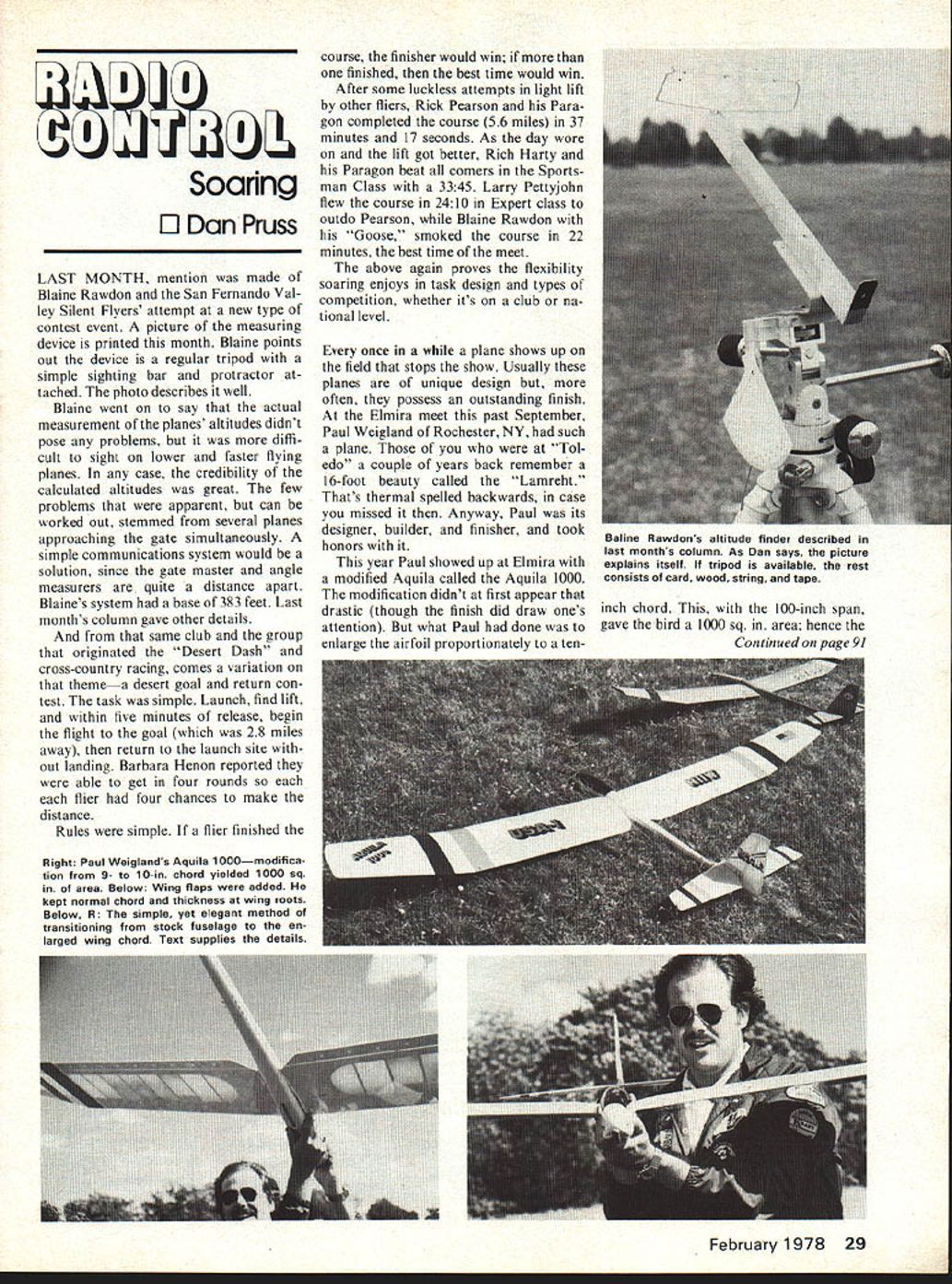
LAST MONTH, mention was made of Blaine Rawdon and the San Fernando Valley Silent Flyers' attempt at a new type of contest event. A picture of the measuring device is printed this month. Blaine points out the device is a regular tripod with a simple sighting bar and protractor attached. The photo describes it well.
Blaine went on to say that the actual measurement of the planes' altitudes didn't pose any problems, but it was more difficult to sight on lower and faster flying planes. In any case, the credibility of the calculated altitudes was great. The few problems that were apparent, but can be worked out, stemmed from several planes approaching the gate simultaneously. A simple communications system would be a solution, since the gate master and angle measurers are quite a distance apart. Blaine's system had a base of 383 feet. Last month's column gave other details.
And from that same club and the group that originated the "Desert Dash" and cross-country racing, comes a variation on that theme — a desert goal and return contest. The task was simple. Launch, find lift, and within five minutes of release, begin the flight to the goal (which was 2.8 miles away), then return to the launch site without landing. Barbara Henon reported they were able to get in four rounds so each flier had four chances to make the distance.
Rules were simple. If a flier finished the course, the finisher would win; if more than one finished, then the best time would win.
After some luckless attempts in light lift by other fliers, Rick Pearson and his Paragon completed the course (5.6 miles) in 37 minutes and 17 seconds. As the day wore on and the lift got better, Rich Harty and his Paragon beat all comers in the Sportsman Class with a 33:45. Larry Pettyjohn flew the course in 24:10 in Expert class to outdo Pearson, while Blaine Rawdon with his "Goose," smoked the course in 22 minutes, the best time of the meet.
The above again proves the flexibility soaring enjoys in task design and types of competition, whether it's on a club or national level.
Every once in a while a plane shows up on the field that stops the show. Usually these planes are of unique design but, more often, they possess an outstanding finish. At the Elmira meet this past September, Paul Weigland of Rochester, NY, had such a plane. Those of you who were at "Toledo" a couple of years back remember a 16-foot beauty called the "Lamreht." That's thermal spelled backwards, in case you missed it then. Anyway, Paul was its designer, builder, and finisher, and took honors with it.
This year Paul showed up at Elmira with a modified Aquila called the Aquila 1000. The modification didn't at first appear that drastic (though the finish did draw one's attention). But what Paul had done was to enlarge the airfoil proportionately to a ten-inch chord. This, with the 100-inch span, gave the bird a 1000 sq. in. area; hence the name Aquila 1000.
So he could use the existing fuselage. Paul maintained the original root rib dimensions, and transitioned to the enlarged section from the root to the next rib as shown in the photos. This not only pro- duced a favorable aesthetic effect, but allowed for stock wing interchangeability with the stock fuselage.
Flaps were added as shown, and actuated a la the pull system provided with dial cord on spoiler systems. The cord, instead of being connected directly to the flaps via a 90-degree bend through tubing as in a spoiler system, runs parallel through the wing to an arm on a 90-degree bellcrank. A 1/16-in. wire pushrod is then run from the bellcrank's other arm to the flaps.
The bellcrank is mounted on a plywood sheet between the ribs, and is spring loaded to a preset down position by an adjustable stop. Flap travel is only a few degrees either side of neutral, and the flaps are used primarily to effect a slight camber change.
Paul claims flap flutter has not been a problem, as one would think might exist with a nonrigid system. However, attention should be kept with regard to battery drain because of such a drive system.
For his award winning finishes, Paul uses acrylic lacquer on the fuselage, while the flying surfaces are Monokoted. The trim is also Monokote. For the shadowed letter effect, letters are cut from any adhesive backed material and then stuck on to black Monokote trimsheet. The desired outline then is cut out, and the finished pattern applied to the wings, tail, or whatever—a most eye-pleasing effect.
Two new products that are long overdue
Two new products that are long overdue come from Sailplane Accessory Co., Box 412, Bardonia, NY 10954. One is a wing support system that incorporates two spring steel blades. The method isn't new. Some imported kits have had the system for years, and Jerry Mrlik has used it on his Astro-Jeffs for just as long. However, besides the blades, Sailplane Accessory Co. provides not only beautifully molded set of wing channels, but also a center vee section. The latter wasn't available from the imports.
The blade measures 7 1/4 x 1/8 inches and the wing blade box is 5 3/4 x 5/8. The vee block measures four inches long by 3/8 deep, and each of the channels and vee section is 1/4 inch thick. The complete assembly sells for $7.50.
Advantages of such a wing mounting system includes better launches because of less wing flex. Also, with such a mount, short wing dihedrals can be used near the trailing edge. This allows the wing to flex forward in the event of a sudden stopping and has saved more than a few Astro-Jeff wings.
The other product from the same company is called the E-Z Spoiler Linkage. Again, the system isn't new but is now available in the USA. All components are beautifully and accurately molded and provide for a direct and positive link from fuselage to wing. The package says spoiler linkage, but the hardware also could be used for actuating ailerons or flaps. This assembly sells for $3.50.
FAI Report: Members of the National Soaring Society again coordinate planning for an FAI team selection program in 1978 for a possible world championship in 1979, in accord with the current FAI practice of scheduling world championships in any particular category on an every-other-year basis. Thus, the 1979 event is the earliest that another RC Soaring World Championships can be held.
NSS president Dr. Stan Pfost appointed Ray Marvin to head up the coordination effort in conjunction with AMA. Ray advises that the program is expected to be similar to the one Jim Simpson administered in 1976. This means a series of quarter finals in possibly April through June, and the semi-finals in July; the finals would be in September. Details must first be approved by participants in the program. Sites will be announced later.
WINGS, or Women In National Gliding Society, announced their 1977 competition winner. Taking four best contests out of six for scoring, Joan Nolte was tops. Joan is the wife of the late, and only, fourth LSF level V, Neil Nolte.
In case you were wondering department: The annual pilgrimage to Cumberland, Md. this year was a success only from a gourmet's point of view. This annual post-contest-season get-together was a fog/rainout this year. The no-contest, no-pressure event usually brings out different types of planes not usually associated with the contest circuit. This year was no different, but it was strictly hangar flying. Weather kept us all close to the fire. Dave Corven did manage one 25-minute flight—only because he got up before breakfast. The rest of the Detroit contingent was smarter.
By noon on Saturday, the clans from Detroit and Pennsylvania had fondue pots going and homemade wine and sausage laid out. Where does it say only 10-minute maxes can be fun? Let it rain! On Saturday evening, Don Clark from the DCRC, who coordinates this annually with the Cumberland Aero Modeling Society, announced at the banquet no change in the schedule for next year. So circle Nov. 4 and 5, 1978 for a fun soaring weekend—whatever the weather.
Dan Pruss, Rt. 2, Box 490, Plainfield, IL 60544.
Transcribed from original scans by AI. Minor OCR errors may remain.

