
Radio Control: Soaring
Dave Garwood 5 Birch Lane, Scotia NY 12302 E-mail: DaveGarwood@compuserve.com
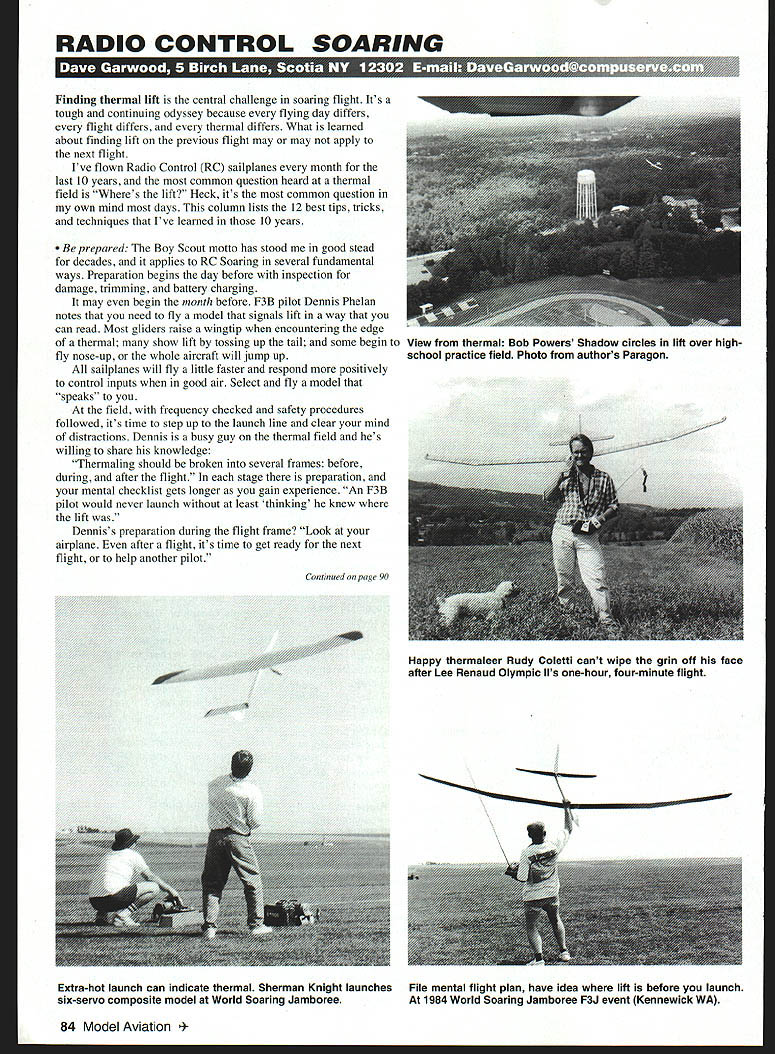
Finding thermal lift is the central challenge in soaring flight. It's a tough and continuing odyssey because every flying day differs, every flight differs, and every thermal differs. What is learned about finding lift on the previous flight may or may not apply to the next flight.
I've flown radio-control (RC) sailplanes every month for the last 10 years, and the most common question heard at a thermal field is "Where's the lift?" Heck, it's the most common question in my own mind most days. This column lists the 12 best tips, tricks, and techniques that I've learned in those 10 years.
Preparation
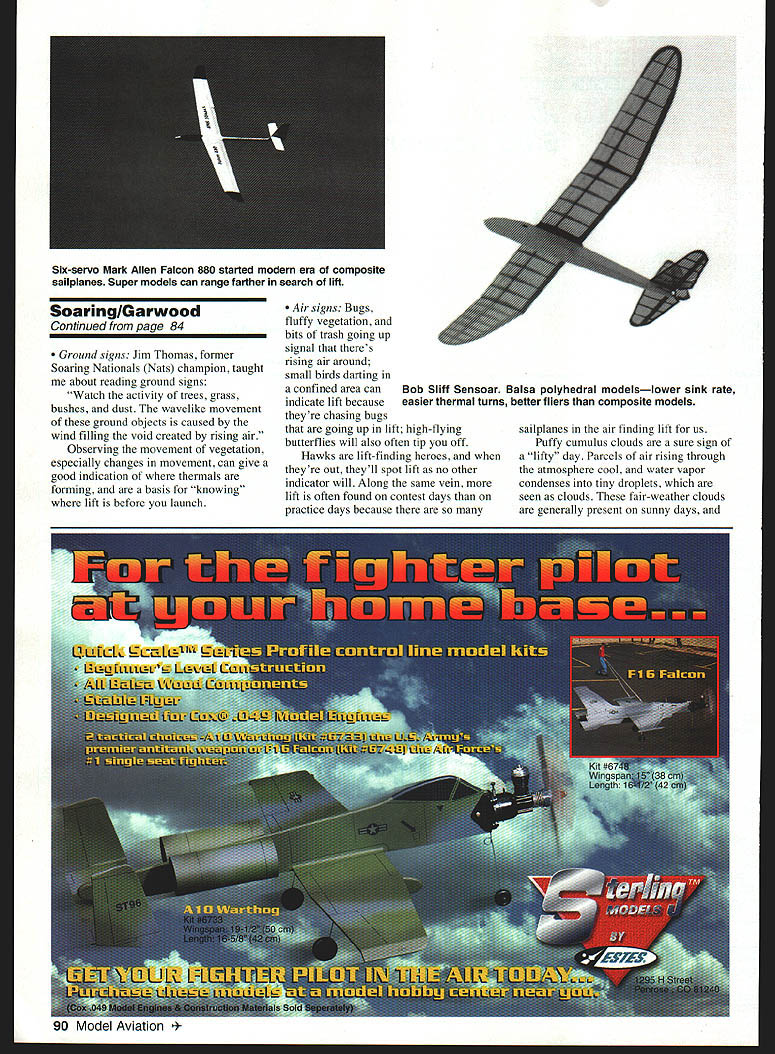
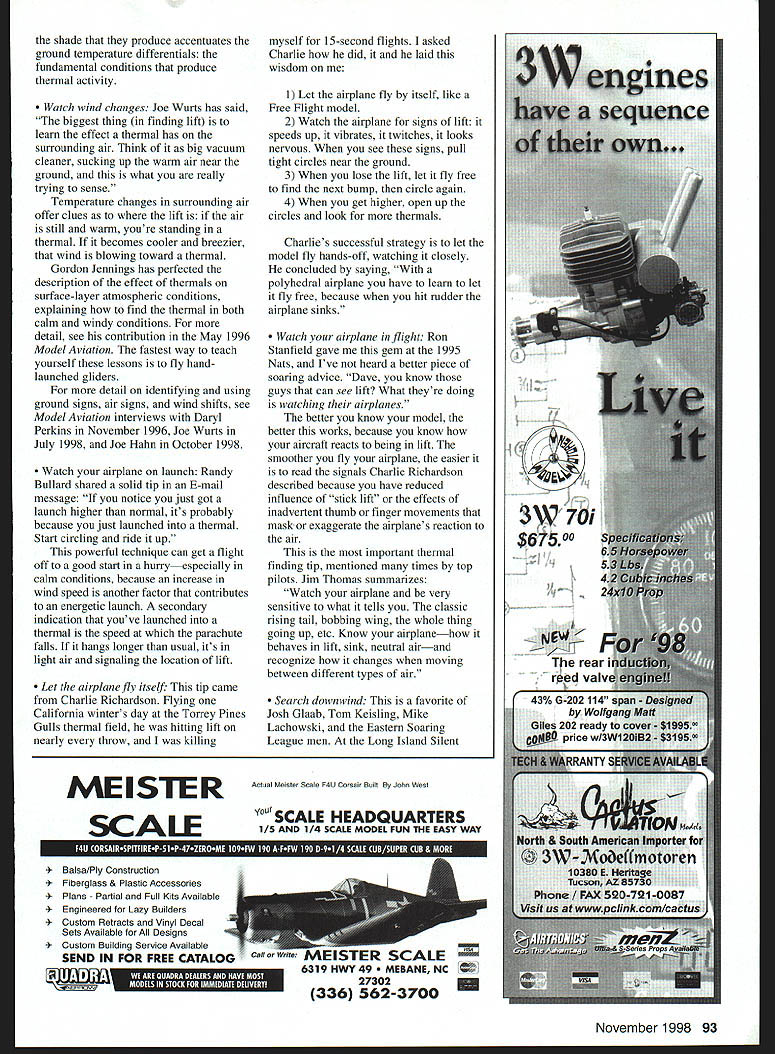
Be prepared: the Boy Scout motto has stood me in good stead for decades, and it applies to RC soaring in several fundamental ways. Preparation begins the day before with inspection for damage, trimming, and battery charging. It may even begin the month before. F3B pilot Dennis Phelan notes that you need to fly a model that signals lift in a way you can read. Most gliders raise a wingtip when encountering the edge of a thermal; many show lift by tossing up the tail; some begin to fly nose-up; and some models will simply jump up.
All sailplanes will fly a little faster and respond more positively to control inputs when in good air. Select and fly a model that "speaks" to you.
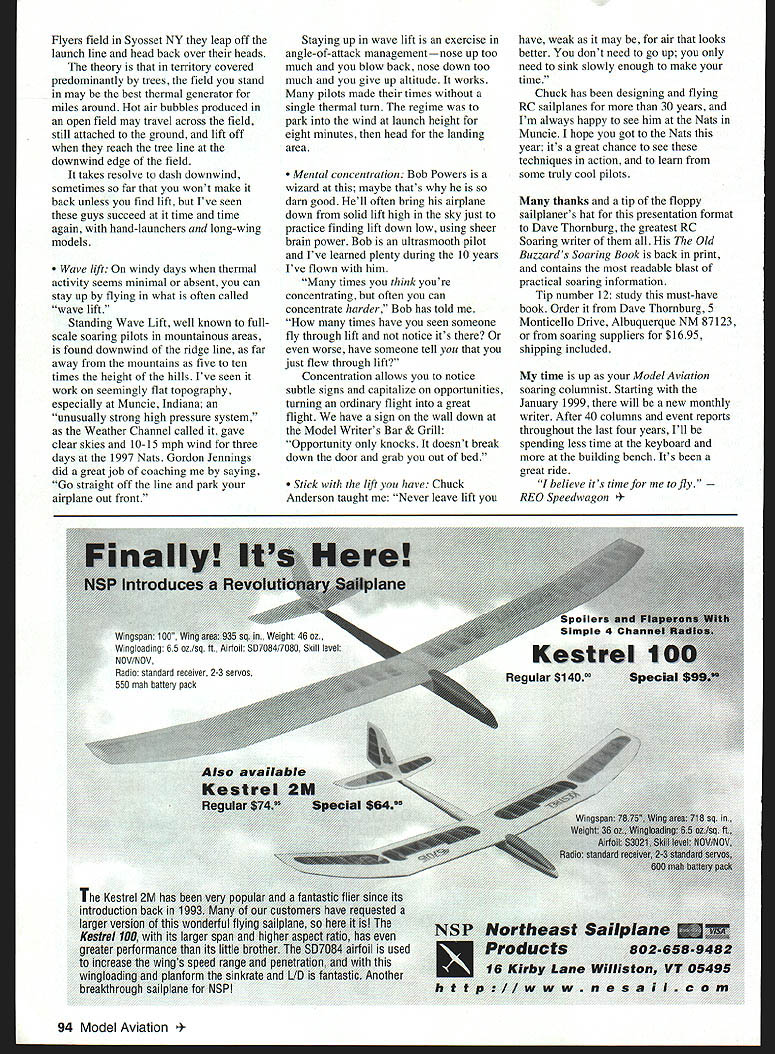
At the field, with frequency checked and safety procedures followed, it's time to step up to the launch line and clear your mind of distractions. Dennis is a busy guy on the thermal field and he's willing to share his knowledge: "Thermaling should be broken into several frames: before, during, and after the flight." In each stage there is preparation, and your mental checklist gets longer as you gain experience. "An F3B pilot would never launch without at least 'thinking' he knew where the lift was."
Dennis's preparation during the flight frame? "Look at your airplane. Even after a flight, it's time to get ready for the next flight, or to help another pilot."
Ground signs
Jim Thomas, former Soaring Nationals champion, taught me about reading ground signs: "Watch the activity of trees, grass, bushes, and dust. The wavelike movement of these ground objects is caused by the wind filling the void created by rising air." Observing the movement of vegetation, especially changes in movement, can give a good indication of where thermals are forming, and is a basis for "knowing" where lift is before you launch.
Air signs
- Bugs, fluffy vegetation, and bits of trash going up signal that there's rising air around.
- Small birds darting in a confined area can indicate lift because they're chasing bugs that are going up in lift.
- High-flying butterflies will also often tip you off.
- Hawks are lift-finding heroes; when they're out, they'll spot lift as no other indicator will.
- More lift is often found on contest days than on practice days because there are so many sailplanes in the air finding lift for us.
Puffy cumulus clouds are a sure sign of a "lifty" day. Parcels of air rising through the atmosphere cool and water vapor condenses into tiny droplets, which are seen as clouds. These fair-weather clouds are generally present on sunny days and often indicate where thermals are forming.
Watch wind changes
Joe Wurts has said the biggest thing in finding lift is to learn the effect a thermal has on the surrounding air. Think big—a vacuum cleaner sucking up warm air near the ground; what you're really trying to sense are temperature and wind changes in the surrounding air. They offer clues. If the air is still warm where you're standing, when a thermal becomes cooler it becomes breezier; wind will often blow toward the thermal.
Gordon Jennings has a polished description of how thermals affect surface-layer atmospheric conditions and how to find thermals in both calm and windy conditions; see his contribution in the May 1996 Model Aviation. The fastest way to teach yourself is to fly hand-launched gliders and practice identifying ground signs, air signs, and wind shifts; see Model Aviation interviews with Daryl Perkins (November 1996), Joe Wurts (July 1998), and Joe Hahn (October 1998).
Watch your airplane on launch
Randy Bullard shared a solid tip in an e-mail: "If you notice you just got a launch higher than normal, it's probably because you just launched into a thermal. Start circling and ride it."
This powerful technique can get a flight off to a good start in a hurry—especially in calm conditions—because an increase in wind speed is another factor that contributes to an energetic launch. A secondary indication that you've launched into a thermal is the speed at which the parachute falls. If it hangs longer than usual, it's in light air and signaling the location of lift.
Let the airplane fly itself
This tip came from Charlie Richardson after a winter day at the Torrey Pines Gulls thermal field when he was hitting lift on nearly every throw:
- Let the airplane fly by itself, like a free-flight model.
- Watch the airplane for signs of lift: it speeds up, it vibrates, it twitches, it looks nervous. When you see these signs, pull tight circles near the ground.
- When you lose the lift, let it fly free to find the next bump, then circle again.
- When you get higher, open up the circles and look for more thermals.
Charlie's strategy is to let the model fly hands-off, watching it closely. He concluded, "With a polyhedral airplane you have to learn to let it fly free, because when you hit rudder the airplane sinks."
Watch your airplane in flight
Ron Stanfield gave me this gem at the 1995 Nats: "Dave, you know those guys that can see lift? What they're doing is watching their airplanes."
The better you know your model, the better this works, because you know how your aircraft reacts to being in lift. The smoother you fly your airplane, the easier it is to read the signals Charlie described because you reduce the influence of "stick lift"—inadvertent thumb or finger movements that mask or exaggerate the airplane's reaction to the air.
This is the most important thermal-finding tip, mentioned many times by top pilots. Jim Thomas summarizes: "Watch your airplane and be very sensitive to what it tells you. The classic rising tail, bobbing wing, the whole thing going up, etc. Know your airplane—how it behaves in lift, sink, neutral air—and recognize how it changes when moving between different types of air."
Search downwind
This is a favorite of Josh Glaab, Tom Keisling, Mike Lachowski, and the Eastern Soaring League men. At the Long Island Silent Meet, flyers at the field in Syosset, NY, leap off the launch line and head back over their heads.
The theory is that in territory covered predominantly by trees, the field you stand in may be the best thermal generator for miles around. Hot air bubbles produced in an open field may travel across the field, still attached to the ground, and lift off when they reach the tree line at the downwind edge of the field.
It takes resolve to dash downwind—sometimes so far that you won't make it back unless you find lift—but I've seen these guys succeed at it time and time again, with hand-launchers and long-wing models.
Wave lift
On windy days when thermal activity seems minimal or absent, you can stay up by flying in what is often called "wave lift."
Standing wave lift, well known to full-scale soaring pilots in mountainous areas, is found downwind of the ridge line, as far away from the mountains as five to ten times the height of the hills. I've seen it work on seemingly flat topography, especially at Muncie, Indiana. An "unusually strong high pressure system," as the Weather Channel called it, gave clear skies and 10–15 mph wind for three days at the 1997 Nats. Gordon Jennings coached me: "Go straight off the line and park your airplane out front."
Staying up in wave lift is an exercise in angle-of-attack management—nose up too much and you blow back; nose down too much and you give up altitude. It works. Many pilots made their times without a single thermal turn. The regime was to park into the wind at launch height for eight minutes, then head for the landing area.
Mental concentration
Bob Powers is a wizard at this; maybe that's why he is so darn good. He'll often bring his airplane down from solid lift high in the sky just to practice finding lift down low, using sheer brain power. Bob is an ultralight pilot and I've learned plenty during the 10 years I've flown with him.
"Many times you think you're concentrating, but often you can concentrate harder," Bob told me. "How many times have you seen someone fly through lift and not notice it's there? Or even worse, have someone tell you that you just flew through lift?"
Concentration allows you to notice subtle signs and capitalize on opportunities, turning an ordinary flight into a great flight. We have a sign on the wall down at the Model Writer's Bar & Grill: "Opportunity only knocks. It doesn't break down the door and grab you out of bed."
Stick with the lift you have
Chuck Anderson taught me: "Never leave lift you have, weak as it may be, for air that looks better. You don't need to go up; you only need to sink slowly enough to make your move."
Chuck has been designing and flying RC sailplanes for more than 30 years, and I'm always happy to see him at the Nats in Muncie. I hope you got to the Nats this year; it's a great chance to see these techniques in action and to learn from some truly cool pilots.
Tip 12: Read Dave Thornburg
Many thanks and a tip of the floppy sailplaner's hat to Dave Thornburg, the greatest RC soaring writer of them all. His The Old Buzzard's Soaring Book is back in print and contains an outstanding blast of practical soaring information.
Study this must-have book. Order it from Dave Thornburg, 5 Monticello Drive, Albuquerque, NM 87123, or from soaring suppliers for $16.95, shipping included.
My time is up as your Model Aviation soaring columnist. Starting with the January 1999 issue, there will be a new monthly writer. After 40 columns and event reports throughout the last four years, I'll be spending less time at the keyboard and more at the building bench. It's been a great ride.
"I believe it's time for me to fly." — REO Speedwagon
Transcribed from original scans by AI. Minor OCR errors may remain.

