
RADIO CONTROL SOARING
Ron Scharck, 7319 Olivetas Ave., La Jolla CA 92037
Each year the Soaring Nats gets better. This year it was great!
Thanks to the drive and tenacity of the League of Silent Flight (LSF) leadership, working in harmony with AMA, improvements have been substantial across the board. The events were better organized and ran more smoothly; the soaring site and equipment improved dramatically; and someone is arranging for the weather to improve each year: no rain (one slight drizzle) and highs in the 80s!
In a period of eight days there were nine soaring events, the "officially unofficial" HL Golf event, and a banquet. Two new events, Cross Country and RES (Rudder–Elevator–Spoiler), were well attended.
We were pleased to see 14 entries in the Junior/Senior divisions. Seniors included:
- Jeff Pfeifer
- Ben duPont
- Jeff Martzal
- Jeff Decker
- Eric Lewis
- Nathan Enders
- Daniel Vest
- Luke Waters
Juniors included:
- Dusty Miller
- Jim Brittin
- Chris Saunders
- Paul Griebenow
- Ryan Baldi
- Jon Miller
Cross Country (XC)
Cross Country had been absent from the schedule for a number of years. Eight teams competed — a total of 37 pilots and crew members.
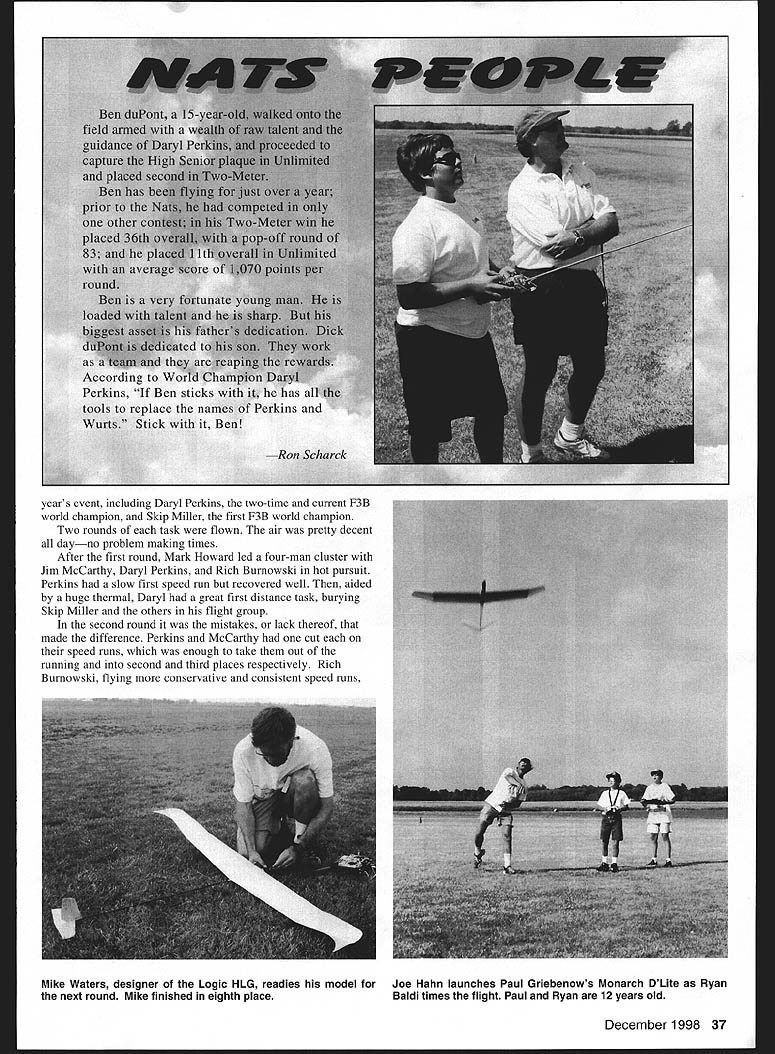
The course was 12.4 air miles (16.1 miles of road surface to complete) and presented a challenge. It included three "blind spots" (canopies of trees), a number of 90° turns, heavy-duty power lines, and fields of mature corn that threatened to swallow errant sailplanes. Most teams used variometers (also known as "ears"), big XC models, and a truck (or, in a couple of cases, convertibles).
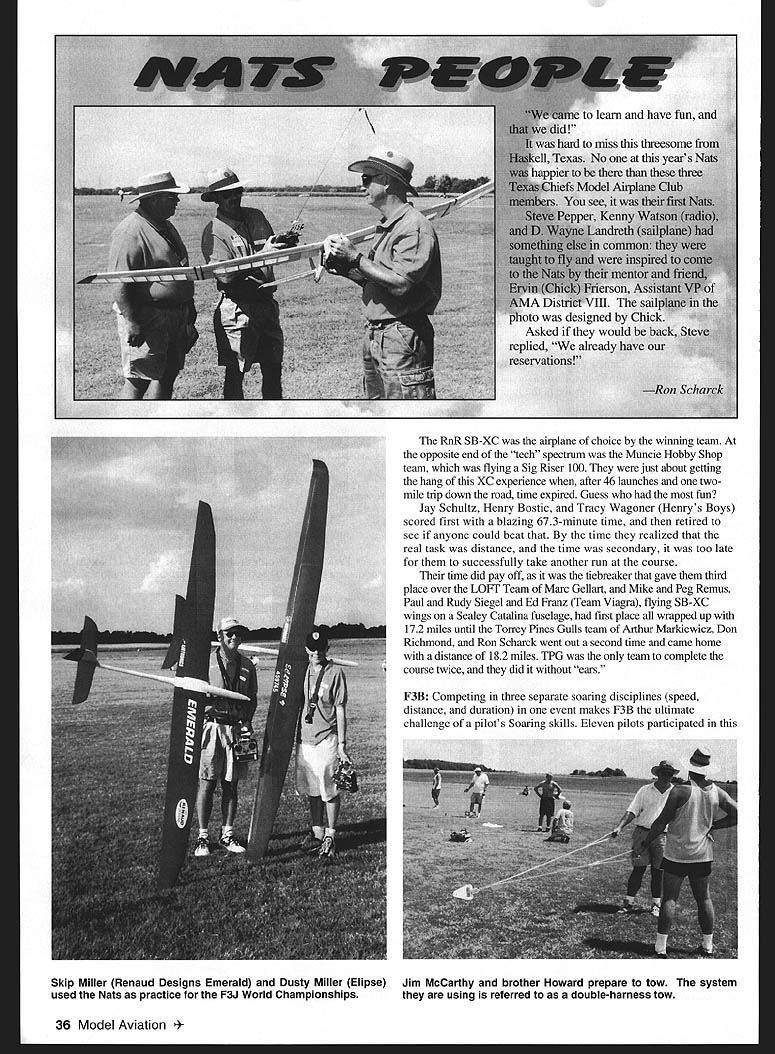
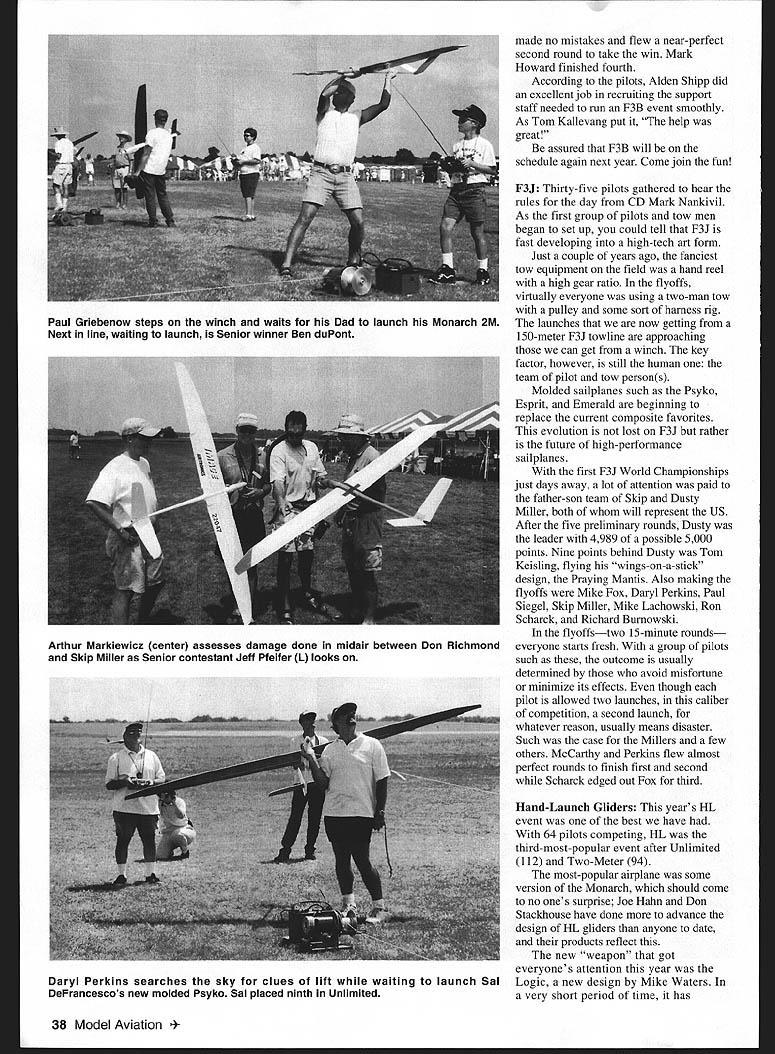
The R&R SB-XC was the airplane of choice by the winning team. At the opposite end of the tech spectrum was the Muncie Hobby Shop team, which flew a Sig Riser 100. They were just about getting the hang of the XC experience when, after 46 launches and one two-mile trip down the road, time expired. Guess who had the most fun?
Final results and notable teams:
- First place: Torrey Pines Gulls — Arthur Markiewicz, Don Richmond, Ron Scharek — distance 18.2 miles (the only team to complete the course twice, and they did it without "ears").
- Second place: Paul and Rudy Siegel and Ed Franz (Team Viagra) — flew SB-XC wings on a Sealey Catalina fuselage; had first place wrapped up with 17.2 miles until TPG's second run.
- Third place: Henry Bostic (Henry's Boys) — Jay Schultz, Henry Bostic, and Tracy Wagoner scored first with a blazing 67.3-minute time which later served as the tiebreaker over the LOFT Team.
F3B
Competing in three separate soaring disciplines (speed, distance, and duration) in one event makes F3B the ultimate challenge of a pilot's soaring skills. Eleven pilots participated in this event.
Two rounds of each task were flown. The air was pretty decent all day—no problem making times.
After the first round, Mark Howard led a four-man cluster with Jim McCarthy, Daryl Perkins, and Rich Burnowski in hot pursuit. Perkins had a slow first speed run but recovered well. Then, aided by a huge thermal, Daryl had a great first distance task, burying Skip Miller and the others in his flight group.
In the second round it was the mistakes, or lack thereof, that made the difference. Perkins and McCarthy each had one cut on their speed runs, which was enough to take them out of the running and into second and third places respectively. After the second round, Daryl Perkins won, Jim McCarthy took second, and Rich Burnowski finished third.
Alden Shipp did an excellent job recruiting the support staff needed to run the F3B event smoothly. As Tom Kallevang put it, "The help was great and assured the F3B will be scheduled again next year. Come join the fun."
F3J
Thirty-five pilots gathered to hear the rules the first day. Contest Director (CD): Mark Nankivil. As the first groups of pilots and tow men began to set up, you could tell F3J was fast developing into a high‑tech art.
Just a couple of years ago, the fanciest tow equipment on the field was a hand reel with a high gear ratio. In the flyoffs, virtually everyone was using a two‑man tow with a pulley and some sort of harness rig. The launch functions that we are now getting from a 150‑meter F3J towline are approaching those we can get from a winch. The key factor, however, is still the human one: the team of pilot and tow person(s).
Molded sailplanes such as the Psyko, Esprit, and Emerald are beginning to replace the current composite favorites. This evolution is not lost on F3J but rather is the future of high‑performance sailplanes.
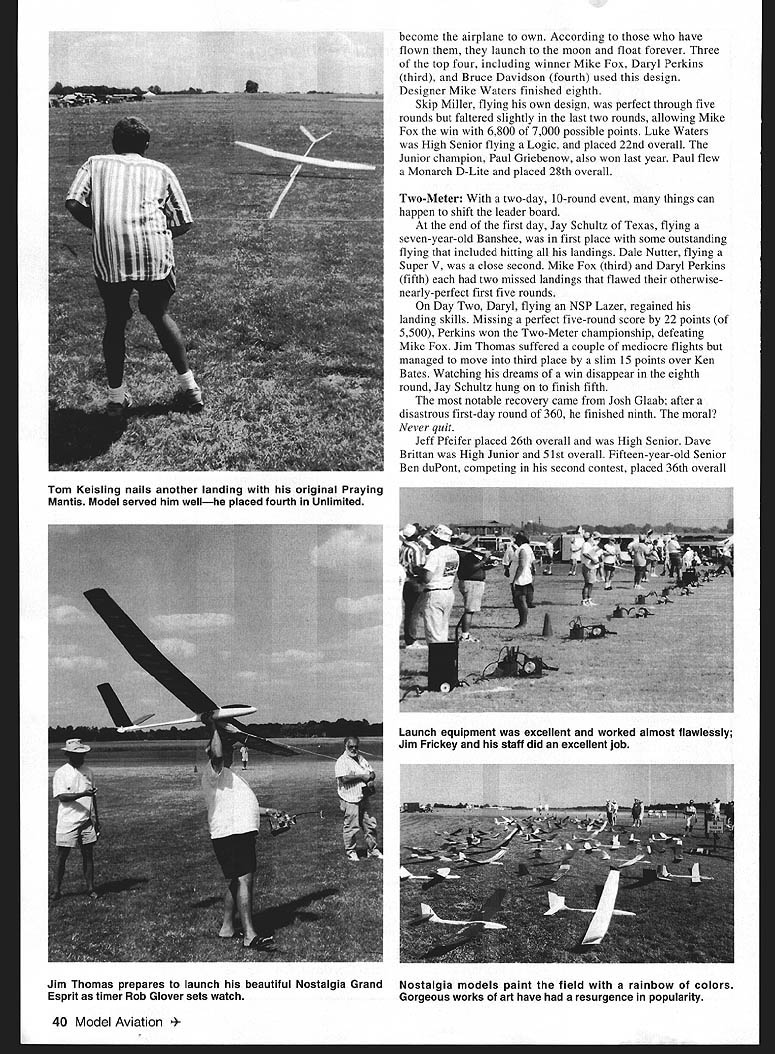
With the first F3J World Championships just days away, a lot of attention was paid to the father‑son team of Skip and Dusty Miller, both of whom would represent the US. After the five preliminary rounds, Dusty was the leader with 4,989 of a possible 5,000 points. Nine points behind Dusty was Tom Kieseling, flying his "wings-on-a-stick" design, the Praying Mantis. Also making the flyoffs were Mike Fox, Daryl Perkins, Paul Siegel, Skip Miller, Mike Lachowski, Ron Scharek, and Richard Burnowski.
In the flyoffs—two 15‑minute rounds—everyone starts fresh. With a group of pilots such as these, the outcome is usually determined by those who avoid misfortune or minimize its effects. Even those who are allowed two launches, in this caliber of competition, find that a second launch usually means disaster. Such was the case for the Millers and a few others. McCarthy and Perkins flew almost perfect rounds to finish first and second while Scharek edged out Fox for third.
Hand-Launch Gliders (HL)
This year's HL event was one of the best we have had. With 64 pilots competing, HL was the third-most-popular event after Unlimited (112) and Two‑Meter (94).
The most-popular airplane was some version of the Monarch, which should come as no one's surprise; Joe Hahn and Don Stackhouse have done more to advance the design of HL gliders than anyone to date, and their products reflect this.
The new "weapon" that got everyone's attention this year was the Logic, a new design by Mike Waters. In a very short period of time, it has become the airplane to own. According to those who have flown them, they launch to the moon and float forever. Three of the top four, including winner Mike Fox, Daryl Perkins (third), and Bruce Davidson (fourth) used this design. Designer Mike Waters finished eighth.
Skip Miller, flying his own design, was perfect through five rounds but faltered slightly in the last two rounds, allowing Mike Fox the win with 6,800 of 7,000 possible points. Luke Waters was High Senior flying a Logic, and placed 22nd overall. The Junior champion, Paul Griebenow, also won last year. Paul flew a Monarch D‑Lite and placed 28th overall.
Two‑Meter
With a two‑day, 10‑round event, many things can happen to shift the leaderboard.
At the end of the first day, Jay Schultz of Texas, flying a seven‑year‑old Banshee, was in first place with some outstanding flying that included hitting all his landings. Dale Nutter, flying a Super V, was a close second. Mike Fox (third) and Daryl Perkins (fifth) each had two missed landings that flawed their otherwise nearly perfect first five rounds.
On Day Two, Daryl, flying an NSP Lazer, regained his landing skills. Missing a perfect five‑round score by 22 points (of 5,500), Perkins won the Two‑Meter championship, defeating Mike Fox. Jim Thomas suffered a couple of mediocre flights but managed to move into third place by a slim 15 points over Ken Bates. Watching his dreams of a win disappear in the eighth round, Jay Schultz hung on to finish fifth.
The most notable recovery came from Josh Glaab; after a disastrous first‑day round of 360, he finished ninth. The moral? Never quit.
Jeff Pfeifer placed 26th overall and was High Senior. Dave Brittan was High Junior and 51st overall. Fifteen‑year‑old Senior Ben duPont, competing in his second contest, placed 36th overall.
Daryl Perkins won the Two‑Meter championship with 8,326 points, including one pop‑off round of 36 points.
Unlimited
This is the big show! Big airplanes, big attendance (112), big scores.
The weather for both days was unusually cool (80s) with overcast skies. Thermals were few and far between, but the air was very buoyant. Most pilots who made the longer flight times (10 minutes or more) did so by launching high, cruising until they hit an area of hyper‑buoyant air, then making as few S‑turns as possible to stay in the area. Efficiency was the keyword.
At the end of Day One, Daryl Perkins' molded Psyko was two points off perfect with a 4,398 score. Mike Lachowski, Richard Burnowski, Tom Kieseling, and Bob Powers were in a virtual four‑way tie for second. Fewer than 100 points separated the top 16 places.
After Day Two, the top ten remained virtually intact, aside from some shuffling of places and the addition of Sal DeFrancesco. The second‑best performance for the day was by Josh Glaab (5,467) who placed 13th.
When discussing outstanding flying, include the names of Seniors Ben duPont, Eric Lewis, and Jeff Pfeifer, and Junior Chris Saunders. Ben finished 11th overall, with an average score of 1,070 points per round, and was High Senior. Chris Saunders (29th) was High Junior.
A hidden statistic that tarnished the overall standings was that each of these young pilots had at least one disastrous flight of less than 500 points, including a zero for Jeff. Each of these young men are talented pilots and forces to be reckoned with—now!
Sport Scale
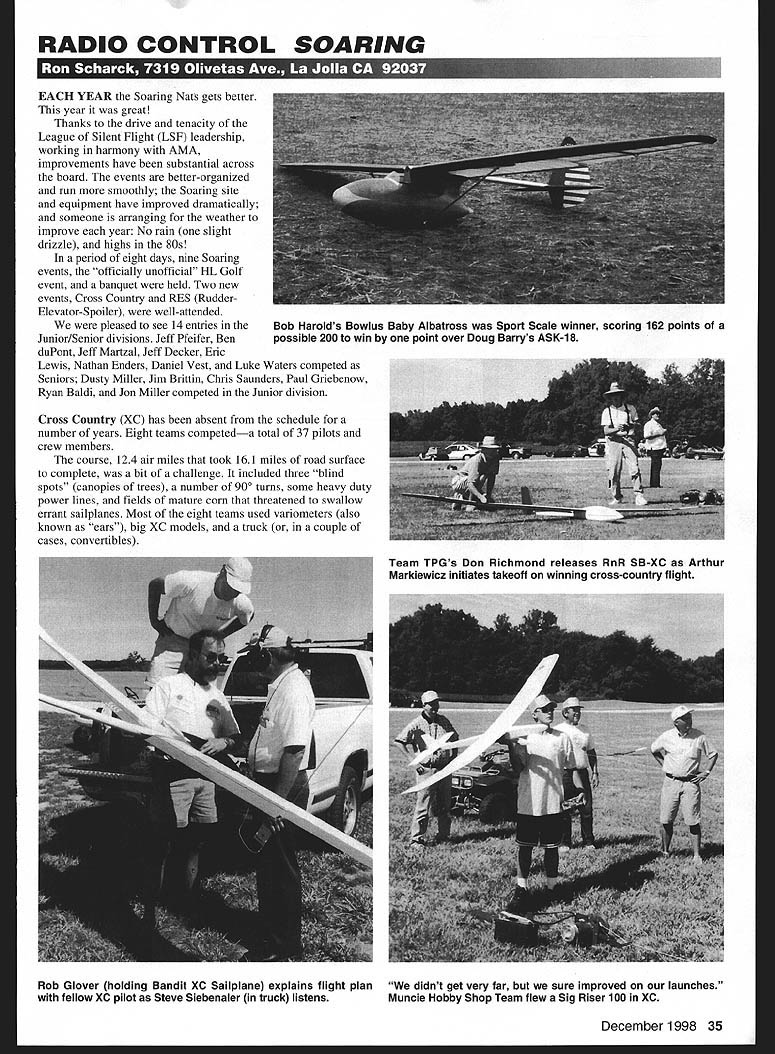
For the first time in a number of years, this was a contest. No one was happier about the competition than Bob Harold, who has been the lone participant for the past several years. Flying his signature three‑meter Bowlus Baby Albatross, Bob won the event with 162 of a possible 200 points. Doug Barry, flying his four‑meter ASK‑18, had the highest flight score but finished second by one point. David Elias of Florida flew his 3.4‑meter Kestrel 19 to a third‑place finish, while Oklahoman D.O. Darnell finished fourth with his sleek glass slipper, a four‑meter Discus C.
Look for some changes to next year's scheduling and format, including the probability of aerotowing. LSF and AMA are working on a plan to make it possible. Plan to be a part of this great event in 1999.
Nostalgia and RES (Rudder–Elevator–Spoiler)
Legionnaire, Grand Esprit, Bird of Time, Sailaire, Windfree, Challenger—the names go on, and the chance to see these great sailplanes from the past in the same thermal is awe‑inspiring.
Nostalgia (for sailplanes that were published before January 1, 1980) is gaining in popularity, with 40 entries this year. Thirty‑nine pilots competed in the new RES event. Twenty‑four of the 39 flew in both events with Nostalgia‑legal airplanes.
The format was for each event to fly four alternating rounds. The combination of a strong breeze, fast‑moving thermals, and airplanes that don't penetrate too well made even the best pilots take the "walk of shame."
Nostalgia winners:
- Jim Thomas
- Johnny Berlin
- Don Harris
- Oliver Wilson
- Leon Kincaid
RES winners:
- Bob Johnson
- John Schmoll
- Leon Kincaid
- Pat Flinn
- Steve Siebenaler
Hand‑Launch Golf (HL Golf)
The "break" in the real competition comes on the two afternoons of the Two‑Meter event, when a wild and crazy group of guys head off across the Indiana back roads to Cardinal Hills Golf Course. Armed with hand‑launch gliders, a sufficient cache of beverages, golf carts, and drivers (for the golf carts), 30 or so normally sane adults and a handful of youths turn an otherwise tranquil rural setting into a scene from the Keystone Kops.
If it appears that there is a lack of names and scores, there is a reason: it's not really important. The objective is to race from tee box to green in the fastest time with the least number of throws (shots) to get the airplane within a wingspan of a foam cup (the hole). This series of steps is repeated for each of the nine holes played.
After the golf part is over, the serious part of the evening is when the fliers gather around the last hole and bet they can knock a cap off a bottle with an HLG without disturbing the bottle. It costs a buck a try and the winner takes all. Most players pay the dollar for the opportunity to hear the gathered crowd chant their name in unison. After two nights and countless attempts, a winner was established: Josh Glaab is now retired and is living somewhere in the Bahamas.
Organization and Thanks
LSF president Cal Posthuma and Alden Shipp, LSF/AMA Nats Director, were the driving forces behind this year's Nats. They had an excellent team to work with, including LSF Vice President Jack Strother and Contest Directors Mark Howard, Jim Frickey, Mark Nankivil, Dan Abra, Jim Porter, Jack Lafret, Mike McGowan, Bob Harold, and Henry Bostick.
The 100+ members of the volunteer support staff that ran the winches (Jim Frickey), turnarounds (Dana Fleming), impound area (Marna Jefferies), scoring (John Hazel), etc., did a superlative job. This group, together with AMA's Steve Kaul and District X's Al Williamson's constant attention to make sure we had everything we needed from AMA, made the '98 Nats the best ever.
If you really love to fly a variety of sailplanes, there is no better vacation than a week at the Nats. As far as cost goes, Muncie is one of the most reasonable places I know. The accommodations are great. The AMA site is fantastic and getting better every year. Plan to spend an unforgettable week in Muncie next year at the 1999 Soaring Nats, July 25–August 5, and bring a friend!
Transcribed from original scans by AI. Minor OCR errors may remain.

