
RADIO CONTROL SOARING
Ray Juschkus 59 Livingston St., St. James NY 11780 E-mail: rayjay@ix.netcom.com
It is December, and the temperature here has been in the 60s for the last few weeks. I was out flying in a light jacket this past weekend; the wind was light and the lift was excellent.
Typically I would be wearing a heavy coat, and my hands would be so cold that my fingers would feel as if they were going to fall off. The great news is that this weekend promises to be the same, but this will soon pass and the temperatures will get back to normal — in the 30s.
This is the time of year that thoughts turn to building. If you are building a competitive model for this coming season, why not consider making it more visible? There is nothing worse than flying in competition and losing sight of your airplane when it's up about 1,500 feet.
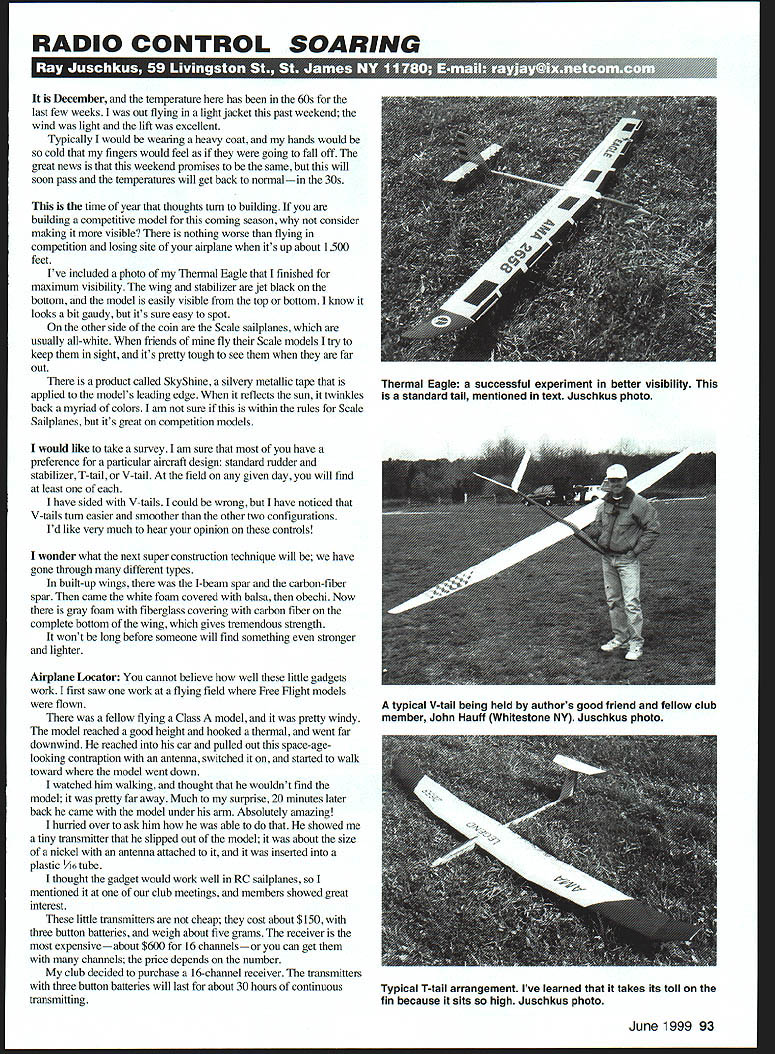
I've included a photo of my Thermal Eagle that I finished for maximum visibility. The wing and stabilizer are jet black on the bottom, and the model is easily visible from the top or bottom. I know it looks a bit gaudy, but it's sure easy to spot.
On the other side of the coin are the scale sailplanes, which are usually all-white. When friends of mine fly their scale models I try to keep them in sight, and it's pretty tough to see them when they are far out.
There is a product called SkyShine, a silvery metallic tape that is applied to the model's leading edge. When it reflects the sun, it twinkles back a myriad of colors. I am not sure if this is within the rules for scale sailplanes, but it's great on competition models.
Tail Preference Survey
I would like to take a survey. I am sure that most of you have a preference for a particular aircraft design:
- standard rudder and stabilizer
- T-tail
- V-tail
At the field on any given day, you will find at least one of each. I have sided with V-tails. I could be wrong, but I have noticed that V-tails turn easier and smoother than the other two configurations. I'd very much like to hear your opinion on these controls!
Construction Techniques
I wonder what the next super construction technique will be; we have gone through many different types. Examples we've seen in built-up wings include:
- I-beam spar and carbon-fiber spar
- white foam covered with balsa, then obechi
- gray foam with fiberglass covering and carbon fiber on the complete bottom of the wing, which gives tremendous strength
It won't be long before someone finds something even stronger and lighter.
Airplane Locator
You cannot believe how well these little gadgets work. I first saw one work at a flying field where free flight models were flown.
There was a fellow flying a Class A model, and it was pretty windy. The model reached a good height and hooked a thermal, and went far downwind. He reached into his car and pulled out this space-age-looking contraption with an antenna, switched it on, and started to walk toward where the model went down.
I watched him walking, and thought that he wouldn't find the model; it was pretty far away. Much to my surprise, 20 minutes later he came back with the model under his arm. Absolutely amazing!
I hurried over to ask him how he was able to do that. He showed me a tiny transmitter that he slipped out of the model; it was about the size of a nickel with an antenna attached, and it was inserted into a plastic 1/16-inch tube.
I thought the gadget would work well in RC sailplanes, so I mentioned it at one of our club meetings, and members showed great interest.
These little transmitters are not cheap; they cost about $150, include three button batteries, and weigh about five grams. The receiver is the most expensive — about $600 for a 16-channel unit — or you can get receivers with many channels; the price depends on the number. The transmitters with three button batteries will last for about 30 hours of continuous transmitting.
One might ask, would you want to spend that kind of money on a gadget? After you have control of a model you can usually bring it back and land it. You never know.
My friend Paul Zink has his own setup — meaning his own transmitter and receiver. While out flying, a rather expensive sailplane (exceeding $1,000 including radio equipment) had a little transmitter onboard. Shortly after he launched, he heard something go wrong with the winch. Paul looked down to see what was going on, looked back up, and could no longer see the airplane. He had no idea what direction the model went — besides downwind — and was never able to get a sighting. The model disappeared.
Paul turned on his trusty receiver and started to scan the horizon. He started walking in the direction of the strongest signal coming in. After about a mile the signal got very strong. He looked up and the model was in a tree. Paul was able to get the sailplane down and it lived to fly another day.
What chances would Paul have had of finding the airplane without the equipment? Pretty slim. I'm sure you can think of a time when you could have used one of these little miracles. If you would like information about the units, contact Walston Retrieval Systems, 800-657-4672.
Events and Club News
F3J Eastern Semifinals / US F3J Selection Finals will be held at the Long Island Silent Flyers Field, Syosset, NY. If your club makes the host, it sounds like fun. The 1999 flying season looks busy, with Eastern Soaring League contests in June and an aero-tow fun-fly in May.
Scale sailplanes are showing a great rebirth; more and more are showing up at my club's field every weekend. My friend Peter DeStefano is trying to convert our members into scale builders; unfortunately, we are not as flawless at building as Pete.
If you attended the Elmira, NY, aero-tow event in June of last year, you might have seen Pete's museum-quality Schweizer TG-2. The previous year he placed first overall and received his award from Mr. Schweizer himself; Pete was thrilled.
My club keeps records of outstanding flights that our members have made. Klaus Schmid and Sal Iasilli are ardent devotees of scale, and are expert scale model fliers. They hold many records, such as Team Scale Thermal Duration of two hours and three minutes from a winch launch — not an easy task.
If you have ever flown the more modern type of scale airplanes, with the T-tails and launching from a winch, you might have experienced the classic tail-tuck that you get immediately after launch. It has happened to me, and it's a trying moment before the aircraft straightens out and continues up.
Klaus and Sal have mastered a way to prevent this from happening: use a bridle. This is not a new idea, but instead of having a towhook under the fuselage, they put a towhook on each side of the fuselage just under the leading edge of the wing.
The bridle consists of a sort of yoke of heavy line, with two rings which are attached to the hooks and released with the drag of a chute.
I would like to hear about what you and your club or group are doing, as far as building or flying is concerned, so that I can include it in the column.
After all, we are all in this sport together, and we should share our knowledge with each other. This could be a lot of fun for you and for me. See you downwind.
Transcribed from original scans by AI. Minor OCR errors may remain.

