
RADIO CONTROL SOARING
Which radio do I need?
Which radio do I need for a sailplane? Many people ask that question, and my response is, "do you want the short version or the long version?"
Short version: one that is legal and reliable.
Long version: any current-market radio will do fine for the average sailplane. Airtronics is popular among competitive fliers, although Futaba, JR, Hitec, Tower, and others will work well for a beginning sailplane pilot.
Buy the best radio you can afford without destroying your hobby budget. A top-of-the-line radio won't make you fly any better, and it may even cause problems—ask the pilot at your local club who occasionally plants an airplane because of a wrong switch.
Generally, beginners are intimidated by the latest and greatest equipment. One could easily spend more than $2,000 for a cutting-edge transmitter and servos, but you don't need to start at the top.
The Soaring recruitment effort will be more successful if we don't scare newcomers off. Imagine telling the parent of a 10-year-old that you have $1,500 invested in that carbonized King Fisher in front of you. He'll probably roll his eyes and leave. If you show him a modest Two-Meter model you paid $26 for, an $80 radio, and $40 worth of glue, covering, and accessories, he's more likely to stay. Let them see how well the inexpensive model flies and let them take a turn.
Beginners won't need channel mixing, flaps, butterfly, crow, spoilers, reflex, elevator compensation, rudder/aileron coupling, or aileron differential for a while. By the time they know what those features mean, they'll be ready for a computer radio.
Recommendations for beginners
- For newcomers, a simple three- or four-channel radio is recommended.
- Used radios can be a good deal, but make sure the unit uses a legal frequency—preferably FM and FCC-compliant.
- Check that the radio has good range and change the batteries before use.
- Consider Hitec's single-stick three-channel radios; they're inexpensive and all you need to fly beginner airplanes, slopers, and foamies.
- Less expensive is okay for starters, but a four-channel radio limits the types of aircraft you can easily set up and adjust.
If a beginner buys a simple radio and later wants to upgrade, they may find it hard to sell the old unit. Most people want to move up rather than down; sell the starter radio to another newbie or to a hand-launch or slope pilot looking for a low-end system.
Computer radios and upgrading
The truth is that most competitive high-performance sailplanes that use ailerons and flaps require the features that only a computer radio can provide. Computerized radios allow you to:
- Hold mixes in memory.
- Store setups for several aircraft.
- Easily program multi-channel aircraft.
If you are serious, start saving for a computer radio and plan for at least six servo channels: rudder, elevator, two for flaps, and two for ailerons. The ease of programming in newer models makes it fairly simple to set up a two- or three-channel aircraft; most people can learn that task in a few minutes.
Through the years, radio prices have dropped. In the 1970s a Kraft seven-channel cost more than $500; today you can get close to state-of-the-art functionality for a fraction of that price, though some extras may still cost more.
Final tips
- Keep it simple (the KISS philosophy) if you are a newbie.
- One radio capable of controlling all your aircraft is easier to manage than multiple complete systems—less maintenance and upkeep.
- If you are starting out or just trying sailplanes, start with a simple system. If you are serious, invest in a computer radio with sufficient channels.
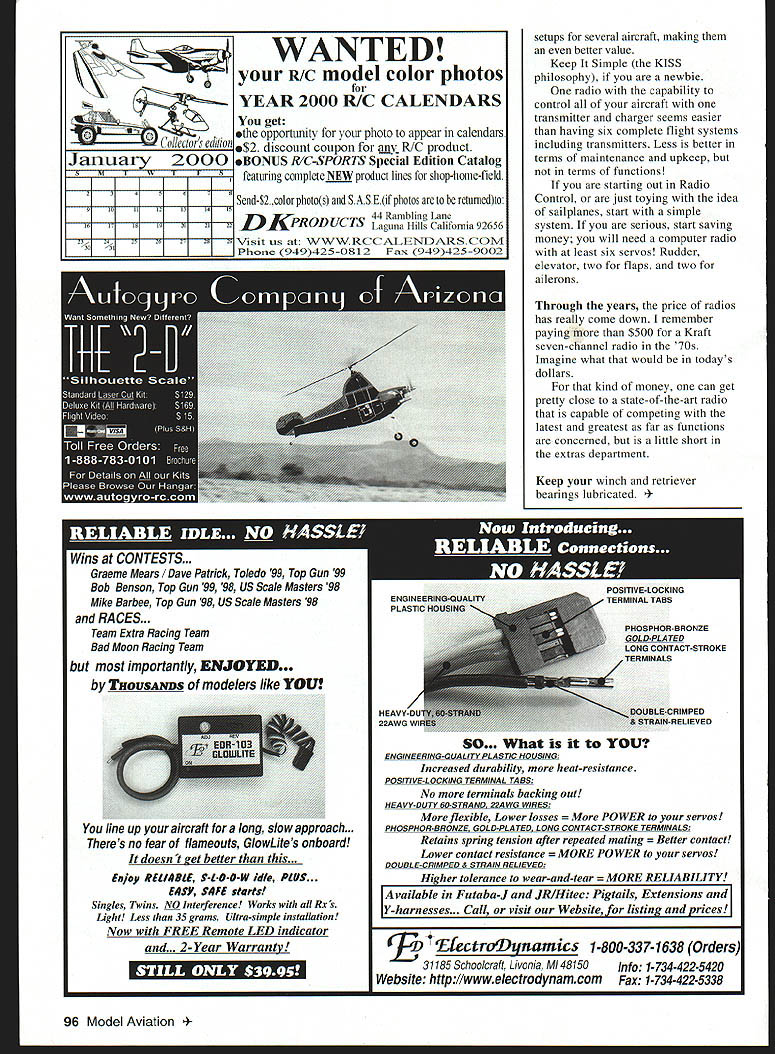
- Keep your winch and retriever bearings lubricated.
Transcribed from original scans by AI. Minor OCR errors may remain.

