
RADIO CONTROL SOARING
Mike Garton 506 NE 6th St., Ankeny IA 50021 E-mail: mike@iastate.edu
Airtronics and the Nostalgia Class
The Airtronics name has played a significant part in soaring during the last three decades. Lee Renaud's designs, especially the Aquila and Sagitta, have become classics. As contemporary glider design marched on, those designs became dated and were discontinued.
The advent of the Nostalgia class has sparked new interest in some of these older designs. Nostalgia class allows pre-1980 designs to compete against each other in a separate "antique glider" class.
Jack Lafret, the creator of the Nostalgia rules, intentionally set the cutoff at designs that were kitted or published before January 1, 1980, to exclude the Airtronics Sagitta. The Sagitta had many of the features of modern designs.
At the end of this column is a website address for a complete listing of Nostalgia class rules.
Dream Catcher Hobbies and the Airtronics Purchase
On April 23, 1999, Roy Simpson of Dream Catcher Hobbies Inc. purchased the rights to the old Airtronics designs and tooling, which included 23 glider designs, 12 power airplanes, and two electric airplanes. The only Airtronics design that Roy did not purchase rights to was the Olympic II, which is still in production under the Whyte Wings label.
Roy said it took him and his staff a couple of weeks to inventory the 112,000 pieces of hardware from the purchase.
The glider designs included
- Adante
- Aquila
- Aquila Grande
- Aquila XL
- Cadet UT-1
- Cumic
- Cumic Plus
- Duster (BJ-1B) Scale
- Esprit
- Gem HLG
- Grand Esprit
- Legend
- Olympic 650
- Questor
- Sagitta 600
- Sagitta 900
- Sagitta XC
- Square Soar 72
- Super Olympic
- Super Questor
- Vector 76
- Whisper 95
- Whisper Two-Meter
Don't expect to see any of the old Airtronics designs for sale immediately; Roy has a great deal of work to do before any of them appear. He must decide which kits to reintroduce, which ones to do first, whether to beef up structures, whether to redraw plans in CAD (computer-aided drafting), and work up necessary machine fixtures and prototypes. Redesigned kits must be made, tested, and marketing photos taken before release. Roy is anxious to find out the current status; check the Dream Catcher web page listed at the end of the article to familiarize yourself with the company.
Dream Catcher is a manufacturer and mail-order retailer with real facilities in Bristol, Indiana, and full-time employees. The company currently produces 14 kits under its own label and another 56 under contract for other companies. As a manufacturing operation, Dream Catcher does not have a storefront for visitors, but it does accept telephone, mail, fax and e-mail orders for retail sales. Dream Catcher has a policy of not quoting specific shipping dates.
The Sailaire kit has already been successfully reintroduced by Dream Catcher. The old Craft-Air Sailaire kit sold for $159.95 in 1976; you can buy the new Dream Catcher kit for less through Tower Hobbies. The lower costs made possible by modern manufacturing may mean that prices for reintroduced Airtronics designs will follow the same trend.
Most Nostalgia-legal airplanes have polyhedral wings and high-lift airfoils. Relative to modern airplanes they are easy, relaxing fliers. Sailaire fliers often bring a lawn chair to sit while thermaling. Another practice seen with big slow models is to dial thermal turn with rudder trim and set the transmitter down. Once you get the big floaters specked out in a thermal they may stay up another 30 minutes while you relax and look for additional lift. This relaxing style of flying sounds like a cup of tea.
Also check out the product lines from Ray Hayes, Sky Bench, and Aerotech for subjects related to Nostalgia.
Wind Freak — a Flying Wing Anecdote
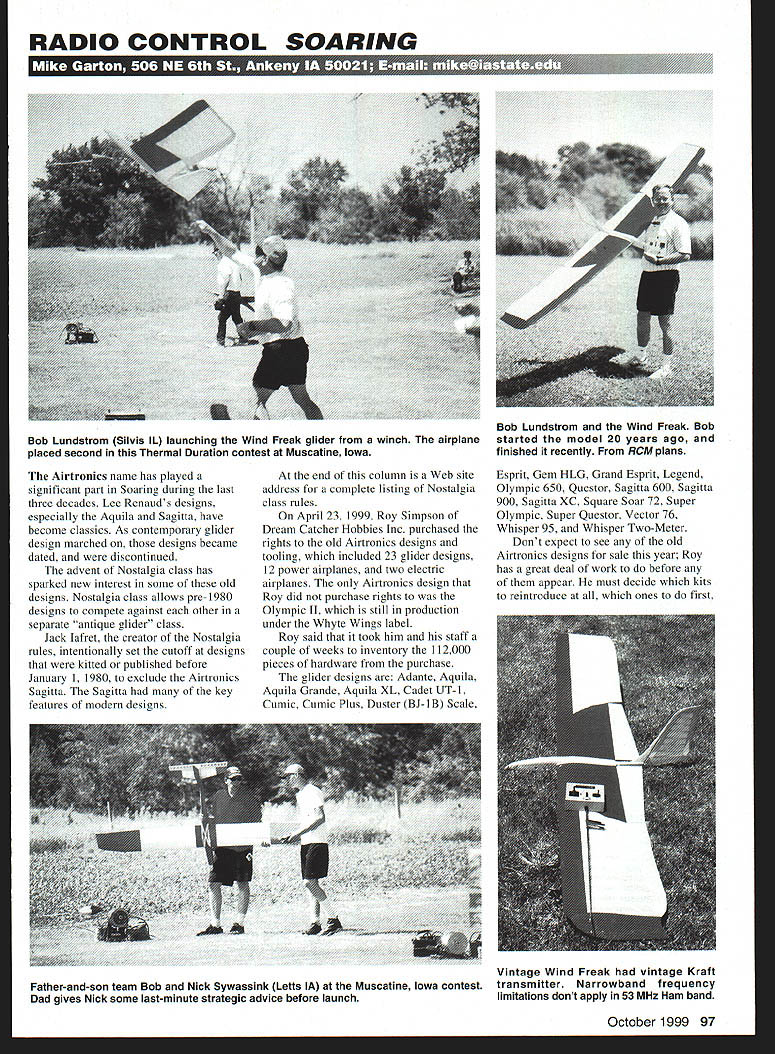
Long ago I saw a very rare old airplane attending a contest in Muscatine, Iowa. Bob Lundstrom, Silvis, Illinois, was flying Wind Freak, a flying wing built from Radio Control Modeler (RCM) plans. Bob framed up the wooden structure in 1979 and only just got around to finishing it recently — a surprising age for an airplane. Bob winch-launched the Wind Freak and did very well in the contest.
Winch-launching a flying wing can be tricky because of the low-lift airfoils and limited yaw control. Bob timed a seven-minute max flight and made a good landing, placing second in the Thermal Duration contest.
Most contemporary flying-wing designs use trailing-edge surfaces called elevons that act as both ailerons and elevators. The Wind Freak does have elevons, but it uses two-channel control (rudder and elevator). The surface at the center of the trailing edge functions solely as an elevator. It was the first time I had seen a flying wing entered in a contest.
SOAR Club Event and Boy Scouts Involvement
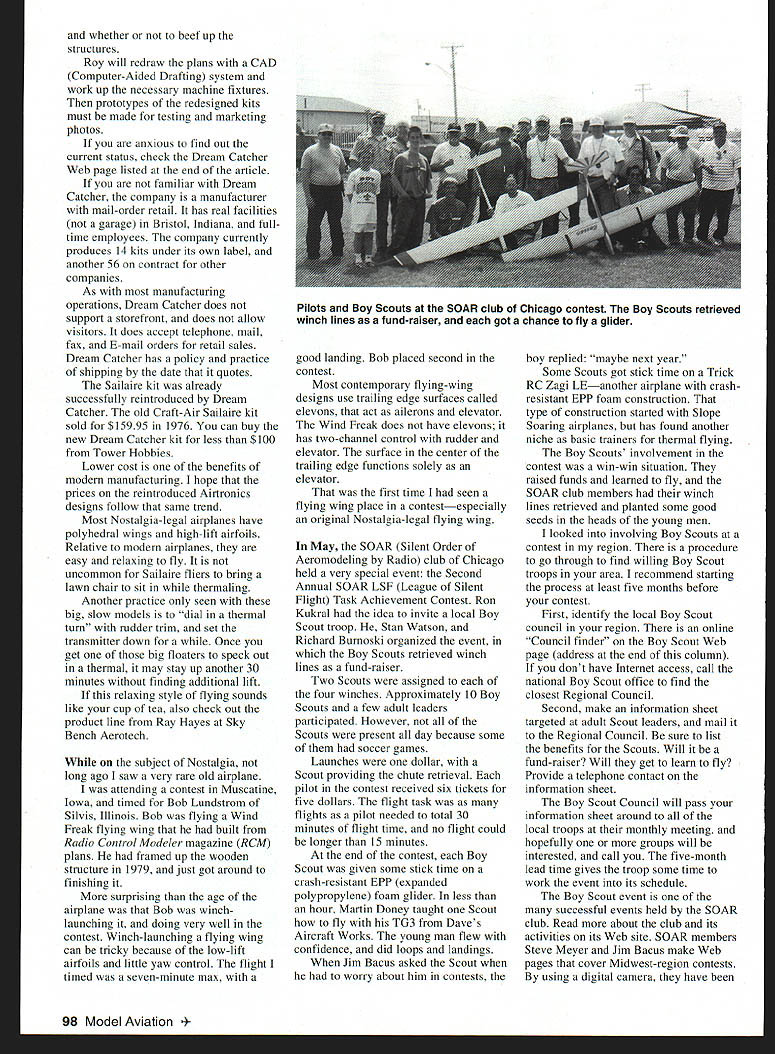
In May, the SOAR (Silent Order of Aeromodeling by Radio) club of Chicago held a special event: the Second Annual SOAR LSF (League of Silent Flight) Task Achievement Contest. Ron Kukral had the idea to invite a local Boy Scout troop. He, Stan Watson, and Richard Barnosky organized the event, in which the Boy Scouts retrieved winch lines as a fundraiser.
Two Scouts were assigned to each of the four winches. Approximately 10 Boy Scouts and a few adult leaders participated, although not all Scouts were present all day because some had soccer games.
Launches were one dollar, with a Scout providing the chute retrieval. Each pilot in the contest received six tickets for five dollars. The flight task was as many flights as a pilot needed to total 30 minutes of flight time, and no flight could be longer than 15 minutes.
At the end of the contest, each Boy Scout was given some stick time on a crash-resistant EPP (expanded polypropylene) foam glider. In less than an hour, Martin Dorney taught one Scout how to fly with his TG3 from Dave’s Aircraft Works. The young man flew with confidence, performing loops and landings.
When Jim Bacus asked the Scout when he had to watch out for him in contests, the boy replied: “maybe next year.”
Some Scouts got stick time on a Trick RC Zagi L-E — another airplane with crash-resistant EPP foam construction. That type of construction started with slope-soaring airplanes, but has found another niche as basic trainers for thermal flying.
The Boy Scouts’ involvement in the contest was a win-win. They raised funds and learned to fly, and the SOAR club members had their winch lines retrieved and planted some good seeds in the heads of the young men.
How to involve Boy Scouts at a contest
I looked into involving Boy Scouts at a contest in my region. There is a procedure to find willing Boy Scout troops in your area. I recommend starting the process at least five months before your contest.
- Identify the local Boy Scout council in your region. There is an online "Council Finder" on the Boy Scout web page (addresses at the end of this column). If you don’t have Internet access, call the national Boy Scout office to find the closest regional council.
- Make an information sheet targeted at adult Scout leaders, and mail it to the regional council. Be sure to list the benefits for the Scouts. Will it be a fundraiser? Will they get to learn to fly? Provide a telephone contact on the information sheet.
- The Boy Scout council will pass your information sheet around to all of the local troops at their monthly meeting, and hopefully one or more groups will be interested and call you. The five-month lead time gives the troops time to work the event into the local schedule.
The Boy Scout event is one of the many successful events held by the SOAR club. Read more about the club and its activities on its website. SOAR members Steve Meyer and Jim Bacus make web pages that cover Midwest-region contests. By using a digital camera, they have been able to get web pages finished and online a couple of days after an event.
Sources
- Dream Catcher Hobby, Inc.
Box 77, Bristol IN 46507 (219) 523-1938 www.dchobby.com
- Whyte Wings
774-A North Twin Oaks Valley Rd., San Marcos CA 92069 (760) 744-1553 www.torreypinesgulls.org/WWHome.htm
- Official Nostalgia rules and list of legal designs:
- Tower Hobbies
Box 9078, Champaign IL 61826-9078 (800) 637-7303 www.towerhobbies.com
- Sky Bench Aerotech
Box 316, Washington MI 48094 Tel./Fax: (810) 781-7018 www.skybench.com
- Wind Freak plans, RCM plan number #743, Designed by Roger Sanders, RCM 11/78
RCM Magazine Plans Service Box 487, Sierra Madre CA 91025 (800) 523-1736 www.mag-web.com/rc-modeler/index.html
- Dave's Aircraft Works (DAW)
34455 Camino El Molino, Capistrano Beach CA 92624 (949) 248-2773 www.davesaircraftworks.com
- Trick RC Products
938 Victoria Ave., Venice CA 90291 (310) 301-1614 www.zagi.com/Home/home.html
- SOAR club of Chicago contact: Bill Christian
1604 Chestnut Ave., Arlington Heights IL 60004 www.mcs.net/~stmeyer/SOAR
- Jim Bacus' web site:
www.mcs.net/~bacuslab/soaring.html
- Boy Scouts national home page:
- Boy Scouts Council Finder:
www.bsa.scouting.org/nav/recruit.html
Transcribed from original scans by AI. Minor OCR errors may remain.

