
Radio Control: Soaring
Mike Garton 506 NE 6th St., Ankeny IA 50021 E-mail: mike@iastate.edu
Model Aircraft Aerodynamics — Fourth Edition
Martin Simons has announced that the fourth edition of Model Aircraft Aerodynamics has finally been printed. It's a must-have reference for model-airplane builders.
The book covers all major aspects of aerodynamics while assuming no prior knowledge of the subject. Topics include airfoils, planforms, wingtips, drag, propellers, turbojets, electric power, stability and control, and many others. New Soaring-related sections include dynamic soaring, the effect of wind on turning near the ground, the UIUC (University of Illinois Urbana-Champaign) wind-tunnel tests, and aerotowing. The appendices include coordinates for 180 popular airfoils.
The first Model Aircraft Aerodynamics was printed more than 20 years ago. Martin has added material and updated the book with each edition. The new version has more pages — 344 including the appendices — printed on larger paper. All diagrams were redrawn for the new book, and it includes more than 50 color photographs.
No other book available introduces aerodynamics as well as this one; concepts are explained with words instead of mathematics. Some colleges have used previous editions in introductory aerospace engineering courses. The book is well worth the money. When purchasing the fourth edition, ask for ISBN 1-85486-190-5.
US F3J Team Trials
The US F3J team trials were held at Long Island, NY in July. Conditions were hot, but the event went well.
The new US team headed for Greece consists of:
- Joe Wurts
- Larry Jolly
- John Roe
- Alternate: Darrell Zaballos
Joe Wurts won the trials and made the team; he was the F3J world champion in 1998. Longtime flier Larry Jolly is in fine form again; his day job is making radio-controlled airplanes and helicopters for movies. John Roe is an up-and-coming pilot who has been flying since 1994. He is a full-time martial arts instructor; his discipline translates well to soaring. John earned sixth place out of 195 entries at the 1998 International F3J Interglide competition and placed fourth at this year's International Hand Launch Glider Festival.
The F3J Junior team consists of:
- Paul Griebenow
- Chris Jolly
- Dusty Miller
- Richard Waters
East Coast Hand Launch Classic — May 15-16
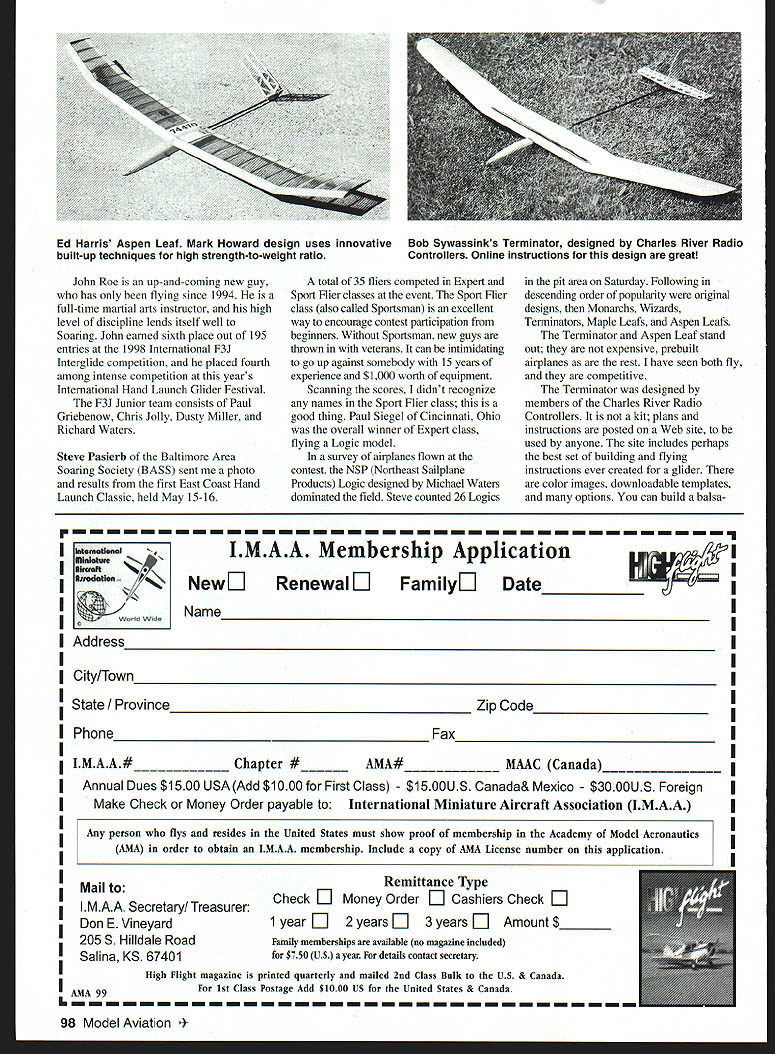
Steve Pasierb of the Baltimore Area Soaring Society (BASS) sent a photo and results from the first East Coast Hand Launch Classic.
- A total of 35 fliers competed in Expert and Sport Flier (also called Sportsman) classes.
- The Sport Flier class is an excellent way to encourage contest participation from beginners; without it, new pilots face intimidating competition from veterans.
- Paul Siegel of Cincinnati, Ohio was the overall winner of the Expert class, flying a Logic model.
A survey of airplanes flown at the contest showed the NSP (Northeast Sailplane Products) Logic, designed by Michael Waters, dominating the field. Steve counted 26 Logics in the pit area on Saturday. In descending order of popularity were:
- Original designs
- Monarchs
- Wizards
- Terminators
- Maple Leafs
- Aspen Leafs
The Terminator and Aspen Leaf stand out; they are not inexpensive prebuilt airplanes like many others. Both fly competitively.
Design Highlights
Terminator
- Designed by members of the Charles River Radio Controllers.
- Not a kit; plans and instructions are posted on a website for free use.
- The site includes an excellent set of building and flying instructions with color images, downloadable templates, and many options.
- You can build a balsa-ribbed wing or a foam-and-composite vacuum-bagged wing. Conventional and V-tails are shown.
- The Terminator flies well in both windy and calm conditions.
Aspen Leaf
- A relatively new design by Mark Howard.
- Innovative built-up wing and extensive carbon use result in an airplane that weighs 6 to 10 ounces ready-to-fly, yet is fairly strong.
- Example: Ed Harris's Aspen Leaf weighs 7½ ounces with a 110 mAh battery pack, FMA Tetra receiver, and two MPX30 servos.
- The balsa ribs of the Aspen Leaf wing are capped with a pre-cured carbon strip, producing a torsionally stiff wing. The spar is two round carbon rods with a balsa shear web between them. The airfoil is thin and undercambered.
- While not recommended for beginning builders, the Aspen Leaf is a great light-air machine.
Contest Notes and Equipment
The Baltimore Area Soaring Society owns a "lineman's" pole that extends to at least 50 feet. During the two days of the contest, the pole was used to retrieve airplanes from trees at least 10 times. The availability of the pole may have encouraged riskier flying.
- Average number of airplanes per pilot at the contest: four.
- Number of airplanes that had to have wings clipped to meet the 1.5-meter (59.055 inches) wingspan limit before the contest: four.
All major contests seem to be enforcing the 1.5-meter (59.055 inches) wingspan limit for Hand-Launch this year. In years past, 60-inch wingspans were allowed. Now that the 1.5-meter limit is widely adopted, there is little reason to build a 60-inch model.
EllipseUSA Imports
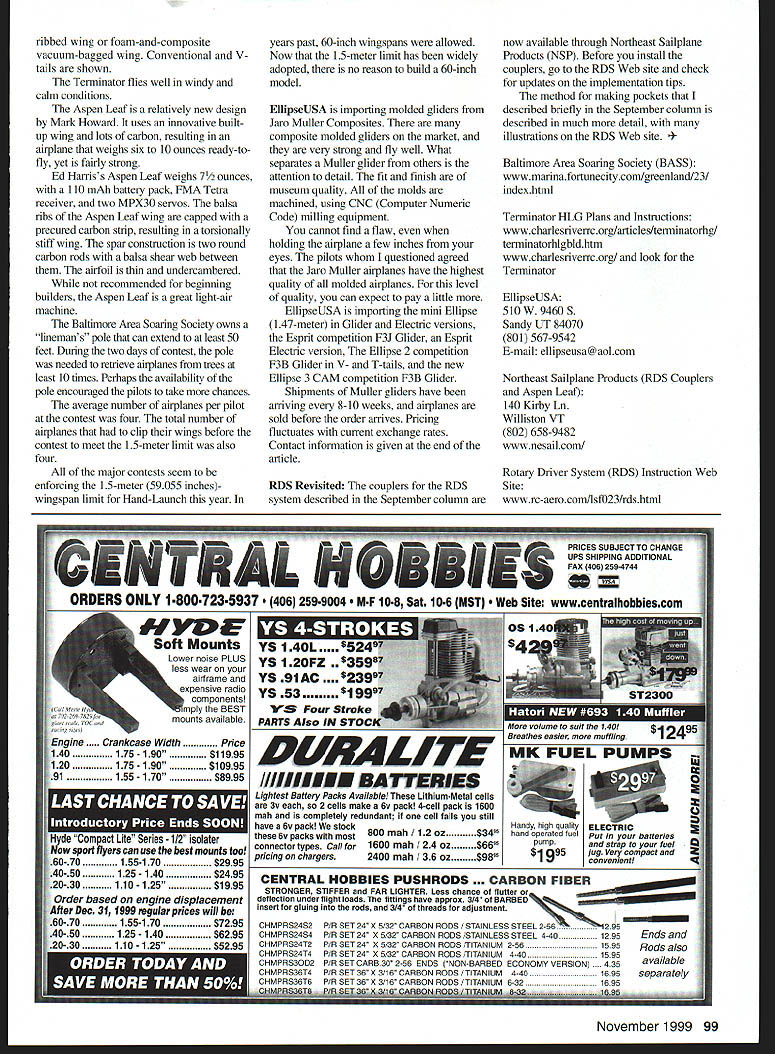
EllipseUSA is importing molded gliders from Jaro Muller Composites. Many composite molded gliders are available; they are strong and fly well. What separates a Muller glider is attention to detail: fit and finish are of museum quality. All molds are machined using CNC milling equipment. Pilots agreed that Jaro Muller airplanes have the highest quality among molded airplanes. For this level of quality, expect to pay a little more.
EllipseUSA is importing:
- Mini Ellipse (1.47-meter), glider and electric versions
- Esprit competition F3J Glider
- Esprit Electric version
- Ellipse 2 competition F3B Glider in V- and T-tails
- Ellipse 3 CAM competition F3B Glider
Shipments of Muller gliders have been arriving every 8–10 weeks, and airplanes are often sold before the order arrives. Pricing fluctuates with current exchange rates.
RDS Revisited
The couplers for the RDS (Rotary Driver System) described in the September column are now available through Northeast Sailplane Products (NSP). Before installing the couplers, check the RDS website for implementation updates.
The method for making pockets described briefly in the September column is explained in much more detail, with many illustrations, on the RDS website.
Contacts and Resources
- Baltimore Area Soaring Society (BASS)
www.marina.fortunecity.com/greenland/23/index.html
- Terminator HLG Plans and Instructions
www.charlesriverrc.org/articles/terminatorhg/terminatorhgld.htm www.charlesriverrc.org/ (look for the Terminator)
- EllipseUSA
510 W. 9460 S. Sandy UT 84070 (801) 567-9542 E-mail: ellipseusa@aol.com
- Northeast Sailplane Products (RDS Couplers and Aspen Leaf)
140 Kirby Ln. Williston VT (802) 658-9482 www.nesail.com
- Rotary Driver System (RDS) Instruction Web Site
www.rc-aero.com/lsl023/rds.html
Transcribed from original scans by AI. Minor OCR errors may remain.

