
Radio Control: Soaring
Dan Pruss
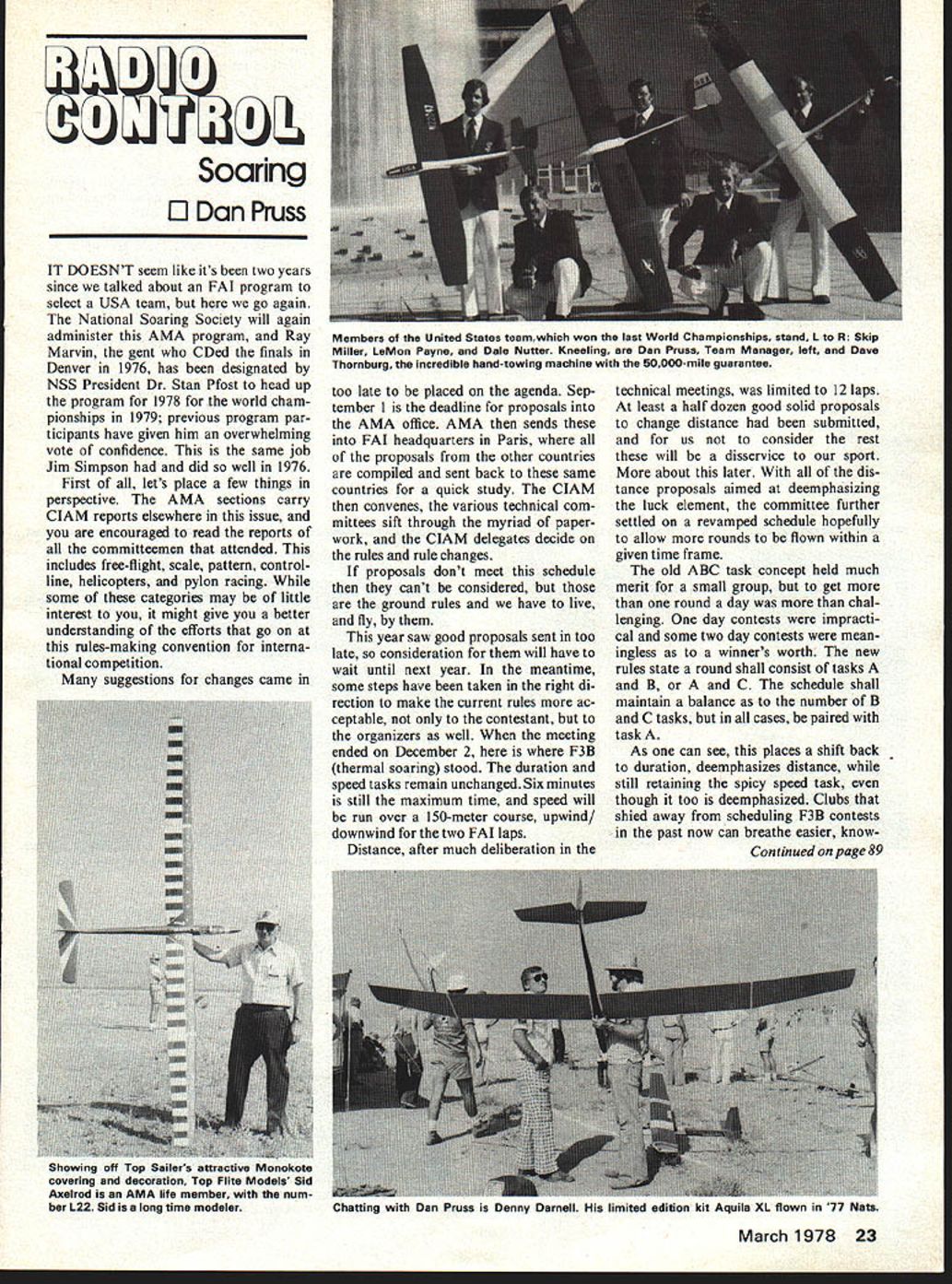
IT DOESN'T seem like it's been two years since we talked about an FAI program to select a USA team, but here we go again. The National Soaring Society will again administer this AMA program, and Ray Marvin, the gent who CDed the finals in Denver in 1976, has been designated by NSS President Dr. Stan Pfost to head up the program for 1978 for the world championships in 1979; previous program participants have given him an overwhelming vote of confidence. This is the same job Jim Simpson had and did so well in 1976.
First of all, let's place a few things in perspective. The AMA sections carry CIAM reports elsewhere in this issue, and you are encouraged to read the reports of all the committeemen that attended. This includes free-flight, scale, pattern, control-line, helicopters, and pylon racing. While some of these categories may be of little interest to you, it might give you a better understanding of the efforts that go on at this rules-making convention for international competition.
Many suggestions for changes came in too late to be placed on the agenda. September 1 is the deadline for proposals into the AMA office. AMA then sends these into FAI headquarters in Paris, where all of the proposals from the other countries are compiled and sent back to these same countries for a quick study. The CIAM then convenes, the various technical committees sift through the myriad of paperwork, and the CIAM delegates decide on the rules and rule changes.
If proposals don't meet this schedule then they can't be considered, but those are the ground rules and we have to live, and fly, by them.
This year saw good proposals sent in too late, so consideration for them will have to wait until next year. In the meantime, some steps have been taken in the right direction to make the current rules more acceptable, not only to the contestant, but to the organizers as well. When the meeting ended on December 2, here is where F3B (thermal soaring) stood. The duration and speed tasks remain unchanged. Six minutes is still the maximum time, and speed will be run over a 150-meter course, upwind/downwind for the two FAI laps.
Distance, after much deliberation in the technical meetings, was limited to 12 laps. At least a half dozen good solid proposals to change distance had been submitted, and for us not to consider the rest these will be a disservice to our sport. More about this later. With all of the distance proposals aimed at deemphasizing the luck element, the committee further settled on a revamped schedule hopefully to allow more rounds to be flown within a given time frame.
The old ABC task concept held much merit for a small group, but to get more than one round a day was more than challenging. One day contests were impractical and some two day contests were meaningless as to a winner's worth. The new rules state a round shall consist of tasks A and B, or A and C. The schedule shall maintain a balance as to the number of B and C tasks, but in all cases, be paired with task A.
As one can see, this places a shift back to duration, deemphasizes distance, while still retaining the spicy speed task, even though it too is deemphasized. Clubs that shied away from scheduling F3B contests in the past now can breathe easier, know. Having a more meaningful event can be held, because more rounds can be flown.
In the past, the throwaway round was treated with mixed emotions. If one round per day was all that could be flown in a meet, in effect, one day of the organizer's efforts was for naught. But the flier could throw out that round that saw a line break, or a tow go sour. Yet, he too had mixed feelings, for sometimes a throwaway round wasn't all that bad, and what could be a consideration for consistency received a big X on the scoreboard.
To help offset the bad luck of a bad launch, broken line, or whatever, the flier now will be allowed a relaunch within his working time, provided he hadn't crossed plan "A" in the speed or distance tasks. For what it's worth: If the top five at the South African World Championships retained their throwaway rounds, they would still have finished in the same order! The USA team would still have finished in first place, but second and third places would have been swapped between Australia and Great Britain.
As mentioned, many proposals had merit, but were turned down for whatever reasons. The one-on-one concept did receive much attention, but was treated most negatively by countries that supported it last year. The difficulties encountered included refights because a flagman or timer miscued, resulting in an entire relaunch of that group. The idea of mixing groups didn't always work in the intended manner, because like frequencies prevented certain contestants from competing head to head, and further resulted in hot fliers being always pitted against lesser rivals. More frequencies for RC will help in this area, but this will take some time.
A suggestion that had wide support was the allowance of self-starting electric gliders for F3B. At the moment the FAI ruling appears to favor not allowing them in world events (a special ruling would be needed). In our domestic contests we might adopt them as a class, or allow their use. Electric launchers give consistent launches and remove the need for towboats and helpers. There is some concern about the effect of electric launches on the towlines, and the possibility of hot launches that could be dangerous. Safety rules would have to be strict.
Radio Control: Soaring
Denmark, Norway, and Sweden all but scrapped the F3B program for last year's contest calendar, and flew task A and their own combined B and C task. B/C was a four-lap task flown crosswind over a 150-meter course, not unlike the current AMA rules. Denmark's proposal was not only worthy of consideration but included a most comprehensive report covering several Scandinavian organized contests. However, the proposals were sent in past the deadline and couldn't be honored.
Other rules included designating F3B category to RC Thermal Soaring Gliders only. F3F will be for slope soaring, and F3G for RC powered gliders, the latter of which seems all but a dead event internationally.
A proposal to limit launching to one system—hand towing—was squelched, and World War III was averted. The distance course is now divided into quarter laps, instead of ten, and this should make it somewhat easier for organizers, especially when a course has to be changed because of a wind shift.
About the best news to come from the meeting is that an overall freeze of three years will not be policy. However, the sporting code (that little pink book) will be broken down into two sections. The former will be known as before, as the sporting code, and will list the rules that are not prone to annual revision or change. This includes definition of helpers, official flights, basic definitions, classifications, builder-of-the-model rules, etc. This section will have a four-year freeze, while the second section—the supplement or annex—will allow annual changes. This section includes the meat of F3B—launching, tasks A, B, and C, and scoring. The one restriction on this section is the freeze on the rules the year before a world championships. More specifically, the rules established at this meeting will be used for 1978, and for the world championships in 1979. New proposals can be submitted in 1978, but cannot be used in official international competition. Incidentally, the USA and Belgium both submitted offers to hold the sailplane championships in 1979. A decision will be made at the bureau meeting in March as to which country will host the event.
Toward the beginning of this article it was mentioned how much deliberation was done over the many proposed changes to the distance task. The fact that so many proposals had merit makes one also realize these same proposed changes might be considered at a later date. But, if only one year is acceptable, it could take six to ten years to see your version of the task implemented.
This scribe's proposal was to allow all the acceptable proposed tasks to be included in the rules. The organizers could then choose the task or tasks that suit the site and stage a contest. This proposal was deemed too radical by the sub-committee chairman. However, other committee members do support such an idea and the next CIAM could just use acceptance of the triathlon, speed/distance as one task, man on man, eight-, ten- or 12-lap distance, and whatever else you propose. And that's the key word—you.
Frank Deis, Jr. is the FAI rules chairman for the NSS. One doesn't have to wait until the end of the flying season to offer a proposal. If you've got a hot idea, send it in now and avoid the rush next September 1st.
In the meantime support your club and its efforts in running a quarter-, semi-, or finals to select a U.S.A. team. The new rules indicate you'll have more fun flying them. Yet the contest should be easier for your club to run.
If you're eager, but haven't been put on the NSS schedule contact: Ray Marvin, FAI Contest Coordinator, 2781 S. Garfield, Denver, CO 80210.
Dan Pruss, Rt. 2, Box 490, Plainfield, IL 60544.
Transcribed from original scans by AI. Minor OCR errors may remain.

