
Radio Control: Soaring
Mike Garton, 506 NE 6th St., Ankeny IA 50021; E-mail: mike@iastate.edu
HOT AND HUMID were understatements for Soaring week at the Nationals (Nats), July 24–31. Temperatures reached 100°F, with heat indices averaging 110°F. While most of the Midwest stayed indoors, 174 glider pilots were out flying in the sun.
The sweltering daytime heat was accompanied by similar nights. Because of the minimal temperature differential, most thermals were weaker than typical Midwest thermals. These conditions made the super pilots stand out from the intermediate pilots.
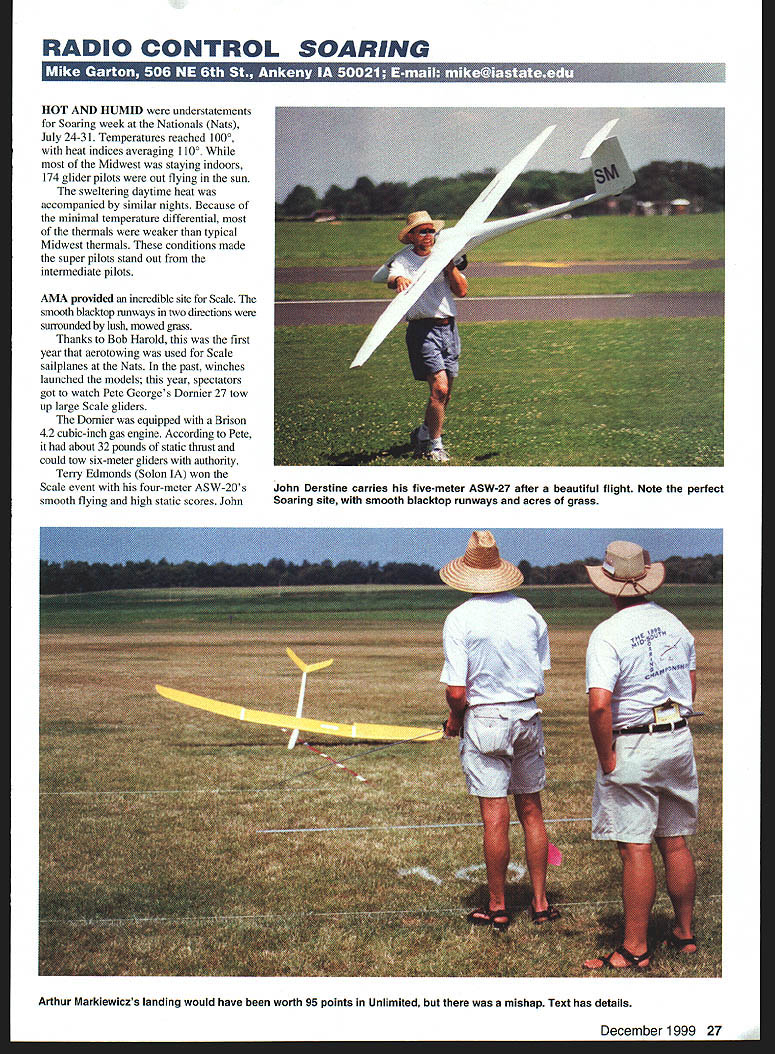
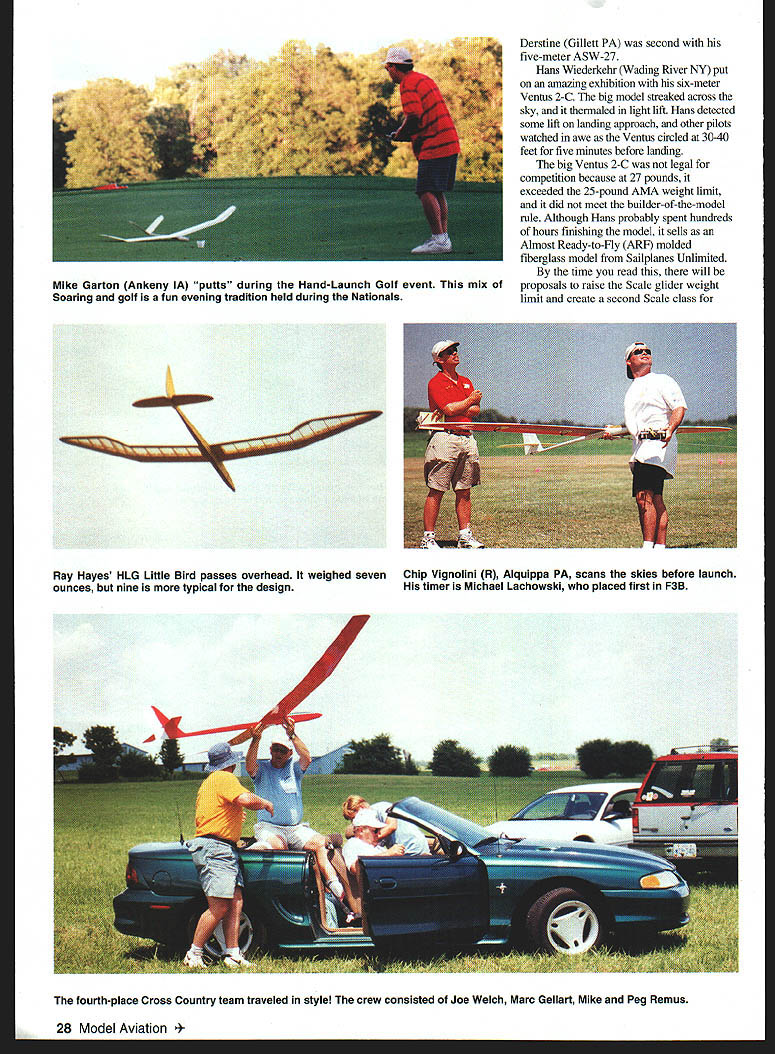
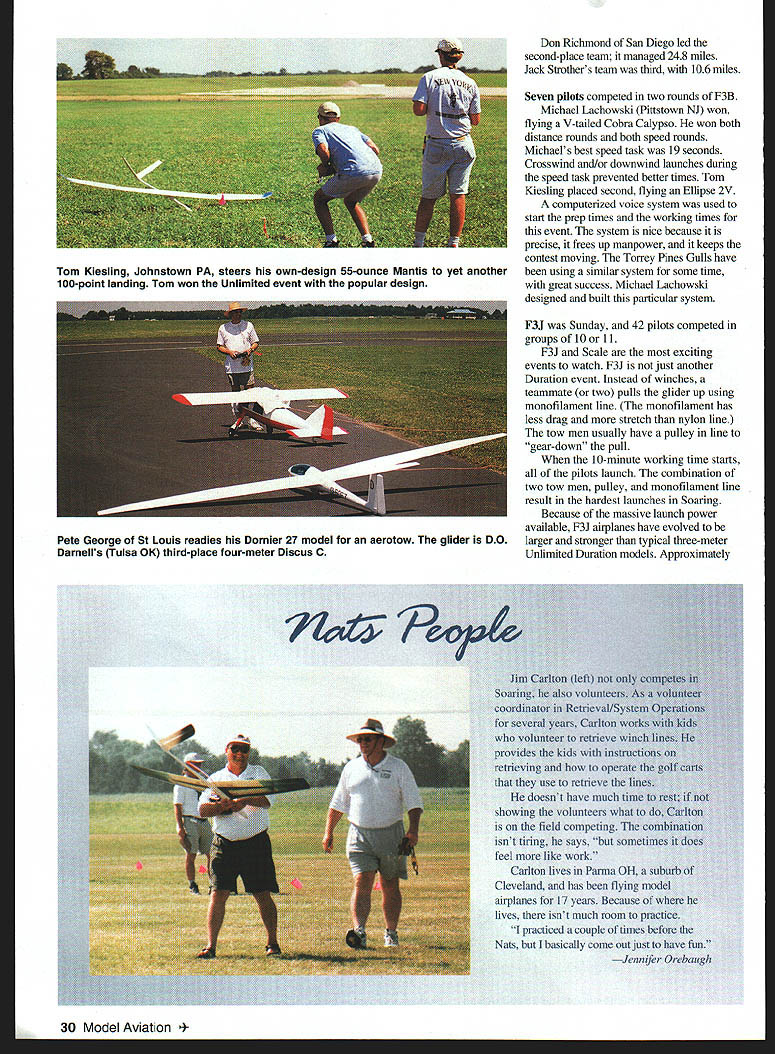
AMA provided an incredible site for Scale. The smooth blacktop runways in two directions were surrounded by lush, mowed grass. Thanks to Bob Harold, this was the first year that aerotowing was used for Scale sailplanes at the Nats. In the past, winches launched the models; this year, spectators watched Pete George's Dornier 27 tow up large Scale gliders.
The Dornier was equipped with a Brison 4.2 cubic-inch gas engine. According to Pete, it had about 32 pounds of static thrust and could tow six-meter gliders with authority.
Scale
Terry Edmonds (Solon, IA) won the Scale event with his four-meter ASW-20’s smooth flying and high static scores. John Derstine (Gillett, PA) was second with his five-meter ASW-27.
Hans Wiederkehr (Wading River, NY) put on an amazing exhibition with his six-meter Ventus 2-C. The big model streaked across the sky and thermaled in light lift. Hans detected some lift on landing approach, and other pilots watched in awe as the Ventus circled at 30–40 feet for five minutes before landing.
The big Ventus 2-C was not legal for competition because, at 27 pounds, it exceeded the 25-pound AMA weight limit and it did not meet the builder-of-the-model rule. Although Hans probably spent hundreds of hours finishing the model, it is sold as an Almost Ready-to-Fly (ARF) molded fiberglass model from Sailplanes Unlimited.
By the time you read this, there will likely be proposals to raise the Scale glider weight limit and to create a second Scale class for ARF-type gliders. In combination with the near-perfect flying site and aerotowing, those changes should make the Scale event more popular at future Nationals.
This year eight Scale competitors were preregistered, with four airplanes competing.
Cross Country (XC)
Twelve teams competed in Cross Country. Winners were:
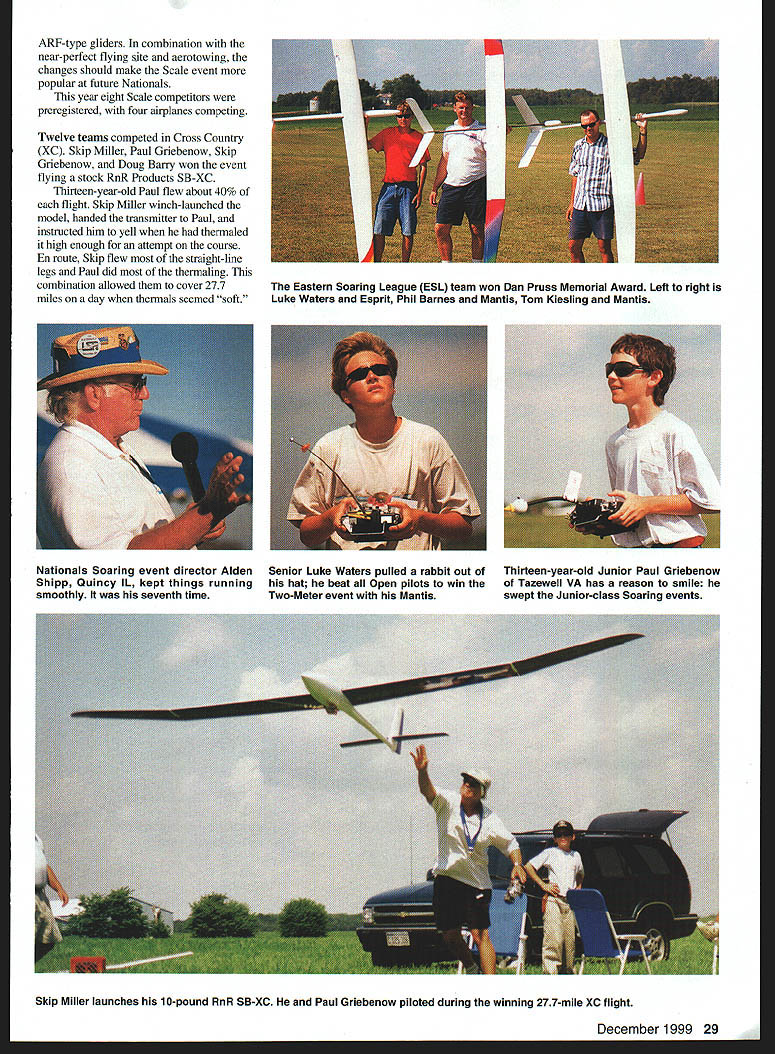
- Skip Miller, Paul Griebenow, Skip Griebenow, and Doug Barry — flying a stock RnR Products SB-XC — winners, covering 27.7 miles on a day when thermals were soft.
- Thirteen-year-old Paul flew about 40% of each flight. Skip Miller winch-launched the model, handed the transmitter to Paul, and instructed him to call when he had thermaled high enough for the course attempt. Skip flew most straight-line legs; Paul did most of the thermaling.
- Second place: Don Richmond (San Diego) and team — 24.8 miles.
- Third place: Jack Strother’s team — 10.6 miles.
F3B
Seven pilots competed in two rounds of F3B. Michael Lachowski (Pittstown, NJ) won, flying a V-tailed Cobra Calypso. He won both distance rounds and both speed rounds; his best speed task was 19 seconds. Crosswind and/or downwind launches during the speed task prevented better times. Tom Kiesling placed second, flying an Ellipse 2V.
A computerized voice system was used to start the prep times and the working times for this event. The system is precise, frees up manpower, and keeps the contest moving. The Torrey Pines Gulls have used a similar system with great success. Michael Lachowski designed and built this particular system.
F3J
F3J was on Sunday, with 42 pilots competing in groups of 10 or 11.
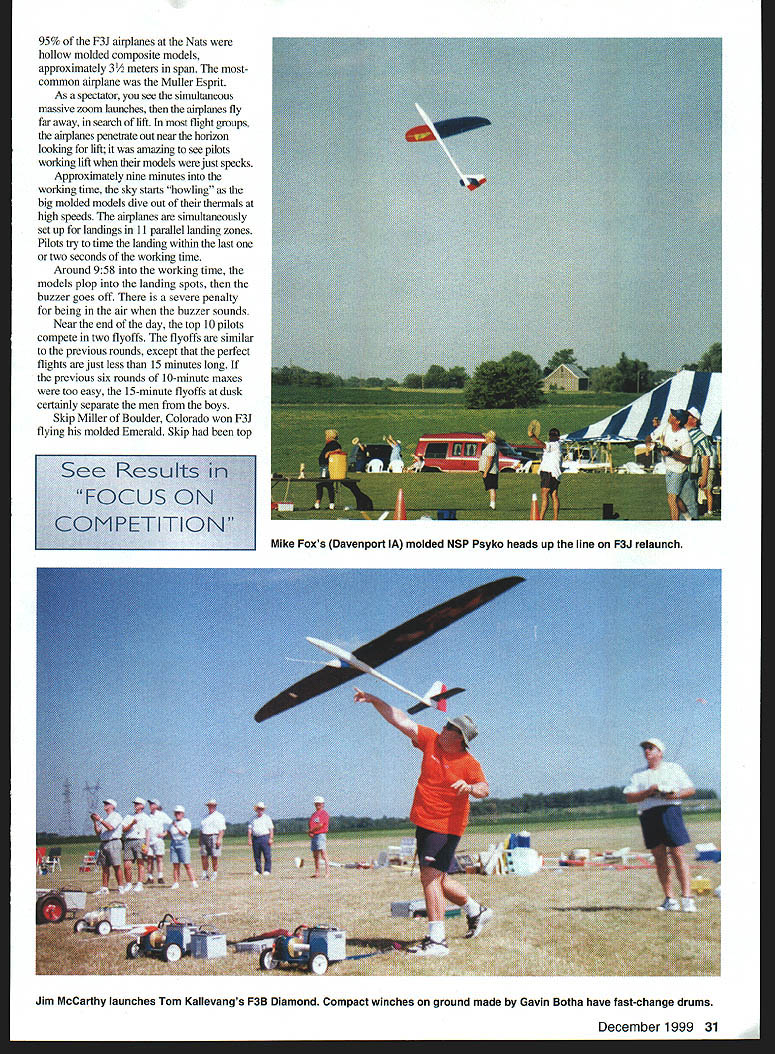
F3J and Scale are the most exciting events to watch. F3J is not just another Duration event. Instead of winches, a teammate (or two) pulls the glider up using monofilament line (monofilament has less drag and more stretch than nylon). The tow men usually have a pulley in line to "gear down" the pull.
When the 10-minute working time starts, all pilots launch. The combination of two tow men, a pulley, and monofilament results in the hardest launches in Soaring.
Because of the massive launch power available, F3J airplanes have evolved to be larger and stronger than typical three-meter Unlimited Duration models. Approximately 95% of the F3J airplanes at the Nats were hollow molded composite models, about 3½ meters in span. The most common airplane was the Muller Esprit.
As a spectator you see the simultaneous massive zoom launches, then the airplanes fly far away in search of lift. In most flight groups, the airplanes penetrate out near the horizon looking for lift; it was amazing to see pilots working lift when their models were just specks.
Approximately nine minutes into the working time, the sky starts "howling" as the big molded models dive out of their thermals at high speeds. The airplanes are simultaneously set up for landings in 11 parallel landing zones. Pilots try to time the landing within the last one or two seconds of the working time.
Around 9:58 into the working time, the models plop into the landing spots, then the buzzer goes off. There is a severe penalty for being in the air when the buzzer sounds.
Near the end of the day, the top 10 pilots competed in two flyoffs. The flyoffs are similar to the previous rounds, except that the perfect flights are just under 15 minutes long. If the previous six rounds of 10-minute maxes were too easy, the 15-minute flyoffs at dusk certainly separate the men from the boys.
- Winner: Skip Miller (Boulder, CO) — flying a molded Emerald. Skip had been top man during the regular rounds of the US F3J team trials.
- Second: Jim McCarthy.
- Third: Cal Posthuma.
It was impressive to see these pilots stay aloft nearly 15 minutes at 8 p.m. with heavy molded airplanes.
Hand-Launch Gliders (HLG)
Monday started sunny with 5–10 mph winds for Hand-Launch Gliders. There were 77 entries, minus a few no-shows. A computerized voice system was also used for this class. Four rounds were completed before a thunderstorm with lightning closed the contest.
- Winner: Skip Miller — flying a 9.4-ounce Mirage (manufactured by Don Peters).
- The Mirage is a two-channel polyhedral model with a modified 7035 airfoil. Skip reports the Mirage has better penetration than the Maple Leaf while maintaining a good climb rate in thermals.
- Second: Luke Waters (Rockville, MD) — Senior contestant, flying an NSP Logic.
- Third: Steve Meyer (Park City, IL) — flying a Logic.
- Fourth: Mike Fox (Davenport, IA) — flying a Focus.
Logics, Maple Leafs, and variants continue to be the hot models in Hand Launch.
Joe Hahn of DJ Aerotech was flying a new unnamed prototype that looked like a stretched version of DJ’s Nymph (Mosquito Class) airplane. It had a fiberglass pod and carbon tube tailboom with a high-aspect-ratio wing. Joe reports the model is promising.
Anecdote: At one point Joe Hahn, who is not very tall, was helping a Junior flier. The Junior, eye-to-eye with him, asked, "Do you launch your plane all by yourself?" Joe replied with a smile, "Yes."
Two-Meter
Eighty-eight pilots competed over two days in Two-Meter class.
- Winner: Luke Waters — flying a Two-Meter Mantis.
- Second: Tom Kiesling — also with a Mantis.
- Third: Arthur Markiewicz (Encinitas, CA) — with an original design.
- Fourth: Skip Miller — flying a Don Peters Image.
Unlimited
Unlimited was the most popular Soaring event, with 100 entries and two days of flying.
- Winner: Tom Kiesling — designer of the Mantis; his Mantis performed very well in light-air conditions.
- The Mantis is distinctive because it uses a nontapered composite tube for a fuselage. A three-meter version weighs roughly 55 ounces. The light weight and large V-tail help it make very slow, yet controlled, landings. The Mantis design claimed first in Unlimited, first and second in Two-Meter, and seventh in F3J.
- At the beginning of the week many pilots commented on the Mantis’s "ugly," sticklike fuselage. By the end of the week, pilots were asking where they could buy one. The Mantis web site: http://pages.hotbot.com/biz/flymantis/index.html
- Second: Jerry Robertson (Flagstaff, AZ) — flying an NSP Bird of Prey with winglets.
- Third: Arthur Markiewicz — with his Esprit. Arthur also received a Spirit of Soaring award for outstanding sportsmanship.
- Arthur had been leading after a few rounds, but a penny-sized piece of fiberglass chipped off his model’s nose skeg on a hard landing. He pointed out the broken piece to officials and dutifully took a zero score for the landing.
Nostalgia and RES (Rudder‑Elevator‑Spoiler)
Winds were relatively calm all week, but they came up just in time for Nostalgia and RES flying. The winds started about 15 mph and increased to 20–25 mph. Landings in the wind did not go well; possibly half the airplanes were turned on final and pilots discovered they could not penetrate into the wind. Many pilots managed to land polyhedral airplanes in the spot only to have them flip over before they were scored — just like the good old days.
By midafternoon three rounds of each class had been completed. When most of the next flight group folded their models’ wings on launch, the contest was stopped.
Nostalgia and RES are good concepts but not compatible with high-wind days. On a calm day, scores in those events would probably be nearly as high as Unlimited scores.
- Nostalgia (34 pilots)
- First: Tom Kallevaag — flying an Olympic II.
- Second: Jim Thomas — flying a Grand Esprit.
- Third: Marc Gellart — flying a Grand Esprit.
- Roy Simpson of Dream Catcher Hobbies has announced he will reintroduce the Grand Esprit. Some rarer models in attendance included two Mirages, a Maestro Megan, a Cirrus, and a Little Plank.
- RES (41 entries)
- First: Jim Thomas — Grand Esprit.
- Second: Jack Jarrett — Paragon.
- Third: Ed Wilson — 17-year-old stretched Sagitta. Ed reports the wings have been re-MonoKoted three times, but the structure is still sound.
Awards and Volunteers
For the seventh time, Alden Shipp directed the Soaring events. Alden is great to work for; he asks people to do things and makes them feel it is more a privilege than a chore. At the banquet he received the Lee Gray award for outstanding contribution to Soaring.
Marna Jeffries received a Spirit of Soaring award. She uses her one vacation each year to come out and run the transmitter impound at the Nats.
League of Silent Flight officers and many other volunteers make the Nats happen; there are no paid positions. Unlike other major contests, the Nats are flown and scored man-on-man. Although labor-intensive, this is the best means possible for choosing a national champion with minimal "luck factor."
People who deserve high praise for running a great contest include:
- Cal Posthuma
- Mark Nankivil
- Dennis Phelan
- Bob Harold
- Jim Frickey
- Dennis Adamisin
- Doug Barry
- Jack and Karen Strother
- Jack Jarrett
- Dan Ahron
- John Vennermon
- Marna Jeffries
- Dana Flemming
- Jim Carlton
- Dick Deichs
- Mike Stump
- Jim Thomas
- Joyce Shipp
- Johnnie Berlin
I apologize if I missed anyone.
Conclusion With the exception of the heat, the Nats went great. The site is one of the best in the nation.
Transcribed from original scans by AI. Minor OCR errors may remain.

