
Radio Control: Soaring
Dan Pruss
LEAGUE OF Silent Flight: Gordon Pearson, LSF/410, was elected as the new League of Silent Flight president for the 1978-1979 term. Gordon, a modeler since the days when the use of balsa substitutes was a reminder that there was a war on, has been active in all phases of modeling through the years. His devotion to RC sailplanes started several years back and, since then, he has been most active as an organizer, builder and flyer. His scale models of the Ibex and Vector were show-stoppers wherever he appeared.
Elected with Gordon was John Nielsen as vice-president. John had served the previous four years as the League's secretary, and that post now is being filled by newly elected Warren Tiahrt, of Troy, Michigan. Keith Finkenbiner was voted in as treasurer.
These four gents have been most active in the past years, not only as flyers but also as organizers. The nearly 2800 LSF members can look forward with pride to this kind of leadership.
It should be noted that 39 percent of the membership voted, and that is considered a remarkably high figure. Membership information can be obtained by sending a self-addressed envelope to: League of Silent Flight, Box 39068, Chicago, IL 60639, USA.
Membership requirements include having AMA and FCC licenses.
National Soaring Society: The NSS's Excellence Award Program for 1977 saw Fred Weaver, of San Jose, California as winner over more than 140 competitors from across the country. Scoring for the program was based on a flyer's four best contests out of no more than six. There is no class distinction in this awards program, and the records show that three Standard Class planes took the top three spots. Fred, by the way, elbowed his way into first by beating out second place Skip Miller, current FAI World Champion. Fred also is one of the four LSF level V's in the world. Further information and membership into the National Soaring Society can be obtained by joining the NSS. Write to: Dave Cook, Secretary, Star Route, Granby, CO 80446.
Membership cost is ten dollars and includes a subscription to "Sailplane."
And speaking of winners, included in the LSF regional tournaments of 1977, were awards for the best technical achievements. Awards were presented for the best idea at each meet, and these top ten were eligible for the LSF Best Technical Achievement of the year, a $100 cash award offered by well-known plane designer, Lee Renaud. Judges for the final BTA selection were Walt Good, Warren Tiahrt and Lee Renaud.
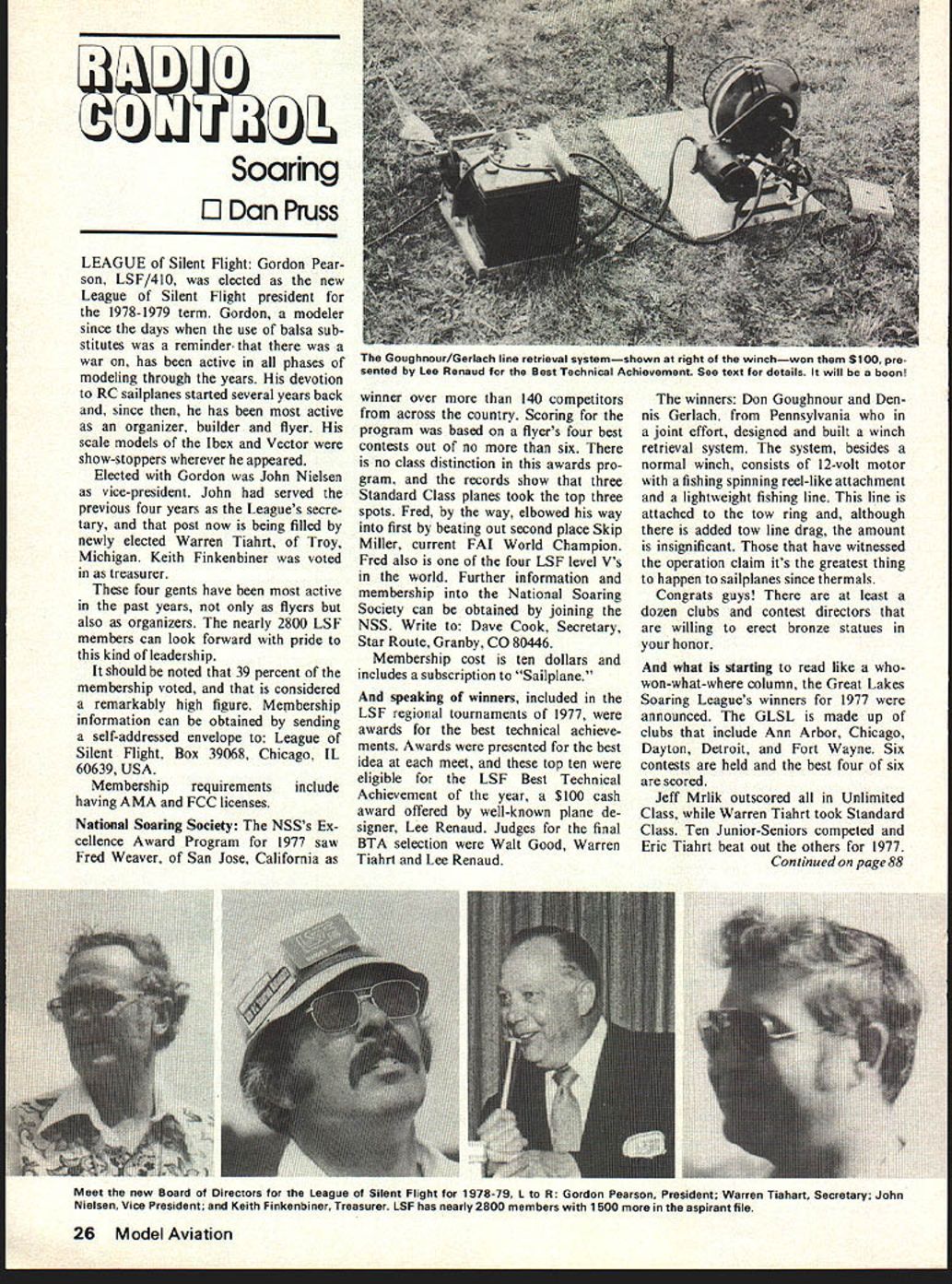
The winners: Don Goughnour and Dennis Gerlach, from Pennsylvania who in a joint effort, designed and built a winch retrieval system. The system, besides a normal winch, consists of a 12-volt motor with a fishing spinning reel-like attachment and a lightweight fishing line. This line is attached to the tow ring and, although there is added tow line drag, the amount is insignificant. Those that have witnessed the operation claim it's the greatest thing to happen to sailplanes since thermals.
Congrats guys! There are at least a dozen clubs and contest directors that are willing to erect bronze statues in your honor.
And what is starting to read like a who-won-what-where column, the Great Lakes Soaring League's winners for 1977 were announced. The GLSL is made up of clubs that include Ann Arbor, Chicago, Dayton, Detroit, and Fort Wayne. Six contests are held and the best four of six are scored.
Jeff Mrlik outscored all in Unlimited Class, while Warren Tiahrt took Standard Class. Ten Junior-Seniors competed and Eric Tiahrt beat out the others for 1977. To be shown at the 1978 Toledo R/C Conference is a line of sailplanes from Carrera, of Germany. While this column is not intended to serve as a kit review we will mention the unique and unusual. Carrera's catalog illustrates such models. The models are ARFs (Almost Ready to Fly). Reminiscent of the Graupner Cumulus in degree of completion are the following: ASW 17—wing span, 2200 mm; flying weight, 1200 g. ASW 17—wing span, 3200 mm; flying weight, 1550 g. SB-10—wing span, 3200 mm; flying weight, 1870 g. Kestrel—wing span, 3800 mm; flying weight, 2400 g. The above are semi-scale with molded fuselages, balsa-covered two-piece wings, and balsa-covered foam rudder and flying stabs. The ASW 3200-mm wing is an optional built-up version.
Multiply the wing span by .04 for a quick conversion to inches, and the weight by .035 to get ounces, for figures that are more familiar.
Three versions of a model called the Draco are available, with wing spans of 2500, 2800, and 3000 mm. All the models mentioned have a wing-wire mounting that includes a hold-on system, again reminiscent of the Cumulus and Cirrus. However, the hold-on system includes clips that are molded in such a fashion so they can be pulled out, twisted 90 degrees, and left in an "open" position. The two-piece wings are slid on to the wires and clips— the latter are twisted 90 degrees and "closed," and in less time than it took to read this, the wings are securely mounted.
However, the piece de resistance is a model that boggles a modeler's mind. It's a scale SB-10. Wing span: 5060 mm! No time for you to convert here. That's 202.4 in., or 16.87 feet! Weight: 9.4 lbs. Wing area: 94.16 dm², or 1459 sq. in. The two-piece wing (transporting could be a concern if you have to ride a trolley) is fully sheetted with three layers of wood—not plywood in the sense of the word, but three separate layers, with the grain all running span-wise. That the wing has structural integrity has been proven by flyers doing outside loops on the slopes in Germany.
The fuselage length is 63 inches, which, with the wing of over three times this length, gives the plane a most full scale-like appearance.
The hardware included allows a quick assembly of the model by providing slip-connect fittings at the wing/fuselage joints. These fittings accommodate the ailerons and spoilers. The wing is mounted on a blade, and three sets of the aforementioned hold-on clips keep the model assembled under air loads.
Canopies for all models are beautifully molded with hold-on clips provided. All models mentioned also include scale-like cockpit figures ready for painting. Because the fuselage is of a material that won't be affected by most glues, the radio compartment (cockpit) has a molded floor that bolts on through the nose skid. Radio components are mounted in a breadboard fashion. No prices are available yet, but they should be announced by "Toledo" time.
Hi Johnson, of Pacoima, California, has a catalog that is well worth the $1.50 price. First, the listing shows wings and airfoil specifications of foam wings that are available. The list includes most of the more popular models. Prices range from ten dollars for 48-in. wing panel for a slope racer, to $18 for a Grand Esprit half-wing.
The catalog also lists, and shows in profile, 33 airfoils, and additional information that can be obtained concerning these same airfoils. Also included are wing tongue-and-groove hardware for different size models. Three fiberglass fuselages are also offered.
Hi also provides detailed information on foam wing assembly and covering techniques with the details including exploded drawings, tools to be used, and notes on wing tuning. A table includes weights of various wing structures and materials most often used. In all, it's the best written and most comprehensive study on foam wing techniques this scribe has seen. It would be a buck and a half well spent for you or your club's library. Send to: Superwings, 11015 Glenoaks Blvd., Pacoima, CA 91331.
Ray Marvin has the FAI team selection program well underway, and wishes the following to be known. While the clubs that participated in the program two years ago were the first to be contacted this year, it doesn't preclude other clubs from hosting a quarter-finals or semi-finals. If your club is interested, contact him now. It's the only way he'll find out your intentions. Write to: Ray Marvin, 2781 S. Garfield, Denver, CO 80210.
Dan Pruss, R. 2, Box 490, Plainfield, IL 60544.
Transcribed from original scans by AI. Minor OCR errors may remain.

