
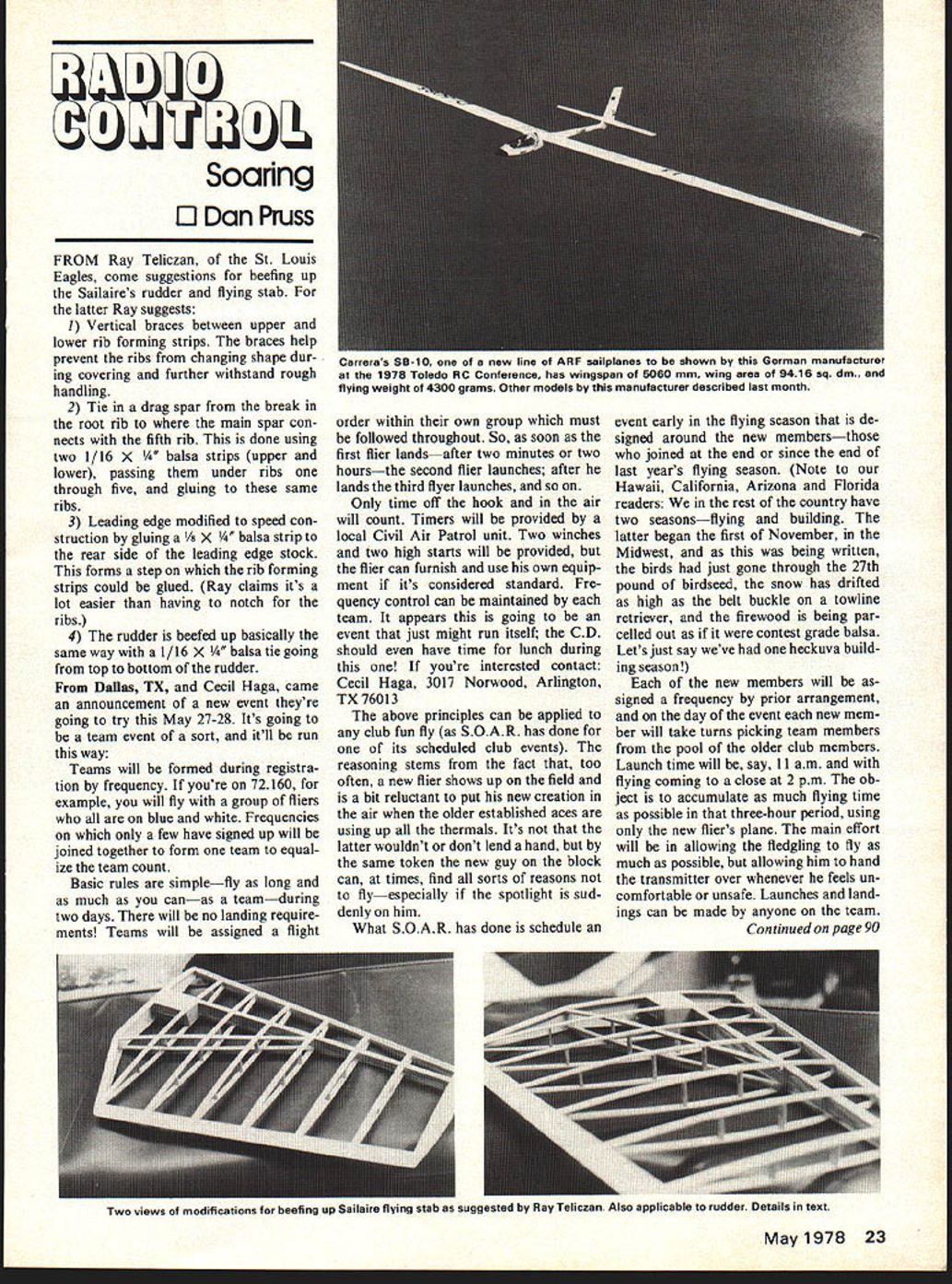
Radio Control: Soaring
Dan Pruss
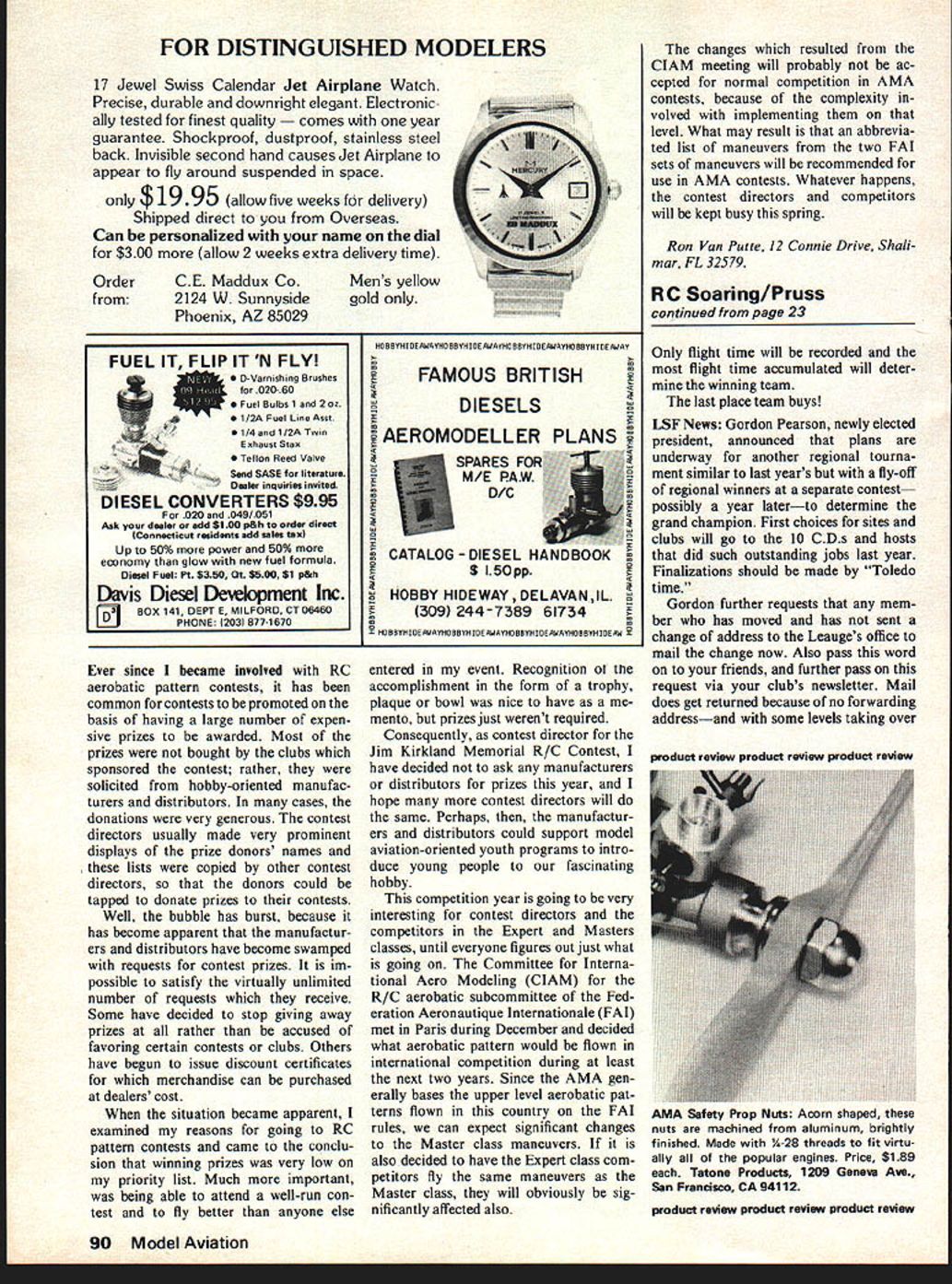
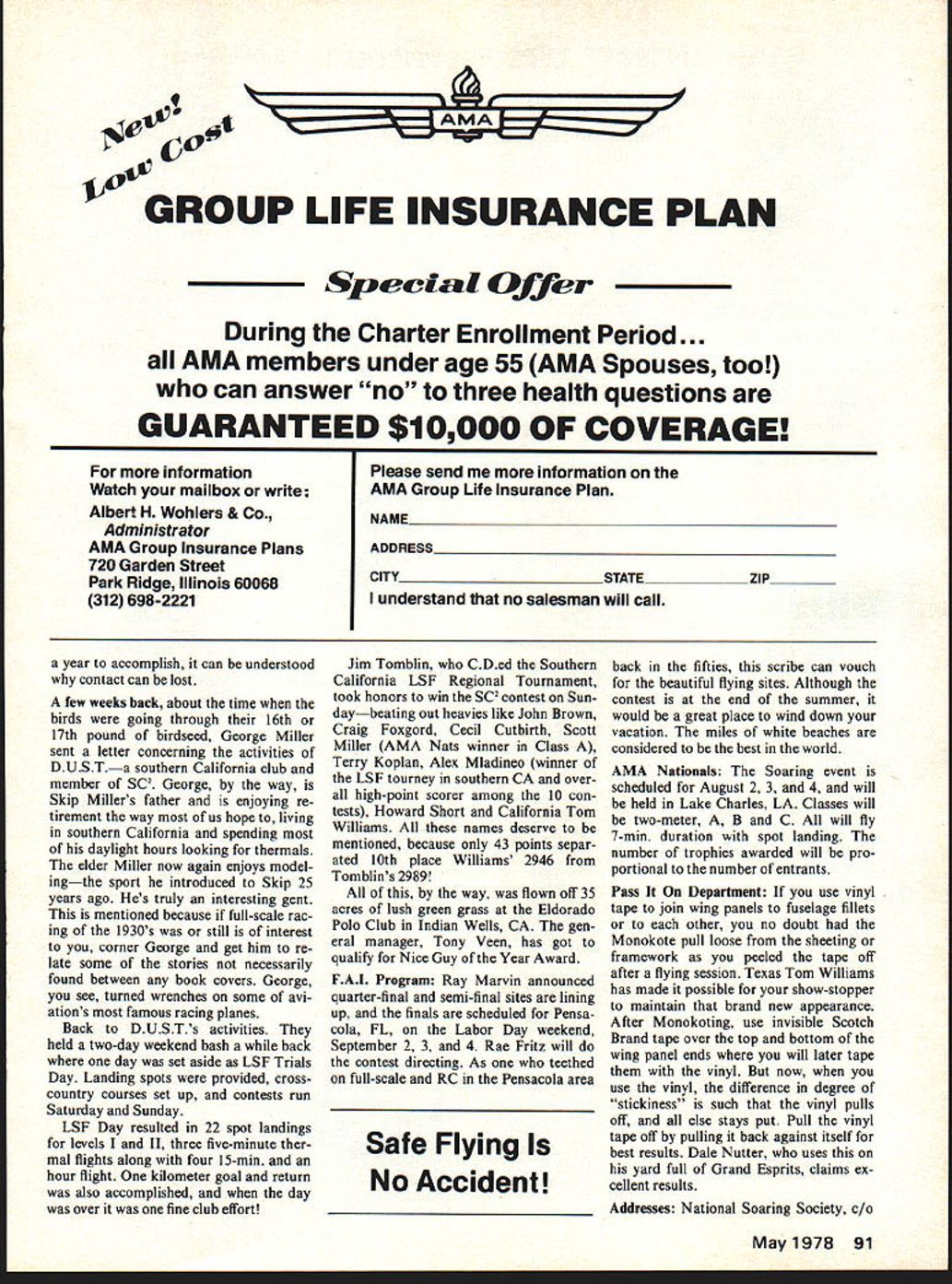
FROM Ray Teliczan, of the St. Louis Eagles, come suggestions for beefing up the Sailaire's rudder and flying stab. For the latter Ray suggests:
1) Vertical braces between upper and lower rib forming strips. The braces help prevent the ribs from changing shape during covering and further withstand rough handling.
2) Tie in a drag spar from the break in the root rib to where the main spar connects with the fifth rib. This is done using two 1/16 x 1/4 balsa strips (upper and lower), passing them under ribs one through five, and gluing to these same ribs.
3) Leading edge modified to speed construction by gluing a 1/8 x 1/4 balsa strip to the rear side of the leading edge stock. This forms a step on which the rib forming strips could be glued. (Ray claims it's a lot easier than having to notch for the ribs.)
4) The rudder is beefed up basically the same way with a 1/16 x 1/4 balsa tie going from top to bottom of the rudder.
From Dallas, TX, and Cecil Haga, came an announcement of a new event they're going to try this May 27-28. It's going to be a team event of a sort, and it'll be run this way:
Teams will be formed during registration by frequency. If you're on 72.160, for example, you will fly with a group of fliers who all are on blue and white. Frequencies on which only a few have signed up will be joined together to form one team to equalize the team count.
Basic rules are simple—fly as long and as much as you can—as a team—during two days. There will be no landing requirements! Teams will be assigned a flight order within their own group which must be followed throughout. So, as soon as the first flier lands—after two minutes or two hours—the second flier launches; after he lands the third flier launches, and so on. Only time off the hook and in the air will count. Timers will be provided by a local Civil Air Patrol unit. Two winches and two high starts will be provided, but the flier can furnish and use his own equipment if it's considered standard. Frequency control can be maintained by each team. It appears this is going to be an event that just might run itself; the C.D. should even have time for lunch during this one! If you're interested contact Cecil Haga, 3017 Norwood, Arlington, TX 76013.
The above principles can be applied to any club fun fly (as S.O.A.R. has done for one of its scheduled club events). The reasoning stems from the fact that, too often, a new flier shows up on the field and is a bit reluctant to put his new creation in the air when the older established aces are using up all the thermals. It's not that the latter wouldn't or don't lend a hand, but by the same token the new guy on the block can, at times, find all sorts of reasons not to fly—especially if the spotlight is suddenly on him.
What S.O.A.R. has done is schedule an event early in the flying season that is designed around the new members—those who joined at the end or since the end of last year's flying season. (Note to our Hawaii, California, Arizona and Florida readers: We in the rest of the country have two seasons—flying and building. The latter began the first of November, in the Midwest, and as this was being written, the birds had just gone through the 27th pound of birdseed, the snow had drifted as high as the belt buckle on a towline retriever, and the firewood is being parceled out as if it were contest grade balsa. Let's just say we've had one heckuva building season!)
Each of the new members will be assigned a frequency by prior arrangement, and on the day of the event each new member will take turns picking team members from the pool of the older club members. Launch time will be, say, 11 a.m. and with flying coming to a close at 2 p.m. The object is to accumulate as much flying time as possible in that three-hour period, using only the new flier's plane. The main effort will be in allowing the fledgling to fly as much as possible, but allowing him to hand the transmitter over whenever he feels uncomfortable or unsafe. Launches and landings can be made by anyone on the team. Only flight time will be recorded and the most flight time accumulated will determine the winning team. The last place team buys!
LSF News: Gordon Pearson, newly elected president, announced that plans are underway for another regional tournament similar to last year's but with a fly-off of regional winners at a separate contest—possibly a year later—to determine the grand champion. First choices for sites and clubs will go to the 10 C.D.'s and hosts that did such outstanding jobs last year. Finalizations should be made by "Toledo time."
Gordon further requests that any member who has moved and has not sent a change of address to the League's office to mail the change now. Also pass this word on to your friends, and further pass on this request via your club's newsletter. Mail does get returned because of no forwarding address—and with some levels taking over a year to accomplish, it can be understood why contact can be lost.
A few weeks back, about the time when the birds were going through their 16th or 17th pound of birdseed, George Miller sent a letter concerning the activities of D.U.S.T.—a southern California club and member of SC^2. George, by the way, is Skip Miller's father and is enjoying retirement the way most of us hope to, living in southern California and spending most of his daylight hours looking for thermals. The elder Miller now again enjoys modeling—the sport he introduced to Skip 25 years ago. He's truly an interesting gent. This is mentioned because if full-scale racing of the 1930's was or still is of interest to you, corner George and get him to relate some of the stories not necessarily found between any book covers. George, you see, turned wrenches on some of aviation's most famous racing planes.
Back to D.U.S.T.'s activities. They held a two-day weekend bash a while back where one day was set aside as LSF Trials Day. Landing spots were provided, cross-country courses set up, and contests run Saturday and Sunday.
LSF Day resulted in 22 spot landings for levels I and II, three five-minute thermal flights along with four 15-min. and an hour flight. One kilometer goal and return was also accomplished, and when the day was over it was one fine club effort!
Jim Tomblin, who C.D.ed the Southern California LSF Regional Tournament, took honors to win the SC^2 contest on Sunday—beating out heavies like John Brown, Craig Foxgord, Cecil Cubirth, Scott Miller (AMA Nats winner in Class A), Terry Koplan, Alex Mladineo (winner of the LSF tourney in southern CA and overall high-point scorer among the 10 contests), Howard Short and California Tom Williams. All these names deserve to be mentioned, because only 43 points separated 10th place Williams' 2946 from Tomblin's 2989!
All of this, by the way, was flown off 35 acres of lush green grass at the Eldorado Polo Club in Indian Wells, CA. The general manager, Tony Veen, has got to qualify for Nice Guy of the Year Award.
F.A.I. Program: Ray Marvin announced quarter-final and semi-final sites are lining up, and the finals are scheduled for Pensacola, FL, on the Labor Day weekend, September 2, 3, and 4. Rae Fritz will do the contest directing. As one who teethed on full-scale and RC in the Pensacola area back in the fifties, this scribe can vouch for the beautiful flying sites. Although the contest is at the end of the summer, it would be a great place to wind down your vacation. The miles of white beaches are considered to be the best in the world.
AMA Nationals: The Soaring event is scheduled for August 2, 3, and 4, and will be held in Lake Charles, LA. Classes will be two-meter, A, B and C. All will fly 7-min. duration with spot landing. The number of trophies awarded will be proportional to the number of entrants.
Pass It On Department: If you use vinyl tape to join wing panels to fuselage fillets or to each other, you no doubt had the Monokote pull loose from the sheeting or framework as you peeled the tape off after a flying session. Texas Tom Williams has made it possible for your show-stopper to maintain that brand new appearance. After Monokoting, use Invisible Scotch Brand tape over the top and bottom of the wing panel ends where you will later tape them with the vinyl. But now, when you use the vinyl, the difference in degree of "stickiness" is such that the vinyl pulls off, and all else stays put. Pull the vinyl tape off by pulling it back against itself for best results. Dale Nutter, who uses this on his yard full of Grand Esprits, claims excellent results.
Addresses: National Soaring Society, c/o Dave Cook, Secretary, Star Route, Granby, CO 80446. Stanley Pfost, DDS, NSS President, 1481 Howell Branch Road, Winter Park, FL 32789. League of Silent Flight, Box 39068, Chicago, IL 60639. Gordon Pearson, LSF President, 8232 Earhart Rd., South Lyon, MI 48178.
Dan Pruss, Rt. 2, Box 490, Plainfield, IL 60544.
From Ray Teliczan, St. Louis: Eagles come suggestions beefing up Sailaire's rudder and flying stab. Latter, Ray suggests:
- Vertical braces between upper and lower rib forming strips. Braces help prevent ribs changing shape during covering and further withstand rough handling.
- Tie drag spar at break root rib; main spar connects fifth rib. Done using two 1/16 x a strips, upper and lower, passing under ribs through five, gluing same ribs.
- Leading edge modified speed construction — gluing 3/8 x balsa strip to rear side of leading edge stock; forms step rib forming strips could be glued. Ray claims it's a lot easier having notched ribs.
- The rudder beefed up basically same way — 1/16 x balsa tie going top to bottom of rudder.
Dallas, TX: Cecil Haga came up with announcement of a new event they're going to try May 27-28. It's going to be a team event, sort of; it'll run this way. Teams will be formed during registration by frequency. You're 72, 160, for example, will fly as a group. Fliers of frequencies who have signed up will be joined together to form teams to equalize team count. Basic rules are simple: fly as long as much as can as a team during two days — there will be no landing requirements. Teams will be assigned flight order within their own group and must follow it throughout. So soon as the first flier lands, after two minutes to two hours the second flier launches; after he lands, the third flyer launches. Only time off-hook/air time will count. Timers will be provided by the local Civil Air Patrol unit. Two winches and two high starts will be provided; flier can furnish or use his own equipment — it's considered standard. Frequency control can be maintained. The team-appearing event just might run itself. CD should have time for lunch. If you're interested contact Cecil Haga, 3017 Norwood, Arlington, TX 76013.
The above principles can be applied to a club fun fly. SOAR has done its scheduled club events. The reasoning stems from the fact that too often a new flier shows up at the field a bit reluctant to put a new creation in the air because older established aces are using up thermals. The latter wouldn't necessarily lend a hand; on the same token a new guy can find all sorts of reasons not to fly — especially when the spotlight suddenly aims at him. What SOAR has done is schedule events early in the flying season designed around new members — those who joined since the end of last year's flying season.
Note: Hawaii, California, Arizona, Florida readers and the rest of the country have two seasons — flying and building. The latter began the first of November. In the Midwest as this is being written, the birds have just gone through, 27-lb. bags of birdseed, snow has drifted high, belt buckle towline retriever, firewood is being parceled out, contest-grade balsa. Let's just say we've had a heckuva building season.
New members will be signed to a frequency by prior arrangement. On the day of the event new members will take turns picking team members from a pool of older club members. Launch time will be, say, 11 a.m.; flying will come close at 2 p.m. The object is to accumulate as much flying time as possible during the three-hour period using the new flier's plane. The main effort will be allowing the fledgling to fly as much as possible, allowing him to hand the transmitter over whenever he feels uncomfortable or unsafe. Launches and landings can be made by anyone on the team.
Transcribed from original scans by AI. Minor OCR errors may remain.

