
Radio Control: Soaring
Dan Pruss
SNOFLY VIII: For the eighth winter, in as many, that hearty lot from Detroit staged their annual February "Let's All Get Together and Torment Our Bodies and Sailplanes Fly-In." Fifty-six contestants answered contest director Art Slagle's call and fliers from Cincinnati, Chicago, Indiana, and other parts of Ohio and Canada, tried to outlast the Michigan bunch. The final results had seven trophy winners out of eight from Michigan.
In case your life for the past few months has been somewhat cloistered, you're not aware that this year's winter was one midwesterners will be talking about to their grandchildren. Besides record snowfalls, they'll tell how on the morning of Snofly VIII the thermometer registered five below zero on the old Fahrenheit scale. However, in Detroit that day the temperature did get into the teens, the sky was absolutely clear, and what saved the day was the fact there was no wind, except for a slight breeze when a thermal would come through!
Sure, there are thermals in the winter — with winter temperatures. After all, that day saw a rise in temperature of about 20 degrees and in about four hours. In fact, more seven-minute maxes were logged in that one day than in two days at the LSF regional tournament in Ann Arbor last August — and as a whole, by the same fliers, flying the same sailplanes!
The Greater Detroit Soaring and Hiking Society hosted this now annual affair and did an outstanding job. Because of at least a foot of snow on the ground, the G.D.S. & H.S. plowed out a parking area and provided two snowmobiles for line retrieval.
The system worked; three rounds were flown and the contest was run in a little over five hours. A set time frame for each round was established, and the open winch concept was used and worked well. Snoflies have become a tradition in a large number of contestants who always attend. The Beginner, Novice, Advanced, and Expert pattern will be from the 1976/1977 rules. The Master pattern will include a set of not more than ten maneuvers, including takeoff and landing, which total not more than 260 possible points. The contestant will be able to choose from any of the maneuvers in Schedule A, B, or the Extra Maneuvers. Only one Figure M will be used.
My reasoning for setting the point limit at 260 was as follows: both Schedule A and B maneuvers have a K-factor average of 2.7. If Takeoff and Landing is subtracted, an abbreviated pattern of ten maneuvers would total 240, including Takeoff and Landing, if maneuvers with 2.7 K-factor average were selected. Boosting the maximum possible points to 260 encourages the selection of one or more of the difficult Extra Maneuvers.
There are many top level pattern competitors who do not like all the new Master pattern maneuvers. Some maneuvers are disliked simply because they are very difficult and will require a lot of work to master. I don't agree with this argument. A few years ago the Double Immelmann was a very difficult maneuver for all competitors, but it only rates a K-factor of two in the new list. Everyone can do a good Double Immelmann these days, except for a few of us. Many of the new maneuvers are very challenging, but they can be performed by top level competitors flying conventional pattern airplanes, if they are willing to invest the effort.
However, some of the new maneuvers in the Master class are not popular because they place a premium on very light, high-powered airplanes. They encourage another "horsepower race" in which most competitive airplanes will feature very costly Schnuerle-ported, rear-exhaust engines with tuned pipes. I agree with the argument against these maneuvers.
Despite the above arguments, it is still possible for a Master competitor to select high K-factor maneuvers which he likes and still be competitive when using a conventional pattern airplane.
We haven't begun to assess all that the new Master pattern means and it will be very interesting to see how it looks to all of us by the end of the 1978 competition year.
Ron Van Putte, 12 Connie Drive, Shalimar, FL 32579
soaring and the free entry fee for enthusiasts in California has now been extended to Florida fliers. See you next year! Results:
- Unlimited: 1st, Jeff Mrlik—Astro Jeff; 2nd, Pat Flynn—Astro Maggie; 3rd, Ken Bates—Original.
- Standard: 1st, Warren Tiahrt—SD 100; 2nd, Dave Leach—Aquila; 3rd, Walt Hill—Aquila.
- Jr.-Sr.: 1st, Chris Corven—Original; 2nd, Mike Campbell—Windlord.
Side notes... Standard Class outnumbered Unlimited two to one, a reversal of a couple of years ago... reliability of radios in Snofly temperatures was a concern a few years ago. This year, only one failure occurred and that was attributed to interference. A tip of the hat to all manufacturers for providing us with equipment that is so dependable.
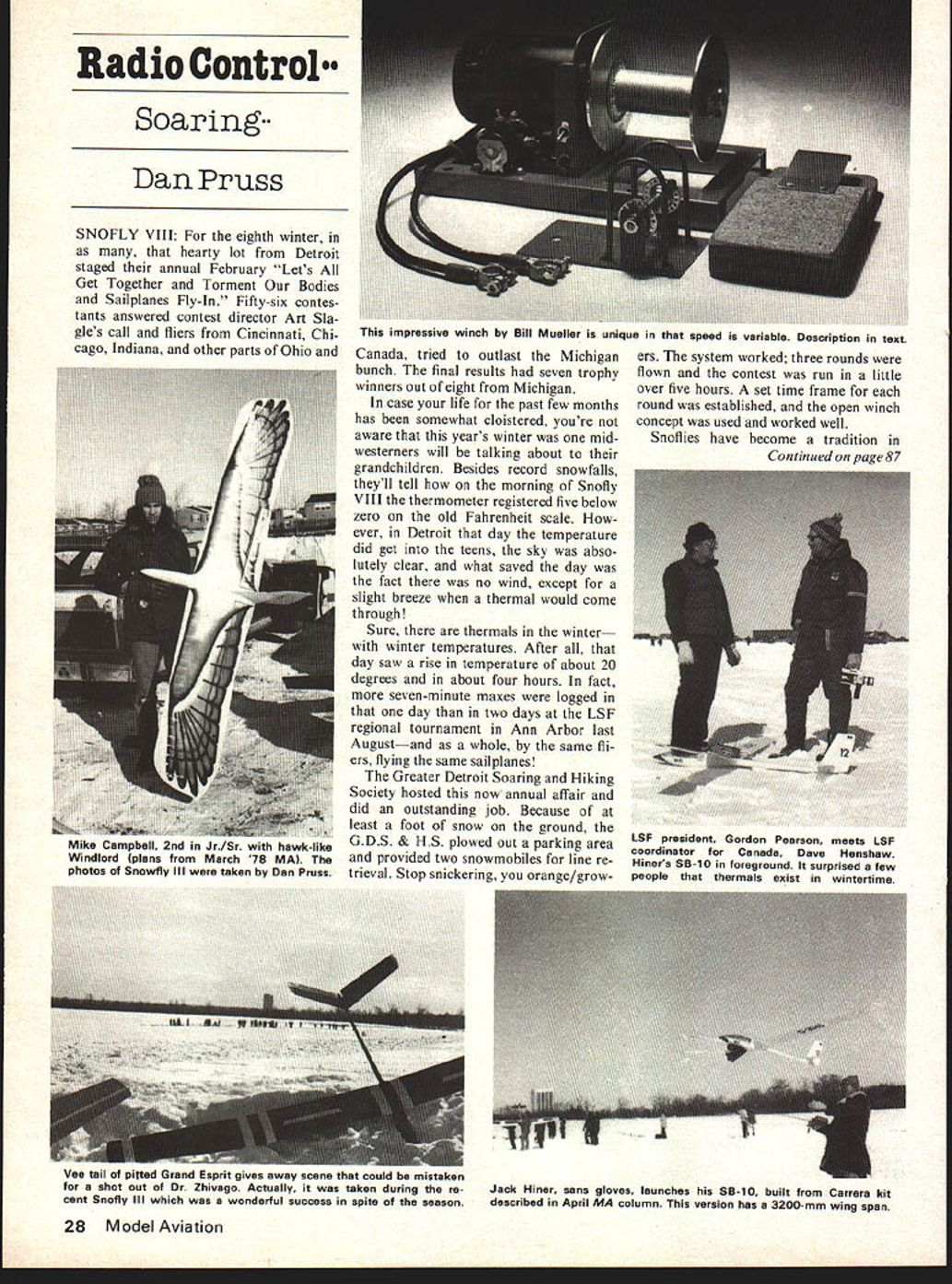
New Product: From Bill Mueller, of Hemet, California, comes the announcement of a new winch that is now available, called the Hi Flight 12. Quoting Bill's claims, "The Hi Flight 12 is powered by a conventional 12-volt automotive battery, and is unique in the fact that a single foot control allows the flier to choose slow, medium, or high winch speed. The speed may be varied continuously through the launch as dictated by glider size and wind conditions. Low speed is typically used for line tensioning and launching of light aircraft under windy conditions. Medium speed will launch Standard Class sailplanes in no wind conditions, or Unlimited ships in breezy conditions. High speed will launch the heaviest Unlimited Class sailplane with ease. An isolation switch is provided." Bill further claims, "The Hi Flight 12 consists of a rugged-welded steel frame, a completely rebuilt 12-volt motor, a finely machined steel drum with two inch core, and all electrics necessary for its operation. Included with the Hi Flight 12 is a ball-bearing turn-around. The price of the entire Hi Flight 12 launch system is $179.00 F.O.B., Hemet, California."
The winch is also available in kit form. For $89.00 you get a welded frame that is drilled. Complete instructions, showing assembly and wiring, are included. Rebuilt long-shaft starters are also available for $22.50, and winch drums for $24.95.
Write: Hi Flight Model Products, 43225 Whittier Ave., Hemet, CA 92434 — Phone (714) 927-4666.
Milwaukee, Minneapolis, Winston-Salem: Three areas where soaring is growing, as reported first from Ron Kopp of Milwaukee. The Suds City Sailplane Team had an amicable split from their power club and are doing it on their own. If you're from that area contact: Ron Kopp, 8010 W. Waterford Ave., Milwaukee, WI 53220.
From Minneapolis comes news that "The Minnesota Soaring Team" is well underway. Unfortunately, no address was provided but H. Evanston says the club has three winches and a sod farm about ten miles south of Minneapolis. Activities are designed around the family and, if you can't find the sod farm, Evanston's claim of one hour and 30-minute flights with his Sailaire should draw your attention.
And from Charles Spear, secretary of the Triad Thermal Thumbers, comes the announcement of the forming of a club from the Winston-Salem, Greensboro, High Point area of North Carolina. With a charter of less than a year they've already scheduled an FAI quarter-finals, and are hoping they warrant an L.S.F. regional. Contact: Charles Spear, 800 Holly Lane, Mocksville, NC 27028.
Great Race III was announced by Ken Ward, president of S.O.A.R. The heralded event, which first started in 1976 and has become an annual classic, will be run in conjunction with a Stand-off Scale contest. The race is open to any AMA chartered club and is scheduled for August 12; the Stand-off Scale contest will be held August 13 and is open to any AMA member. For details contact: Bill Christian, CD; 1604 N. Chestnut; Arlington Hts., IL 60004.
League of Silent Flight: From Gordon Pearson, LSF President, comes news that should interest every sailplane flier in the world! The LSF National Tournament, or should we say International Tournament, will again be held this year on the traditional last weekend of August—the 26th and 27th. Already, at least ten sites have been chosen for regionals, and plans are underway for additional tournaments where foreign chapters exist. This will be a two-year program whereby a percentage of the top scorers from each of the regions will be eligible to compete in an international fly-off to determine the LSF Champion. The fly-off would be scheduled in 1979.
Discussions are underway for extra-special events—this at the 1979 contest—whereby any LSF member could fly in them. The potential of this event could be the greatest get-together for any soaring event-ever.
Details when finalized will be announced and sent to all LSF members.
Dan Pruss, Rt. 2, Box 490, Plainfield, IL 60544.
Transcribed from original scans by AI. Minor OCR errors may remain.

