
Radio Control: Soaring
Dan Pruss
BELGIUM: That was the country chosen at the FAI/CIAM Bureau Meeting in late March to host the R/C Sailplane World Championships in July, 1979. As you may have known, the site selection was for either the U.S.A. or Belgium. Among reasons given for selecting the latter was one of economics. South Africa is hosting a pattern championship, also in 1979, and to send teams from European countries to both U.S.A. and South Africa could impose a financial burden on a lot of aero clubs.
So, if you have a ship that can eke out six minutes from a tow of 150 meters and fly about eight 150-meter laps out of a possible 12, plus turn that same course in 15 seconds for two laps, you'll have a good chance to earn a berth on the U.S. team. See page 76 of our June issue for the FAI contest calendar. The April issue lists the basic rules and changes (pages 78 and 79) and, if you have questions concerning the FAI program, consult Ray Marvin, 2781 S. Garfield, Denver, CO 80210.
Toledo—What a show! The city that has become synonymous with RC staged their 24th annual—let's all get together and compare equipment—conference. What's new in sailplanes included Lee Renaud of Cox Hobbies' Aquila-Grande, an enlarged version (not to be confused with the X-L version of a couple of years ago) of the Aquila—but in wing span and tail feathers only. The new version has a wingspread of 121.3 in. and an area of 1000 sq. in.; aspect ratio is 14.71 and empty weight is 56-58 oz.
At first glance, the prototype has the general appearance of the standard Aquila, but the fine print reveals a new airfoil that sports a Phillips entry. The beefed-up wing attaches to the fuselage by means of a 5/16 in. steel rod that should withstand any winch/foot-switch techniques that can be applied. The fuselage is of epoxy/glass and is available separately from Cox Hobbies, Customer Service, 1525 E. Warner Ave., Santa Ana, CA 92702. Price is $40.00 plus postage.
Tom Williams, of Craft Air, showed his new Viking—a ship around which two wings have been designed. Both wings have spans of three meters (118 in.), with areas of 1200 sq. in. The Mark I version has an 11½% flat-bottom airfoil, while the Mark II is 12% in thickness and is somewhat semi-symmetrical. Controls include spoilers. Wings are attached to the fuselage by means of two ¼-in. steel rods. Empty weights are 54 oz. for the Mark I, and 56 oz. for the Mark II. For further information write: Craft Air, 7851 Alabama Ave., Canoga Park, CA 91304.
Carrera displayed the line of models mentioned in this column in the April issue. Three days of beating an ASW-17 fuselage on the concrete floor of the sports arena proved the fuselages—typical of the line—are virtually indestructible. These models are available through: Carrera, USA, P.O. Box 566, Westmont, IL 60559.
At Toledo the Midwest Sailplane Society had an area where people could hand-launch and fly. Even though the wind was light, there was some good hand-launched activity. The models were of widely varying design and included the early Wanderlust-type designs and modern mini-sailplanes. The interest in hand-launching seems to be growing. Ed Slobod, of Pierce Arrow Company and Paragon fame, showed his Ridge Rat. The Ridge Rat is designed for slope flying and, from Ed's claims, it's a plane that won't cut into your modeling budget—building time or money-wise.
Designed to be assembled in a few evenings, the RR features a one-piece wing with full-span ailerons. Elevator control is the plane's only other control function. The 49-in. wing straps on to the bottom of the fuselage. All-up weight is 32 oz.
Ed also has a two meter, 670-sq.-in., 24-oz. bird on the drawing board. Write: Pierce Arrow Co., 9626 Jellico Ave., Northridge, CA 91324.
The Weak Signals, the club from Toledo that has hosted this annual Expo for over a generation, recognizes the various categories of models by providing display areas and giving awards by category, for Best Finish, Best Monokote, and Best of Show.
Feel fortunate if you didn't have to judge the sailplane event. There were over a dozen models in that class on display and over half of those were considered show stoppers.
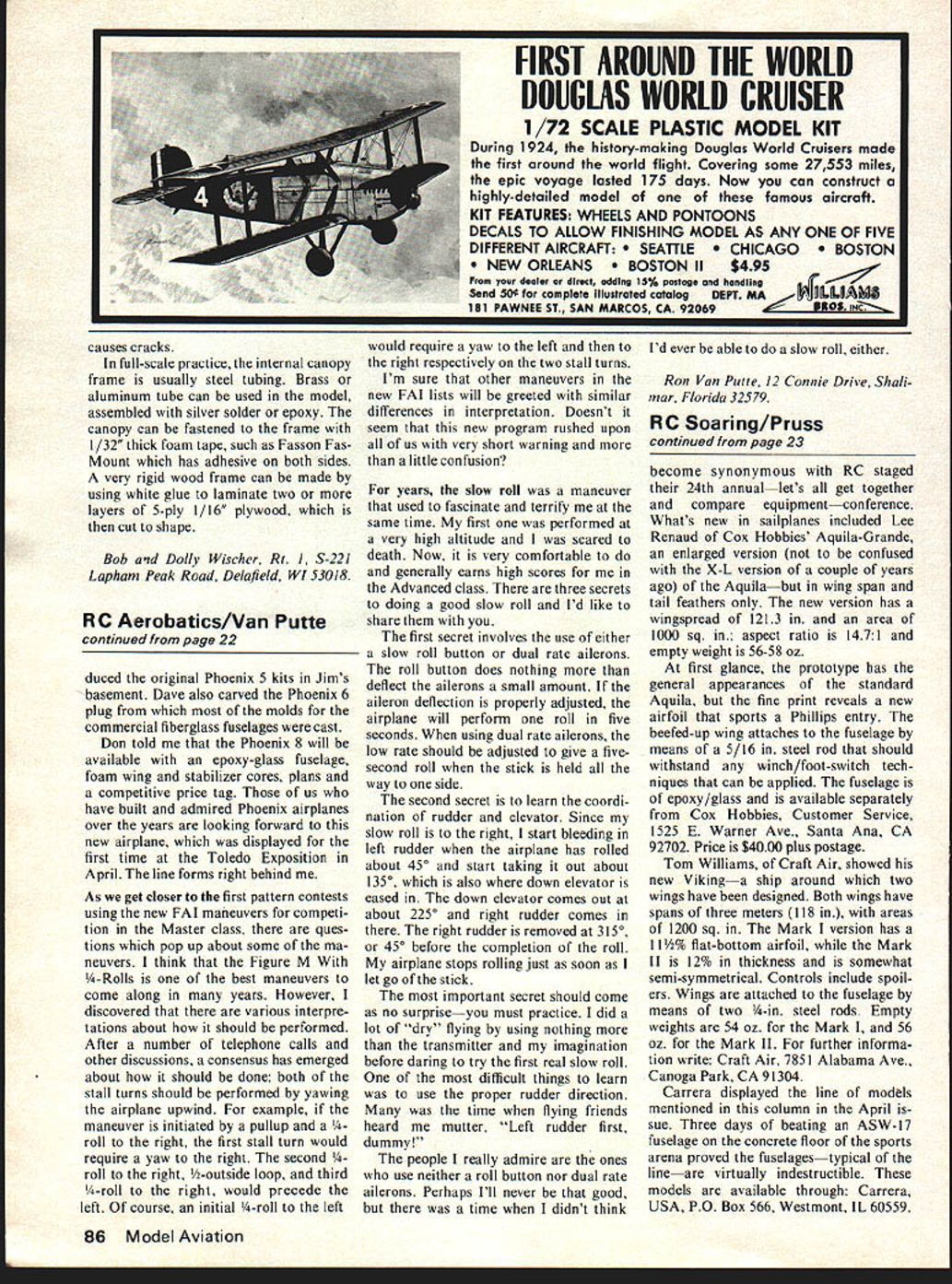
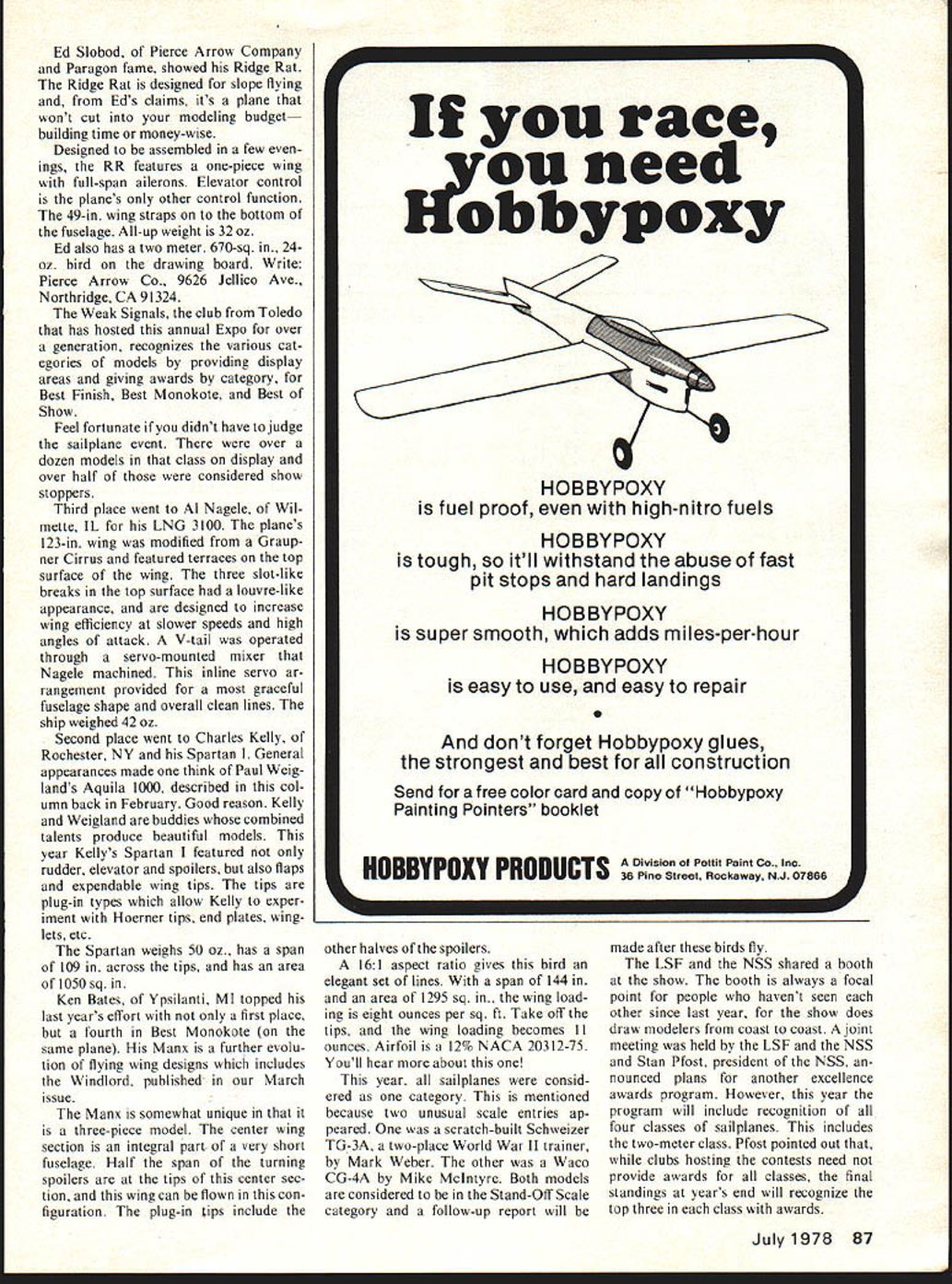
Third place went to Al Nagele, of Wilmette, IL, for his LNG 3100. The plane's 123-in. wing was modified from a Graupner Cirrus and featured terraces on the top surface of the wing. The three slot-like breaks in the top surface had a louvre-like appearance, and are designed to increase wing efficiency at slower speeds and high angles of attack. A V-tail was operated through a servo-mounted mixer that Nagele machined. This inline servo arrangement provided for a most graceful fuselage shape and overall clean lines. The ship weighed 42 oz.
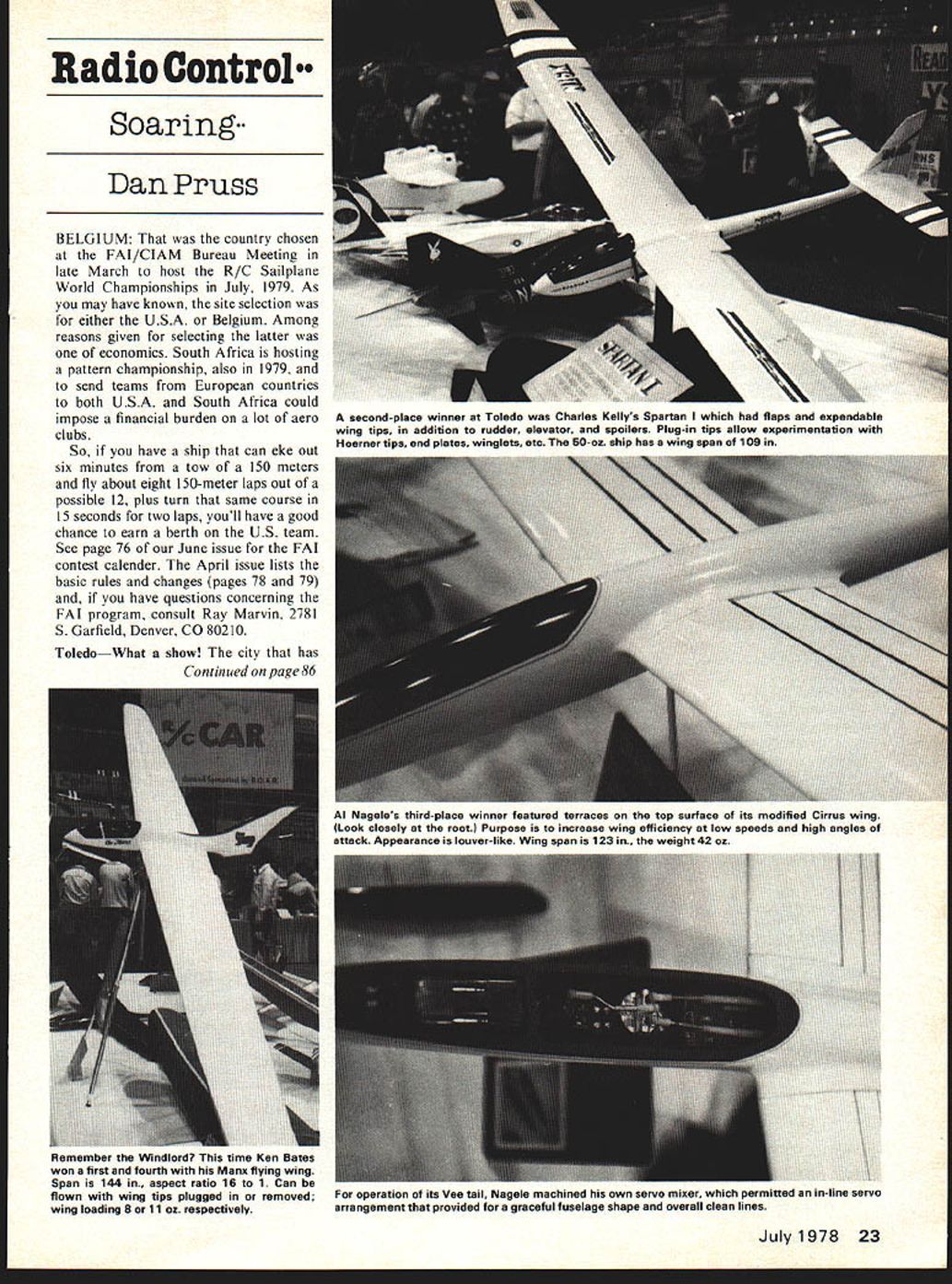
Second place went to Charles Kelly, of Rochester, NY and his Spartan I. General appearances made one think of Paul Weigland's Aquila 1000, described in this column back in February. Good reason. Kelly and Weigland are buddies whose combined talents produce beautiful models. This year Kelly's Spartan I featured not only rudder, elevator and spoilers, but also flaps and expendable wing tips. The tips are plug-in types which allow Kelly to experiment with Hoerner tips, end plates, winglets, etc.
The Spartan weighs 50 oz., has a span of 109 in. across the tips, and has an area of 1050 sq. in.
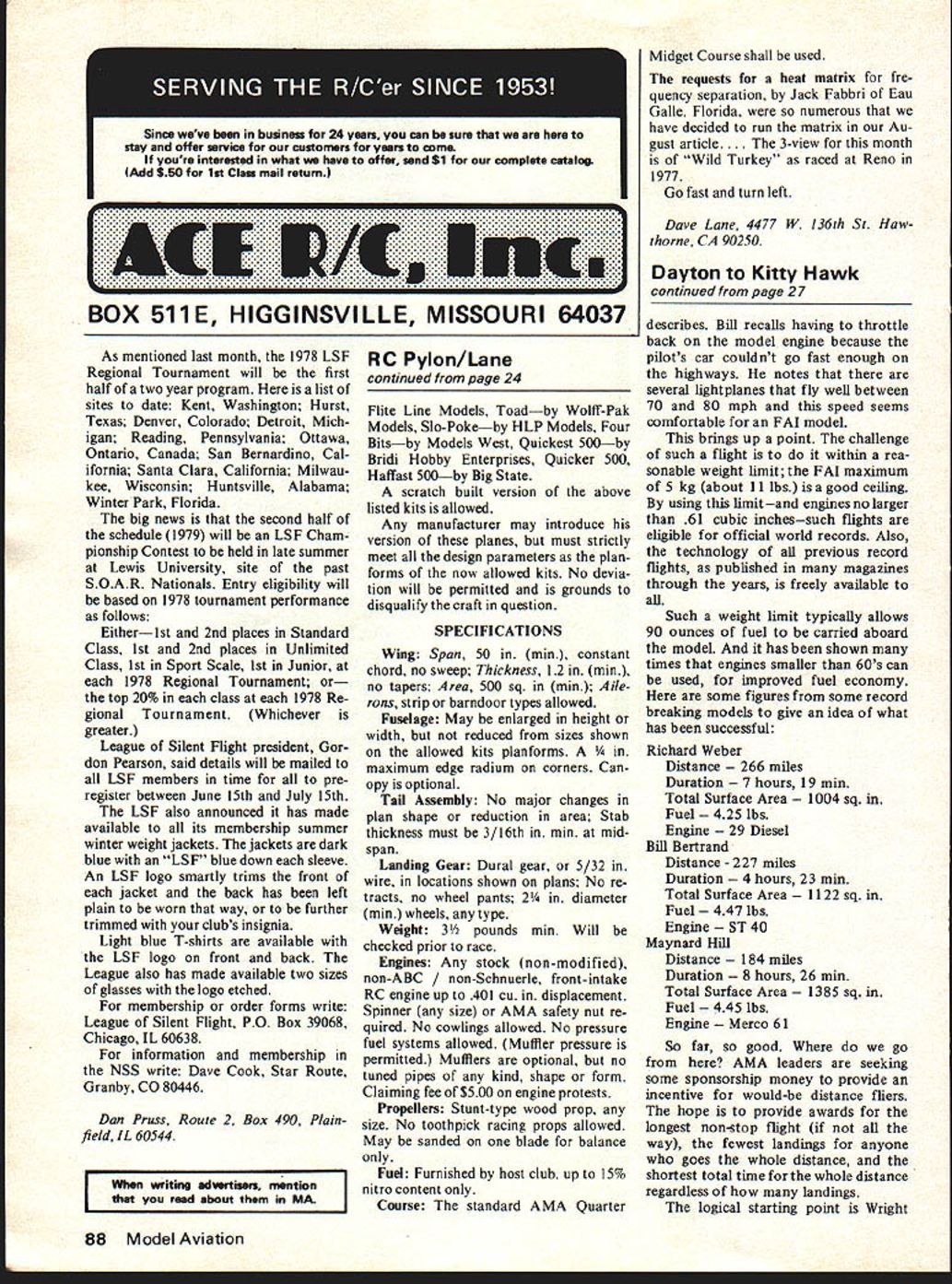
Ken Bates, of Ypsilanti, MI topped his last year's effort with not only a first place, but a fourth in Best Monokote (on the same plane). His Manx is a further evolution of flying wing designs which includes the Windlord, published in our March issue.
The Manx is somewhat unique in that it is a three-piece model. The center wing section is an integral part of a very short fuselage. Half the span of the turning spoilers are at the tips of this center section, and this wing can be flown in this configuration. The plug-in tips include the other halves of the spoilers.
A 16:1 aspect ratio gives this bird an elegant set of lines. With a span of 144 in. and an area of 1295 sq. in., the wing loading is eight ounces per sq. ft. Take off the tips, and the wing loading becomes 11 ounces. Airfoil is a 12% NACA 23012-75. You'll hear more about this one!
This year, all sailplanes were considered as one category. This is mentioned because two unusual scale entries appeared. One was a scratch-built Schweizer TG-3A, a two-place World War II trainer, by Mark Weber. The other was a Waco CG-4A by Mike McIntyre. Both models are considered to be in the Stand-Off Scale category and a follow-up report will be made after these birds fly.
The LSF and the NSS shared a booth at the show. The booth is always a focal point for people who haven't seen each other since last year, for the show does draw modelers from coast to coast. A joint meeting was held by the LSF and the NSS and Stan Pfost, president of the NSS, announced plans for another excellence awards program. However, this year the program will include recognition of all four classes of sailplanes. This includes the two-meter class. Pfost pointed out that, while clubs hosting the contests need not provide awards for all classes, the final standings at year's end will recognize the top three in each class with awards.
Radio Control: Soaring
Dan Pruss
As mentioned last month, the 1978 LSF Regional Tournament will be the first half of a two year program. Here is a list of sites to date: Kent, Washington; Hurst, Texas; Denver, Colorado; Detroit, Michigan; Reading, Pennsylvania; Ottawa, Ontario, Canada; San Bernardino, California; Santa Clara, California; Milwaukee, Wisconsin; Huntsville, Alabama; Winter Park, Florida.
The big news is that the second half of the schedule (1979) will be an LSF Championship Contest to be held in late summer at Lewis University, site of the past S.O.A.R. Nationals. Entry eligibility will be based on 1978 tournament performance as follows:
Either — 1st and 2nd places in Standard Class, 1st and 2nd places in Unlimited Class, 1st in Sport Scale, 1st in Junior, at each 1978 Regional Tournament; or — the top 20% in each class at each 1978 Regional Tournament. (Whichever is greater.)
League of Silent Flight president, Gordon Pearson, said details will be mailed to all LSF members in time for all to pre-register between June 15th and July 15th.
The LSF also announced it has made available to all its membership summer and winter weight jackets. The jackets are dark blue with an "LSF" blue down each sleeve.
An LSF logo smartly trims the front of each jacket and the back has been left plain to be worn that way, or to be further trimmed with your club's insignia.
Light blue T-shirts are available with the LSF logo on front and back. The League also has made available two sizes of glasses with the logo etched.
For membership or order forms write: League of Silent Flight, P.O. Box 39068, Chicago, IL 60638.
For information and membership in the NSS write: Dave Cook, Star Route, Granby, CO 80446.
Dan Pruss, Route 2, Box 490, Plainfield, IL 60544.
Transcribed from original scans by AI. Minor OCR errors may remain.

