
Radio Control: Soaring
Dan Pruss
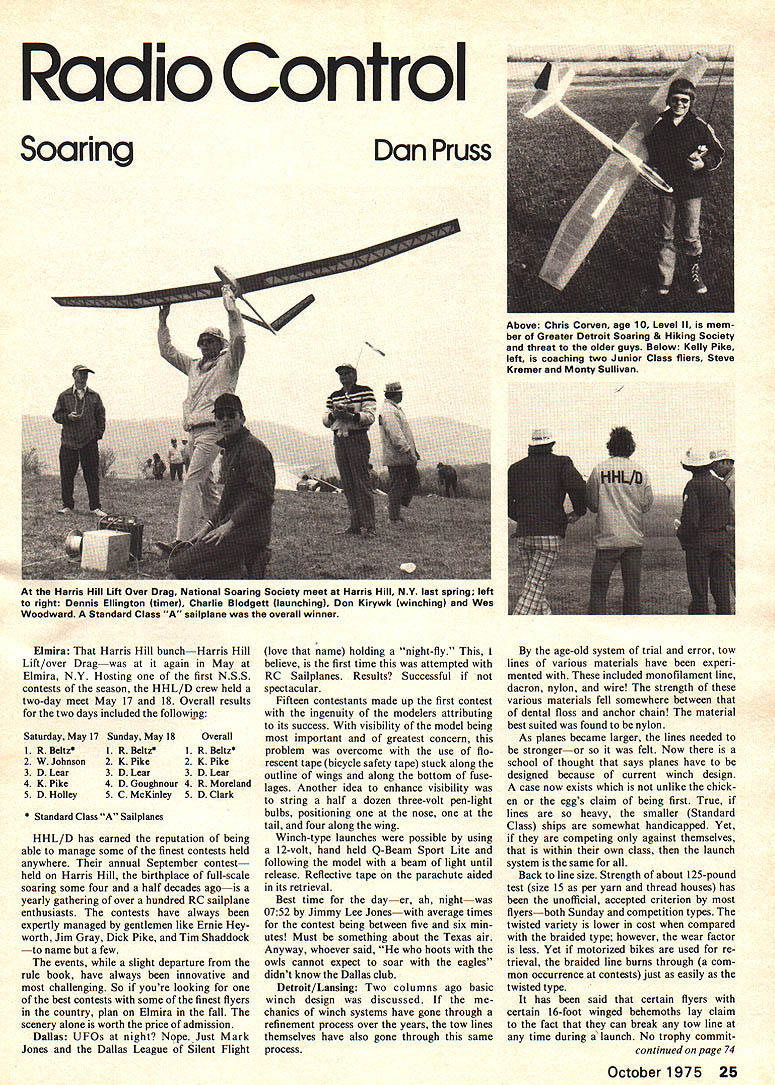
Elmira: That Harris Hill bunch—Harris Hill Lift/Over Drag—was at it again in May at Elmira, N.Y. Hosting one of the first N.S.S. contests of the season, the HHL/D crew held a two-day meet May 17 and 18. Overall results for the two days included the following:
Saturday, May 17
- R. Beltz*
- W. Johnson
- D. Lear
- K. Pike
- D. Halley
Sunday, May 18
- R. Beltz*
- K. Pike
- D. Lear
- D. Goughnour
- C. McKinley
Overall
- R. Beltz*
- K. Pike
- D. Lear
- D. Goughnour
- C. McKinley
* Standard Class "A" Sailplanes
HHL/D has earned the reputation of being able to manage some of the finest contests held anywhere. Their annual September contest—held on Harris Hill, the birthplace of full-scale soaring some four and a half decades ago—is a yearly gathering of over a hundred RC sailplane enthusiasts. The contests have always been expertly managed by gentlemen like Ernie Heyworth, Jim Gray, Dick Pike, and Tim Shaddock, to name but a few. The events, while a slight departure from the local rule book, have always been innovative and challenging. So you're looking for one of the best contests with some of the finest flyers in the country, plan on Elmira in the fall. The scenery alone is worth the price of admission.
Dallas: UFOs at night? Nope. Just Mark Jones and the Dallas League of Silent Flight love the name and are holding a night-fly — believe it's the first time attempted with RC sailplanes. Results? Successful if not spectacular. Fifteen contestants made up the first contest with the ingenuity of the modelers attributing its success. With visibility of the model being most important and of greatest concern, this problem was overcome with the use of fluorescent tape (bicycle safety tape) stuck along the outline of wings and along the bottom of fuselages. Another idea to enhance visibility was to string a half-dozen three-volt pen-light bulbs, positioning one at the nose, one at the tail, and four along the wing. Winch-type launches were possible using a 12-volt, hand-held Q-Beam Sport Lite and following the model with a beam of light until release. Reflective tape on the parachute aided its retrieval. Best time for the day—or, ah, night—was 07:52 by Jimmy Lee Jones, with average times between five and six minutes. Must be something about the Texas air. Anyway, whoever said "He who roots with the owls cannot expect to soar with the eagles" didn't know the Dallas club.
Detroit/Lansing: Two columns ago the basic winch design was discussed. If the mechanics of winch systems have gone through a refinement process over the years, the tow lines themselves have also gone through the same process. Age-old systems, by trial and error, experimented with tow lines of various materials including monofilament line, dacron, nylon and wire. The strength of various materials has fallen somewhere between dental floss and anchor chain! The material best suited was found to be nylon. As planes became larger, lines needed to be stronger. Now the school of thought says planes have been designed because current winch design now exists—unlike the chicken-and-egg claim of which came first. True, if lines are so heavy, the smaller (Standard Class) ships are somewhat handicapped. Yet they are competing only against themselves within their own class. Back line size and strength—about 125-pound test (size 15 per yarn thread)—has become an unofficially accepted criterion by most flyers for both contest types. The twisted variety is lower cost compared to the braided type; however, the wear factor is less for the braided. Yet if motorized bikes are used for retrieval, braided line burns through in common occurrence at contests just as easily as the twisted type. It has been said that certain flyers with certain 16-foot-winged behemoths lay claim to the fact that they can break tow line at any time during a launch. No trophy committee has yet come up with a suitable award for the heroics. Bud Manning and Tom Kelley of the C.A.R.D.S./L tee has yet come up with a suitable award for his heroic achievement. It has been said that winchmasters do not have a warm spot in their hearts for such displays of airmanship. (To quell any rumors to the contrary, winchmasters do have hearts.)
Bud Manning and Tom Kelley of the C.A.R.D.S./Lansing and Bud Pell and Art Slagle of the G.D.S.&H.S./Detroit discussed the problem of the above and may have found a very workable solution. Although too new to try on a national level, it has been successfully tried at local club gatherings.
For wear and durability, the 125-pound test line is used. However, a "weak link"—a six-foot length of 45-pound test fishing line—is tied in between the parachute or flag and the regular tow line.
With a slight amount of prudence, the heaviest ships can be launched to heights attained before. Yet, any lurching or jerking can break the line. The technique is not unlike the fisherman that successfully lands a twenty-pound musky while fishing with a six-pound test line.
Carry the "weak-link" system a step further, if the main tow line breaks, this can be attributed to line wear, etc. Result: a relaunch. However, if the "weak-link" breaks, then it is considered overstressing the winch system and no relaunch is given. The chance of the "weak-link" fraying or wearing is very slight due to the fact it is seldom in contact with the ground. It can be inspected before each flight because it is the section of line usually handled during retrieval and "hook-up." While not perhaps the cure-all for the elimination of attempted relights, this does seem to be a step towards that end.
Albuquerque:
Seems as though the elusive 10-kilometer goal and return for Level V in the League of Silent Flight is not too elusive for the A.R.S.E.s (Albuquerque Radio Sailplane Enthusiasts). Dave Thornburg, LSF/581, started it all by being the first to achieve this distance back in April. Buzz Averill, LSF/523, followed shortly thereafter. Recently, Steve Work, LSF/571, also accomplished the task. John Baxter, LSF/024, from California, traveled to Albuquerque and he too managed the 2.64 miles out and back. It should be mentioned that Jack Hiner, LSF/383, as of this writing, is the only other Level V aspirant to accomplish the goal task.
Other L-S Efforts:
Chris Corven, LSF/940, can lay claim to being the youngest LSF member. At the age of ten and working on Level III of the accomplishment program, Chris is another Junior to watch. His performances with his Aquila in standard class and Legendaire in unlimited class have left more than a few open fliers with thoughts of sending him away to camp during the next contest season.
New Products:
From Su Karta Hobbies comes a clever antenna installation kit. With the majority of flyers running the antenna through the fuselage, it is sometimes inconvenient to make a quick change with one's receiver. There are also times when the antenna length far exceeds the fuselage length and an installation out through the wing would be preferred.
The antenna connector—called "Shove-it"—comes with material enough for two airplanes.
New Sailplane Organization:
Well, gentlemen of the sport, it has happened. The women have organized. W.I.N.G.S.—Women in National Glider Soaring—is a group boasting a membership from at least six states. President of the newly formed organization is Meryl Gill, 216 Stutely Lane, Springfield, Ill. 62704. This address also serves as the organization's headquarters. Lila Stamm of Grandview, Mo., is the Vice President and Helen Olsen of Springfield, Ill., serves as Secretary/Treasurer.
Individually, the members have been most active as fliers and the newly formed organization—which incidentally is the only organized all-women group of modelers—fielded a team at the '75 RC Soaring Nationals. Don't know what'll develop from here guys, but we might expect even more involvement from the family doctor type to talk such as:
He: "Mildred, why are you recovering that wing?"
She: "Well, Harvey, the new fall colors look so groovy and besides the old covering clashed with my new outfit."
He: "What next for new channel?"
She: "Well, I was walking by Al's Hobby the other day and there in the window was the cutest rig on sale so I thought I might as well save you some money so I bought it."
Transcribed from original scans by AI. Minor OCR errors may remain.

