
Radio Control: Soaring
Dan Pruss
TWO-METER CLASS: Proponents of this class have made little headway over the last few years in getting recognition for the two-meter sailplane—that is one with a wing span of two meters or less. The negative side probably comes from the fact that in contests this class or category of ship usually can't be put into the same competition ring with the "big guy." And because most clubs, when they do split the classes for contests, usually hold events for Standard and Unlimited classes and the fliers lean towards the "proven" contest type birds. This in turn tends to support the belief that the two-meter class is unpopular and the theory snowballs into the "why hold a contest for a class for which there is no interest syndrome?" However, judging from the number of two-meter ships sold during the past few years, there must be a heckuva lot of cluttered rafters. Enter the AMA, LSF, and NSS.
For the first time, the AMA will recognize the two-meter class—as a separate class—at the AMA Nationals. The LSF will also hold a two-meter event at all of its regional tournaments this summer. However, Gordon Pearson, president of the LSF, announced that competitors may enter the two-meter category in addition to Standard class or Unlimited class. Flying in the two-meter event only will also be permitted.
The added expense for trophies for an additional class has also been a drawback to the two-meter class. Most often the club budget can't stretch that far so these clubs host events only for the Standard and Unlimited sizes. The NSS recognizes this problem and will honor the two-meter class with their Excellence Awards Program, but will impose no award restriction on clubs hosting NSS contests.
By the time this is being read it is realized the contest season will be well underway. Yet you still have time to dust off that old 78-in. wing and have at it. If the parts are still in the box you also have time to build it and compete.
Since the negative—or seemingly negative—side has been mentioned here, it's only fair to note the plus side to two-meter sailplanes—especially if you're new to the sport.
First of all, they are inexpensive when compared with the higher priced spreads. If you're a part tracer you can copy all of the pieces on similar materials and have a second model ready to build at only a fraction of the cost of the first. And since two-meter planes don't usually have fancy hardware and sophisticated fittings as do their bigger brothers, reproducing a second and third model is a snap. By the way, if you've never built two models at once, try it—whether they both come as kits or as a result of your pencil and #11 X-Acto blade. You'll find the second one assembles in a fraction of the time of the first one because the "thinking about it" time spent on the first one is already thought out for the second one.
If that old two-channel radio has been put in a drawer because you just had to upgrade to three channels or more, put the former in a two-meter ship. Rudder and elevator is all you need (no, no, you don't hook up a two-channel rig to spoilers and a releasable tow hook).
Again to new comers... the two-channel radios are relatively inexpensive but, if you're buying your first "wireless," think ahead. If you feel you'll require additional controls later you might want to think about more than two channels. But if two channels is all you really want, a good used one might be in the dealer's showcase because someone else traded it in on a new "Glitchless 7."
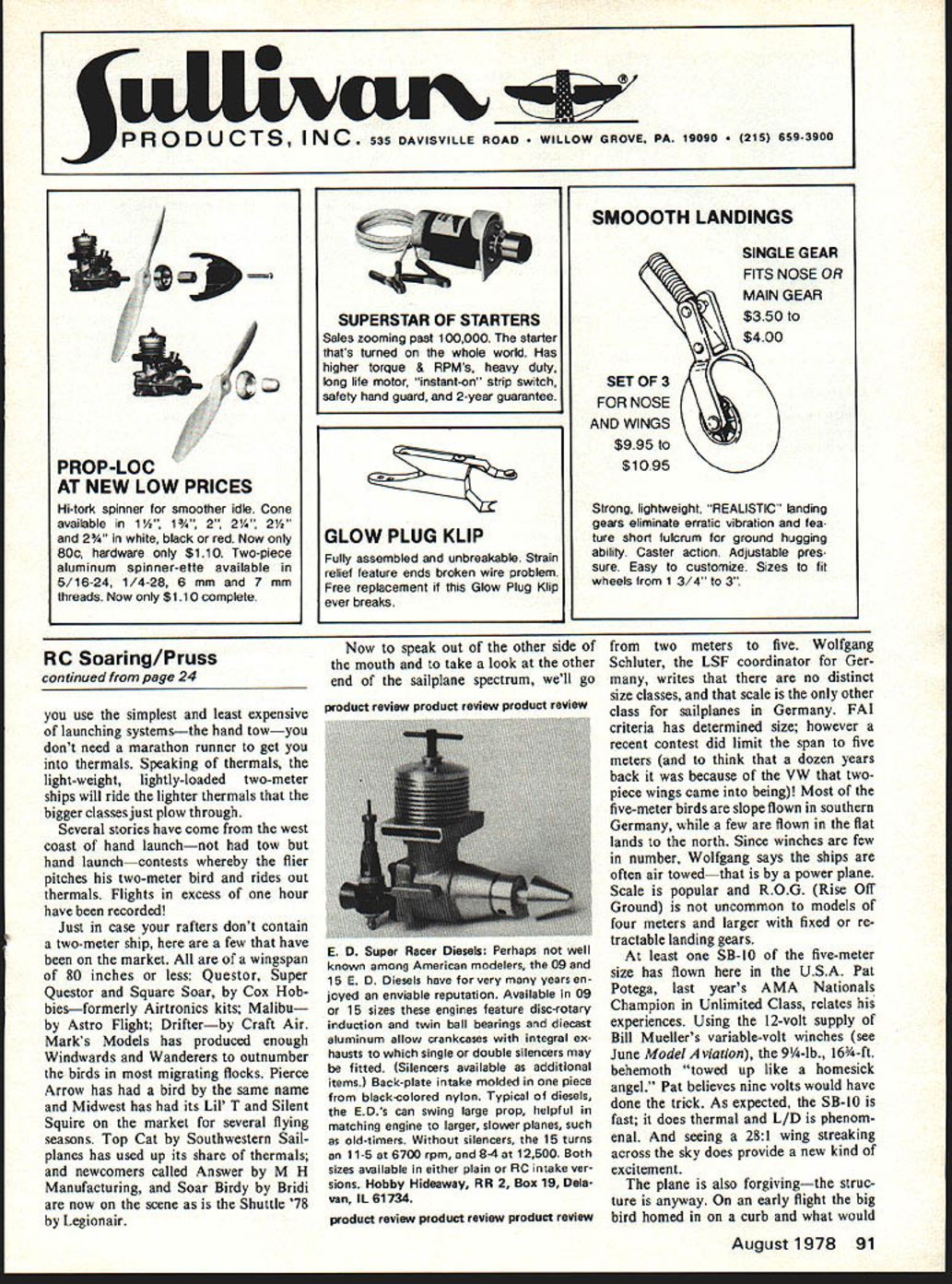
The list of advantages for two-meter ships can go on and on. You don't need a van to haul them to the flying field and if the wing is a two-piece arrangement you can sneak the whole business out of the house in a much less obvious manner than your neighbor has to with his big 'ole golf sack. School yards can serve as flying fields—for test flying anyway; light duty high-starts serve well in launching and, if you use the simplest, least expensive launching systems—the hand tow—you don't need a marathon runner to get thermals.
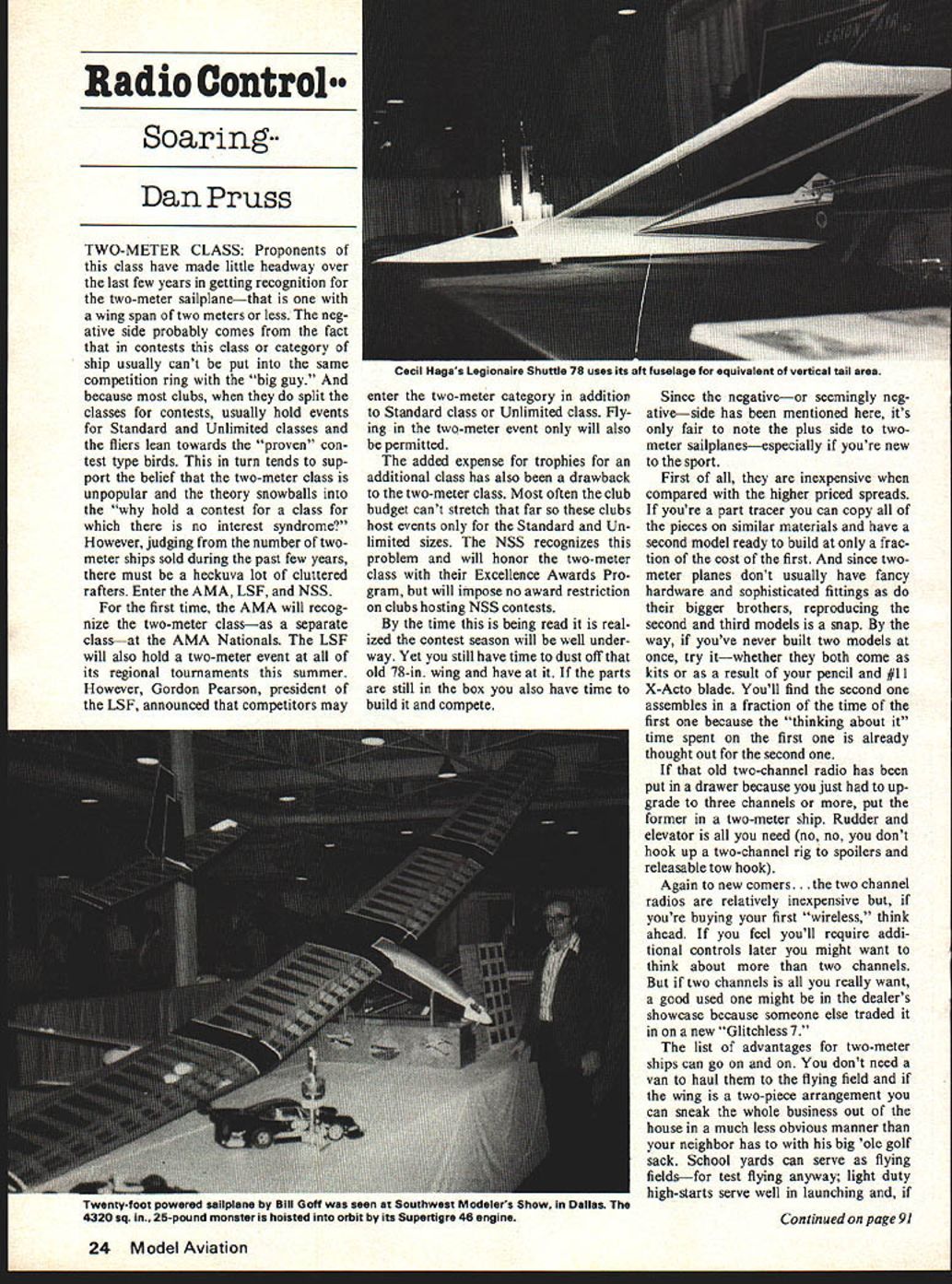
Speaking of thermals, light-weight, lightly-loaded two-meter ships will ride lighter thermals where bigger classes just plow through. Several stories have come out of west coast hand-launch (not tow, hand-launch) contests whereby the flier pitches the two-meter bird and it rides out thermals. Flights in excess of an hour have been recorded. Just in case rafters don't contain two... meter ship, here are a few that have been on the market. All are of a wingspan of 80 inches or less: Questor, Super Questor and Square Soar, by Cox Hobbies—formerly Airtronics kits; Malibu—by Astro Flight; Drifter—by Craft Air. Mark's Models has produced enough Windwards and Wanderers to outnumber the birds in most migrating flocks. Pierce Arrow has had a bird by the same name and Midwest has had its Lil' T and Silent Squire on the market for several flying seasons. Top Cat by Southwestern Sailplanes has used up its share of thermals; and newcomers called Answer by M H Manufacturing, and Soar Birdy by Birdz are now on the scene as is the Shuttle '78 by Legionair.
Now to speak out of the other side of the mouth and to take a look at the other end of the sailplane spectrum, we'll go from two meters to five. Wolfgang Schluter, the LSF coordinator for Germany, writes that there are no distinct size classes, and that scale is the only other class for sailplanes in Germany. FAI criteria has determined size; however a recent contest did limit the span to five meters (and to think that a dozen years back it was because of the VW that two-piece wings came into being!). Most of the five-meter birds are slope flown in southern Germany, while a few are flown in the flat lands to the north. Since winches are few in number, Wolfgang says the ships are often air towed—that is by a power plane. Scale is popular and R.O.G. (Rise Off Ground) is not uncommon to models of four meters and larger with fixed or retractable landing gears.
At least one SB-10 of the five-meter size has flown here in the U.S.A. Pat Potega, last year's AMA Nationals Champion in Unlimited Class, relates his experiences. Using the 12-volt supply of Bill Mueller's variable-volt winches (see June Model Aviation), the 9¼-lb., 16½-ft. behemoth "towed up like a homesick angel." Pat believes more volts would have done the trick. As expected, the SB-10 is fast; it does thermals and its L/D is phenomenal. And seeing a 28:1 wing streaking across the sky does provide a new kind of excitement.
The plane is also forgiving—the structure is anyway. On an early flight the big bird homed in on a curb and what would have shattered a fiberglass fuselage merely flexed the SB-10's polythene fuselage and popped the canopy loose.
TWO-METER CLASS
Proponents of the class have made little headway over the last few years getting recognition for two-meter sailplanes that span two meters or less. The negative side probably comes from the fact that in contests the class-category ship usually can't put up the same competition ring as the big guy because clubs split classes and contests usually hold events for Standard and Unlimited classes. Fliers lean toward proven contest-type birds, and this tendency tends to support the belief the two-meter class is unpopular. The theory snowballs into a "hold a contest—no interest" syndrome.
However, judging by the number of two-meter ships sold during the past few years, there must be a heckuva lot cluttering rafters. Enter AMA, LSF and NSS. For the first time AMA will recognize the two-meter class as a separate class at the AMA Nationals. LSF will also hold a two-meter event in its regional tournaments this summer. Gordon Pearson, president of LSF, announced competitors may enter the two-meter category in addition to Standard and Unlimited classes. Flying in the two-meter event will also be permitted; the added expense of trophies for an additional class is a drawback—most often club budgets can't stretch far enough to host Standard and Unlimited sizes. NSS recognizes the problem and will honor the two-meter class Excellence Awards Program and will impose no award restrictions on clubs hosting NSS contests for the time being.
Realize contest season will be well under way, yet there's still time to dust off that old 78-inch wing, if parts are still in the box, and to build and compete. Since the negative—or seemingly negative—side has been mentioned, it's fair to note the plus side of two-meter sailplanes, especially if you're new to the sport. First, they are inexpensive compared with higher-priced ships. If you're a parts tracer you can copy pieces of similar materials and have a second model ready to build at a fraction of the cost of the first. Since two-meter planes don't usually have fancy hardware or sophisticated fittings like their bigger brothers, reproducing second and third models is a snap. Once you've built two models—whether both come from kits or are the result of pencil and #11 X-Acto blade work—you'll find the second assembles in a fraction of the time the first took because the thinking about the first has already been worked out.
If an old two-channel radio has been put in the drawer because you upgraded to three channels, don't hook up the rudder and elevator; no, no—don't hook up a two-channel rig to spoilers—use a releasable tow hook. Again, newcomers: two-channel radios are relatively inexpensive. If you're buying your first wireless set, think ahead; if you feel you'll require additional controls later you might want to consider three channels. If two channels really are what you want, good used sets can often be found at dealer showcases because someone else traded up.
The list of advantages of two-meter ships can go on. You don't need a van to haul to the flying field; with a two-piece wing you can sneak the whole business out of the house in a much less obvious manner—your neighbor won't think you have a big old golf sack. Schoolyards can serve as flying fields for test flying, and light-duty high-starts serve well for launching. Use the simplest, least expensive launching systems—the hand tow—you don't need a marathon runner to get into thermals. Speaking of thermals, light-weight, lightly-loaded two-meter ships will ride lighter thermals where the bigger classes just plow through. Several West Coast hand-launch contests (hand launch, not tow) have been held in which the flier pitches the two-meter bird and it rides out thermals. Flights in excess of an hour have been recorded. Just in case rafters don't contain two-meter ships.
Transcribed from original scans by AI. Minor OCR errors may remain.

