
Radio Control--
Soaring.
Dan Pruss
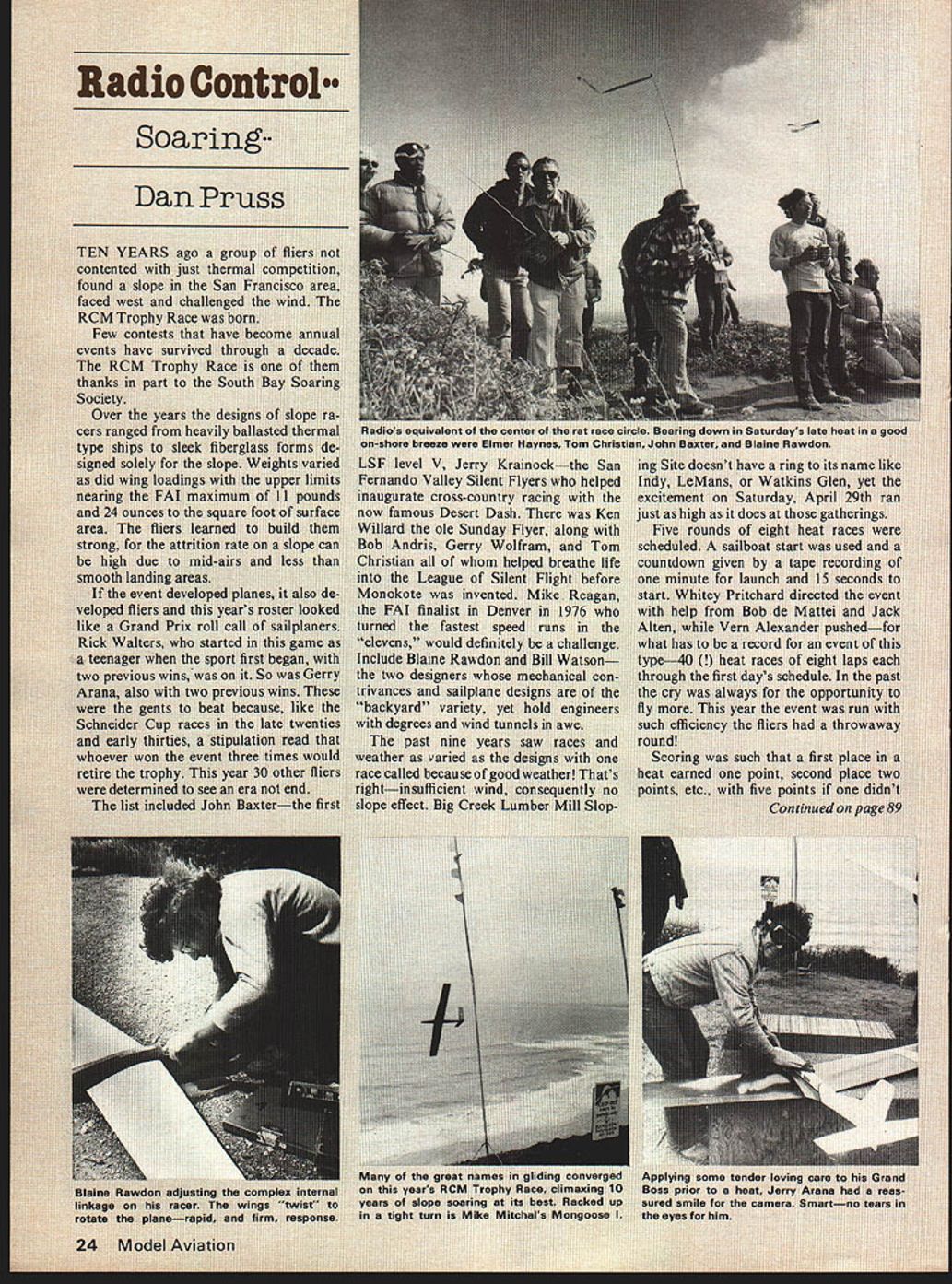
TEN YEARS ago a group of fliers not contented with just thermal competition, found a slope in the San Francisco area, faced west and challenged the wind. The RCM Trophy Race was born.
Few contests that have become annual events have survived through a decade. The RCM Trophy Race is one of them thanks in part to the South Bay Soaring Society.
Over the years the designs of slope racers ranged from heavily ballasted thermal type ships to sleek fiberglass forms designed solely for the slope. Weights varied as did wing loadings with the upper limits nearing the FAI maximum of 11 pounds and 24 ounces to the square foot of surface area. The fliers learned to build them strong, for the attrition rate on a slope can be high due to mid-airs and less than smooth landing areas.
If the event developed planes, it also developed fliers and this year's roster looked like a Grand Prix roll call of sailplaners. Rick Walters, who started in this game as a teenager when the sport first began, with two previous wins, was on it. So was Gerry Arana, also with two previous wins. These were the gents to beat because, like the Schneider Cup races in the late twenties and early thirties, a stipulation read that whoever won the event three times would retire the trophy. This year 30 other fliers were determined to see an era not end.
The list included John Baxter — the first LSF level V, Jerry Krainock — the San Fernando Valley Silent Flyers who helped inaugurate cross-country racing with the now famous Desert Dash. There was Ken Willard the ole Sunday Flyer, along with Bob Andris, Gerry Wolfram, and Tom Christian all of whom helped breathe life into the League of Silent Flight before Monokote was invented. Mike Regan, the FAI finalist in Denver in 1976 who turned the fastest speed runs in the elevens, would definitely be a challenge. Include Blaine Rawdon and Bill Watson — the two designers whose mechanical contrivances and sailplane designs are of the "backyard" variety, yet hold engineers with degrees and wind tunnels in awe.
The past nine years saw races and weather as varied as the designs with one race called because of good weather! That's right — insufficient wind, consequently no slope effect. Big Creek Lumber Mill Sloping Site doesn't have a ring to its name like Indy, LeMans, or Watkins Glen, yet the excitement on Saturday, April 29th ran just as high as it does at those gatherings.
Five rounds of eight heat races were scheduled. A sailboat start was used and a countdown given by a tape recording of one minute for launch and 15 seconds to start. Whitey Pritchard directed the event with help from Bob de Matteis and Jack Alten, while Vern Alexander pushed — for what has to be a record for an event of this type — 40 (!) heat races of eight laps each through the first day's schedule. In the past the cry was always for the opportunity to fly more. This year the event was run with such efficiency the fliers had a throwaway round!
Scoring was such that a first place in a heat earned one point, second place two points, etc., with five points if one didn't finish. By Saturday's end Rick Walters, Gerry Arana and Mike Mitchell were tied with four points each. There were some five pointers and enough six pointers to have at least ten to 12 in contention for the cup on Sunday.
Three rounds of seven-heat racing were scheduled for day two with time allowed also for any possible fly-offs. All of the drama of the past ten years was squeezed into the last two rounds as Walters, Arana, and Mitchell were still tied. The last heat was set. From the ready area managed by Jon Lowe, came Rick Walters and his brother Jeff who was to call Rick's turns. Mike Mitchell had current NSS champion and LSF level V holder Fred Weaver assisting while Dick Tacklind called for Jerry Arana.
The race was on. Walters scurried into a quick lead and it was apparent that only a mistake would do him in. Arana and Mitchell had their own race and both stayed ahead of Spicer.
Thirty-one others made it a contest but, just as Britain took the Schneider Cup in 1931 for the third time to end an era, Rick Walters ended another era by taking the RCM Trophy for the third and final time.
The top five: 1) Rick Walters, 2) Mike Mitchell, 3) Gerry Arana, 4) Ken Willard, and 5) Bill Watson.
Fastest time: Gerry Arana 19.1 seconds/lap (44.3 mph on 621-ft. course)
Design Award: Gerry Arana.
If the foregoing seemed a bit competitive or high-key for the average "wait for a thermal to come by" flier, read on.
As mentioned in the May issue of Model Aviation Cecil Haga was to run a different kind of event. He did. What is so unique about this contest is it can be applied to any club for a low key, easy to manage affair. Whether inter or intra club, the managing is minimal.
Cecil "Legionair" Haga determined that each four-man team had to make a minimum of 56 flights during the day with a maximum of 112. Cecil arrived at these figures by averaging out Texas conditions of light-pole-bending winds and hot, sucking thermals. The idea was to fly as much as possible during the two day event. Rules were simple. Launch by any approved legal method (two winches were provided). Time started when off tow and ended on touchdown; no points for landing.
A rotation was written within each four-man team and, as soon as one flier landed, the next scheduled one would launch or pass. The idea, of course, was for a group to keep one flier in the air as much as possible and to still get in the required 56-112 flights. What made managing so easy is that, once the gun went off to start the contest, each group had to run and manage their own individual contest. Frequencies were within a group. Nice twist: The fliers spend the days in the sun while the contest director sat in the shade. Love it!
The winning team was headed by Lemon Payne. One modification to the 56-112 flights Cecil had worked was to increase these figures by two for each additional member. This possibility was considered because more than four people on one frequency could show up or if the frequency spread wasn't divisible by four. It also was an easy way to accommodate late comers, but this had to be OKed by the respective flight group.
Payne's team numbered five and Helmer Johnson, Connie Jones, Jim Smith, and Scott Jamieson wound up with 106 flights for a total of 718 minutes of air time! That was only one and a half minutes longer than the second place team which had 105 flights! Total air time scheduled was 810 minutes (13.5 hours).
Besides teamwork, strategy entered into the scoring with regards to flight time, for Haga also announced flight time would be logged to the nearest whole minute. That meant, if you weren't planning slightly ahead, you could throw away up to 29 seconds per flight. Of course, you could also gain 29 seconds by landing at the 31 second mark. This could have a drastic effect on one's overall score over 100 flights.
Only three flights were over 40 minutes and seven were over 20 minutes.
Some fliers have been heard to claim they don't attend contests because they can't get enough flying in. The only negative comment according to Cecil about his "Dallas Marathon" was "too much flying." Haga says, "Looking back, one day would have been enough—for the fliers."
So, if you're after an event that can involve your whole club, heed Cecil Haga's outline. Better yet, run the event!
Dan Pruss, Rt. 2, Box 490, Plainfield, IL 60544.
Transcribed from original scans by AI. Minor OCR errors may remain.

