
Radio Control: Soaring
Dan Pruss
Long Overdue
Recently a proposal was submitted to establish rules for setting national AMA records by RC sailplanes. Don Clark of Kensington, MD made the proposal, which includes the following classifications:
- Absolute Duration
- Thermal Duration
- Declared Distance
- Open Distance
- Closed Course Distance
- Altitude
- Speed
The proposal suggested minimums for each classification such that the first established records would have to exceed:
- Eight hours for Absolute Duration
- Two hours for Thermal Duration
- 10 kilometers for Declared Distance
- 20 kilometers for Open Distance
- 100 kilometers for Closed Course Distance
- 1,000 meters for Altitude
- 100 kilometers/hour for Speed
The first three classifications are the same as requirements included in the LSF program for Level V. This is a natural jumping‑off point since more than just a few already have logged these accomplishments. Some details still need to be finalized, but chances are that soon there will be some national records to shoot for in addition to the FAI world records.
Cross-Country Racing Has Come of Age
This past summer the S.O.A.R. Club hosted the third running of The Great Race. This 76‑kilometer event began in 1976; the distance of 76 km was selected as part of the bicentennial theme. The event was a success, and the two subsequent events have proved that it is here to stay.
This year six clubs entered (a seventh was entered but had to withdraw), and for the first time all entrants finished. They not only finished, but the last-place team's time would have been good enough for second place in 1976. Indeed, cross‑country racing has come of age.
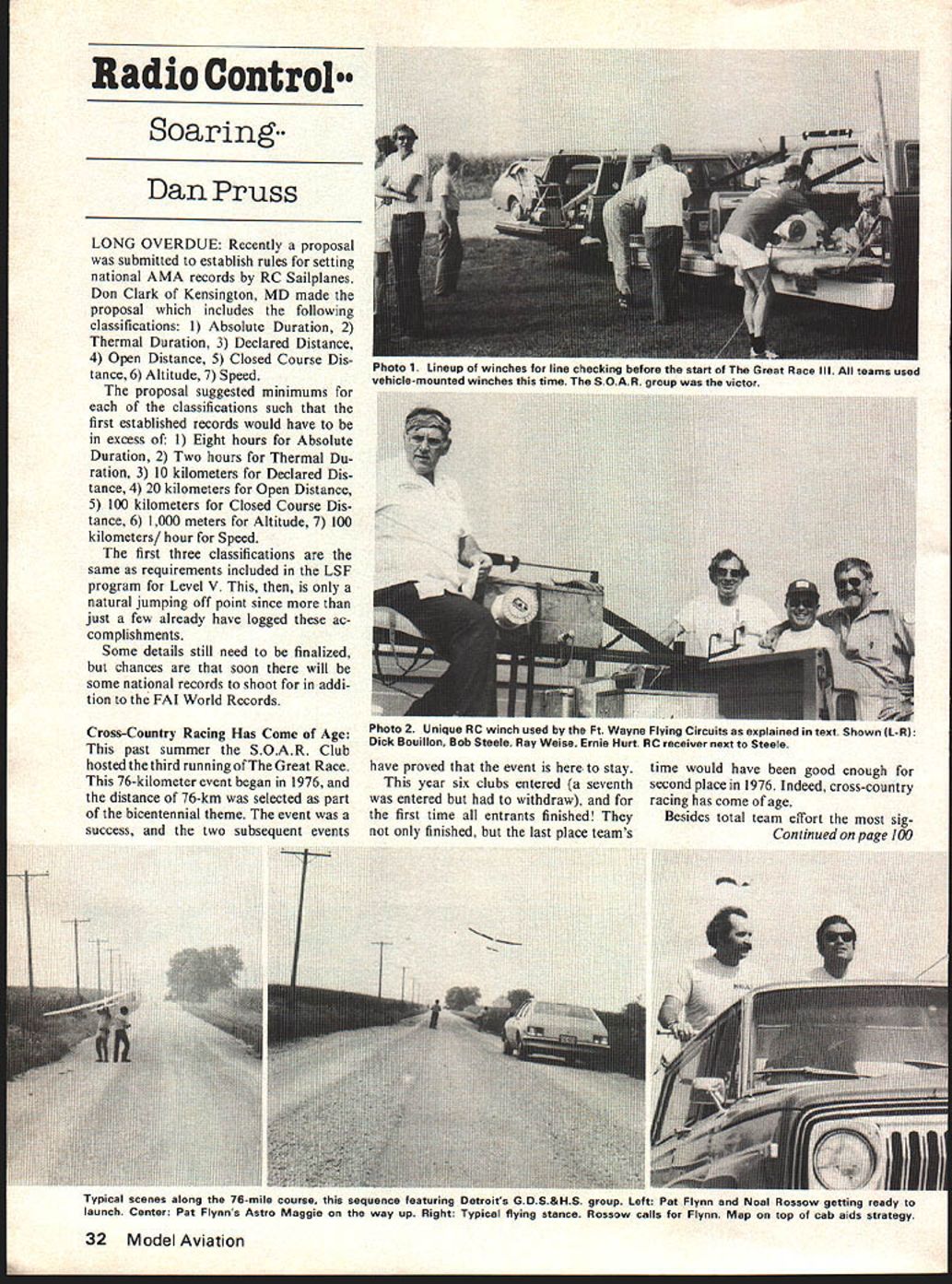
Besides total team effort, the most significant factor in teams finishing this year was the launching system. In 1976, high‑starts and hand‑tow lines drifted across cornfields and ate up a lot of pit time in retrieval efforts. Boys in Detroit that year fastened a winch back on a station wagon (no upwind pulley was used) and sat at the finish line to savor first place over two hours before they could tell who was second. The winch‑type launch prevailed, and what the Greater Detroit Soaring & Hiking Society used in 1976 became standard. In 1978 six teams used winches mounted on the backs of either station wagons, pickup trucks, or four‑wheel‑drive rigs. Picture #1, taken during line measurement before the race, gives an idea of the basic systems. All winch lines were tied off at 300 meters.
Although winches have become standard, the Flying Circuits of Fort Wayne, IN, had a very clever variation. As with many types of racing, an event can be won in the pits and not necessarily just on the track; the same can be said for the Great Race. Since overall time determines the winner, the less time spent on the ground the better.
Most of us are accustomed to winching our models with a winch that is controlled by the flier as the model launches. This is accomplished because the line runs through an upwind turnaround and back to the flier. But to run a line through an upwind turnaround during the cross‑country race would be too time consuming; thus vehicle‑mounted winches are used. However, this system requires superb coordination between flier and winch operator—not to mention stout wing and wing‑mounting construction. Back in 1976, when the Detroit gang waltzed into first place, their plane was an Astro‑Jeff—a sailplane whose wing structure has an integrity factor somewhere between that of the Golden Gate Bridge and the Great Wall of China.
All wings aren't built that way, and when the "foot switch"—in effect—is 300 meters away from the flier, the slightest miscue on the part of either the launcher or launchee can and has had disastrous results on sailplanes—not to mention some of the finest corn in Illinois.
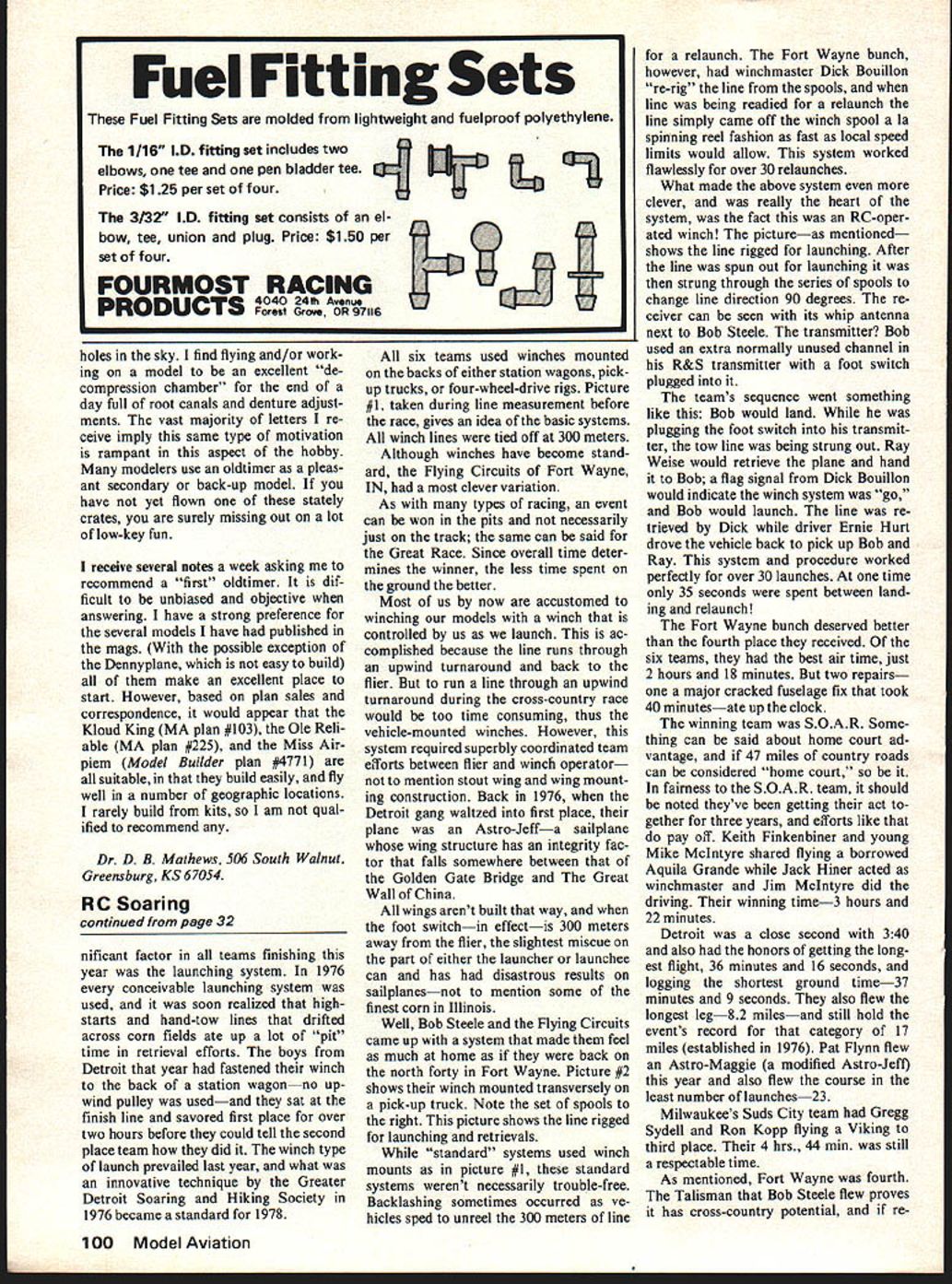
Bob Steele and the Flying Circuits came up with a system that made them feel as much at home as if they were back on the north forty in Fort Wayne. Picture #2 shows their winch mounted transversely on a pickup truck. Note the set of spools to the right. This picture shows the line rigged for launching and retrieval.
While "standard" systems used winch mounts as in picture #1, these standard systems weren't necessarily trouble‑free. Backlashing sometimes occurred as vehicles sped to unreel the 300 meters of line for a relaunch. The Fort Wayne team, however, had winchmaster Dick Bouillon "re‑rig" the line from the spools, and when line was being readied for a relaunch the line simply came off the winch spool a la spinning‑reel fashion as fast as local speed limits would allow. This system worked flawlessly for over 30 relaunches.
What made the system even more clever—and was really the heart of it—was that this was an RC‑operated winch. The picture shows the line rigged for launching. After the line was spun out for launching it was then strung through a series of spools to change line direction 90 degrees. The receiver can be seen with its whip antenna next to Bob Steele. The transmitter? Bob used an extra, normally unused channel in his R&S transmitter with a foot switch plugged into it.
The team's sequence went something like this:
- Bob would land and plug the foot switch into his transmitter while the tow line was being strung out.
- Ray Weise would retrieve the plane and hand it to Bob.
- A flag signal from Dick Bouillon would indicate the winch system was "go," and Bob would launch.
- The line was retrieved by Dick while driver Ernie Hurt drove the vehicle back to pick up Bob and Ray.
This system and procedure worked perfectly for over 30 launches. At one time only 35 seconds were spent between landing and relaunch!
The Fort Wayne bunch deserved better than the fourth place they received. Of the six teams, they had the best air time, just 2 hours and 18 minutes. But two repairs—one a major cracked‑fuselage fix that took 40 minutes—ate up the clock. The Talisman that Bob Steele flew proves it has cross‑country potential, and if repairs hadn't been needed it would have been their day.
The winning team was S.O.A.R. Something can be said about home‑court advantage, and if 47 miles of country roads can be considered "home court," so be it. In fairness to the S.O.A.R. team, it should be noted they've been getting their act together for three years, and efforts like that do pay off. Keith Finkenbinder and young Mike McIntyre shared flying a borrowed Aquila Grande while Jack Hiner acted as winchmaster and Jim McIntyre did the driving. Their winning time was 3 hours and 22 minutes.
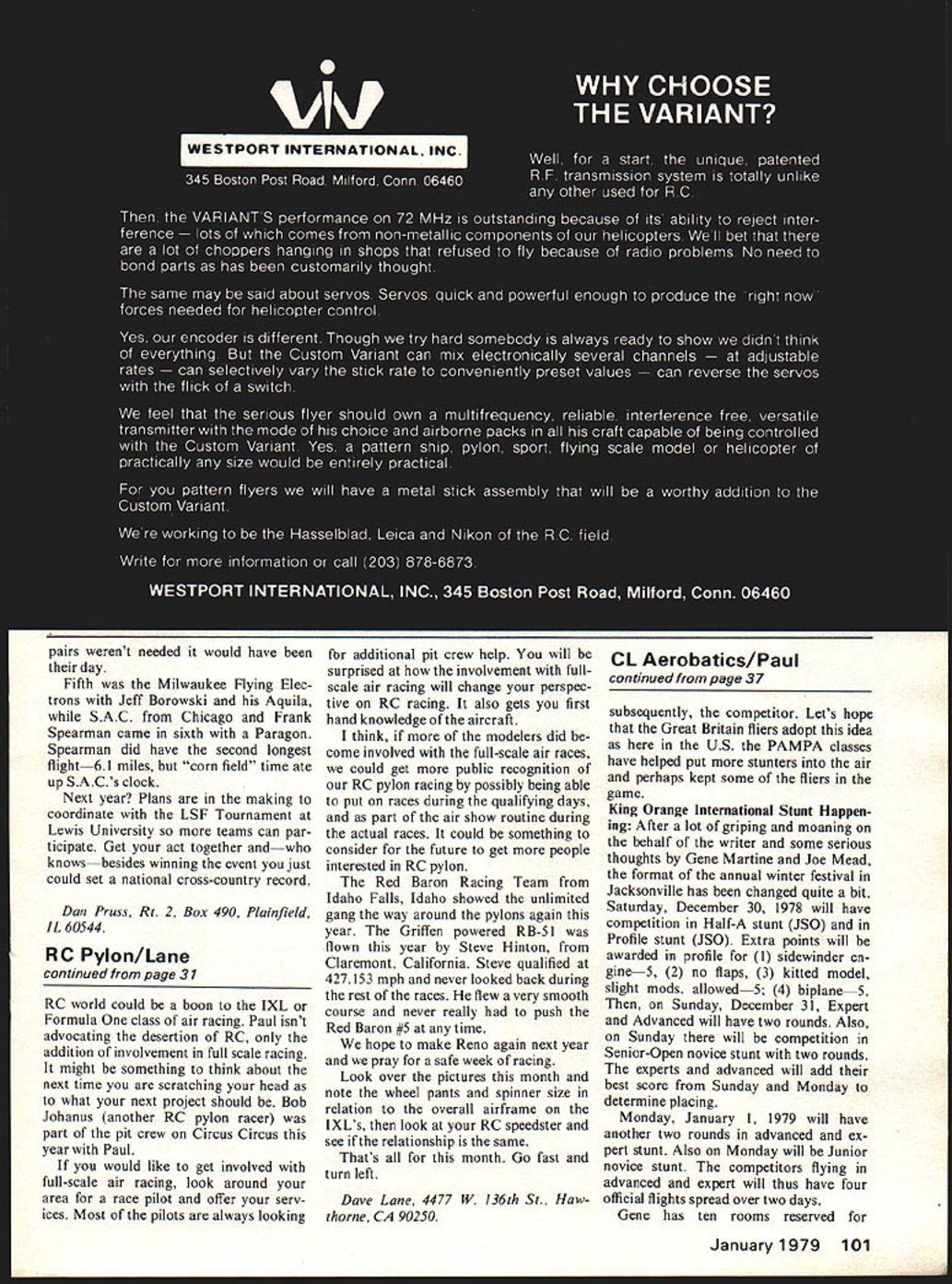
Detroit was a close second with 3:40 and also had the honors of the longest single flight—36 minutes and 16 seconds—and the shortest total ground time—37 minutes and 9 seconds. They also flew the longest leg—8.2 miles—and still hold the event's record for that category of 17 miles (established in 1976). Pat Flynn flew an Astro‑Maggie (a modified Astro‑Jeff) this year and also flew the course in the fewest number of launches—23.
Milwaukee's Suds City team had Gregg Sydell and Ron Kopp flying a Viking to third place with a time of 4 hours, 44 minutes—still a respectable showing.
Fifth was the Milwaukee Flying Electrons with Jeff Borowski and his Aquila, while S.A.C. from Chicago, with Frank Spearman flying a Paragon, came in sixth. Spearman did have the second longest flight—6.1 miles—but "corn field" time ate up S.A.C.'s clock.
Next year? Plans are in the making to coordinate with the LSF tournament at Lewis University so more teams can participate. Get your act together and—who knows—besides winning the event you might set a national cross‑country record.
Dan Pruss Rt. 2, Box 490 Plainfield, IL 60544
Transcribed from original scans by AI. Minor OCR errors may remain.

