
Radio Control: Soaring
By Ron Van Putte
CHRIS ADAMS, of Pacific Palisades, California, won his club-sponsored Desert Dash and became the eighth member in the League of Silent Flight to achieve Level V.
Twenty-four members of the San Fernando Valley Silent Flyers competed in a contest that scheduled three rounds of cross-country flying. The three rounds — all goal-and-return — had goals of 0.7, 1.3 and 6.3 miles scheduled. These figures were set to be slightly in excess of the LSF Levels III, IV, and V requirements. Two of the fliers, including Chris, finished the 12.6 miles, and that has to say something about the flying and the fliers in the SFVSF.
Chris more recently won the scale event at this year's LSF regional in Los Angeles with his scratch-built Caproni. This model has been developed over three years, mostly while Chris was working on an MS degree in biochemistry at the University of Wyoming.
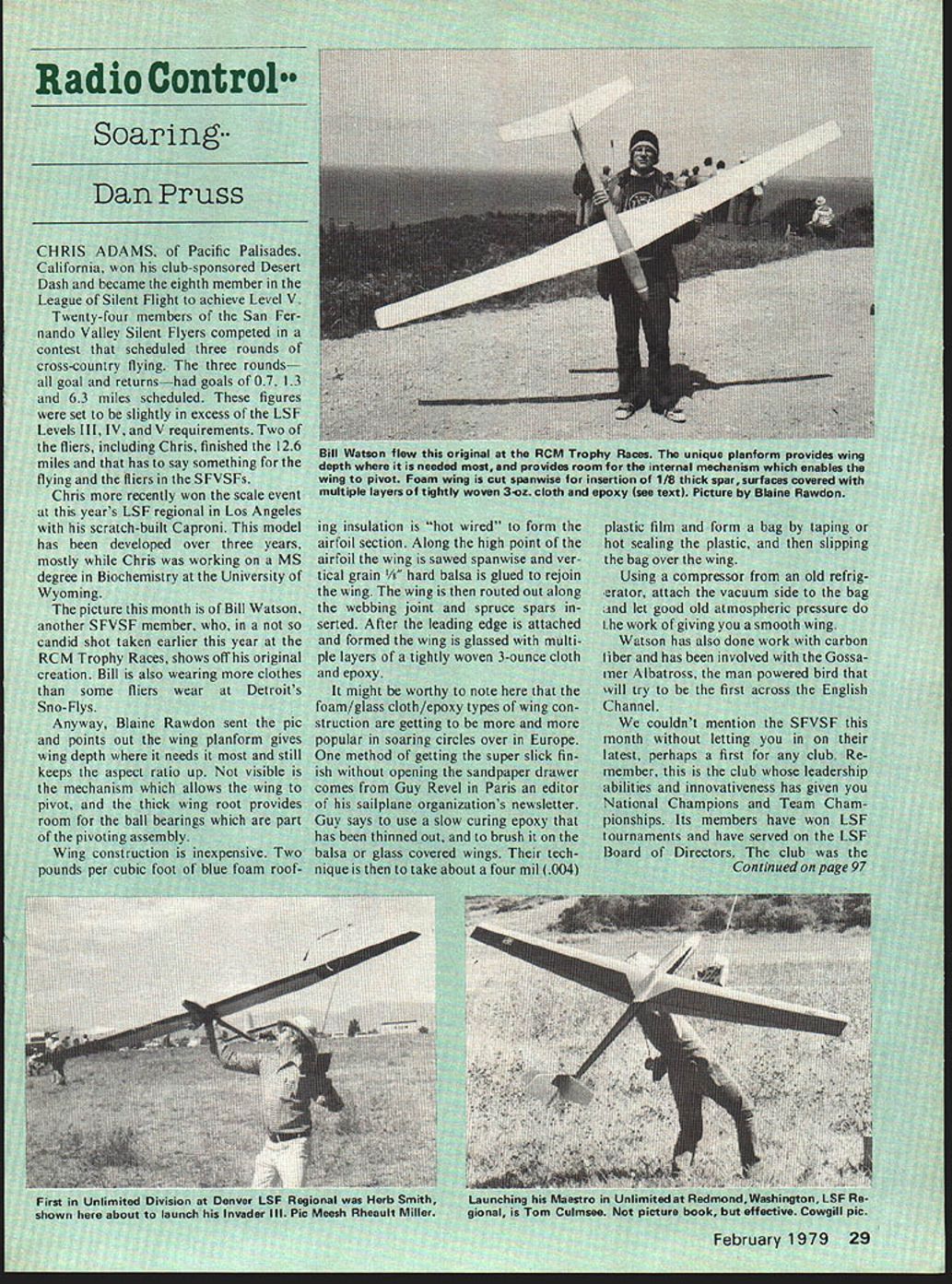
The picture this month is of Bill Watson, another SFVSF member, who, in a not-so-candid shot taken earlier this year at the RCM Trophy Races, shows off his original creation. Bill is also wearing more clothes than some fliers wear at Detroit's Sno-Flys.
Blaine Rawdon sent the pic and points out the wing planform gives wing depth where it was needed most and still keeps the aspect ratio up. Not visible is the mechanism which allows the wing to pivot, and the thick wing root provides room for the ball bearings which are part of the pivoting assembly.
Wing construction is inexpensive. Two-pound-per-cubic-foot blue foam roofing insulation is "hot wired" to form the airfoil section. Along the high point of the airfoil the wing is sawed spanwise and vertical-grain 1/8" hard balsa is glued to rejoin the wing. The wing is then routed out along the webbing joint and spruce spars inserted. After the leading edge is attached and formed, the wing is glassed with multiple layers of a tightly woven 3-ounce cloth and epoxy.
It might be worth noting that the foam/glass-cloth/epoxy type of wing construction is becoming more popular in soaring circles in Europe. One method of getting a super-slick finish without resorting to sanding comes from Guy Revel in Paris, an editor of his sailplane organization's newsletter. Guy suggests using a slow-curing epoxy that has been thinned and brushing it onto the balsa or glass-covered wing. Their technique is then to take about a four-mil (.004") plastic film, form a bag by taping or hot-sealing the plastic, and slip the bag over the wing.
Using a compressor from an old refrigerator, attach the vacuum side to the bag and let atmospheric pressure do the work of giving you a smooth wing.
Watson has also done work with carbon fiber and has been involved with the Gossamer Albatross, the man-powered bird that will try to be the first across the English Channel.
We couldn't mention the SFVSF this month without letting you in on their latest — perhaps a first for any club. Remember, this is the club whose leadership and innovativeness have produced National Champions and Team Championships. Its members have won LSF tournaments and have served on the LSF Board of Directors.
The club was faced with a substantial number of beginner-class entries when contest publicity indicated that the class would be available. Unfortunately, this is only a limited solution since the flier must jump into the fire at his next contest and face all the hotshots with their super airplanes.
Another event which has been tried at a few contests and met with success is a Novice class in which the airplane combination is limited to those that do not have Schnuerle-ported (or Perry-ported) engines, tuned pipes, or functioning retractable landing gear. One good feature about this event is that it provides an event for beginners and for some fliers who will never be great, but who like to compete in pattern competition.
Another idea which continues to gain support is the handicap Novice event in which flight scores are modified by adding points for fixed gear and conventional engines/mufflers or subtracting points for functioning retractable landing gear, special engine porting, or tuned pipes. An obvious problem with this idea is the assessment of appropriate handicap points for the different features. A handicap system can be fouled up if judges are either tougher or more generous than anticipated.
Yet another idea would be the ban of retractable landing gear, special engine porting, or tuned pipes from the Novice pattern event entirely. This might drive down airplane size in the Novice event somewhat to take advantage of a better power-to-weight ratio when using a conventional engine. It would also place a Novice-event "graduate" in the position of needing a new airplane to compete in Advanced.
There must be many more ideas around the country which bear consideration. If you have one, write to me or your NSRCA district vice president about it so that it can be publicized.
For several years I have been preaching to newcomers that many "fuel problems" are caused by the glow plug. If an engine which has been running well starts having problems the glow plug should be suspected. A bad plug can make an engine seem to be lean or rich and adjusting the needle valve may even temporarily alleviate the condition. One way to detect a plug problem is to remove the battery clip when the engine is idling and listen for a speed change. If the engine speed drops more than a slight amount, the glow plug should be replaced.
While the previous test is usually sufficient to detect a bad plug, it isn't foolproof. At the CCRCC Fall Carnival near New Orleans, Louisiana, I struggled through four rounds of flying with alternately "rich" and "lean" engine runs only to discover that the glow-plug element was mangled and pushed against the side of the chamber. A new glow plug made all the "fuel problems" go away.
Contest fliers are more vocal when it comes to problems with glow plugs because a bad engine run can spoil a competition flight. During the 1978 contest season I heard more complaints about defective glow plugs than in all the other years put together. Statements like, "I've used Brand X plugs for years and now I can't trust them anymore," were common. Perhaps if many of us save the defective new plugs we discover until we have half a dozen or so and mail them to plug manufacturers with a demand for a refund or replacement, the manufacturers will get the message.
NSRCA District 6 vice president Earl Haury published a caution in the November issue of the K Factor which bears repeating. "Of all the articles discussing the relative safety points of our current aircraft and large aircraft, the most hazardous aspect is not mentioned. GASOLINE. Spark-ignition engines are fueled with gasoline instead of our usual alcohol-based fuel. While gasoline is an everyday commodity, it is so common we often overlook just how dangerous it can be. The flash point (the minimum temperature at which flammable vapors will be present) is -45 degrees F for gasoline while it is +52 degrees F for methanol and even higher for nitromethane. Vapor pressure (the pressure exerted upon a closed container at 20 degrees C) of gasoline is four times that of methanol and nearly 12 times that of nitromethane. The auto-ignition temperature (the temperature at which a material will ignite spontaneously) of gasoline is about half that of alcohol. What all this means is that a very real probability of fire exists in a crash. A definite possibility of a delayed explosion is also present. A quart or so of gasoline exploding as you pick up your damaged model will definitely shorten your modeling career if not your life! Merely transporting, handling and storing gasoline is infinitely more hazardous than glow fuel. Don't think white gas, unleaded, higher or low octane is any different. It is all gasoline and demands extreme care in handling." Thanks, Earl.
Next month I plan to get back to descriptions of how to perform pattern maneuvers. The next maneuver description will be the Stall Turn. I also plan to report on a couple of new products.
Ron Van Putte 12 Connie Drive Shalimar, FL 32579
Radio Control: Soaring
By Dan Pruss
Bob and Tom Williams (California) — their Paragon and Windrider designs have allowed club members like Ed to take a few bows, and Tom has done likewise with other designs.
The club has Terry Koplan — one-third of your USA FAI team that will compete in Belgium this summer. And, of course, Blaine Rawdon and Bill Watson, with their design wizardry. But back to their latest.
Not titanium wing spars or swing wings or a new space-age material that allows you to shoot spot landings from 400 feet high. Their latest — a bake sale. Wait! Don't go away. This was a different bake sale. The same hands that mixed five-minute epoxy sifted flour. The same hands that crafted exotic designs into world beaters now made layer cakes, pies, and tarts, and made the old clubhouse look like a Viennese pastry shop.
Their goal? To raise a buck or two for the club coffers. Rules? All items for auction had to be made by the members. Results? Eighty bucks plus in the club till, and another first for the San Fernando Valley Silent Flyers.
There is no truth to the rumor that Ed Slobod's lemon chiffon cake had a solid center with removable tips. Barbara Henon's applesauce cake did, however, go for ten dollars — high for the auction. Meanwhile, Dick Shilling wowed them all with his Tarte des Demoiselles Tatin. For clubs with no class that's an upside-down apple pie. (How does one come up with a name like "Rubber Ducky" for a sailplane and "Tarte des Demoiselles Tatin" for a pie?)
Anyway, the bake sale sounds like a good idea to steal as a future club project and who knows? The next LSF Tournament could possibly have a club bake-off!
Elsewhere, the annual Cumberland pilgrimage saw about 50 fliers enjoy almost summerlike weather. No wind for slope flying as was hoped, but good weather and one heckuva buffet on Saturday night. Don Coughnour had his winch and retrieval system performing for the whole hill and, judging from reports, the retrieving system works as well or better than anything including a motorbike. Don's system won Best Technical Achievement overall in 1977 for the LSF Tournaments. For further information and prices write: Don Coughnour, RD 2, Red Lion, PA 17356.
The South Bay Soaring Society came up with a contest that probably separates the Unlimited Class from all others in a most equitable way. The contest was called "Large Sailplane Thermal Contest" and was restricted to sailplanes whose wing and tail area combined measured at least 1,350 sq. in. This included birds such as the Aquila XL, Sailaire, Astro-Jeff, etc. These planes are usually the type that stand out performancewise at a contest if weather favors the ships with a high MonoKote content. A restriction of this type makes more sense to anyone who has had to fly in 30-mph winds with his Windward and hoped to stay on top of the scoring column with his buddy and his "Cloudcover 12." Their events included 3-, 5-, and 7-minute precision and a 12-minute precision/duration event.
LSF headquarters announced dates for the 1979 Tournament: July 24, 25, 26. Site will be at Lewis University, Lockport, Illinois, and S.O.A.R. will host the event. Great Race IV will be held July 21 (Saturday), and July 22 and 23 will have events scheduled for all LSF members who didn't qualify during the 1978 regionals. Details to be announced. The events for the "biggie" on the 24th will include tasks other than duration. More on this later.
Happy Building Season!
Dan Pruss Rt. 2, Box 490 Plainfield, IL 60544
Transcribed from original scans by AI. Minor OCR errors may remain.

