
Radio Control
Soaring.
Dan Pruss
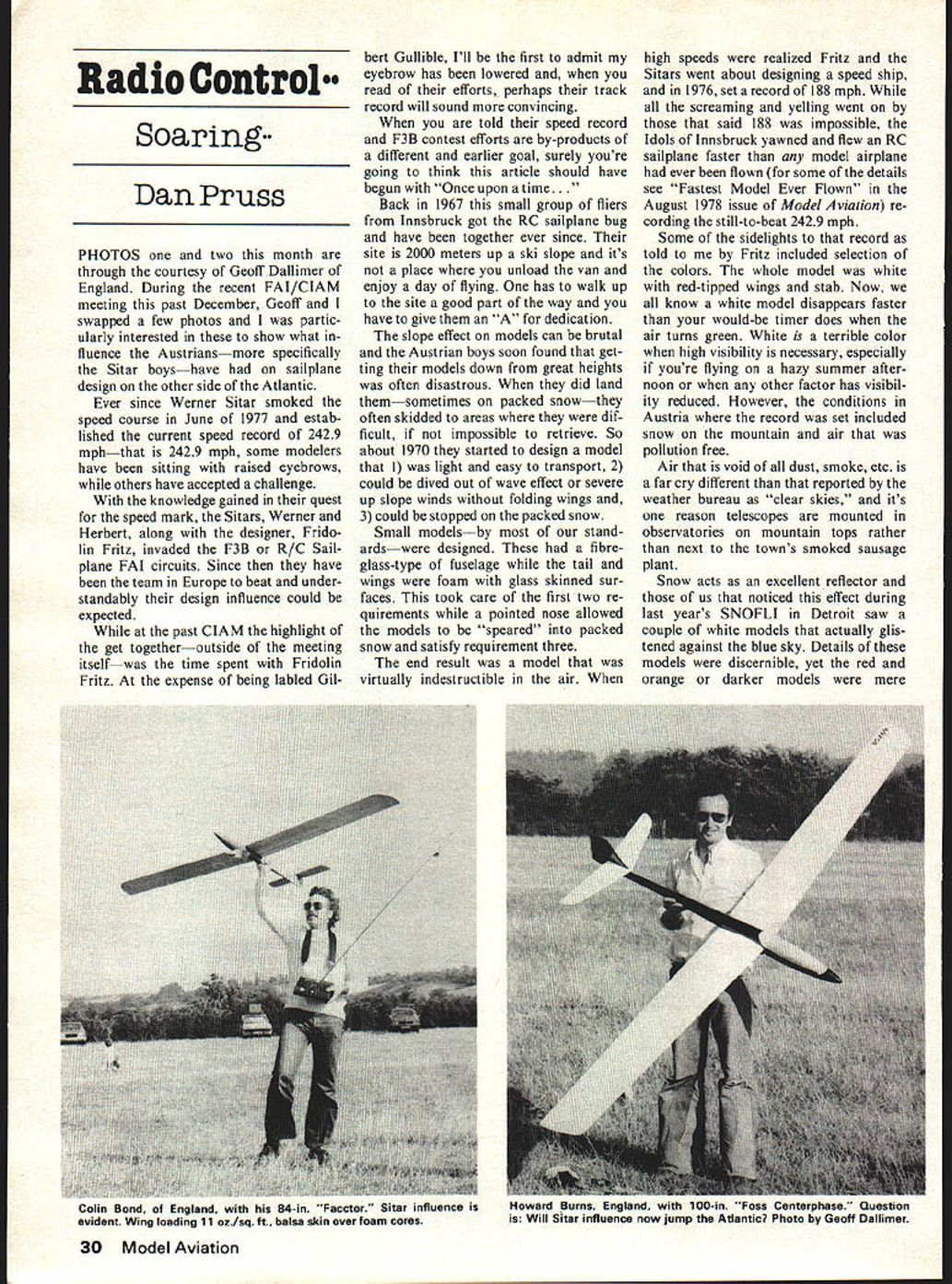
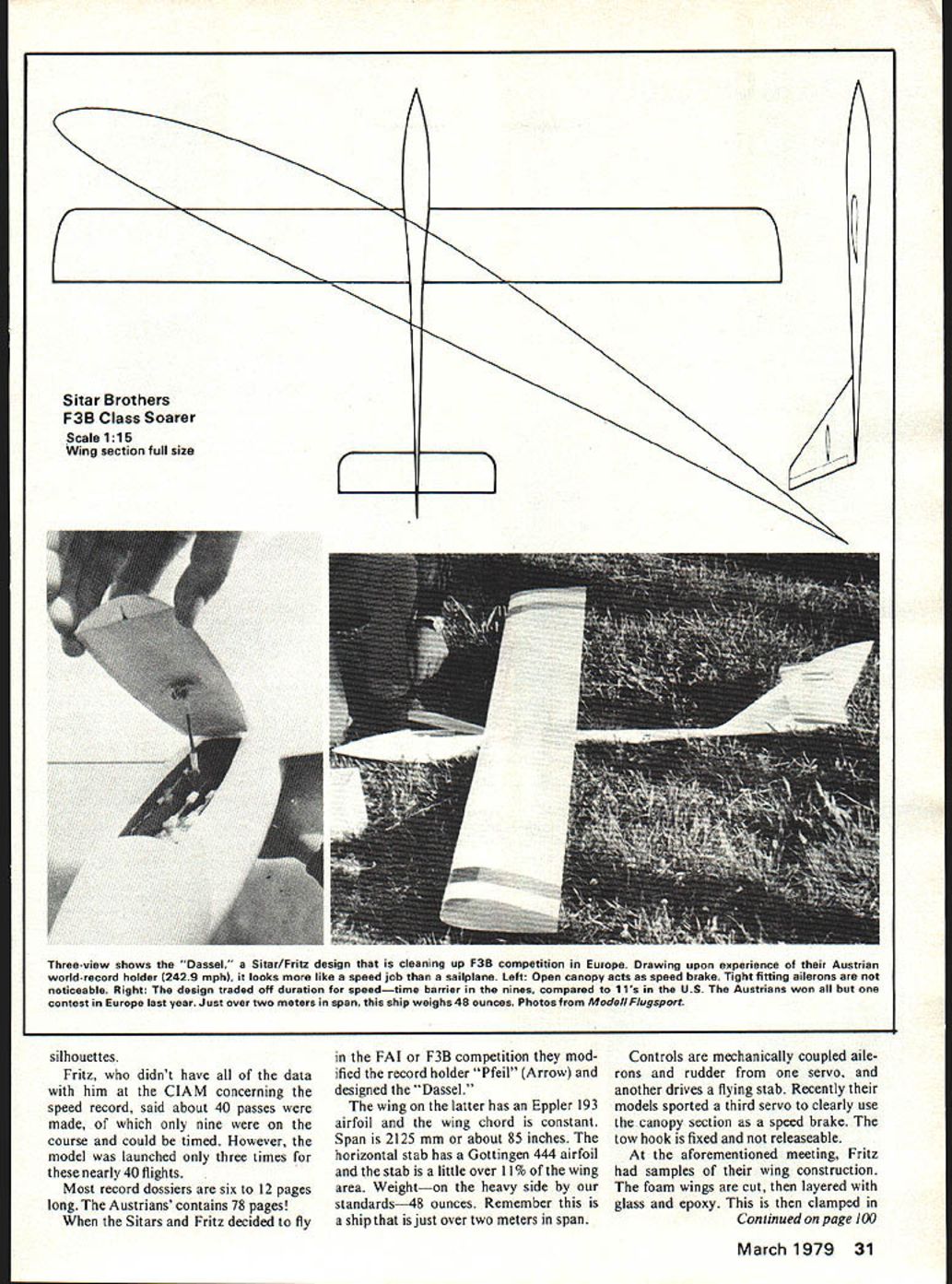
PHOTOS one and two this month are courtesy of Geoff Dallimer of England. During the recent FAI/CIAM meeting last December, Geoff and I swapped a few photos and I was particularly interested in these to show what influence the Austrians—more specifically the Sitar boys—have had on sailplane design on the other side of the Atlantic.
Ever since Werner Sitar smoked the speed course in June of 1977 and established the current speed record of 242.9 mph, some modelers have been sitting with raised eyebrows, while others have accepted the challenge.
With the knowledge gained in their quest for the speed mark, the Sitars, Werner and Herbert, along with the designer Fridolin Fritz, invaded the F3B (R/C sailplane FAI) circuits. Since then they have been the team in Europe to beat, and understandably their design influence could be expected.
At the past CIAM meeting the highlight of the get-together—outside of the meeting itself—was the time spent with Fridolin Fritz. At the expense of being labeled Gilbert Gullible, I'll be the first to admit my eyebrow has been lowered; when you read of their efforts, perhaps their track record will sound more convincing.
When you are told their speed record and F3B contest efforts are by-products of a different and earlier goal, surely you're going to think this article should have begun with "Once upon a time...."
Back in 1967 this small group of fliers from Innsbruck got the RC sailplane bug and have been together ever since. Their site is 2000 meters up a ski slope and it's not a place where you unload the van and enjoy a day of flying. One has to walk up to the site a good part of the way and you have to give them an "A" for dedication.
The slope effect on models can be brutal and the Austrian boys soon found that getting their models down from great heights was often disastrous. When they did land them—sometimes on packed snow—they often skidded to areas where they were difficult, if not impossible, to retrieve. So about 1970 they started to design a model that would:
- be light and easy to transport,
- be capable of diving out of wave effect or severe up-slope winds without folding wings, and
- be stopped on packed snow.
Small models—by most of our standards—were designed. These had a fiberglass-type fuselage while the tail and wings were foam with glass-skinned surfaces. This took care of the first two requirements while a pointed nose allowed the models to be "speared" into packed snow and satisfy requirement three.
The end result was a model that was virtually indestructible in the air. When high speeds were realized, Fritz and the Sitars went about designing a speed ship, and in 1976 set a record of 188 mph. While all the screaming and yelling went on by those that said 188 was impossible, the Idols of Innsbruck yawned and flew an RC sailplane faster than any model airplane had ever been flown (for some of the details see "Fastest Model Ever Flown" in the August 1978 issue of Model Aviation), later recording the still-to-be-beat 242.9 mph.
Some sidelights to that record, as told to me by Fritz, included selection of the colors. The whole model was white with red-tipped wings and stab. Now, we all know a white model disappears faster than your would-be timer does when the air turns green. White is a terrible color when high visibility is necessary, especially if you're flying on a hazy summer afternoon or when any other factor has reduced visibility. However, the conditions in Austria where the record was set included snow on the mountain and air that was pollution-free.
Air that is void of dust, smoke, etc., is a far cry different than what is reported by the weather bureau as "clear skies," and it's one reason telescopes are mounted in observatories on mountain tops rather than next to the town's smoked sausage plant.
Snow acts as an excellent reflector and those of us who noticed this effect during last year's SNOFLI in Detroit saw a couple of white models that actually glistened against the blue sky. Details of these models were discernible, yet the red, orange, or darker models were mere dots or silhouettes.
Fritz, who didn't have all of the data with him at the CIAM meeting concerning the speed record, said about 40 passes were made, of which only nine were on the course and could be timed. However, the model was launched only three times for these nearly 40 flights.
Most record dossiers are six to 12 pages long. The Austrians' contains 78 pages!
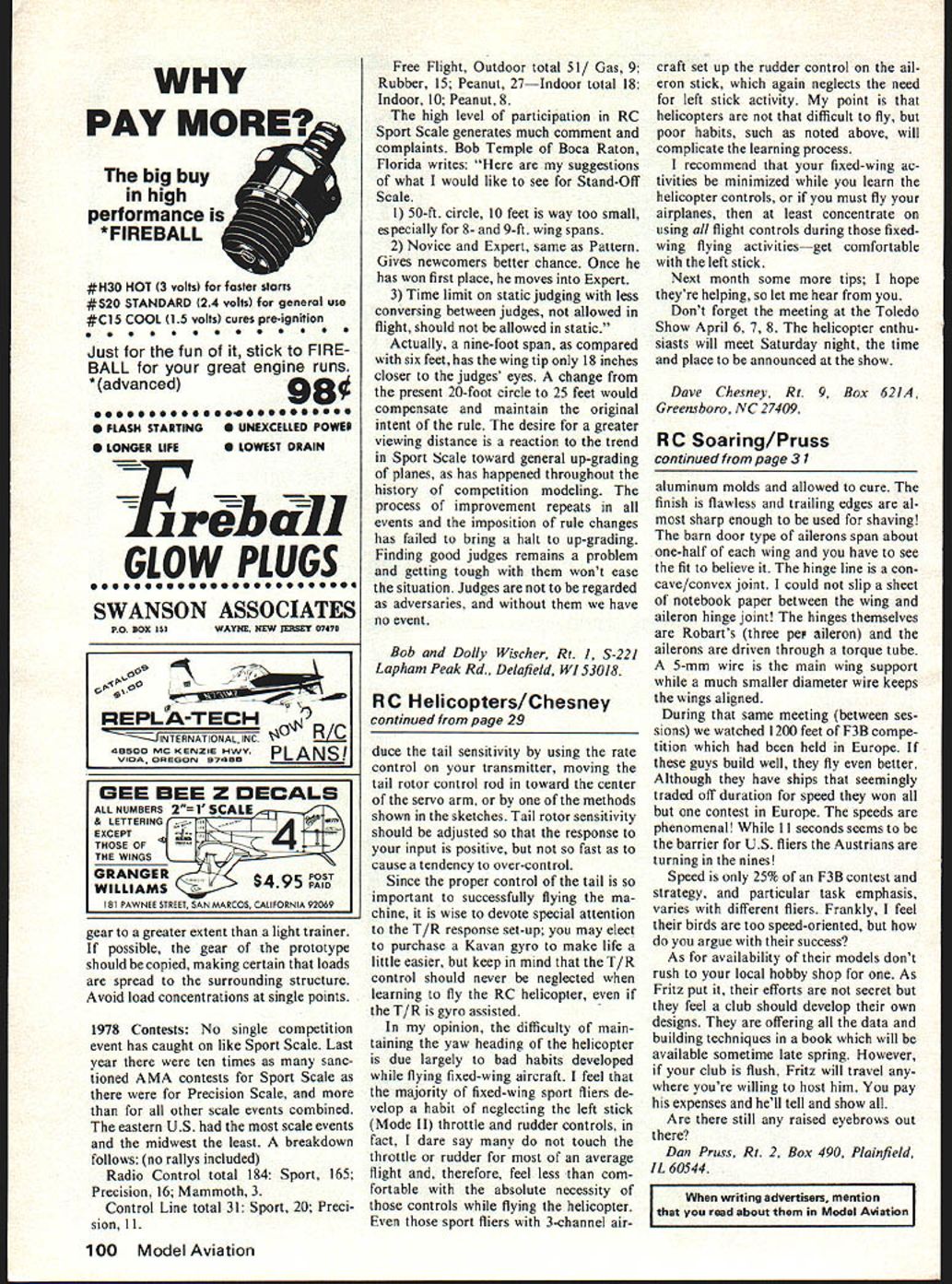
When the Sitars and Fritz decided to fly in the FAI (F3B) competition they modified the record holder "Pfeil" (Arrow) and designed the "Dassel."
Key features of the Dassel:
- Wing airfoil: Eppler 193; wing chord is constant.
- Span: 2125 mm (about 85 inches).
- Horizontal stab: Göttingen 444 airfoil; stab area a little over 11% of the wing area.
- Weight: 48 ounces (on the heavy side by our standards) — remember this is a ship just over two meters in span.
- Controls: mechanically coupled ailerons and rudder from one servo; another servo drives a flying stab.
- Recent addition: a third servo to clearly use the canopy section as a speed brake.
- Tow hook: fixed and not releasable.
At the aforementioned meeting, Fritz had samples of their wing construction. The foam wings are cut, then layered with glass and epoxy. This is then clamped in aluminum molds and allowed to cure. The finish is flawless and trailing edges are almost sharp enough to shave with! The barn-door type ailerons span about one-half of each wing and you have to see the fit to believe it. The hinge line is a concave/convex joint — I could not slip a sheet of notebook paper between the wing and aileron hinge joint! The hinges themselves are Robart's (three per aileron) and the ailerons are driven through a torque tube. A 5-mm wire is the main wing support while a much smaller diameter wire keeps the wings aligned.
During that same meeting (between sessions) we watched 1200 feet of film of F3B competition which had been held in Europe. If these guys build well, they fly even better. Although they have ships that seemingly trade off duration for speed, they won all but one contest in Europe. The speeds are phenomenal! While 11 seconds seems to be the barrier for U.S. fliers, the Austrians are turning in the nines!
Speed is only 25% of an F3B contest and strategy—and particular task emphasis—varies with different fliers. Frankly, I feel their birds are too speed-oriented, but how do you argue with their success?
As for availability of their models, don't rush to your local hobby shop for one. As Fritz put it, their efforts are not secret but they feel a club should develop its own designs. They are offering the data and building techniques in a book which will be available sometime late spring. However, if your club is flush, Fritz will travel anywhere you're willing to host him. You pay his expenses and he'll tell and show all.
Are there still any raised eyebrows out there?
Dan Pruss Rt. 2, Box 490 Plainfield, IL 60544
Transcribed from original scans by AI. Minor OCR errors may remain.

