
Radio Control: Soaring
Dan Pruss
JUST in case you thought sailplanes had gotten into a design rut over the past couple of years or so, the photo offerings this month should assure you the drawing boards are alive and kickin'.
A picture shows Detroit's Jeff Mrlik with his dad's original-designed slope soarer. Jerry, who designed the Astro Jeff, had the hills of Cumberland in mind when the slope bird took shape. This past November the winds didn't cooperate with those hills to produce the expected slope effect, but the ship apparently didn't know the difference and it thermaled — so well, in fact, that Jack Hiner, who submitted the picture, took it to altitude and performed just about every aerobatic maneuver known to pattern fliers. The plane has rudder, elevator, and nearly full-span ailerons for control.
Jack also sent a picture of another bird, one that is just a bit different. It's a one-quarter-scale Jantar in the hands of Meyer Guttman. Wingspan is 15'-8" and it weighs in at eight and one-half pounds. Reports say it thermals very well and looks most realistic in the air.
Cumberland Soar-In
The annual Cumberland Soar-In is not a contest. It is a friendly post-season wine/cheese/flying get-together. And since it isn't a contest, a lot of birds show up whose owners wouldn't dare enter them at the local ten-minute-duration/spot-landing contest. Over the years, these hills have witnessed a marvelous stand-off scale DC-8, flying wings, at least three 11-lb. KA-6s and other birds of strange feather. So if you have something different on your building board, bring it to Cumberland next November 4th and 5th. The scenery alone is worth the price of the trip.
The Phantom (Blaine Rawdon / Bill Watson)
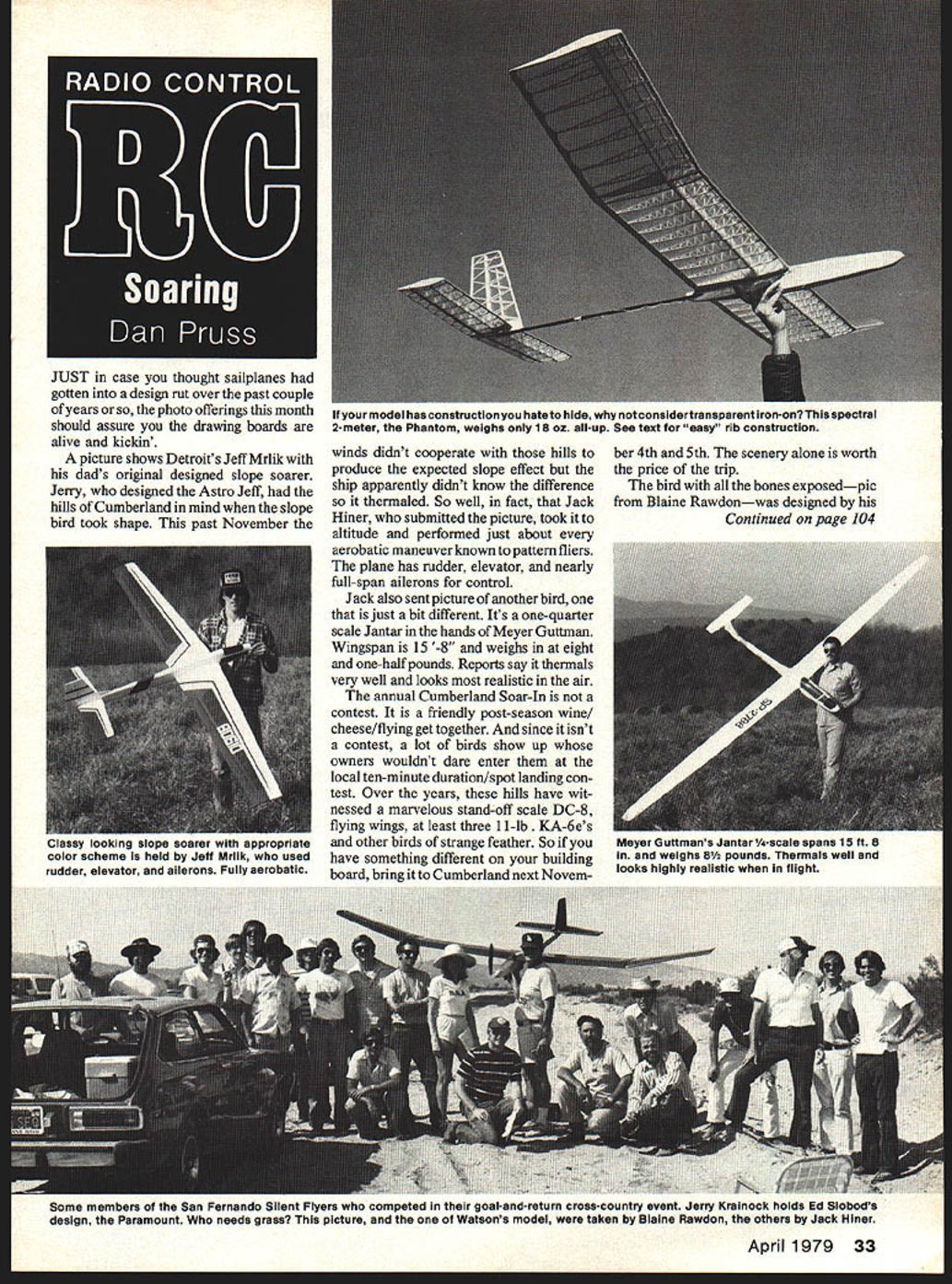
The bird with all the bones exposed — photo from Blaine Rawdon — was designed by his sidekick, Bill Watson. Called the Phantom (the plane, not Bill), it has some most interesting specs:
- Two-meter ship
- Wing chord: 12 inches
- Airfoil thickness: 14%
- Extremely light: 18 ounces all up (2.74 oz./sq. ft.)
- Ribs: a 3-inch-wide rib section is first constructed with all the bracing (in the form of sheets) included, then ribs are sliced from this 3-inch section
- Tail boom: homemade carbon fiber
Blaine claims the airborne Phantom looks like a hand-launch glider. Extremely slow, as one would imagine, it does move out as the nose is lowered. Blaine also states he isn't too sure this is the way to go for two-meter design, but the Phantom is a fun exercise in building and flying. The ship is probably only a step away from an indoor type of RC sailplane — that's a thought for winter flying. Are there any clubs with a close-by coliseum (covered, of course) that would like to start a new challenge?
San Fernando Silent Flyers — Goal-and-Return
In the February column the goal-and-return contest of the San Fernando Silent Flyers was noted. Another picture shows some of the members of that club who competed. The sailplane in the picture is Ed Slobod's Paramount, being helped into the air by Jerry Krainock. Kneeling at the extreme right in the front row is Chris Adams, who won the contest and became the latest Level V member in the LSF. Blaine Rawdon also sent this picture and pointed out the club's cross-country activities now lean towards the goal-and-return with one-launch event, rather than the multiple-launch/straight-line cross-country event.
Blaine also pointed out all of the fliers in the picture flew three rounds. Some of the flights, which were attempts at a 10-kilometer goal-and-return, were longer than 90 minutes.
Large Sailplane Thermal Contest — South Bay Soaring Society
The "Large Sailplane Thermal Contest," which was also mentioned in the February column and was held by the South Bay Soaring Society of the San Francisco area, proved successful. Limited to ships with 1,350 sq. in. or more of surface area, entries included an expanded Paragon, Aquila XLs, some original designs, and the hi-winged Olympic II, which won the design award for its builder, Larry Horacek. Bob McGowen and his expanded Paragon took first place.
Landing Scoring — A Suggested Change
While the subjects mentioned have been leaning toward things that are a bit different, let's continue with an event—or part of a task—that is long overdue for a modification and a suggestion that is different.
First of all, many clubs and contest directors feel the beauty and grace of a thermal flight should not end with a punch at the ground that more often becomes a test for the structural integrity of one's ship. Efforts to de-emphasize the spot landing have seen events with round flat spots, small round spots, long skinny runways, large square runways, many points for landing, and hardly any points for landings. All attempts were efforts to de-emphasize the landing; some were efforts to eliminate the "dork" type of landing.
The Harris Hill gang from Elmira, NY, have been proponents of the "land like the real ones" creed. They even had judges grade landings one year at their annual big bash—no pun intended. The fact that the judges were full-scale fliers, and not necessarily versed in model sailplanes and how they should and could land, created little solution to the landing problem and more arguments than at a rules committee meeting.
LSF tournaments of the past included sites which had hard-surfaced areas. At these same contests it was thought prudence would prevail and greased-on landings would be the order of the day. Didn't happen. The sharpshooters added protective covering to the ships and some planes banged into the 100-point spots carrying more padding than a beauty-pageant reject.
So, over the years, whether the runways were round, square, skinny, or fat, or whether point values were large or small, if the landing points were the margin of victory, the dorkers usually won.
The best solution to the above that has come along is a result of the Mid-Ohio Soaring Society's (M.O.S.S.) efforts to cure the landing syndrome. And the remedy is so simple you'll wonder why it wasn't thought of before.
Bob Cosgrove's idea is to have a line about three inches wide drawn on the ground. This wouldn't be considered a precision line but a guide or reference line. Somewhere on the line another line is drawn at right angles (a cross stripe). Now, the point value at the intersection of the two lines is zero and increases along the reference line at whatever rate you desire. Up to this point, the circular landing zone with a point-value tape, or a rectangular runway, would serve as well as the above-mentioned reference line.
But here is where Bob's system differs. In order to score landing points the model must touch down at or before the cross stripe (or outside of the circle). Points are then earned by where the model comes to rest. Granted, not all fields are close-clipped to allow for this type of scoring, but a lot of them are.
Cosgrove's suggestions further state if you touch down and bounce into the scoring zone, no points for landing are earned and, of course, if you cross the intersection or landing boundaries before touchdown, it's a no-landing score. It can readily be seen the "dork" type of landing strategy is of no value. If it is used before the landing zone you'll either come to an abrupt stop or bounce in, and in either case it's a zero score.
Landings of this type could encourage fields with hard-surfaced runways to be used (are you listening, Harris Hill L/D members?) and would probably promote sailplanes with wheels. The sod-farm fliers surely could try this landing event.
It's hard to say whether it will catch on, but if it does you can bet some of the 90–100 point scores usually attained by some will be a long time coming, and the names of the top ten in some regions will change around during the season.
In the meantime, to use a well-worn cliché — happy landings.
Dan Pruss Rt. 2, Box 490, Plainfield, IL 60544.
Transcribed from original scans by AI. Minor OCR errors may remain.

