

Radio Control: Soaring
By Dan Pruss
If you thought the quiet sport is confined to making lazy circles with thermals providing the excitement or slope updrafts allowing you to make even lazier figure-eights, you should be aware there is an ilk of sailplane fliers whose birds have as much time flying inverted as they do right side up. This type of flier can usually be found standing on a slope flying an aileron-equipped bird—something rarely seen at a thermal contest. With the slow-flying floater types, ailerons are seldom effective (F3B or FAI competition might change that line of thinking, but we'll talk about that later). Not so with the faster slope aerobatic ships that more resemble a pattern ship than your favorite pet hawk.
All this leads up to some interesting gents with planes and ideas this scribe met a while back—as the pictures probably have already hinted. Slope aerobatics is quite popular in Europe, especially in the Scandinavian countries. England runs a regular competition program as does France. On this side of the pond the efforts have been spotty, with any concentrated interests coming from the West Coast. Understandably, after all, the heaviest concentration of soaring interests is there as are the slopes.
A European design that caught my eye
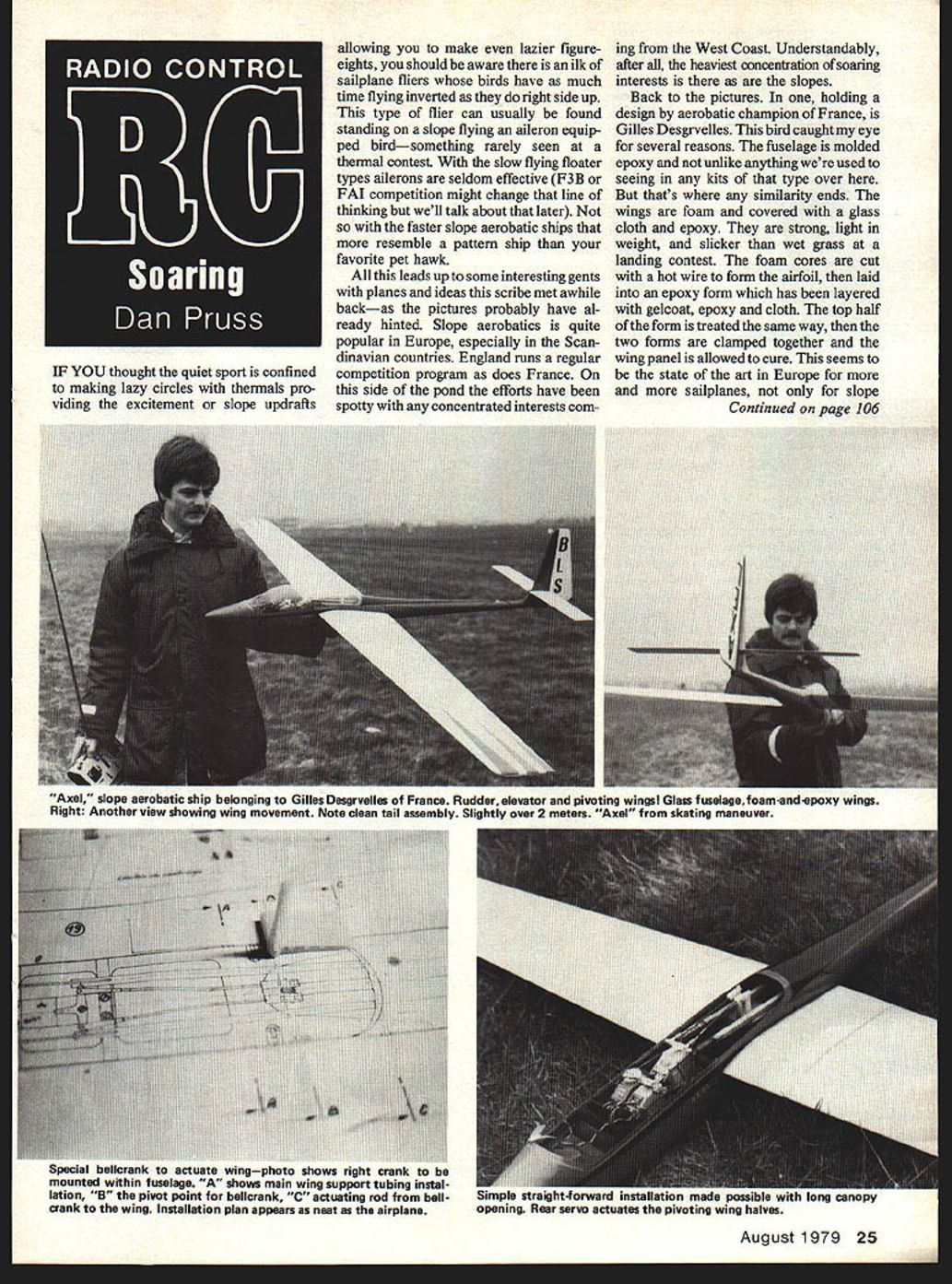
In one photo, holding a design by an aerobatic champion of France, is Gilles Desgrvelles. This bird caught my eye for several reasons. The fuselage is molded epoxy and not unlike anything we're used to seeing in kits of that type over here. But that's where any similarity ends. The wings are foam and covered with a glass cloth and epoxy. They are strong, light in weight, and slicker than wet grass at a landing contest.
The foam cores are cut with a hot wire to form the airfoil, then laid into an epoxy mold which has been layered with gelcoat, epoxy, and cloth. The top half of the mold is treated the same way, then the two halves are clamped together and the wing panel is allowed to cure. This seems to be the state of the art in Europe for more and more sailplanes, not only for slope types but for thermal fliers as well. It should be noted that the wing root is faced with plywood with another plywood rib three inches outboard. These provide the support for the 5 mm I.D. tubing which accommodates the main support wire.
The Axel — moveable-wing concept
This is a three-function glider:
- Rudder
- Elevator
- Moveable wings (not ailerons)
The idea is nothing new. Bob Boucher had an ASW a couple of years back that had the same function, as did others who tried it for the sake of doing it. Some systems were straightforward while others looked like the innards of a slot machine. The French bird is simple. But like most things that appear simple, it's the result of many refinements. Such is the case of the "Axel." Jean-Claude Bosquet—the current French aerobatic champion—refined this design and what you see is the result of four years of development.
The fuselage, although aesthetically sleek in appearance, has flat sides that are parallel. This flatness ends where the trailing edge of the wing meets. The flat sides allow not only for the mechanics to be kept simple, but for an airfoil design to be changed without a fuselage wing fillet giving it away. However, not having a fillet, the fuselage tends to be weak at the wing-trailing juncture, but Bosquet cleverly reinforced the fuselage at this point by epoxying a plywood ring in the fuselage. This might seem like a most simple solution in treating a vulnerable spot. It is. But I've seen some filletless home designs which weren't beefed up in this area, and when a wing tip was used as the first point of touchdown the trailing edge knifed into the fuselage, leaving a "not on the field" repair to be made.
Wing movement mechanism
The heart of this model's wing-moving ability lies in the specially molded bell cranks which Bosquet developed. Again, simple—after you see them—they mount in the fuselage and pivot on a common wire of 1/8 in. diameter. Drive pins stick out from the fuselage and slip into the wings just about two-thirds back from the leading edge.
The wings are held close to the fuselage, and onto the wires, with rubber bands attached to screw-in hooks in the wing roots. The rubber bands stretch behind the main support rod and point of wing pivot, thereby not restricting wing movement. To provide wing and fuselage clearance, the main support tube extends beyond the fuselage sides by 1/32 in. The ends of the fuselage and wing tubes then provide almost a frictionless pivot point. Slick!
Sleekness and drag reduction
As most thermal competition fliers realize, reducing drag means more time in the air. We all know a real hot seeker of a thermal will get you ten-minute maxes with manhole covers, but it's in the dead air where sleekness can mean seconds if not minutes. And sleekness means no ugly protuberances or wide gaps which can cause turbulence. Sloppy fits around canopies and fuselage joints can cost you time. Wide gaps, or just plain gaps, around fuselage-wing joins can induce drag to a point where it's worse than doubling the cross-section of your fuselage at that point!
One of the dirtiest areas, aerodynamically speaking, on most sailplanes is the tail area. If it's a flying stab, you have to provide a gap for the horizontal stab wire to travel. If your plane has a vertical fin and rudder and you are of the "hinge it on one side with MonoKote" school, the V-gap allows rudder movement but can cause the air to do funny things which all equate to drag.
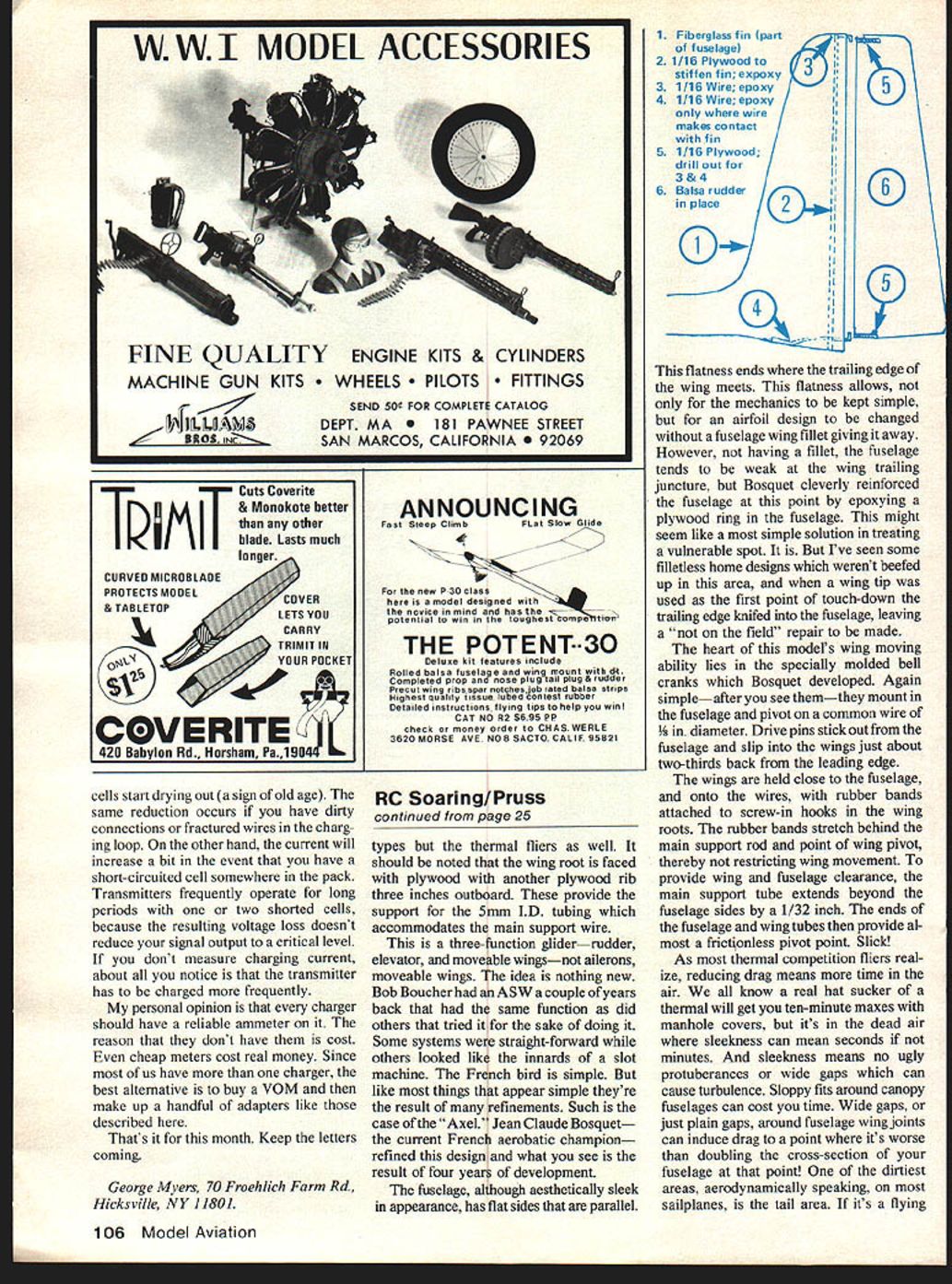
Again, the Axel handles the rudder-hinge problem beautifully. It's one of those simple ideas that falls into the "why didn't I think of that?" department. The sketch shows only two points of pivot—the top of the rudder and the bottom. A short wire is epoxied into the vertical fin. This wire is then bent down to parallel the hinge line. The second wire is long enough to be offset and provide a spring action after an end is epoxied in the fin. The other end is then bent up to align with the top wire. The rudder in the case of the Axel has small plywood pieces glued to the top and bottom. These provide good wear points for the pins. Since we're talking about a glass fuselage (the vertical fin is part of the fuselage) the fin acts as a pocket to accept the leading edge of the rudder. The result is a nice, neat, no-gap fit. All of this slick engineering and design adds up to a whisper-quiet model.
Field report
As mentioned, this column isn't meant to act as a kit review, but when something different comes along it'll be passed on to you. The Axel is that kind of model. Although I didn't get a chance to see it on the slopes, I did see one fitted with a tow hook and got launched on a 150-meter tow line. As it drifted downwind, the flier Gilles Desgrvelles put it through its paces, ending with a four-point slow roll as if it were on a rail, and all this time the model just whispered as it came across the field.
I bought one. Living in a town called Plainfield, you know what the terrain must be like (we do have a curb in town that rises six inches above the pavement). Maybe someone can talk Dave Thornburg into writing an article on microwave soaring—not cooking—or the study of slope effect from zero to six inches above the ground. Anyway, the Axel is almost complete and being only a mite over two meters it'll be easy to transport. You provide a slope—I'll bring the bird.
Dan Pruss Rt. 2, Box 490 Plainfield, IL 60544
Transcribed from original scans by AI. Minor OCR errors may remain.

