
Radio Control: Soaring
Dan Pruss
How many times have you been to a thermal contest and had to lean about 30 degrees off plumb to keep the wind from blowing you over during launch? Or you heard someone holler, "You hold the planes down, I'll hold the winch." Well, let's share a bit of pity for the poor guys and gals of the South Bay Soaring Society who had to cancel the annual RCM Trophy Race last May 5 and 6 because of—you guessed it—no wind.
What really hurt this year was that, for the first time, it would have been an international event. From England came Tony Baker of Solent Sailplanes and Paul and Richard Gerrard. However, there was such an impressive array of racing machines and fliers that an invitation was made to U.S. fliers to compete in the British racing event to be held in September. That one is sponsored by Radio Controlled Models and Electronics magazine, and the site comes complete with wind.
Bob Mattei of the SBSS said the RCM Race is rescheduled for October and the registrations have been reopened. For information contact:
- Bob Mattei, 1580 Parrot Ave., Sunnyvale, CA 94087 — (408) 732-3009.
For the RCM&E Race contact:
- Tony Baker, 10 & 11 Carlton Place, Southampton, Hampshire, England.
Attempted FAI Distance Record
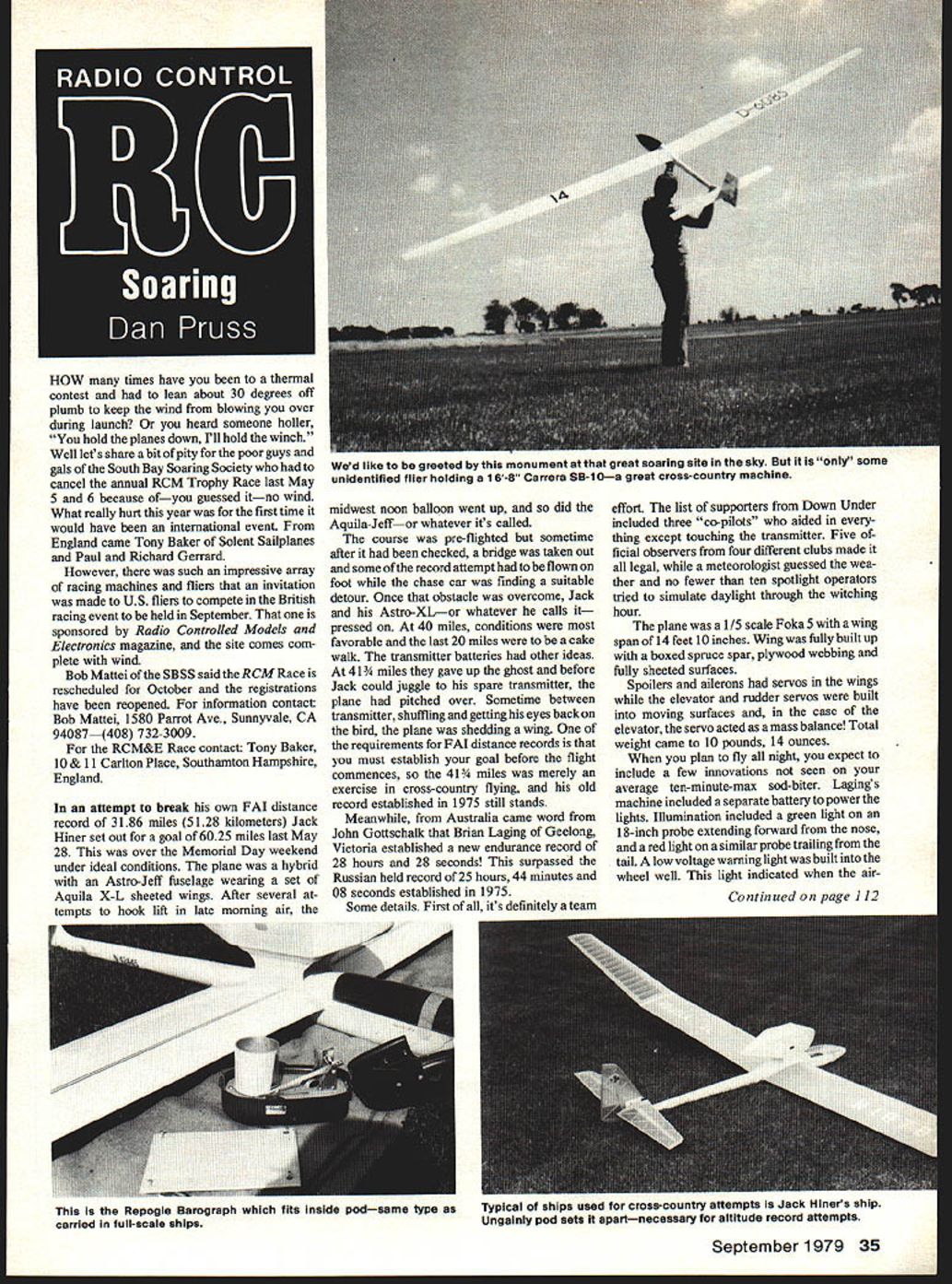
In an attempt to break his own FAI distance record of 31.86 miles (51.28 kilometers), Jack Hiner set out for a goal of 60.25 miles last May 28 over the Memorial Day weekend under ideal conditions. The plane was a hybrid with an Astro-jet fuselage wearing a set of Aquila X-L sheeted wings.
After several attempts to hook lift in late morning air, the midday balloon went up, and so did the Aquila-jet—or whatever it's called. The course was pre-flighted but sometime after it had been checked, a bridge was taken out and some of the record attempt had to be flown on foot while the chase car found a suitable detour. Once that obstacle was overcome, Jack and his plane pressed on.
At 40 miles, conditions were most favorable and the last 20 miles were expected to be a cakewalk. The transmitter batteries had other ideas. At 41.25 miles they gave up the ghost, and before Jack could juggle to his spare transmitter, the plane had pitched over. Sometime between transmitter shuffling and getting his eyes back on the bird, the plane was shedding a wing.
One of the requirements for FAI distance records is that you must establish your goal before the flight commences, so the 41.25 miles was merely an exercise in cross-country flying, and his old record established in 1975 still stands.
Australian Endurance Record
From Australia came word from John Gottschalk that Brian Laging of Geelong, Victoria, established a new endurance record of 28 hours and 28 seconds! This surpassed the Russian-held record of 25 hours, 44 minutes and 08 seconds established in 1975.
Some details:
- It was definitely a team effort. The supporters from Down Under included three "co-pilots" who aided in everything except touching the transmitter.
- Five official observers from four different clubs made it all legal, while a meteorologist guessed the weather.
- No fewer than ten spotlight operators tried to simulate daylight through the witching hour.
The plane was a 1/5-scale Foka 5 with a wingspan of 14 feet 10 inches. The wing was fully built up with a boxed spruce spar, plywood webbing and fully sheeted surfaces. Spoilers and ailerons had servos in the wings, while the elevator and rudder servos were built into moving surfaces and, in the case of the elevator, the servo acted as a mass balance. Total weight came to 10 pounds, 14 ounces.
When you plan to fly all night, you expect to include a few innovations not seen on your average ten-minute-max sod-biter. Laging's machine included a separate battery to power the lights. Illumination included a green light on an 18-inch probe extending forward from the nose and a red light on a similar probe trailing from the tail. A low-voltage warning light was built into the wheel well. This light indicated when the airborne pack dropped to 4.5 volts, which would allow for about an hour more of safe flying.
What makes this record so incredible is that the attempt began with preparations at 2:30 in the morning. The sun came up on schedule, but the wind didn't. It wasn't until 2:12 in the afternoon that the Foka was launched. The flight continued through the night, through all of the next day, and finally landed at 6:18 the second evening. Tip your wing to Brian Laging and company for one heckuva effort.
Clean Living Pays Off Department
Or does anybody wanna buy a 9-volt rabbit's foot?
Do you know that beer commercial on TV that shows the sports celebrities having at it and finally one tears a top off a beer can, says cheers and everybody is happy? If they ever wanted to run one with modelers the ad men should have traveled east to a recent York, Pennsylvania contest.
As Keith Finkenbiner, recently transplanted midwesterner and LSF Treasurer, related the story, it went something like this.
It's the first round and the York boys are using the oft-mentioned Don Goughnour retrieval system. It still works like a charm after two years. Now, the retrieval portion of the winch has a fine monofilament line attached to the ring end of the tow line. The plane comes off and the monofilament is reeled in, bringing back the chute and ring. However, the monofilament is difficult to see but that's seldom a problem—seldom, except for Don Clark of Thermal Sniffer fame, who has a Paragon in the air in search of lift.
What Don doesn't know is he has flown into the monofilament, which is now draped over the center of the wing. No problem—except the monofilament is being spooled in and Don's Paragon wing fold-down rubber bands are being sawed through. They are sawed through! But Don (low-key Clark—there are some who say he is so low-key he has to be awakened during a ten-minute max) watched the wing flutter down wondering, "Hmm, there must be a way out of this one."
There was. While checking the voltage on his rabbit's foot, Don saw the fuselage get entangled in the monofilament. The weight of the fuselage overtook the speed of the take-up spool, but the parachute caused enough drag to allow the fuselage to be lowered gently to the ground.
While the hard-luck boys were yelling foul and uttering "some guys will do anything for a relaunch!", Don—without missing a puff on his pipe—went to the C.D. and calmly asked when he could get his reflight.
Oh yes, Don got the reflight, maxed out four for four, and won the event. Cheers.
Dan Pruss, Route 2, Box 490, Plainfield, IL 60544.
Transcribed from original scans by AI. Minor OCR errors may remain.

