

Radio Control: Soaring
Dan Pruss
Coverage of the World Championships in Amay, Belgium, which appeared here two months ago, dealt mainly with the day-to-day accounts of the competition. This column will pass on some of the ideas, facts and figures that were picked up from some of the 62 competitors.
First off, the U.S. team (Terry Koplan, Skip Miller and Steve Work) wishes to express its deepest thanks to all who supported them. It's impossible to thank each of you individually, so the team, as an expression of appreciation, wants it known that any ideas they picked up will be shared.
While some readers may not be F3B- or FAI-oriented, or even competition-minded, it should be noted that competition breeds new designs, materials and ideas from which we all benefit. The Second World Championships was no exception.
Designs and Statistics
Models mentioned here were pictured in the October issue.
- Smallest wingspan: Austrian Dassel — 2.115 meters.
- Largest wingspan: Swedish Legionnaire — 3.556 meters.
- Average wingspan of all models entered: 2.735 meters.
- Average wingspan of the top seven scorers: 2.677 meters.
Other statistics (average of top seven scorers vs. average of all entries):
- Wing area: 0.5565 sq. meters vs. 0.603 sq. meters.
- Chord: 0.2072 meters vs. 0.207 meters.
- Aspect ratio: 13.05 vs. 13.36.
- Horizontal stab area: 11.18% vs. 11.85% of average wing area.
Average weights of the models for the three tasks (based on statistical data supplied by contestants before the contest; some weights may have varied during the actual competition):
- Duration: top seven 1,629 g vs. all fliers 1,606 g.
- Distance: top seven 1,837 g vs. all fliers 1,612 g.
- Speed: top seven 2,203 g vs. all fliers 2,343 g.
Average wing loadings:
- Duration: top seven 3.115 kg/sq. m vs. all fliers 2.664 kg/sq. m.
- Distance: top seven 3.75 kg/sq. m vs. all fliers 2.67 kg/sq. m.
- Speed: top seven 4.3 kg/sq. m vs. all fliers 3.885 kg/sq. m.
Team Approaches and Construction
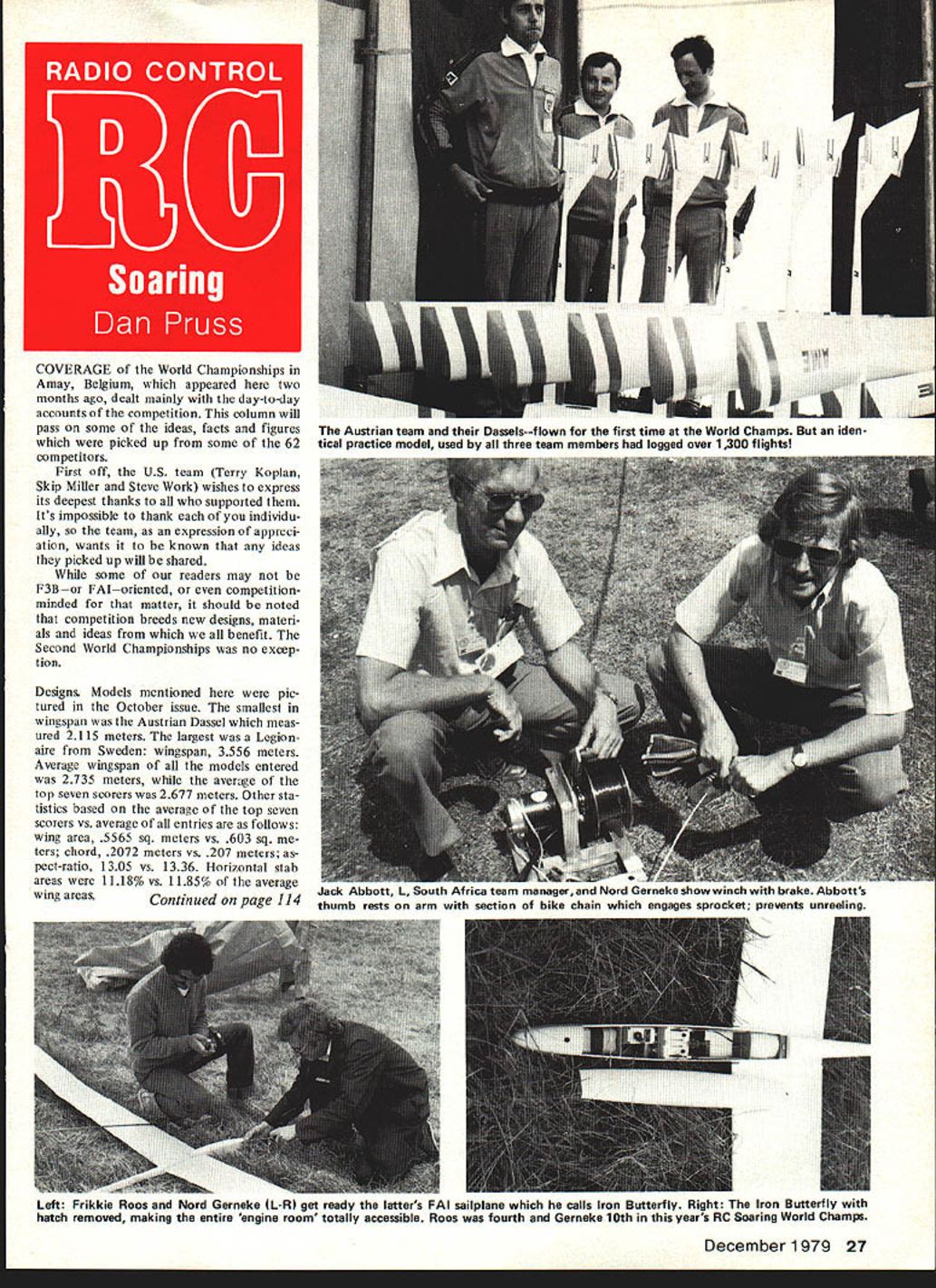
The Austrians' Dassels were within a few grams of each other for all six models (two per flier). One of the most impressive things, after a week of practice and watching the Austrian team use only one plane among all three fliers, was to see the team then process six brand-new birds—never flown—for the contest.
At the opposite end of the design spectrum were the South Africans with their built-up wings and at least two plywood-balsa fuselages. Both teams fought it out for first place, with the South Africans winning team honors by a fraction of a percentage point, while the Austrian Wackerle won the individual honors by a similar slim margin.
Another contrast involving the two top teams: Austria hand-towed exclusively while the South Africans used only a winch. The latter group had a very effective drum brake consisting of a bicycle rear-wheel sprocket attached to the side of the drum. An arm with a small section of bicycle chain was flipped up to allow for line retrieval but engaged with the sprocket while launching was in progress. Line could be taken in, but not an inch could be let out.
Pagliano of Italy and his Allure was a head-turner whenever he appeared to fly. In South Africa two years earlier Pagliano had torn up a horizontal stab that looked like something borrowed from a Wakefield model. That fragile-looking stab contrasted with the foam-and-glass wing and fiberglass fuselage he had at the time. Skip Miller repaired the stab for Pagliano, bonding them into a fast friendship; the first person Pagliano visited in Belgium was Skip to show him his Monokoted Allure. The Allure, with its built-up wing and stab, is a departure from many European designs. On the speed course it turned in a 10.6-second run. Pagliano admitted lack of flying experience prevented a better placing.
If one model had to be selected as carrying the current state of the art to the nth degree, while still maintaining the overall appearance of a full-scale sailplane, it would be Deckert's (Germany). Spending nearly 1,700 man-hours on the wing alone indicates the degree of precision and perfection Deckert and his team put into a model.
But is all this construction time necessary, even in world-class competition? Look at the standings of the top six: second through sixth were less than 4% from the top score. If you look down to 10th place, Gerneke of South Africa was less than 8% from first place. Four out of the top ten planes were of what you could call conventional construction.
Spavins of South Africa, who finished third, was less than 2% away from a World Championship title. The only drawback to his plane was its inability to carry enough ballast when needed. This wasn't a structural deficiency but merely limited ballast space. Wing ballast could solve that problem.
What This Means for U.S. Builders
What does all this mean for the next breed of U.S. planes that expect to be competitive in the FAI World Championships? It's hard to criticize the perfection of glass-covered foam and Eppler 193 airfoils that are within 1/1000th of a millimeter of what the designer intended, especially while you're shaping a leading edge with a sanding block and a template.
You have to ask yourself: of the 1,600-plus hours that were spent on a wing mold, could one take 100 of those hours—which is more than enough—and build a conventional wing, then use the remaining 1,500 hours in practice? Would this less-than-perfect plane be at that much of a disadvantage?
After sifting and analyzing the scores, the U.S. team still feels there is merit in the latter approach. One thing is certain: balsa is not dead!
Coming Next Month
Next month we'll wrap up this article with ideas you can use for any sailplane you build or fly, along with some of the flying techniques used by the top fliers.
Late Item — Two-Meter International Event
Dave Peltz, secretary of the San Fernando Valley Silent Flyers, has announced a Two-Meter international event scheduled for January 19–20, 1980. This event will be for Two-Meter designs only and will involve speed, distance and duration in tasks to be announced.
For further information write to:
- 2-Meter World Cup, c/o Doug Ford, 18630 Nau Ave., Northridge, CA 91326, U.S.A.
Or call:
- Doug Ford: (213) 360-6213
- Sam Brown: (805) 942-4956
This event is co-sponsored by the San Fernando Valley Silent Flyers (SFVSF) and the Antelope Valley Soaring Association.
Dan Pruss Rt. 2, Box 490, Plainfield, IL 60544.
Transcribed from original scans by AI. Minor OCR errors may remain.

