
Radio Control: Soaring
Dan Pruss
LAST month this column mentioned some of the contrasts in the models used by top contenders in the sailplane world championships last summer. The highly technical and most precision approach by the Austrian, German and Swiss teams in the construction of their models was highly contrasted by the South African and U.S.A. teams and their more straightforward approach (as we saw it) with "store bought" models and hobby shop materials.
Many fliers from other countries had models which fell in between the limits from Decker's highly complex gadgetry in design to Spavin's "I built it in a week" model which could be labeled kitable. It was obvious that many of these in-between models had more time spent in construction than they had in the air. Yet, many showed innovativeness and only a lack of practice prevented a better showing by their builders.
This month we'll pass on some of these ideas and flying techniques, and whether you're a weekend flier or contest pro, there is something for all.
Wing Spars
The South Africans and some of Denmark's team used a box-spar construction of spruce and plywood. Full-depth vertical webbing was glued between the 1/8 x 3/8 spruce and then faced with plywood. In the case of the South African birds, the plywood was carried out to the polyhedral break. The Danes' design was a straight wing with a D-tube principle, and the plywood was carried out full span. That the spar construction was strong was evidenced by the South Africans' launching technique. Their 12-volt winch was operated at almost a constant speed. The idea was to build up as much flying speed as possible at the top of the launch, release at just the precise moment, and burn off the excess flying speed by climbing and thereby getting a higher launch height than the winch provided. We won't discuss any height advantage, if any, at this point over the pulse/kite method; the point is, their wings took a tremendous strain but not once did they come apart.
Terry Koplan and Steve Work, of the U.S.A., replaced the spars in their planes with spars of carbon fiber. These were glued in during wing construction with slow-curing epoxy, and it's at least one reason Terry was able to carry 60 ounces of ballast during not only windy but gusty 12-lap distance runs.
Controls
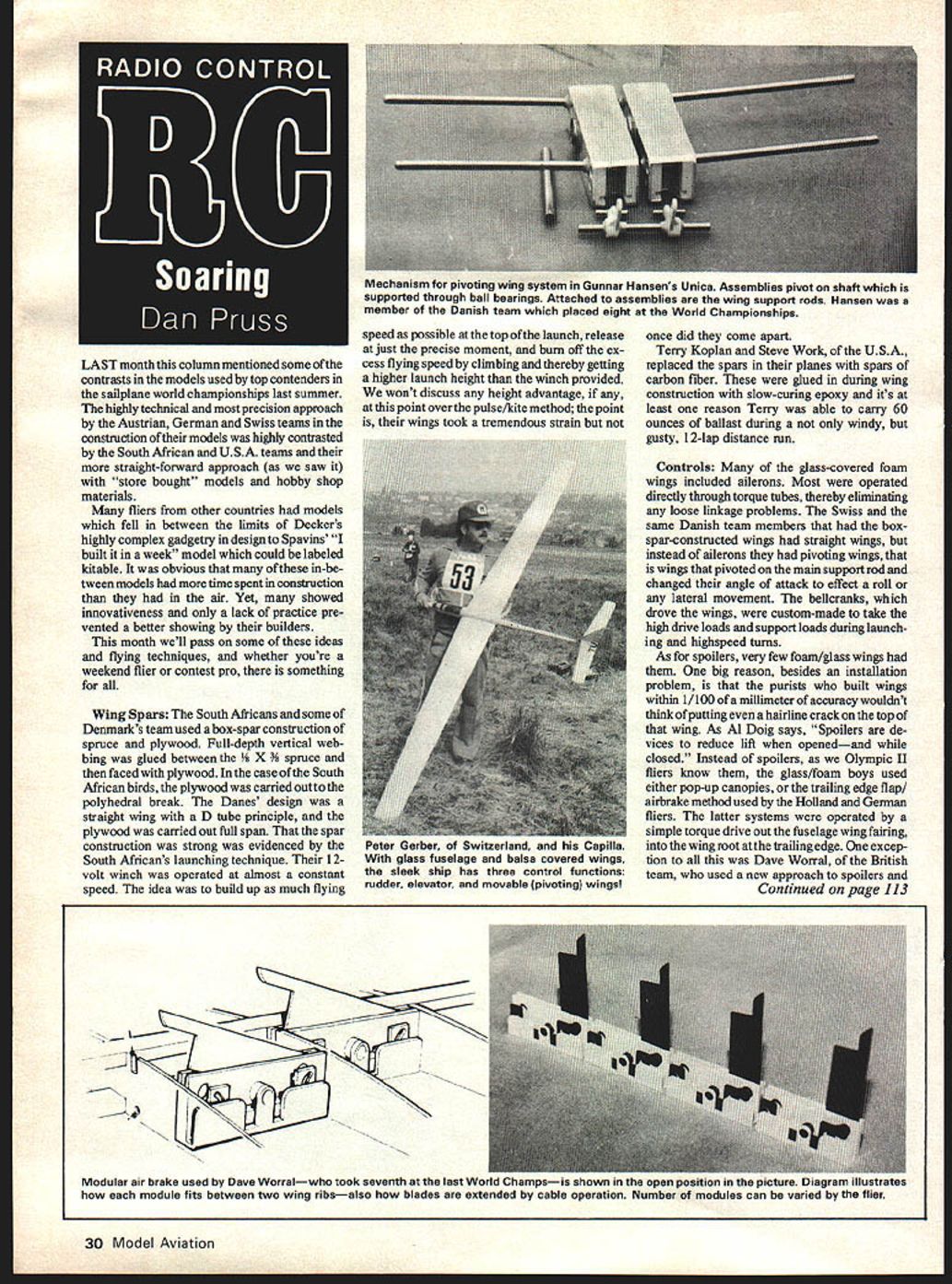
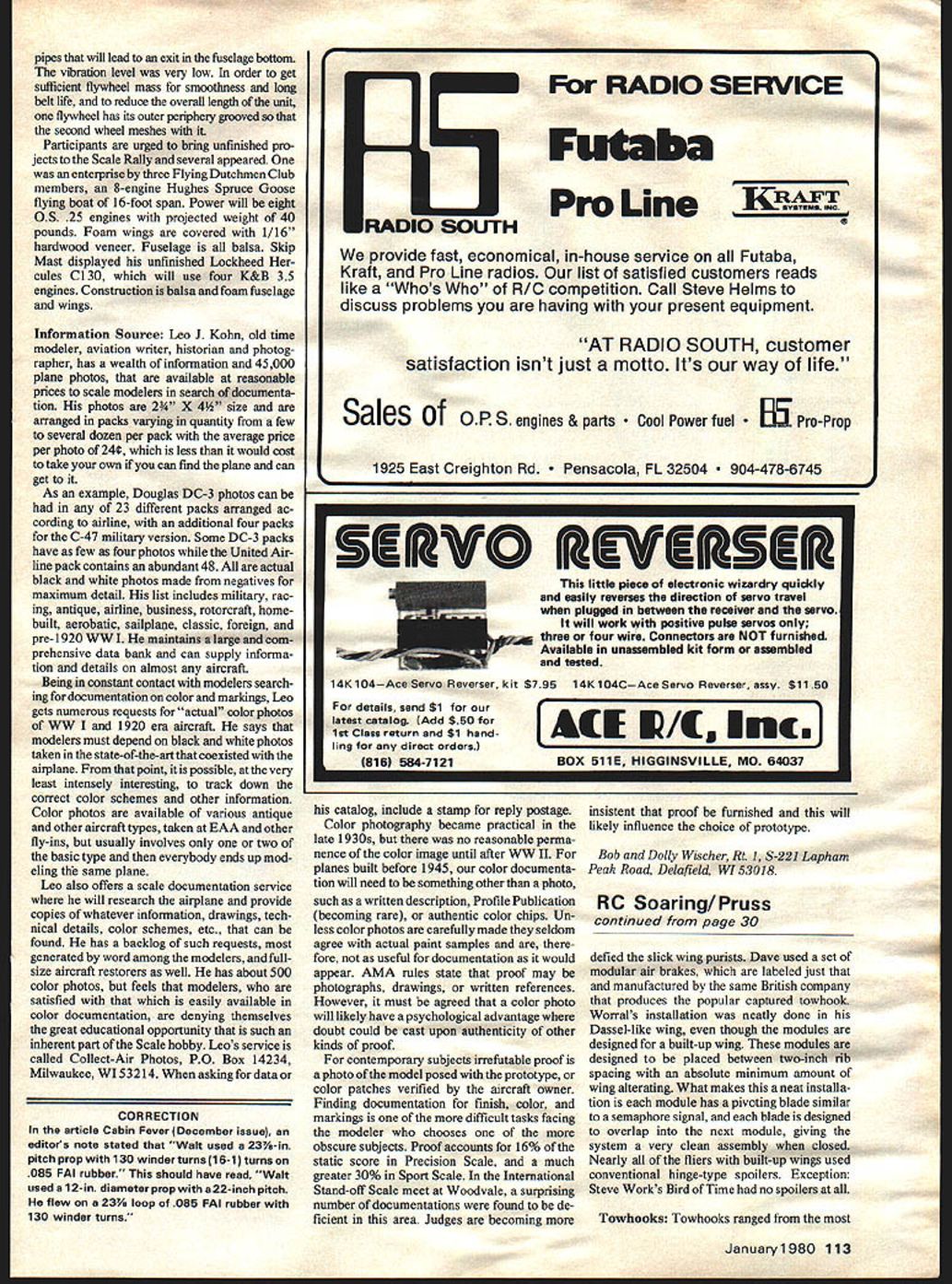
Many of the glass-covered foam wings included ailerons. Most were operated directly through torque tubes, thereby eliminating any loose linkage problems. The Swiss and the same Danish team members that had the box-spar constructed wings had straight wings, but instead of ailerons they had pivoting wings. That is, wings that pivoted on the main support rod and changed their angle of attack to affect a roll or any lateral movement. The bellcranks, which drove the wings, were custom-made to take the high drive loads and support loads during launching and high-speed turns.
As for spoilers, very few glass-and-foam wings had them. One big reason, besides an installation problem, is that the purists who built wings within 1/100 of a millimeter of accuracy wouldn't think of putting even a hairline crack on the top of that wing. As Al Doig says, "Spoilers are devices to reduce lift when opened - and while closed." Instead of spoilers, as we Olympic II fliers know them, the glass-and-foam boys used either pop-up canopies, or the trailing-edge flap/airbrake method used by the Holland and German fliers. The latter systems were operated by a simple torque drive out the fuselage wing fairing into the wing root at the trailing edge.
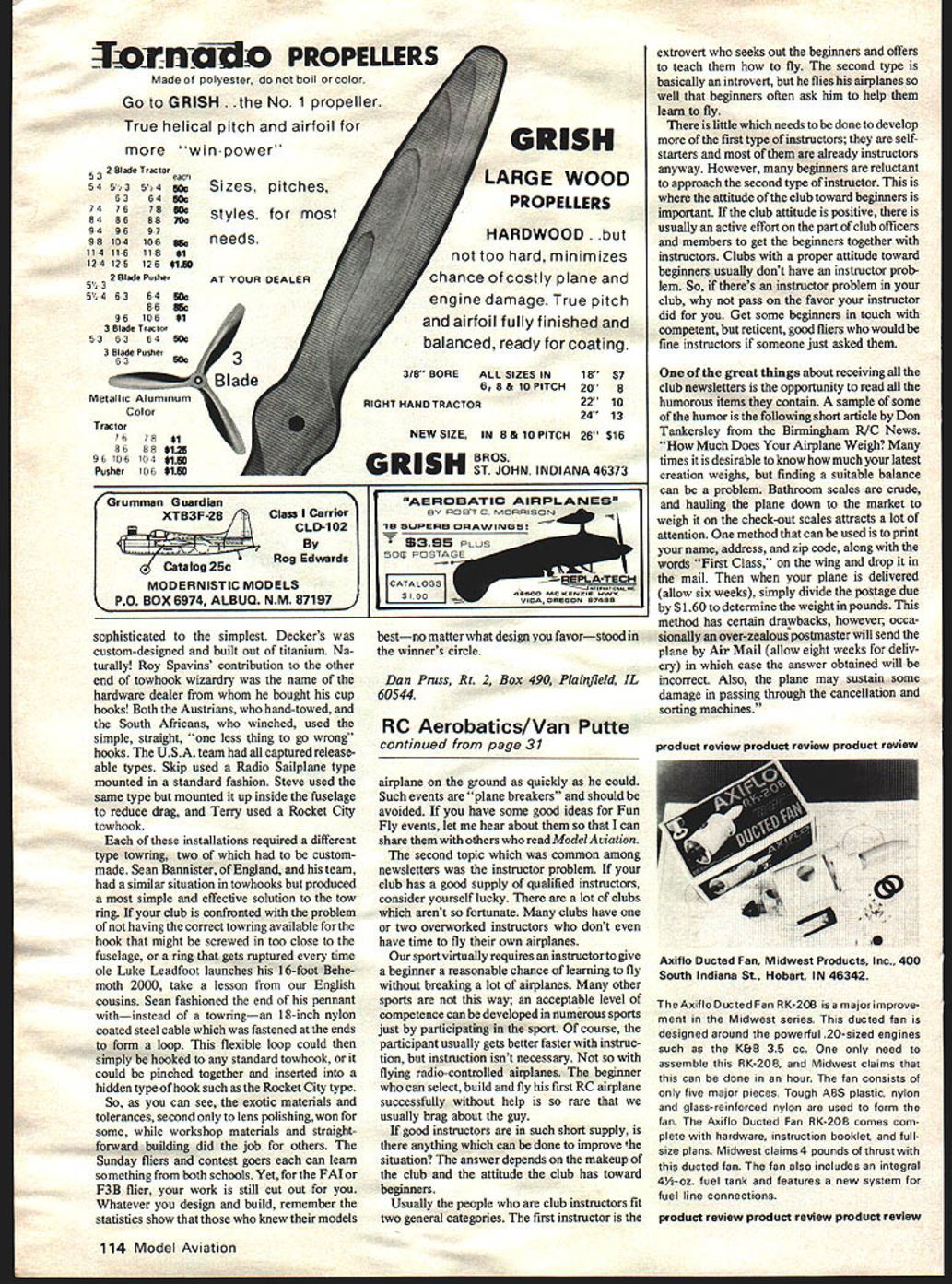
One exception to all this was Dave Worrall of the British team, who used a new approach to spoilers and defied the slick-wing purists. Dave used a set of modular air brakes, which are labeled just that and manufactured by the same British company that produces the popular captured-hook. Worrall's installation was neatly done in his Dassel-like wing, even though the modules are designed for a built-up wing. These modules are designed to be placed between two ribs in a wing with an absolute minimum amount of wing altering. What makes this a neat installation is each module has a pivoting blade similar to a semaphore signal, and each blade is designed to overlap into the next module, giving the system a very clean appearance when closed. Nearly all of the fliers' built-up wings used conventional hinge-type spoilers. Exception: Steve Work's Bird of Time had no spoilers at all.
Towhooks
Towhooks ranged from the most simple to the most sophisticated. Decker's was custom-designed and built out of titanium. Naturally Roy Spavin's contribution to the other end of towhook wizardry was the name of the hardware dealer from whom he bought his cup hooks. Both the Austrians, who hand-towed, and the South Africans, who winched, used the simple, straight, "one less thing to go wrong" hooks. The U.S.A. team had all captured releasable types. Skip used a Radio Sailplane type mounted in a standard fashion. Steve used the same type but mounted it up inside the fuselage to reduce drag, and Terry used a Rocket City towhook.
Each of these installations required a different type of towing arrangement; two of the towing rings had to be custom-made. Sean Bannister, of England, and his team had a similar situation in towhooks but produced a most simple and effective solution to the tow ring. If your club is confronted with the problem of not having the correct towing ring available for the hook that might be screwed into the back of the fuselage, or a ring that gets ruptured every time Luke Leadfoot launches his 16-foot Beechmoth 2000, take a lesson from our English cousins. Sean fashioned the end of his pennant with - instead of a towing ring - an 18-inch nylon-coated steel cable which was fastened at the end to form a loop. This flexible loop could then simply be hooked to any standard towhook, or it could be pinched together and inserted into the hidden type of hook such as the Rocket City type.
So, as you can see, the exotic materials and tolerances, second only to lens polishing, won for some, while workshop materials and straightforward building did the job for others. The Sunday fliers and contest goers each can learn something from both schools. Yet, for the FAI or F3B flier, your work is still cut out for you. Whatever you design and build, remember the statistics show that those who knew their models best - no matter what design you favor - stood in the winner's circle.
Dan Pruss, Rt. 2, Box 490, Plainfield, IL 60544.
Transcribed from original scans by AI. Minor OCR errors may remain.

