
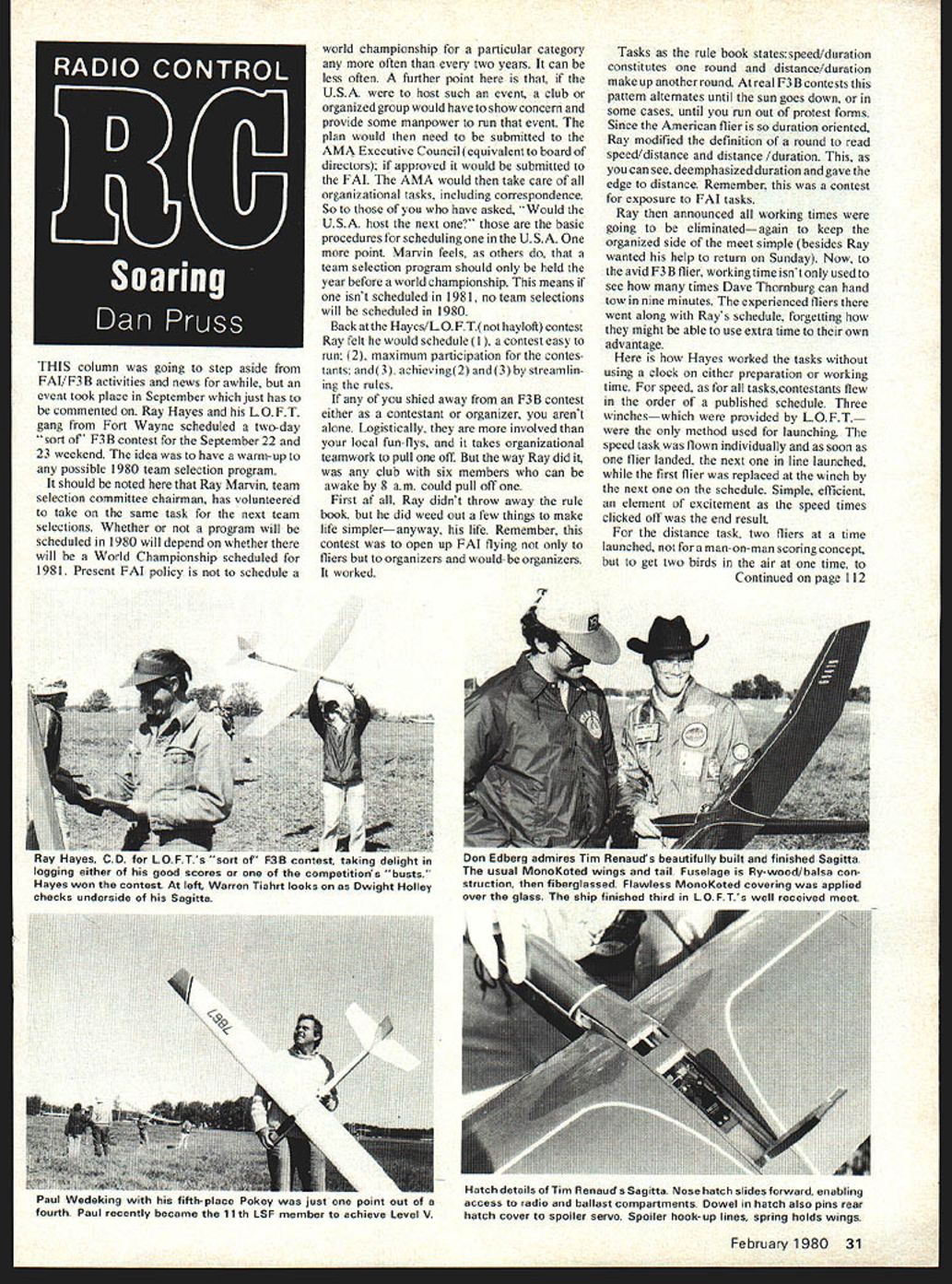
Radio Control: Soaring
Dan Pruss
Background
This column was going to step aside from FAI/F3B activities and news for a while, but an event in September had to be commented on. Ray Hayes and his L.O.F.T. gang from Fort Wayne scheduled a two-day "sort of" F3B contest for the weekend of September 22–23. The idea was to have a warm-up to any possible 1980 team selection program.
It should be noted that Ray Marvin, team selection committee chairman, has volunteered to take on the same task for the next team selections. Whether or not a program will be scheduled in 1980 depends on whether there will be a World Championship scheduled for 1981. Present FAI policy is not to schedule a world championship for a particular category more often than every two years; it can be less often. If the U.S.A. were to host such an event, a club or organized group would have to provide manpower to run it. The plan would then need to be submitted to the AMA Executive Council; if approved it would be submitted to the FAI. The AMA would then take care of all organizational tasks, including correspondence.
Marvin feels, as others do, that a team selection program should only be held the year before a world championship. This means if one isn't scheduled in 1981, no team selections will be scheduled in 1980.
Hayes' L.O.F.T. contest goals
Ray Hayes intended the meet to be accessible and simple. His goals were to:
- Schedule a contest easy to run.
- Maximize participation.
- Achieve (1) and (2) by streamlining the rules.
If any of you have shied away from an F3B contest either as a contestant or organizer, you aren't alone. Logistically, they are more involved than your local fun-flys, and it takes organizational teamwork to pull one off. But Ray ran the meet so simply that any club with six members who can be awake by 8 a.m. could pull one off.
Format changes to simplify entry-level F3B
Ray didn't throw away the rule book, but he weeded out a few things to make life simpler—primarily to make the contest accessible to fliers and would-be organizers. Tasks in the rule book state that speed/duration constitutes one round and distance/duration makes up another round. At real F3B contests this pattern alternates. Because the American flier is so duration-oriented, Ray modified the definition of a round to read speed/distance and distance/duration. This deemphasized duration and gave the edge to distance—appropriate for a contest intended to introduce people to FAI tasks.
Ray also announced that all working times were going to be eliminated to keep the organized side of the meet simple (and because he wanted his helpers to return on Sunday). To the avid F3B flier, working time isn't only used to see how many times one can hand tow in nine minutes. The experienced fliers present went along with Ray's schedule, though some missed the tactical advantages extra working time can give.
Running the tasks without clocks
Hayes operated the tasks without using a clock on either preparation or working time. Contestants flew in the order of a published schedule. Three winches—provided by L.O.F.T.—were the only launching method used.
- Speed: Flown individually. As soon as one flier landed, the next one in line launched while the first flier was replaced at the winch by the next scheduled competitor. Simple, efficient, and exciting as the speed times clicked off.
- Distance: Two fliers launched at a time—not for man-on-man scoring but to get two birds in the air at once, to perhaps compare techniques and machines, and to move the task along. For both speed and distance, Ray specified on-course procedures: launch, turn downwind and fly past base "A," then immediately enter the course. Same rules for everyone.
- Duration: Three planes were launched at a time whenever possible. The duration task was flown like any other duration event, except with F3B times and measurements.
There were a few exceptions to the "launch as soon as Ray cracked the whip" rule. Allowances were made at the time of launch for last-minute adjustments—such as when Stan Watson realized a section of MonoKote the size of a small awning was hanging loose from his half Pegasus wing. The kind CD turned his head while Stan and company did a quick tape job on the wing and launched the 14-foot behemoth. A 14-foot ship at an F3B contest? Sure—remember, this was an event to give and get exposure.
Relaxed rules to encourage participation
L.O.F.T. sidestepped several formal restrictions to streamline the event:
- No limit to the number of helpers.
- Fly any plane, including someone else's if yours broke.
- Launch on either side of the speed course, provided you flew the course on that side.
- Contestants were allowed to pitch in with timing chores.
The result was a contest with over 20 people flying six rounds and finishing just after lunch on Sunday.
Entrants and equipment
Contestants came from 11 states, including Connecticut, Delaware, Colorado, and California. Interest was partly fueled by the Sagitta, a relatively new ship for which Lee Renaud had parts for nine. These nine kits were distributed with the stipulation they had to be built and entered at L.O.F.T.'s F3B contest. Dwight Holley (Connecticut) and Keith Finckenhagen (Delaware) thought it was worth it. Tim Renaud and Don Edberg came from California, and Skip Miller came from Colorado. With only about a month to build and test-fly these ships, test flying was a last-minute affair for some competitors.
Best official speed time was 12.4 seconds by Tim Renaud. Best unofficial times after Saturday flying were 10.6 and 10.4 seconds by Skip Miller; a further attempt destroyed the ship.
Results
Final standings included:
- Ray Hayes — first, flying an Osprey 990 with Bird of Time wings.
- Warren Tiahrt (Michigan) — second, flying a Sagitta in his first F3B contest.
- Tim Renaud — third, with one of the best-looking ships present.
- Skip Miller — fourth, after taking a zero for crossing the centerline in the first speed task; he flew a Sagitta with Aquila Grande components.
It was a weekend well spent by all.
Conclusion
If you and your club are looking for something beyond straight duration tasks, check the FAI section of the AMA rule book. Weed out the items that would give your CD gray hair and try the basic tasks on a club level. Once you get the flavor of F3B, you'll likely invite outsiders to the next one.
Dan Pruss, Rt. 2, Box 490, Plainfield, IL 60544
SAFE FLYING IS NO ACCIDENT
Transcribed from original scans by AI. Minor OCR errors may remain.

