
Radio Control: Soaring
Dan Pruss
LSF News
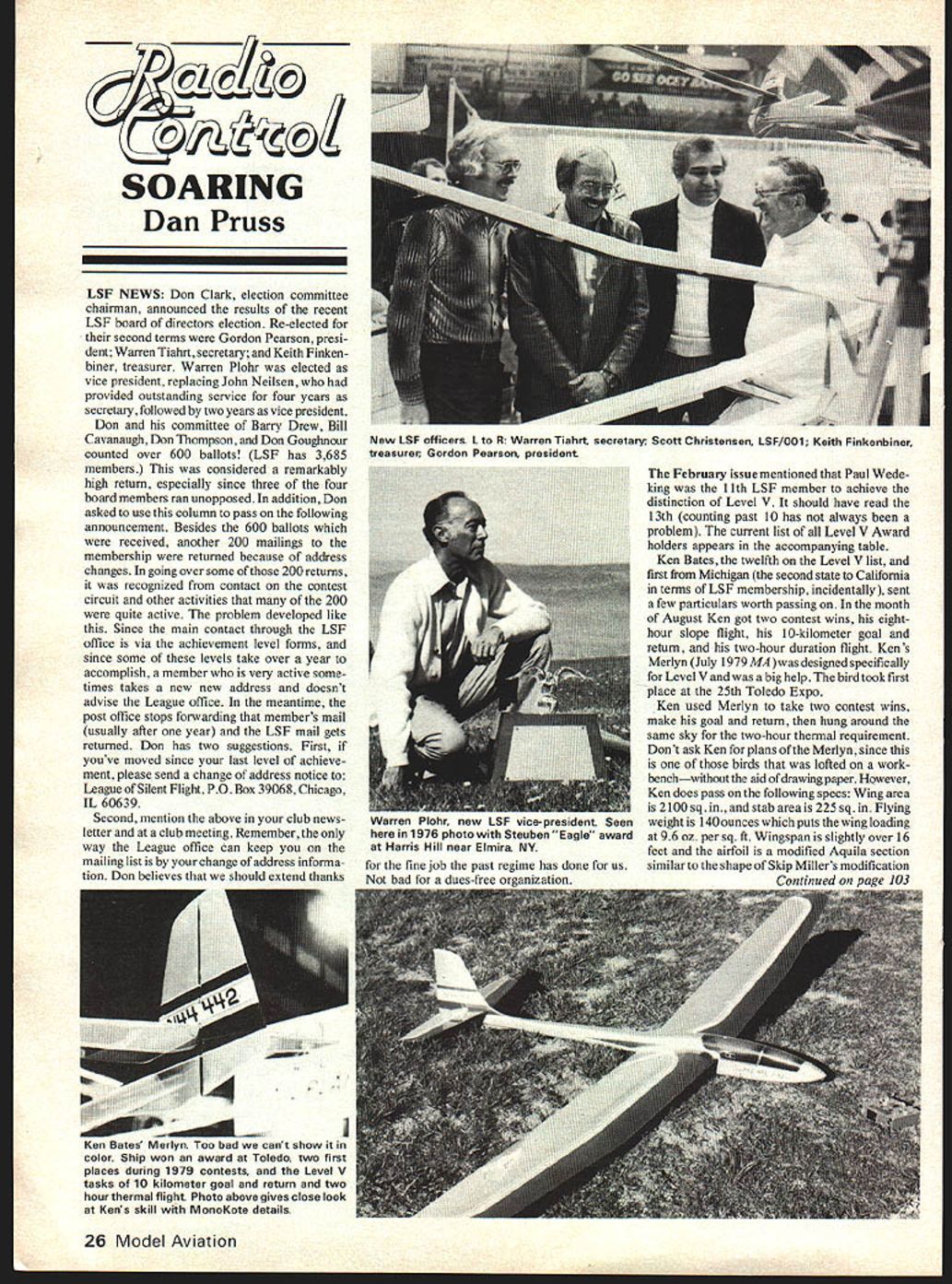
LSF NEWS: Don Clark, election committee chairman, announced the results of the recent LSF board of directors election. Re-elected for their second terms were Gordon Pearson, president; Warren Tiahrt, secretary; and Keith Finkenbiner, treasurer. Warren Plohr was elected as vice president, replacing John Neilsen, who had provided outstanding service for four years as secretary, followed by two years as vice president.
Don and his committee of Barry Drew, Bill Cavanaugh, Don Thompson, and Don Goughnour counted over 600 ballots (LSF has 3,685 members). This was considered a remarkably high return, especially since three of the four board members ran unopposed.
In addition, Don passed on the following announcement. Besides the 600 ballots which were received, another 200 mailings to the membership were returned because of address changes. In going over some of those 200 returns, it was recognized from contact on the contest circuit and other activities that many of the 200 were quite active.
The problem developed like this. Since the main contact through the LSF office is via the achievement level forms, and since some of these levels take over a year to accomplish, a member who is very active sometimes takes a new address and doesn't advise the League office. In the meantime, the post office stops forwarding that member's mail (usually after one year) and the LSF mail gets returned.
Don has two suggestions:
- If you've moved since your last level of achievement, please send a change of address notice to: League of Silent Flight, P.O. Box 39068, Chicago, IL 60639.
- Mention the above in your club newsletter and at a club meeting. Remember, the only way the League office can keep you on the mailing list is by your change of address information.
Don believes that we should extend thanks for the fine job the past regime has done for us. Not bad for a dues-free organization.
The February issue mentioned that Paul Wedeking was the 11th LSF member to achieve the distinction of Level V. It should have read the 13th (counting past 10 has not always been a problem). The current list of all Level V Award holders appears below.
Ken Bates and the Merlyn
Ken Bates, the twelfth on the Level V list, and the first from Michigan (the second state to California in terms of LSF membership, incidentally), sent a few particulars worth passing on. In the month of August Ken got two contest wins, his eight-hour slope flight, his 10-kilometer goal and return, and his two-hour duration flight. Ken's Merlyn (July 1979 MA) was designed specifically for Level V and was a big help. The bird took first place at the 25th Toledo Expo.
Ken used Merlyn to take two contest wins, make his goal and return, then hung around the same sky for the two-hour thermal requirement. Don't ask Ken for plans of the Merlyn, since this is one of those birds that was lofted on a workbench—without the aid of drawing paper. However, Ken does pass on the following specs:
- Wing area: 2,100 sq. in.
- Stabilizer area: 225 sq. in.
- Flying weight: 140 oz. (wing loading 9.6 oz./sq. ft.)
- Wingspan: slightly over 16 ft.
- Airfoil: modified Aquila section similar to Skip Miller's modification (see Miller's article in the December 1977 MA).
- Wing construction: D-tube with leading edge sheeting on both top and bottom from the leading edge to the main spar.
Ken also passes on ideas, opinions, and observations gathered in his quest for Level V. For goal-and-return work Ken cites three considerations:
- A day with little wind is of key importance.
- Weak lift is quite acceptable since there will usually be only weak sink.
- Strong lift with strong sink combined with moderate winds has been the undoing of many goal-and-return attempts. The faster climb rates in strong thermals are negated by the necessity to penetrate strong sink areas.
Ken also noted that since the Astro-Jeff, Jerry Mrlik's fine design, had paved the way for cross-country work in the Midwest with its numerous Level V goal-and-return achievements, plus two wins out of four in S.O.A.R.'s annual Great Race, a design with a better L/D would make looking up a bit easier even if it didn't shorten the time. One of those Great Race wins was a remarkable 21.2-mile non-stop run by Pat Flynn (see November 1979 MA). On that flight, Pat's airborne battery pack gave out and if it had not been for that, the Greater Detroit Soaring and Hiking Society felt they could have gone all the way. The challenge is still there.
In the Merlyn's design, Ken aimed for a climb rate equal to the Astro-Jeff's but with a better L/D. The bottom line is that the Merlyn has about a 30:1 L/D at 20 mph, which compares to the Astro-Jeff's L/D of about 20:1 at the same speed. Due to difficulties in taking exact measurements, these figures aren't 100 percent accurate, but they do verify the soundness of Ken's design.
For further information contact Ken Bates, 738 N. Harris, Saline, MI 48176.
LSF LEVEL V AWARDS
- John Baxter — California — 1975
- Steve Work — New Mexico — 1975
- Fred Weaver — California — 1976
- Noll Nolte — California — 1976
- Marvin Quall — California — 1976
- John Newman — California — 1978
- Don Harris — Ohio — 1978
- Chris Adams — California — 1978
- Tom Christian — California — 1979
- Howard Sears — California — 1979
- Dwight Holley — Connecticut — 1979
- Ken Bates — Michigan — 1979
- Paul Wedeking — New Jersey — 1979
Status as of January, 1980.
Great Race v. S.O.A.R. announced
Great Race V will be run this year on July 19 and 20. Rules will be basically the same as last year. Any AMA-sanctioned club may enter as many members as they wish, with at least one member at LSF Level III or above and as many sailplanes as they care to (however, only one frequency will be assigned to each club).
Rules highlights:
- No relaunching on the course but as many relaunches as desired back at the starting point.
- S.O.A.R. will provide winches for all launches.
- Best time around the course wins or, in the case of no finishers, the longest distance flown will win.
The big difference this year is a two-day contest instead of a one-day event. Fly either or both days. Last year's rules seemed to be well received and the race was acclaimed by most as the most meaningful ever.
So, if you think you have a design better than an Astro-Jeff or a Merlyn, that you can sniff thermals better than Pat Flynn of Michigan, and that you can last longer than 21.2 miles, then get your club together, pitch in for gas—if there's any left—and head for the greatest of all cross-country soaring events.
Dan Pruss, Rt. 2, Box 490, Plainfield, IL 60544.
Transcribed from original scans by AI. Minor OCR errors may remain.

