
SOARING
Dan Pruss
Flying wings and the Manx
Ken Bates of Ann Arbor, Michigan, passes along some information for the flying-wing devotees (see his plans for the Windlord, MA, March 1978). In a later version called the Manx, the 1978 Toledo winner, Ken ran into stability problems.
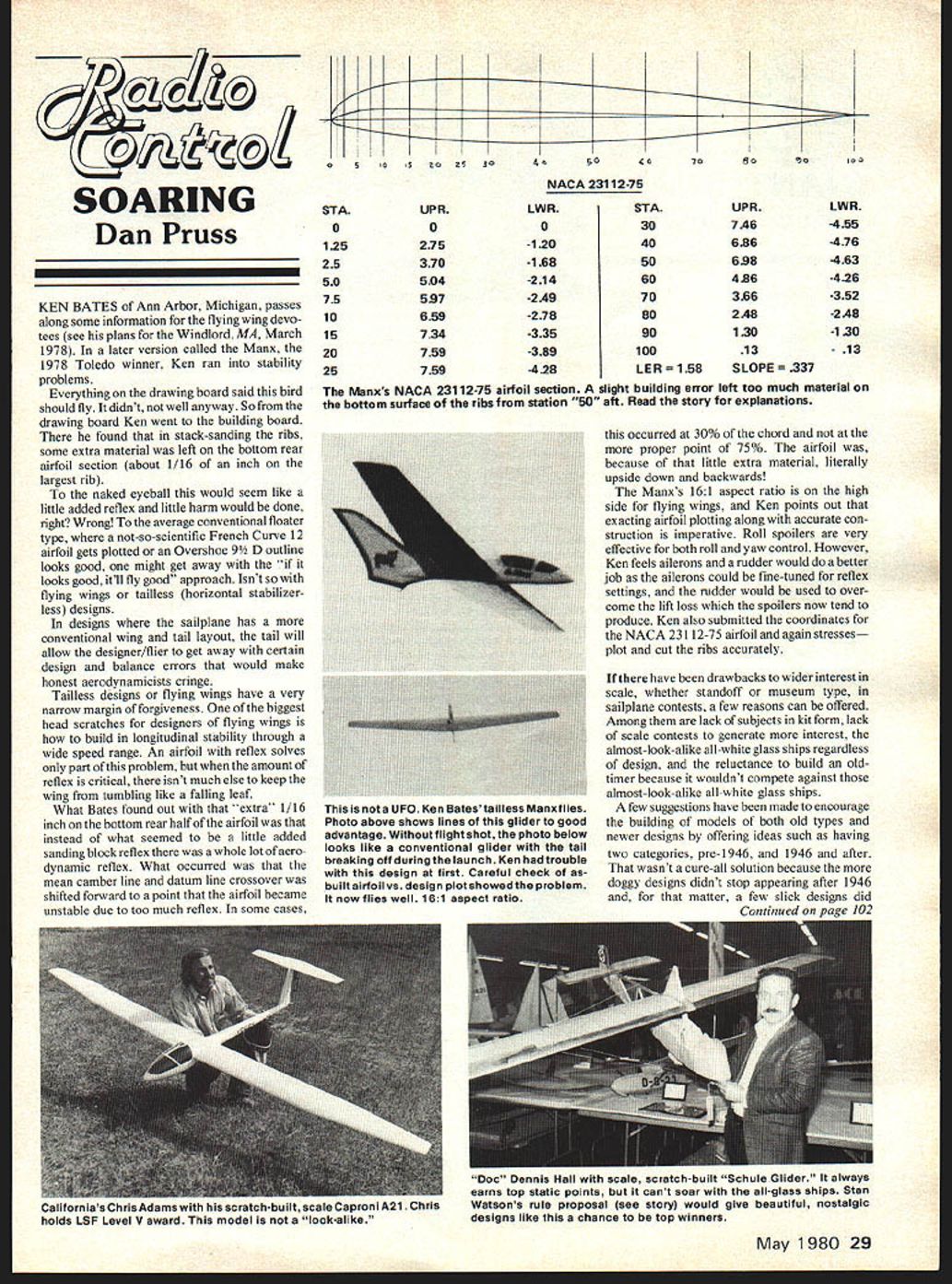
Everything on the drawing board said this bird should fly. It didn't — not well anyway. So from the drawing board Ken went to the building board. There he found that in stack-sanding the ribs, some extra material was left on the bottom rear airfoil section (about 1/16 of an inch on the largest rib).
To the naked eye this would seem like a little added reflex and little harm would be done, right? Wrong. To the average conventional floater type, where a not-so-scientific French Curve 12 airfoil gets plotted or an Overshoe 9-1/2D outline looks good, one might get away with the "if it looks good, it'll fly good" approach. That isn't so with flying wings or tailless (horizontal-stabilizer-less) designs.
In designs where the sailplane has a more conventional wing-and-tail layout, the tail will allow the designer/flyer to get away with certain design and balance errors that would make honest aerodynamicists cringe.
Tailless designs or flying wings have a very narrow margin of forgiveness. One of the biggest head-scratchers for designers of flying wings is how to build in longitudinal stability through a wide speed range. An airfoil with reflex solves only part of this problem, but when the amount of reflex is critical, there isn't much else to keep the wing from tumbling like a falling leaf.
What Bates found out was that the "extra" 1/16 inch on the bottom rear half of the airfoil was not just a little added sanding-block reflex — there was a whole lot of aerodynamic reflex. What occurred was that the mean camber line and datum-line crossover was shifted forward to a point that the airfoil became unstable due to too much reflex. In some cases this occurred at 30% of the chord and not at the more proper point of 75%. The airfoil was, because of that little extra material, literally upside down and backwards!
The Manx's 16:1 aspect ratio is on the high side for flying wings, and Ken points out that exacting airfoil plotting along with accurate construction is imperative. Roll spoilers are very effective for both roll and yaw control. However, Ken feels ailerons and a rudder would do a better job, as the ailerons could be fine-tuned for reflex settings and the rudder would be used to overcome the lift loss which the spoilers now tend to produce. Ken also submitted the coordinates for the NACA 23112-75 airfoil and again stresses — plot and cut the ribs accurately.
Scale sailplane contests and interest
If there have been drawbacks to wider interest in scale (whether standoff or museum type) in sailplane contests, a few reasons can be offered. Among them are lack of subjects in kit form, lack of scale contests to generate more interest, the almost-look-alike all-white glass ships regardless of design, and the reluctance to build an old-timer because it wouldn't compete against those almost-look-alike all-white glass ships.
A few suggestions have been made to encourage the building of models of both older types and newer designs by offering ideas such as having two categories, pre-1946 and 1946 and after. That wasn't a cure-all solution because the more doggy designs didn't stop appearing after 1946 and, for that matter, a few slick designs did appear before World War II. So, chronologically, there really wasn't a cutoff point for the "older designs" or a starting date for the newer ones.
In previous large contests, where the organizers could chance including a scale event, a few stalwarts such as Geier, Hall, Pearson, and Thacker usually showed up with ships which qualified for a separate category all their own — not only because of the quality of building, but because of the scale subjects. While many of us cheered on the Schule Glider of Doc Hall, the same group knew Hall had a slim chance in the 10-minute duration event against the likes of Chris Adams' sleek Caproni A21. And, unless the lift was such that manhole covers were outmaxing Frisbees, the models of Geier, Pearson, and Thacker were just also-rans. This isn't meant to demean the efforts of the fliers of the glass birds. However, to date there hasn't been a contest where the mixture of the various models ever left the final results up for grabs.
Well, maybe the following isn't the cure-all to all the above, but Stan Watson of Hazel Crest, Ill., has come up with a suggestion which just could encourage more scale building of the older-type sailplanes and "mixing" categories. Again, it might not be the answer, but it sure is a step in the right direction.
Stan Watson's proposal: adjusting maxes by full-scale L/D
Stan's idea centers on using the full-scale L/D (lift-to-drag) ratio to adjust contest maxes so lower-performance full-scale ships are not penalized when modeled against high-performance designs. He proposes the formula:
- Max = D × (L/D) / 40
Where the symbols are defined as:
- D = duration task (for example, six minutes)
- L/D = lift-to-drag ratio of the full-size sailplane
- 40 = the average L/D of most high-performance sailplanes (a constant in the formula)
Example:
- If you decide to build something out of the early '30s and the published L/D was 20, then in a six-minute-max contest you would be allowed:
- Max = 6 × 20 / 40 = 3 minutes
- While the high-performance glass ships (L/D ≈ 40) would aim for six minutes.
Plan-building and credit
I don't mean to disparage the plan-built model or the kit-built. Over the years I've certainly built plenty of both. It's just that I feel the term "scratch-built" should really mean starting from scratch with nothing but the desired flight characteristics in mind and, in the case of a scale model, the necessary information about the original airplane.
When built from a kit, the finished model is usually identified with the kit manufacturer; we talk about Nosen P-51s and Bird Rarwins. I think plan-built airplanes should be given the same kind of credit (and publicity) to the person who put the time and effort into designing them. Two examples that come to mind are Bob Mace's fine Cessna 180 and Don Godfrey's outstanding Super Stearman.
There are many Giant Scale plans available, some of which are advertised in one or more of the model mags. For those of you who are interested in plan-building, I intend to review any plans I can get hold of and pass on my comments and opinions. If you have plans available, send me:
- a list of what you have,
- prices,
- how to get them, and
- a copy of at least one of your drawings (which will be returned).
I'll give as objective a report as I possibly can. Plan-building is the logical step between kit-building and scratch-building.
Stan offers a few more ideas and, if you're interested, send a stamped, self-addressed envelope for a three-page copy of the proposal to:
- Stan Watson, 3402 Hickory Lane, Hazel Crest, Ill. 60429.
References for full-scale sailplane specifications include:
- America's Soaring Book — editors of Flying magazine
- Die Berühmtesten Segelflugzeuge (Germany) — George Brütting
- Soarers (Italy) — Ferdi Gale
Carbon fiber spars
Bill Mueller of Hi-Flight Model Products has announced he is producing carbon fiber spars of 36- and 48-inch lengths. Widths are from 1/8 to 1/2 inch and thicknesses are 1/32 and 1/16 inch. Strength of these spars is unbelievable! It's a safe bet to say these spars will do for the construction of sailplanes what MonoKote did for the covering. Other applications of the spars could be looked into, such as blades for wing joiners and slim booms for pod-and-boom designers. See your dealer or write:
- Hi-Flight Model Products, 43225 Whittier Avenue, Hemet, CA 92343.
Send for it now department
Just received notice from SOAR/Utah that the sailplane group out thataway is hosting an RC soaring/vacation week from July 27 to August 3. They're offering Alpine, Thermal and Slope soaring. Lodging is available, as are side trips. Festivities also include art shows, symphony, jazz and pop concerts, swimming, and tennis. All this is in Snowbird, just outside of Salt Lake City, Utah.
The brochure makes it all look quite inviting. For more information write to:
- Joel H. Schoonover, 1425 South 320 East, Orem, UT 84057, or
- Don Hamilton, 760 West Crest, Orem, UT 84057.
If team competition has your club fired up, there's a cross-country race being scheduled out in Hutchinson, Kansas. It is a 15-mile event, and particulars can be obtained in the mail from:
- Pat McCleave, 205½ East 13th, Hutchinson, KS 67501.
Keep building!
Dan Pruss R.R. 2, Box 490, Plainfield, IL 60544.
Transcribed from original scans by AI. Minor OCR errors may remain.

