
Radio Control: Soaring
By
Dan Pruss
Nuremberg Toy Fair — overview
It's called the Nuremberg Toy Fair and it's big. It sprawls over nearly 20 acres, 15 of which are under nine connecting honeycomb-type structures. At least 10 percent of the area was covered with RC manufacturers' displays this year. Forty-two countries were represented by 1,719 exhibitors. The show ran a week, February 2 to February 8, and on the fourth day alone over 32,000 people came through the gates. That's a lot of bratwurst.
If the Toledo show is the modeler's mecca, then Nuremberg is the retailer's. At Toledo, besides the manufacturers and their wares, a large portion of the show is devoted to displaying the handiwork of modelers. At Nuremberg the only models on display are those of the manufacturers. But there were enough models in the booths to keep one drooling until Toledo.
One standout facet of the show was that big isn't only beautiful, it's also very popular. The majority of the manufacturers of power planes are into quarter-scale. Unfortunately, the prices are also quarter-scale.
Radios and electronics
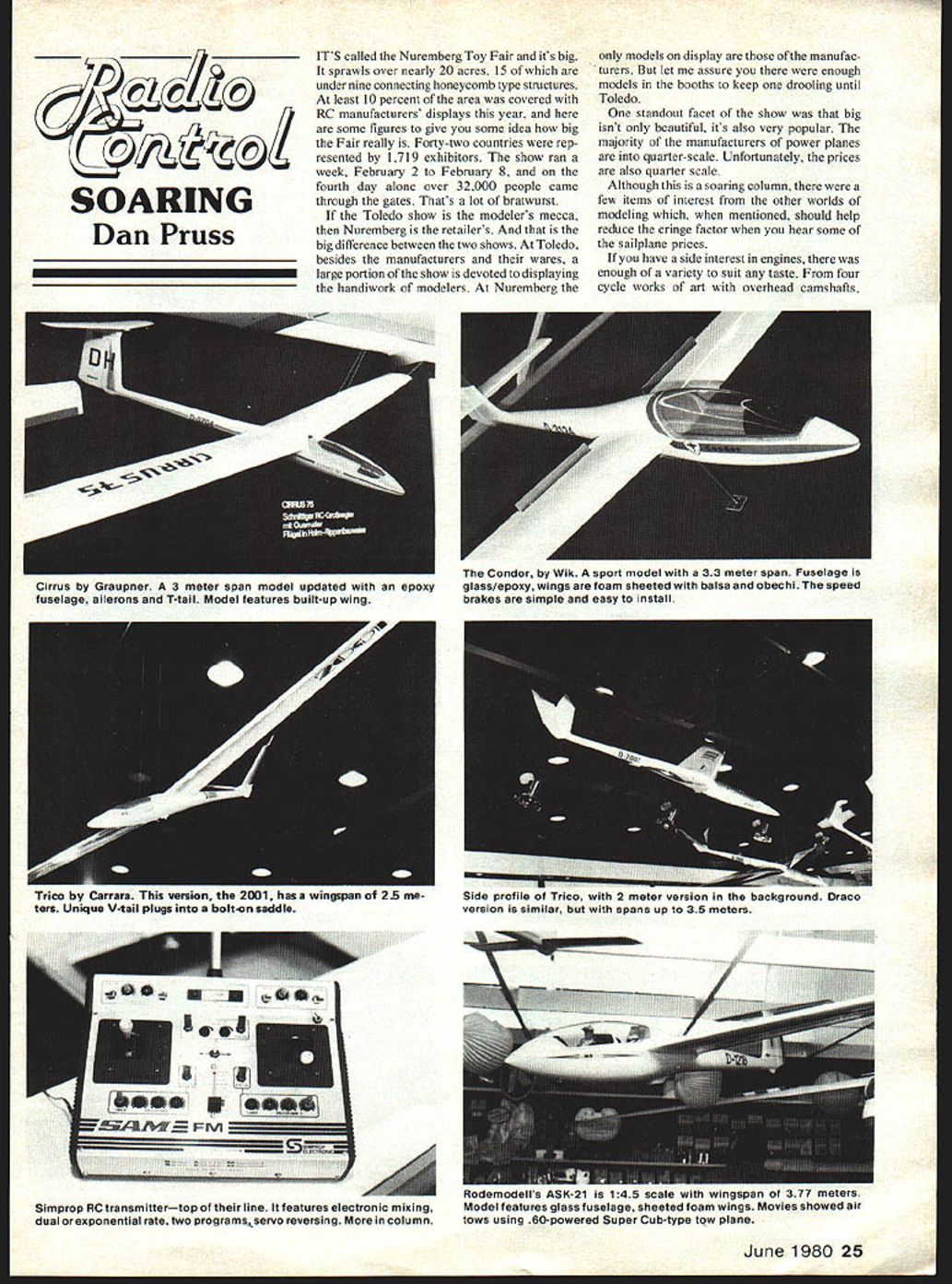
Some of the top-line foreign radios showed state-of-the-art features. An example was the Simprop transmitter:
- Plug-in modules for dual rates and exponential rates.
- Optional plug-in mixer module to eliminate mechanical V-tail mixers.
- Electronic mixing of two servos for programmable maneuvers.
- Three tunable rate knobs for rudder, elevator and ailerons.
- Programmable trims and timers (from a fraction of a second up to five seconds) to perform slow, timed maneuvers.
- Ability to control rudder and ailerons independently (useful in FAI F3B competition).
- Standard features: coupled control override, bank switches, reverse servo travel.
- Removable RF section — can be impounded during a contest while still allowing the transmitter to be used in the pit area via a jumper cord.
Some of these features are available on domestic radios, but they represent the state of the art among top foreign manufacturers. In Germany you may need to watch over 58 frequency clips if you're the impound honcho!
Engines, props and retracts
There was enough variety in engines to suit almost any taste:
- Four-cycle engines with overhead camshafts.
- No-frills two-cycle diesels.
- Small CO2 engines that had just enough thrust to power-assist tiny models.
- Multi-cylinder assemblies (for example, grouped HP-6's mounted to a gearbox) that looked like they were producing a dozen horsepower at rest.
- Tuned pipes that cost nearly as much as some engines.
- Machined reduction drives that sometimes cost more than the engines themselves.
Gear retract systems for quarter-scale Mustangs could be had for about $300 installed. A top-line radio could run another $1,000. To get on a quarter-scale circuit, about $2,500 would not be unusual. Radios have everything except whistles and bells—and that phrase became common referring to the high-priced spread of radio features.
Sailplanes — general observations
Although F3B is the major competition circuit in Europe, it is not the only kind of soaring. F3B represents a small percentage of European sailplanes. There are nearly 500 Low Speed Flight (LSF) members in Europe and over 200 of them are in Germany. Flying seems to dominate the soaring scene both on the slopes and on the flatlands. Sunday get-togethers are more like family outings, and there are many of these gatherings in addition to contests.
Of the sailplanes on display at Nuremberg, very few were competition-only designs. The majority were scale—or near-scale—models in a large variety of types.
F3B and contest models
In the F3B line, several designs were shown and expected to become available:
- Austrian "Dassel"
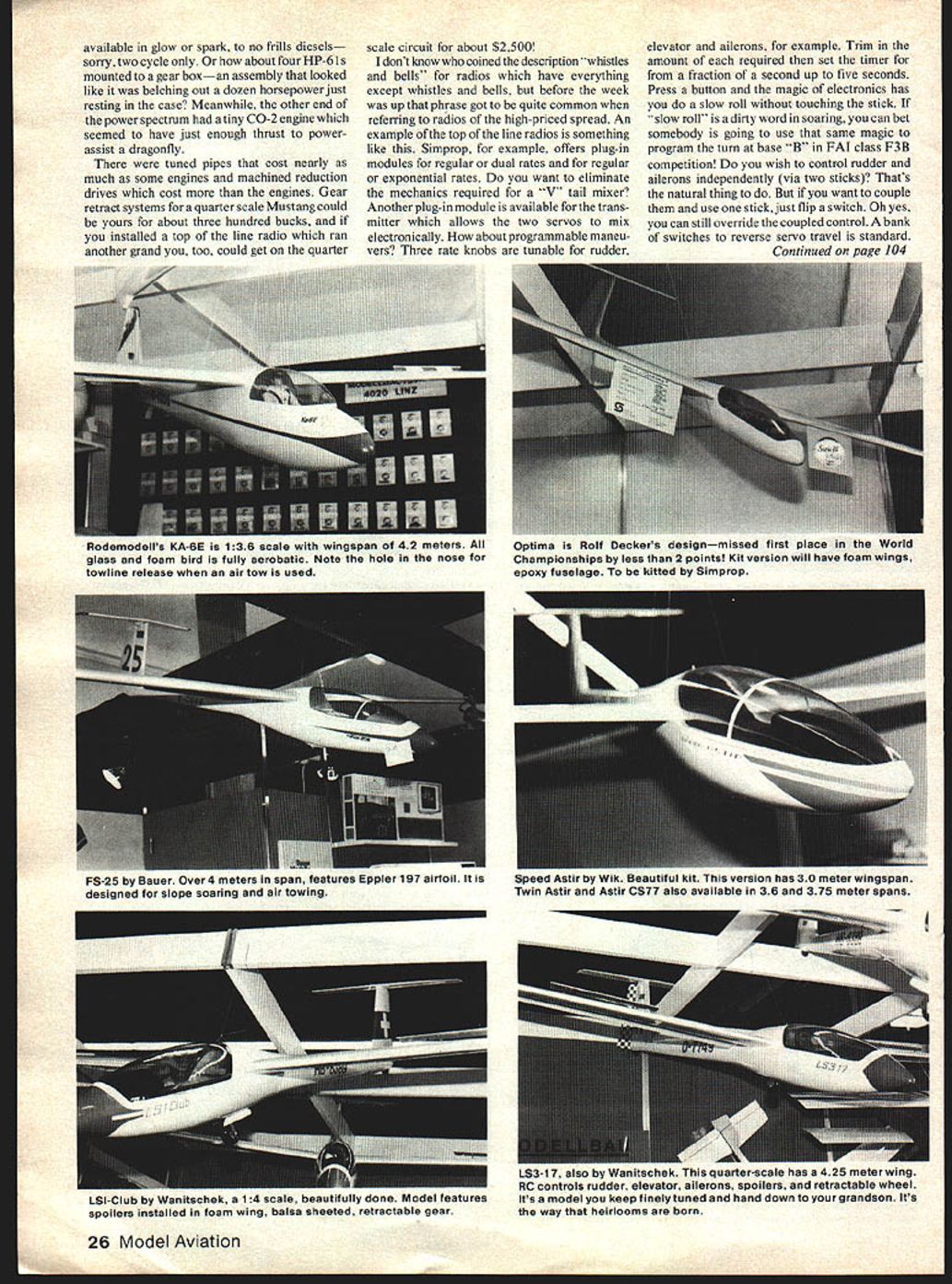
- Decker's "Optima" (name taken from his Belgian entry at the world championships)
- Pawelko's "Sidewind"
Prices and delivery schedules were uncertain, but indications were that the flying season would be well underway before any were widely available. Expected cost: 400–1,000 Deutsche Marks (DM). On February 1 the exchange rate was 1.7 DM = $1.00, which translates to roughly $235–$588.
Notable models and manufacturers
A few highlights from booths and displays:
- Graupner Cirrus: The model that set a standard ten years ago (sold for about $45 then) has been updated with a T-tail and ailerons. Current price: about 260 DM.
- Carrera: Their display resembled a well-stocked hobby shop. Two years ago they introduced a line of stand-offish scale birds up to a 16 ft. SB 10. This year they introduced a series of V-tailed sailplanes that are particularly sleek-looking.
- Robmodelling: Showed a 1:4.5 scale ASK-21 and a 1:3.6 KAE6. Films showed these being towed to altitude by a .60-powered Super Cub type of tug; the tow looked effortless and frequent, and both models performed aerobatics and realistic wheel landings.
- Hegi: Showed a 1:5 scale ASW 15. As with most larger-scale types, the fuselage was epoxy molded and the wing balsa-covered foam.
- Wanitschek: Line includes an LS-1 Club (3.75 m span) and an LS-3-17 (4.25 m span). Others include a Jantar 2 (4.1 m span, 1:5 scale), an HP-18 (1:4 scale, 3.75 m span), and a Jantar 1 (1:4 scale, 4.75 m span) — the Jantar 1 uses built-up wings to keep cost down. Example price: 431.60 DM.
- Wik: Showed a remarkably realistic sailplane called the Condor with rudder, elevator, ailerons and trailing-edge speed brakes. Best of show contenders included a 1:4 Astir CS-77 and a 1:5 Twin Astir — both very complete, with spoilers installed, ailerons shaped and cut out, and all hardware provided.
Big birds — quality and value
The large-scale birds cost anywhere from about $250 to $600. While the price may be hard to justify, the quality and degree of completion are top-notch; they are often complete up to finishing touches. If your time is worth anything, you probably couldn't build one from scratch for any less.
Availability and purchase contact: Jerry Nelson Midwest Model Supply 1354 Naperville Drive Romeoville, IL 60441 Phone: (312) 759-1955
Closing
Jerry Nelson and I spent much time at the various sailplane booths and came away impressed with the quality of the big birds. A week at the fair wasn't long enough. There still were a few bratwursts left.
Dan Pruss RR 2, Box 490 Plainfield, IL 60544
Transcribed from original scans by AI. Minor OCR errors may remain.

