
Radio Control: Soaring
Dan Pruss
Sno Fly 1980
Sno Fly 1980. One of the few contests that gets yearly recognition—and perhaps the only one of any size held in the dead of winter, with winter temperatures just to make it more fun—is the Greater Detroit Soaring and Hiking Society's Annual Sno Fly. While only a few people plan their winter leisure time around it, others trek a couple of hundred miles to take it in. This year 51 thermal seekers showed up in hopes of getting three 7-minute maxes in weather that would make a brass monkey cringe.
According to Warren Tiahrt, contest director, the weather was classic—plenty of cold with just enough wind to test one's constitution. Temperatures ranged from 5°F at briefing time to 20°F for the final round. One snow flurry did show up just to make everything legal, while 10–15 mph winds extended the building season for a few not-so-lucky fliers.
#### Results
Unlimited Class
- Dave Corven ................................ 1202
- Chris Corven ............................... 1101
- Jim Bohmer ................................. 1012
- Bob Robinson .............................. 998
- Pat Flinn ................................... 978
Standard Class
- Ray Hayes .................................. 1014
- Eric Podzielinski ........................ 1019
- Dale Martell ............................... 900
- Walt Hill ................................... 848
- Bill Doyle .................................. 814
Two-Meter
- Mike Fritz .................................. 773
- John Humphreys .......................... 665
- Dave Henshaw ............................. 645
- Jerry Mrlik ................................ 589
- Jeff Mrlik .................................. 464
The event was for Unlimited, Standard, and Two-Meter classes, and Tiahrt reported that the Two-Meter class did quite well—against two-meter birds. He also pointed out that the 51 entrants were individual contestants, as only one entry was allowed per flier. Not bad for a contest where nobody looks for a shade tree.
Spot landings
As long as there are contests with spot landings, there will be what sailplaners refer to as "dork" landings. There probably have been as many suggestions to eliminate this unsailplane-like maneuver as there are fliers. Most past suggestions were designed to de-emphasize the point value of landings, and none of these ideas worked. Reason? If a quarter of a point was all one could earn for a landing, you could bet in a tight duration contest that someone would punch into the spot if that quarter of a point was the difference between first place and just being there.
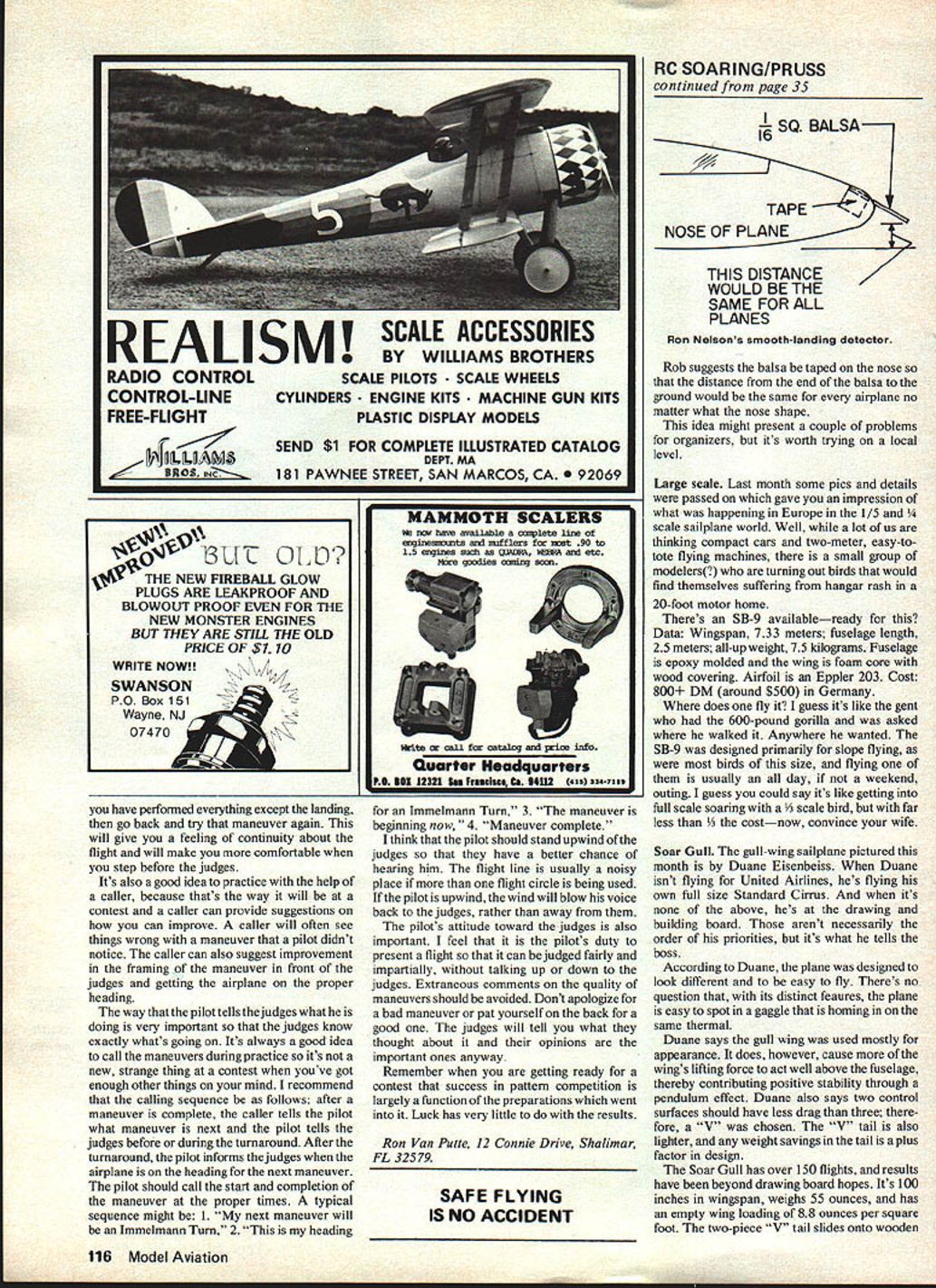
From Rob Nelson, Fresno, CA, came a suggestion that would make landings look like landings—if you wanted to earn points, that is. Rob's suggestion is simple: tape a small 2- to 2½-in. long piece of 1/16" square balsa on the nose of each plane in such a way that anything but a flared landing will break the balsa. If the balsa is broken on landing—no landing points, even if the plane is on the 100-point spot.
Rob suggests the balsa be taped on the nose so that the distance from the end of the balsa to the ground would be the same for every airplane no matter what the nose shape. This idea might present a couple of problems for organizers, but it's worth trying on a local level—especially where boilerplate specials would out-survive somebody else's gossamer-covered beauty.
Pattern flying and judging
If you have performed everything except the landing, then go back and try that maneuver again. This will give you a feeling of continuity about the flight and make you more comfortable when you step before the judges.
It's also a good idea to practice with the help of a caller, because that's the way it will be at a contest and a caller can provide suggestions on how you can improve. A caller will often see things wrong with a maneuver that a pilot didn't notice. The caller can also suggest improvements in the framing of the maneuver in front of the judges and getting the airplane on the proper heading.
The way the pilot tells the judges what he is doing is very important so that the judges know exactly what's going on. It's always a good idea to call the maneuvers during practice so it's not a new, strange thing at a contest when you've got enough other things on your mind. I recommend that the calling sequence be as follows: after a maneuver is complete, the caller tells the pilot what maneuver is next and the pilot tells the judges before or during the turnaround. After the turnaround, the pilot informs the judges when the airplane is on the heading for the next maneuver. The pilot should call the start and completion of the maneuver at the proper times. A typical sequence might be:
- "My next maneuver will be an Immelmann Turn."
- "This is my heading for an Immelmann Turn."
- "The maneuver is beginning now."
- "Maneuver complete."
I think the pilot should stand upwind of the judges so that they have a better chance of hearing him. The flight line is usually a noisy place if more than one flight circle is being used. If the pilot is upwind, the wind will blow his voice back to the judges, rather than away from them. The pilot's attitude toward the judges is also important. It is the pilot's duty to present a flight so that it can be judged fairly and impartially, without talking up or down to the judges. Extraneous comments on the quality of maneuvers should be avoided. Don't apologize for a bad maneuver or pat yourself on the back for a good one. The judges will tell you what they thought about it and their opinions are the important ones anyway.
Remember that when you are getting ready for a contest, success in pattern competition is largely a function of the preparations which went into it. Luck has very little to do with the results.
Ron Van Putte, 12 Connie Drive, Shalimar, FL 32579.
Large scale
Last month some pictures and details were passed on which gave an impression of what was happening in Europe in the 1/5 and 1/4 scale sailplane world. While a lot of us are thinking compact cars and two-meter, easy-to-freight flying machines, there is a small group of modelers turning out birds that would find themselves suffering hangar rash in a 20-foot motor home.
There's an SB-9 available—ready for this? Data: wingspan 7.33 meters; fuselage length 2.5 meters; all-up weight 7.5 kilograms. Fuselage is epoxy molded and the wing is foam core with wood covering. Airfoil is an Eppler 203. Cost: 800+ DM (around $500) in Germany.
Where does one fly it? The SB-9 was designed primarily for slope flying, as were most birds of this size, and flying one of them is usually an all-day, if not a weekend, outing. You could say it's like getting into full-scale soaring with a 3/4-scale bird, but with far less than half the cost—now convince your wife.
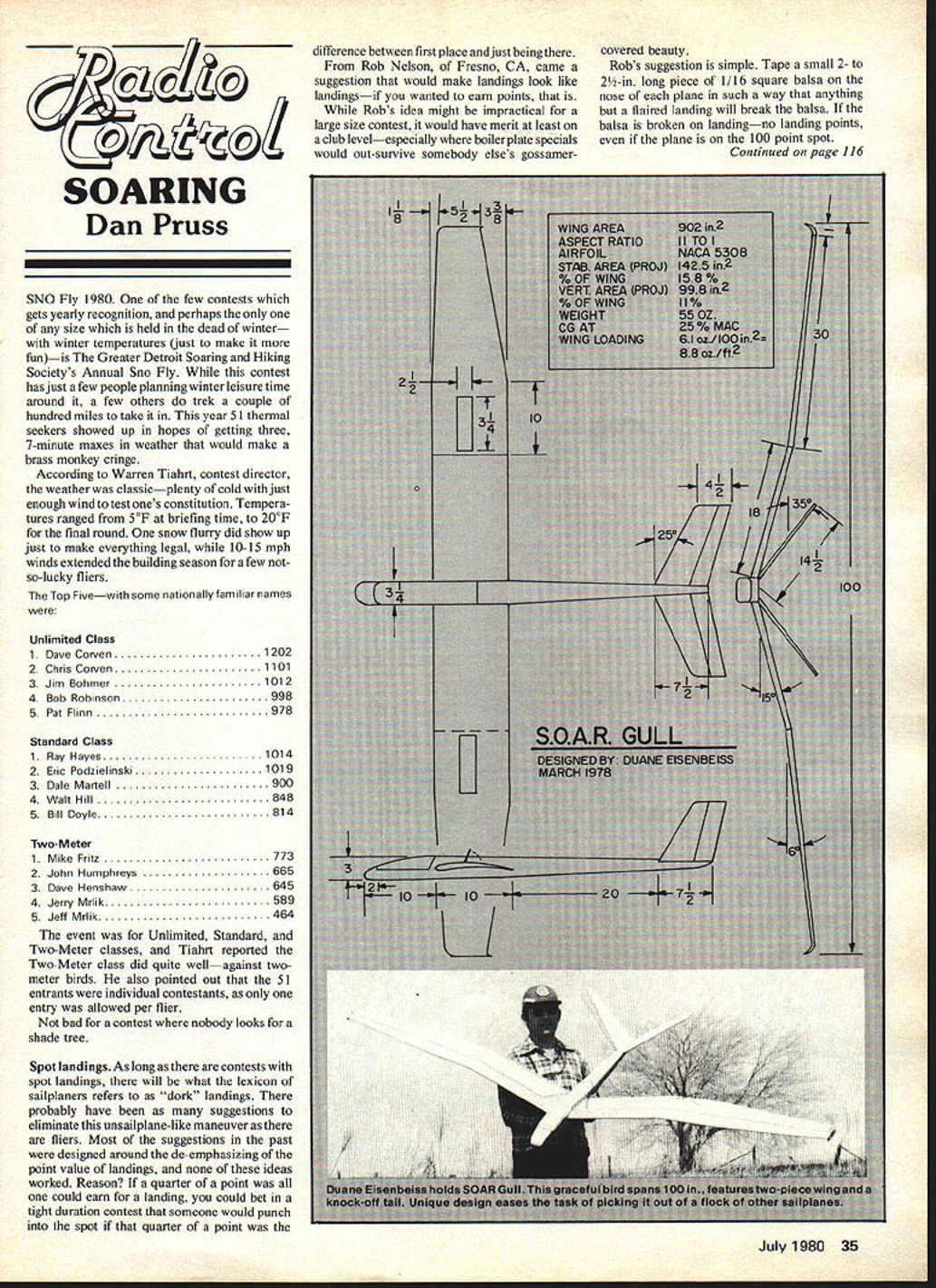
Soar Gull
The gull-wing sailplane pictured this month is by Duane Eisenbeiss. When Duane isn't flying for United Airlines, he's flying his own full-size Standard Cirrus. And when it's none of the above, he's at the drawing and building board.
According to Duane, the plane was designed to look different and to be easy to fly. With its distinct features, the plane is easy to spot in a gaggle homing in on the same thermal. Duane says the gull wing was used mostly for appearance. It does, however, cause more of the wing's lifting force to act well above the fuselage, thereby contributing positively to stability through a pendulum effect. Duane also says two control surfaces should have less drag than three; therefore, a "V" was chosen. The "V" tail is also lighter, and any weight savings in the tail is a plus factor in design.
The Soar Gull has over 150 flights, and results have been beyond drawing-board hopes. It's 8 ft. 10 in. wingspan, weighs 55 ounces, and has an empty wing loading of 8.8 ounces per square foot. The two-piece "V" tail slides onto wooden dowels (for lightness), and the movable tail surfaces are actuated by movable stubs which fit into the tail. The Soar Gull is not only different, it's a package of clever innovations in linkages and design.
FAI team selection program
The FAI team selection program is here again and well underway. Subject to vote by program entrants, the Team Finals will be in Pensacola, FL (excellent flying site), over Labor Day weekend, and Rae Fritz will be the contest director. It's guaranteed excitement and worth watching if you can't compete. The outcome of the Second World Championships last year in Belgium surely will have an influence on designs this year. So if you want to see what F3B is all about and see some designs which were only dreams a year ago, think Pensacola—Labor Day. For further information on the program contact: Ray Marvin, 2781 South Garfield, Denver, CO 80210.
Let's go flying.
Dan Pruss, RR 2, Box 490, Plainfield, IL 60544.
Transcribed from original scans by AI. Minor OCR errors may remain.

