
Radio Control: Soaring
Dan Pruss
Toledo Weak Signals 26th Radio Control Exposition — Overview
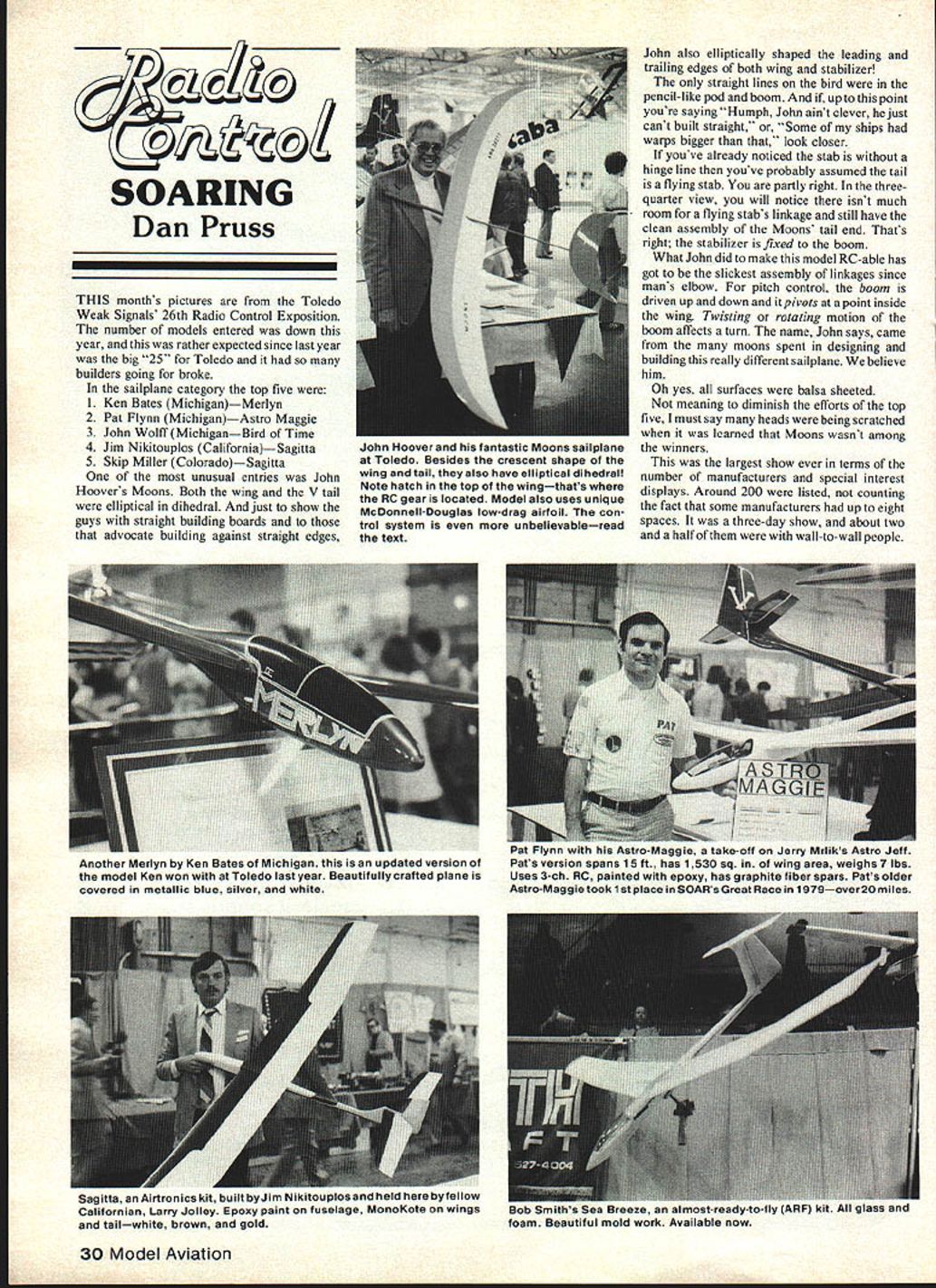
This month's pictures are from the Toledo Weak Signals' 26th Radio Control Exposition. The number of models entered was down this year, which was rather expected since last year was the big "25" for Toledo and it had so many builders going for broke.
In the sailplane category the top five were:
- Ken Bates (Michigan) — Merlyn
- Pat Flynn (Michigan) — Astro Maggie
- John Wolff (Michigan) — Bird of Time
- Jim Nikitopulos (California) — Sagitta
- Skip Miller (Colorado) — Sagitta
One of the most unusual entries was John Hoover's Moons. Both the wing and the V-tail were elliptical in dihedral. And just to show the guys with straight building boards — and to those who advocate building by straight edges — John also elliptically shaped the leading and trailing edges of both wing and stabilizer.
The only straight lines on the bird were in the pencil-like pod and boom. If, up to this point, you're saying "Humph. John ain't clever, he just can't build straight," or, "Some of my ships had warps bigger than that," look closer.
If you've already noticed the stab is without a hinge line then you've probably assumed the tail is a flying stab. You are partly right. In the three-quarter view, you will notice there isn't much room for a flying stab's linkage and still have the clean assembly of the Moons' tail end. That's right; the stabilizer is fixed to the boom.
What John did to make this model RC-able has got to be the slickest assembly of linkages since man's elbow. For pitch control, the boom is driven up and down and it pivots at a point inside the wing. Twisting or rotating motion of the boom affects a turn. The name, John says, came from the many moons spent in designing and building this really different sailplane. We believe him.
Oh yes, all surfaces were balsa-sheathed.
Not meaning to diminish the efforts of the top five, I must say many heads were being scratched when it was learned that Moons wasn't among the winners.
This was the largest show ever in terms of the number of manufacturers and special interest displays. Around 200 exhibitors were listed, not counting the fact that some manufacturers had up to eight spaces. It was a three-day show, and about two and a half of them were wall-to-wall people.
I'm sure some items of interest were missed, but a few which stood out are presented here alphabetically.
Airtronics
After a tour with Cox Hobbies, Lee Renaud is back at the helm of Airtronics. Those sailplaners who teethed on Olympics when the LSF was still a pup and who later flew Grand Esprits, Aquilas and Olympic IIs will be happy to see his signature on sailplane plans again. Lee's latest offering is the Sagitta, a bird talked about for well over a year.
Lee has also jumped onto the radio bandwagon, offering the Airtronics XL Series of radios. The line is complete and runs from the two-channel package up to the six-channel FM (six meters only) spread. The set which caught most sailplaners' eyes was a three-channel beauty. The transmitter has a panel which allows for servo reversing (all three). On the stick assembly for rudder and elevator, the tension can be adjusted right on the gimbal escutcheon. Nice.
Airtronics 1525 E. Warner Avenue Santa Ana, CA 92702
Circus Hobbies
A new name on the scene but with a familiar figure in the main tent. Jerry Nelson, who has come up with more innovations in modeling than Ringling Brothers did with acts, is the prez of Circus Hobbies. Jerry showed his new line of JR Radios. This line runs from two-channel sets to the seven-channel set complete with all "whistles and bells."
Circus Hobbies, Inc. Box 5215 Reno, NV 89513
Craft Aire
Tom Williams showed his latest in a line of designs that include the Drifter, Windrifter, Sailaire, and the Viking. The new addition is the Golden Eagle. The kit features an epoxy-glass fuselage. The wing has a semi-symmetrical airfoil with a turbulatted upper leading edge. This combination gives the Golden Eagle good thermalling qualities and good penetrating ability with a light wing loading.
Craft Aire, Inc. 20115 Nordhoff St. Chatsworth, CA 91311
Bob Smith R/C Aircraft
If you want to see the best job in prefabrication in almost-ready-to-fly sailplanes, look into Bob Smith's Sea Breeze. The quality of workmanship, especially on the glass-covered foam wings, is unequaled even in the high-priced European lines. Treat your eyes and fingertips to a truly outstanding effort. This is a 2-meter model with a span of 99.75 inches and an area of 760 sq. in. The unpainted version lists at $169.95 and is worth every cent!
Bob Smith R/C Aircraft 485 Easy Street Simi Valley, CA 93065
Midwest Models
The Wanitschek "Jantar" from Germany took up most of the sky space over Midwest's booth. The Wittek Condor took up the rest of it. Both models were described in two issues back. Also on display was one of Simprop's (Germany) first-run Optimas — Rolf Decker's FAI ship.
Midwest Model Supply Co. 1354 Naperville Dr. Romeoville, IL 60441
Accessories: Winches and Thermal Sniffers
Two sailplane accessories which generated more inquiries during the year than did rules are worth mentioning again — winches and thermal sniffers.
Fab Teck, Inc. — Sport Winch. The Sport Winch mentioned here a year ago has been in use forever a year now and is more than well proven. It's small, compact, yet does the job very well and is highly recommended by those who have had the opportunity to use one. The compact design includes a built-in handle for one-hand carrying operation. Recommended for a battery is a garden-tractor deep-cycle type.
Fab Teck, Inc. 17 Sugar Hollow Road Danbury, CT 06810
Thermic Sniffer. Walt Goud, Don Clark, and Ben Givens showed the license-free version of their well-proven "Thermic Sniffer." This model operates on 49 MHz. The other version on 144–148 MHz is also available, and either model is recommended for those long thermal and go-and-return flights.
Soaring Products Box 117 Kensington, MD 20795
Spectator Experience
It's more than one man's opinion department. In previous years, many of the people who attended the show were more interested in seeing the models instead of "talking shop" with the manufacturers. When the model displays were in the main arena, wives, friends, and spectators in general could sit up in the galleries and look over the whole display, relax, and shoot the breeze with others who were so inclined.
This year, the model displays were moved out of the main arena into a separate hall which had no grandstand seating. This was great for the commercial exhibits, but it put somewhat of a damper on the enjoyment of the "plain folks." The spectator appeal could be enhanced next time if the show organizers went back to the old scheme.
Dan Pruss RR 2, Box 490 Plainfield, IL 60544
Transcribed from original scans by AI. Minor OCR errors may remain.

